Showing posts with label Batman serial 1943. Show all posts

Wednesday, 30 July 2014

Superheroes on the early 1960s screen

BACK IN THE 1960s, when I was a lad of about ten, our cinema entertainment didn't include an Avengers or an X-Men franchise ... heck, we didn't even have a Fantastic Four franchise. But I'll tell you what we did have in the way of superheroes on the screen - nothing. That's right, zilch.

As I've recounted in an earlier post on this blog, the biggest cause for excitement for me in 1965 was the imminent arrival of  Batman at my local ABC Minors Saturday morning pictures. Not in person, of course, just in the form of the 1943 Batman movie serial.

"Careful what you say, fellas ... you never know who may be listening.
Now let's get this stolen money divided up ..."
As excited as I was, this was tempered with some disappointment that the episodes were in black and white and were obviously very old. But it was Batman. Fighting bad guys. In a costume. When you've never seen real life superheroes doing what they do on screen, this was pretty brilliant stuff.

I've since managed to get DVDs of both the Batman serials and, given when they were made, they both hold up pretty well. I guess for contemporary tastes, these old series must seem pretty repetitive. The first five minutes and the last five minutes are taken up with a recaps and previews of the episodes on either side. But we should remember that these episodes were never intended to be viewed immediately one after the other. Audiences in the 1930s and 1940s would go to the pictures more than once a week. It was their television, and they would have been exposed to a serial chapter on pretty much every visit. So keeping the storylines straight in their heads would have been tough without the constant recaps.

The important point is that Hollywood then, as now, thought of the comics (both newspaper and comic book) and pulps as generous sources of characters and ideas. The result was that these characters were kept uppermost in the public consciousness and, even if only the junior members of the audience went out and bought copies, it added up to sales.

The downside was that the flavour of the adventures portrayed in the serials was more serial than comic book. The superheroes only ever battled thugs in suits and fedora hats, whether fifth columnists, mad scientists or just plain old crooks. There was no Joker, Mr Mind or Red Skull going in in the serials.

The first comic book superhero serial to make it to the screen was The Adventures of Captain Marvel in 1941. It was supposed to have been a Superman serial, but DC/National were giving Republic the runaround during negotiations for the rights, so the studio simply approached Fawcett and did a deal with them instead. It would be almost 10 years before Superman made it to the screen after that lapse in judgement.

Cowboy actor Tom Tyler made a pretty good Captain Marvel in the 1941 serial.
But this wasn't the first time Republic had been knocked back by Superman's publishers. A year earlier, Republic had prepared a serial to star Superman. The scripts were written, the stunt men lined up and then National pulled out. Rather than waste all that preparation, Republic changed the name of the main character to "Copperhead", made him a two-fisted private eye in a chainmail mask, and went ahead with the serial anyway, as The Mysterious Doctor Satan (1940). 


The first chapter of The Mysterious Doctor Satan was titled "Return of the Copperhead",
even though he'd technically never been away.
This was the next serial that turned up at our ABC Minors. And I loved it. It had everything - a mad scientist in the title role; marauding robots, well, robot; loads of knock-down brawls; and a rough-and-tumble hero in a cool mask.

Bob Wayne (Robert Wilcox), descendent of an old West outlaw,
puts on the chainmail mask and battles the thugs of Doctor Satan.
With all these set-backs, Superman wouldn't finally appear on-screen in a serial until 1948, which I wouldn't see until much later. And then in 1952, the character starred in the ground-breaking Adventures of Superman, which would be syndicated across the USA and be re-run until  the late 1960s. However, I was completely unaware of the Superman tv show in 1965. Though I can't be positive, neither I nor any of the folks I've asked can remember the series being screened in the UK during or before the 1960s.


WHAT'S ON TELLY, THEN?

That's not to say there was nothing on tv to capture my imagination. Probably my favourite show was My Favourite Martian (1963). The premise was almost the same as Superman ... an alien - in this case a martian called Exodus - crash-lands on Earth and newspaper reporter Tim O'Hara takes him in while the spacecraft is under repair. The gimmick is that O'Hara is always trying to out Exodus, but the alien outwits him at every turn, using his extraterrestrial (super)powers of invisibility, levitation and mind-reading. Character actor Ray Walston played the visitor and Bill Bixby, who would have another brush with superpowers in the next decade, played the reporter.

The martian ship looked barely big enough to carry a baby, let alone a grown man/martian. But the show was a big success with us kids, and of course there was a Gold Key comic book version, as well.
Other tv shows would shamelessly steal the core idea - ALF, Mork & Mindy - and there was a truly awful big-screen remake with Jeff Daniels and Christopher Lloyd, mugging horrendously as the alien visitor, in 1999.

I only have vague recollections of the Invisible Man tv series, but I do remember it scared the daylights out of me when I was about nine. Particularly the title sequence, which I would watch from behind the living room door (we were too poor to have a sofa).

I haven't seen the show since the early 1960s, but I remember the special effects for The Invisible Man (1958) being quite convincing. I'm probably mistaken ...
Another favourite was the puppet show Space Patrol. I liked it a good deal better than rival show Fireball XL5, because it had solid science fiction ideas and the occasional scary moment ... for example, though the crew of the Galasphere ranged mostly around the solar system, the producers realised that it would take weeks or months to reach Jupiter at sub-light speeds, so the crew went into suspended animation while control of the ship was switched to "robot control".

The adventures of Galasphere 347 would range across the solar system, no faster-than-light speeds here. The design of the spaceship was especially striking and fuelled my boyhood obsession with gyroscopes.
And on that cue, sliding doors would part to reveal a couple of really creepy, spiky robots that didn't talk but did glower effectively. 

The robots in Space Patrol were completely inhuman, unlike Robert the Robot in Fireball XL5 who was given a loveable personality. The shots of the future city were accompanied by throbbing electronic sounds, a bit like the Forbidden Planet soundtrack but stranger and more aggressive.
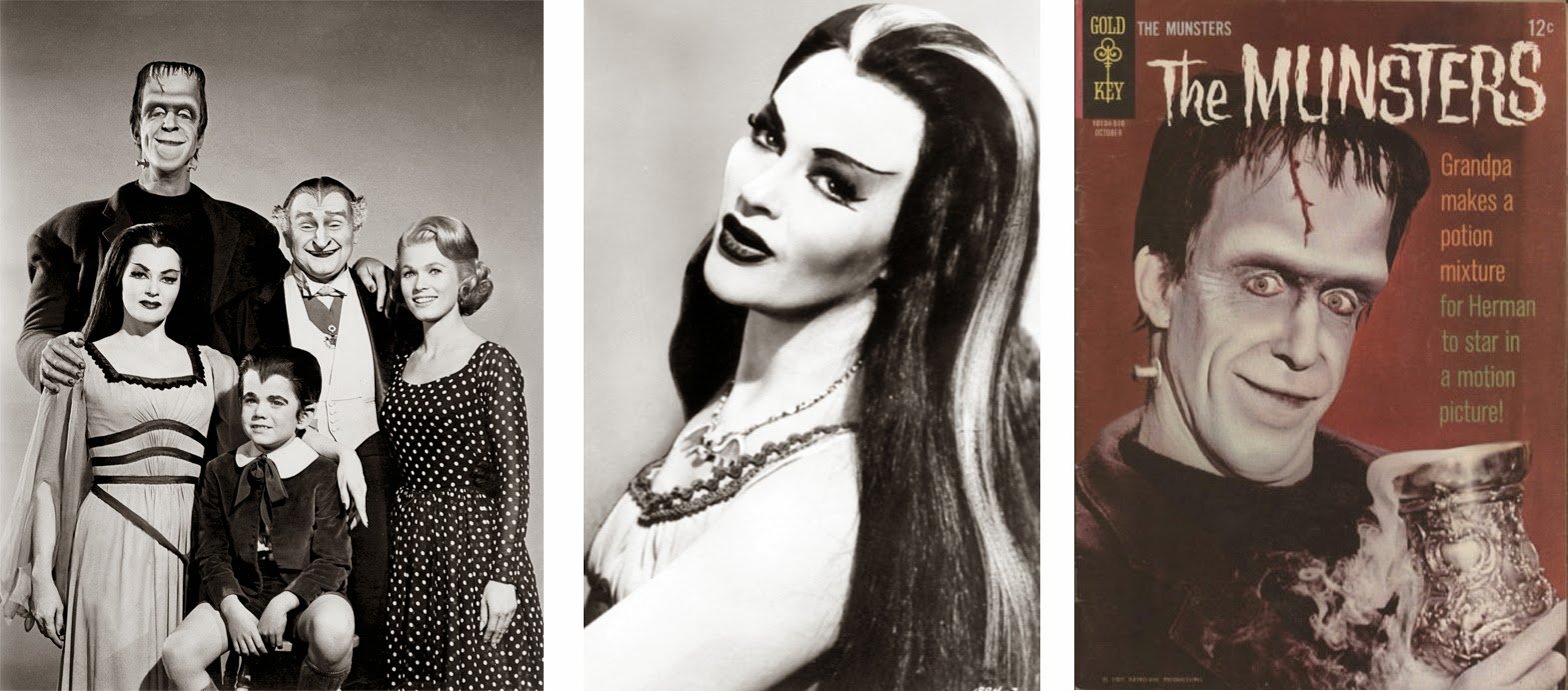
And I liked The Munsters as well ... by 1965, I was already a big fan of Famous Monsters of Filmland and I felt very clever knowing that the Munster family were all based on the classic Universal monsters. Fred Gwynne and Al Lewis had been in the earlier Car 54 Where Are You?, which I had been aware of but hadn't followed.

The Munsters were a typical American suburban family - except that they all looked like classic Universal horror film characters. I'm not sure which one Lily was meant to be, but I thought she was stunning when I was ten years old. And there was the Gold Key comic to scour the newsagents for, as well.
Of course, I much preferred them as The Frankenstein Monster and Dracula than as two bumbling New York police officers. I also loved the way the gorgeous Pat Priest as Marilyn Munster was seen as hideously deformed by the family. And, weird child that I was, I thought there was something strangely attractive about Yvonne de Carlo as Lily Munster ...

And the last pre-Batman show I especially enjoyed was The Avengers. Like all the shows I've mentioned here already, The Avengers managed to pack in elements of science-fiction, horror and fantasy, though it was - at least, on the surface - an espionage series, leading some fans to later dub it "Spy-Fi".

The chemistry between Steed (Patrick McNee) and Mrs Peel (Diana Rigg) added considerably to the  success of The Avengers. The Gold Key comic wouldn't come until 1969, as the US saw the show much later than us.
There had been spy shows before. Top Secret (with its infuriatingly catchy theme tune "Sucu-Sucu"), for example, and the grim and gritty Danger Man with Patrick McGoohan, but for kids of comic-reading age, The Avengers was the perfect television series. Stand-out episodes were the two Cybernaut segments, "The Maneater of Surrey Green" and of course the notorious "Touch of Brimstone" episode, featuring the beautiful Diana Rigg wearing a dominatrix corset in a bullwhip fight with the bad guy, The Honourable John Cleverly Cartney, played by soon-to-be cult actor Peter Wyngarde.

The "Cybernauts" episode was broadcast in the autumn of 1965. At the time I would have been unaware of Peter Cushing. My interest in Hammer films came a little later. But it had "giant robots, karate-ing everything". Mrs Peel didn't do much karate-ing in "A Touch of Brimstone", but then, she didn't need to.
Needless to say, the latter episode was aired quite a bit later at night and I had to plead with my mum to let me stay up and watch it. I can only imagine how uncomfortable she must have felt watching this with her 11 year old son - doubly uncomfortable because it would have just made it worse if she'd drawn attention to it by saying, "This is not suitable, off to bed with you." At the time I would have been completely oblivious to my mother's discomfort, though not to the not-inconsiderable charms of Miss Rigg in bondage gear ...

Much later, Chris Claremont would appropriate Wyngarde's persona from this episode as the basis for Jason "Mastermind" Wyngarde in his 1975 version of The X-Men and have him turn Jean Grey into a red-headed version of Mrs Peel as the "Queen of Sin".

Jason Wyngarde (a reinvented Mastermind) would turn up in X-Men 122  (Jun 1979) as head of the Hellfire Club, though his look would be based on the much later Peter Wyngarde character of Jason King, who played the second-lead in Department S and would spin off into his own, self-titled series.
But other than these shows, it was pretty slim pickings for a comic-reading kid in the first half of the 1960s. Our American cousins, however, were spoiled for choice by comparison ...

NOT IN THE UK, YOU CAN'T ...

During the late 1950s and early 1960s, US television was awash with shows that I would have loved back then. The king of these, which still holds up spectacularly well, was The Twilight Zone. With writers of the calibre of producer Rod Serling, along with Richard Matheson, Charles Beaumont  and George Clayton Johnson, it's little wonder that the series was a huge success. Why we never got it in Britain is anyone's guess. Thank goodness for DVD box sets ... the format was half-hour episodes which invariably ended with an especially clever twist ending. Kind of like EC stories on-screen but not as repetitive ...

A disturbing scene from the second season episode of The Twilight Zone, "Eye of the Beholder".
Rod Serling's iconic voiceover intros have since passed into pop-culture legend. You'll often hear people imitate his dry, clenched-teeth delivery without actually knowing where it came from ... and the writing was always tight, crisp and ever-so-slightly sinister:

"Suspended in time and space for a moment, your introduction to Miss Janet Tyler, who lives in a very private world of darkness, a universe whose dimensions are the size, thickness, length of a swath of bandages that cover her face. In a moment, we'll go back into this room, and also in a moment, we'll look under those bandages, keeping in mind, of course, that we're not to be surprised by what we see, because this isn't just a hospital, and this patient 307 is not just a woman. This happens to be The Twilight Zone, and Miss Janet Tyler, with you, is about to enter it." opening narration, "Eye of the Beholder".

In a similar vein to Twilight Zone was Outer Limits. Again, I have no recollection of this ever turning up on UK tv at the time. The format was slightly different - one hour episodes - but producer Joseph Stefano's writing team would include Harlan Ellison, Leslie Stevens and Stefano himself.

Robert Culp is surgically altered by a group of scientists to look like an alien - part of a plot to make the world think the Earth is imminent danger of invasion from outer space, which they think will force the hostile nations to unite and work together.
The episode "Architects of Fear" has been cited by some as Alan Moore's inspiration - oh, okay, swipe - for the ending of Watchmen. Other stand-out episodes were Ellison's "Soldier" and "The Zanti Misfits", by Stefano, who would also write the screenplay for Alfred Hitchcock's Psycho.

But these were both big-budget, networked fantasy shows that have been written about at length elsewhere. Since the 1960s, I've become aware of far more obscure shows that had used comics as the source material.

Flash Gordon was a half-hour adventure show from 1954 that featured Steve Holland, who later be the model for James Bama's iconic Doc Savage paperback book covers. The show was based on the King Features Syndicate newspaper strip of the same name, that had also been the basis for the 1930s super-serials. Though we didn't get the strip in UK newspapers, I was familiar with the serials during the 1960s.

Flash Gordon star Steve Holland was James Bama's model of choice for the Doc Savage paperbacks. This explains why Doc looks slightly older in Bama's covers than you might expect, as Holland would have been about 40 by this time.
As a syndicated show, this series was shot on the meagrest of budgets, and lasted just the one season, but I'd've loved it if it had been shown on UK tv. More recently, some of the episodes have been broadcast on UK satellite tv.

Another show from that era that popped up on a satellite channel was Sheena, Queen of the Jungle, starring the imposing Irish McCalla in the title role. Created by comics legend Will Eisner, Sheena was a kind of female Tarzan, who was the lead feature in Fiction House's Jumbo Comics from 1938 till 1953. She also enjoyed a run in her own quarterly comic from 1942 - 1953. 

In the end, Sheena Queen of the Jungle proved to be far more than just a female Tarzan knock-off. Surviving as the lead feature in Jumbo Comics from 1938-1953 was some achievement, and she also supported her own title for almost ten years. Actress Irish McCalla was Sheena come to life.
The tv show ran 25 episodes in 1955, and was quite racy for the times. McCalla was never going to win an Emmy for her performance, but her resemblance to the comicbook heroine was uncanny. I would have loved the show at the age of ten as, and I've noted this elsewhere in this blog, even at that age I had an eye for attractive heroines.

And because she is so impressive, here's a completely gratuitous triptych of portraits of the amazing Irish McCalla.
Many years later, Marvel Comics writers like Gerry Conway and Steve Gerber would remember Sheena, and include their own knock-off "Shanna the She-Devil" in Daredevil, then in her own series. One black-and-white strip, "The Wrath of Raga-Shah" from Rampaging Hulk 9 (June 1978), was quite risque and made such an impression on me in the 1970s that I built one of our regular UK Marvel Summer Specials around it.

After guest-star spots from Daredevil 109 on, Shanna became a regular if minor Marvel Comics character. Never really able to sustain her own series, the character was still a hit with 1970s teenagers like myself.
The other, higher profile, superhero series we never got in the UK was The Adventures of Superman. Starting in 1952, the syndicated series ran for six seasons, the last four filmed in colour, even though colour tv wasn't available in the US until 1965.

A couple of years earlier, National Comics had finally struck a deal, with Columbia rather than Republic, to produce a 15-chapter serial, Superman (1948). Kirk Allen was cast in the lead role as Superman/Clark Kent, with Noel Neill as Lois Lane and Tommy Bond as Jimmy Olsen. Vamping to the full, Carol Forman was the deliciously villainous Spider Lady.

Kirk Alyn made a pretty good Superman, better in my opinion than George Reeves. Carol Forman, veteran of several serials, made a slinky Spider Lady, Metroplis' Queenpin of Crime.
Columbia produced a second serial, Atom Man vs Superman, in 1950. Lyle Talbot was cast as the villain, Atom Man, who turned out to be Kal-El's arch-nemesis Lex Luthor. The serial included all of the comic book's tropes, including kryptonite, The Daily Planet and Lois Lane scoffing at the idea she could ever have suspected that mild Clark Kent might be Superman.

The villain Atom Man wore a metal bucket on his head so Superman wouldn't know who he was. All the comic book supporting characters were once again present,  Pierre Watkin (as Perry White), Tommy Bond, Kirk Alyn (here as Clark Kent) and Noel Neill.
The two serials were quite successful, so Superman editor and National's movie contact guy Whitney Ellsworth, starting looking round for another way to exploit DC's main character. Ellsworth struck a deal with Lippert Pictures and cast George Reeves as Superman/Clark Kent (after Kirk Alyn wanted too much money) and Phyllis Coates as Lois Lane in a b-movie length feature Superman and the Mole Men (1951). The idea was to have something to show the networks to demonstrate how a Superman tv series would look, but the running time meant it could be released on the movie circuits to recoup the expenditure if there was no interest from the broadcasters. In the end, National got the best of both worlds. The movie was released on 23 November 1951, and did reasonably well ...

"Full-length" is probably over-egging it a bit. The movie ran just 58 minutes and was later re-edited to form the only two-part story in the whole of Superman's 1950s tv run.
But before that even happened, Ellsworth had launched into production of the new tv series The Adventures of Superman, with the same cast (except for Jeff Corey who fell foul of HUAC and was blacklisted), in September 1951. But, unable to secure a sponsor, production had to shut down after a few weeks. Finally, a year later, National had convinced the sponsor of the Superman radio program Kelloggs to back the tv series and the show began its syndicated run on US tv in September 1952.

The first episode has Superman's father Jor-El trying to convince a sceptical Krypton council of the imminent destruction of their planet, but with his warnings falling on deaf ears, Jor-El is determined to save at least his infant son.

An uncredited Robert Rockwell played the part with steely determination in a cast-off costume from the Flash Gordon serial, Conquers the Universe. Aline Towne is Lara. And here's the original Flash Gordon costume before it was modified.
But when the tiny rocket lands on Earth, it's discovered by Eben (Tom Fadden) and Sara (Frances Morris) Kent, rather then the more familiar Jonathan and Martha. This was early days, after all. The Kents, first appearing in Adventure Comics 103 in 1946, only became established after the Superboy comic began its run in 1949, so the "Jonathan and Martha" names for the Kents weren't so familiar to audiences ... or tv script writers.

Tom Fadden also went uncredited by the producers for his role as Eben Kent, even though he was the one who pulled the infant Kal-El from the blazing rocket, whereas Frances Morris (like Aline Towne) was credited on-screen. I'm detecting a clear bias towards mothers.
The whole section of baby Kal-El arriving on Earth is dispatched in the first few minutes of the first episode of the show. The Smallville years are largely glossed over, except for Eben's death, and it's Sara who provides Clark with his iconic uniform.

Once Clark gets to Metropolis as Superman, the show had to face the thorny problem of his superpowers. The key challenge was making him fly. A few years earlier, the serials had tackled the problem by turning the long-shot figure of Kirk Alyn into a cartoon Superman and literally animating the flying sequences. It kind-of almost worked. But not really. 


The producers of Adventures of Superman took a different approach ... they had George Reeves take run across the set, jump onto an out-of-camera spring board and dive off the side of the frame. Then they'd cut to Reeves lying on a small platform with back-projected sky behind him. That, too, kind-of almost worked. But I know that today's audience would find it Plan 9 From Outer Space funny.

Many years later, the Christopher Reeve version of Superman was heavily marketed with the ad-line, "You'll believe a man can fly". At the time I couldn't figure out what the big deal was. After all, he was Superman, right? What I hadn't realised was that US audiences had grown up with George Reeves' springboard-bouncing take-offs and the moviemakers were worried audiences would be expecting the terrible flying effects of the television show.
But for the most part, this version of Superman was just an airborne strongman. The producers never addressed Superman's full set of superpowers. Occasionally, he'd use X-ray or telescopic vision, but hardly ever super-speed. At least not in the black-and-white shows that I've seen.

I very much liked the way Reeves handled the Clark Kent persona. Instead of the fake coward of the comics, Clark was quite rugged as the Daily Planet journalist. He'd often stand up to crooks in this identity, one time faking out a crook by jamming his steel-hard fingers in the guy's back to make him think it was a gun.

I quite liked Reeves' portrayal of Clark as a capable newspaperman. There was very little sign of the comic book's fake coward here ...
In this show, Clark was just as important a character as Superman, and more than once demonstrated that he could be a capable investigator. Consequently, there was little room for his supporting cast, lead by Phyllis Coates' Lois Lane to speculate that Clark could ever actually be Superman.

Mostly the crooks were just standard criminals in business suits. The black and white photography enhanced the show's noirish qualities. The supporting cast were strong, featuring Jack Larson as Jimmy Olsen, Phyllis Coates as Lois Lane and John Hamilton as Perry White. Coates would be replaced by the serials' Noel Neill from season two onwards.
What the tv show didn't have that the comic books had was ongoing villains. Mostly Superman battled none-too-bright thugs in business suits - not unlike some of the earlier superhero serials. So there was no Trickster or Prankster or Lex Luthor to be seen anywhere in Adventures of Superman. In fact the first two seasons were quite noir-ish in their approach, a feeling enhanced by the back and white photography. Once the series switched to colour with the third season, we began to see a bit more whimsy and humour.

The series was an instant success, even though it was syndicated rather than backed by a major network. This meant that stations across the US could take or leave the show depending on whether the station manager and his audiences liked it, and not have it forced on them through a network contract. Even with that, Adventures of Superman was a smash hit, George Reeves became a huge star on the back of it and the show's catchphrases, such as "Is it a bird, is it a plane?" and "faster than a speeding bullet", entered the US zeitgeist. So massive was the success that Reeves as Superman was a guest star on the phenomenally popular I Love Lucy tv show in January 1957.

Though I Love Lucy was the top-rated comedy show on US tv, with ratings of about 50 million, Superman was played straight, as though he was a real person with real super-powers..
Even though the Superman show lasted just six seasons - the final four really being just half seasons with only thirteen episodes, it ran in syndication well into the late 1960s and beyond. All the more incredible, then, that we never got Superman on tv in the UK during the show's run.

So I was left wishing just as hard as I could that I'd be able to see a "real life" superhero either on television or in the movies. At that age, I had never heard the proverb that says, "When the gods want to punish us, they give us what we wish for". So little did I know that in the spring of 1966, shortly before my twelfth birthday, I would get my wish ...

Next: THAT tv show ...


STOP PRESS  +++  STOP PRESS  +++   STOP PRESS  +++   STOP PRESS

A couple of posts back, while examining the artwork for the trademark Marvel Comics corner box, I was speculating on the origins of the Kirby Sub-Mariner figure used on the later Tales to Astonish covers. I chanced across the solution recently, and I've added the info to the original post. Have another look at the post and learn what I learned ...


Sunday, 3 November 2013

Marvel Comics: Second-Hand Memories

BACK IN THE MID-1960s, when I first became interested in reading as many Marvel Comics as I could lay my hands on, there wasn't the perfect distribution network today's comic fans enjoy. I was reliant on the spotty delivery of American comics to the many independent newsagents in my local area and what I could salvage from the piles of second-hand comics in the various unlikely shops I'd stumble across. Once I realised that there were shops that would sell second-hand comics, I began to explore the area in earnest, ranging far and wide on my bicycle, stashing my new-found treasures in the saddlebag I'd acquired especially for that purpose.

In general, these second-hand shops charged 6d (that's 2.5p in today's money - though adjusting for inflation it's actually about 30p). My pocket money was 2/6, so I could afford to buy five comics for that. Or three if I was buying them new from a newsagent. Caution was often called for.

Of course, I didn't spend all my money on comics. Another favourite pastime for kids back in the 1960s was to go to Saturday Morning Pictures. My local cinema was the ABC on Wellington Street, Woolwich, and every Saturday morning we'd all troop off for three hours of entertainment - a feature film, cartoons, a serial chapter and even birthday celebrations. All for sixpence. 

Top left: An ABC Cinema of the period. Top right: The Woolwich ABC as it is today (sad).
Bottom left: An ABC Minors birthday invite. Bottom right: The classic glow-in-the-dark ABC Minors badge.
If you were feeling particularly flush, you could sit upstairs in The Circle for 9d. The advantage of this was that you wouldn't have kids above you flicking gobs of ice cream at you during the performance. But before we got to see any films, there was a bit of housekeeping. The MC would ask if there were any birthday boys or girls in the audience. Each celebrant would have to come up on the stage and get a free ice lolly. One time my friend Roger Phair pretended it was his birthday. I felt sure he'd be found out, but he returned to his seat, beaming and holding his ill-gotten prize - a Zoom lolly. Then we'd sing the ABC Minors song while the words appeared on the screen. Finally, we got to watch the movies ...

Back in the 1960s a tribal custom was to sing your tribal song at the top of your lungs.
When it got to the last line, all the kids hollered "A-B-C" as loudly as they could.
In 1965, I was excited to hear that Batman would be featured in the following week's matinee. Even though I was a confirmed Marvel fan by that time, it was still a big deal to think that a superhero would be featured on the big screen. The previous year, Batman had undergone a revamp. DC Comics had got rid of the corny old science-fiction tales and remade Batman in the same sleek style they'd used for their Silver Age versions of Green Lantern and The Flash. The character even had a costume redesign ... they put a yellow circle around the bat emblem on Batman's chest, an allusion, I figured, to the famous "Bat Signal".

Though I didn't know it at the time, Batman's early 1964 revamp was
down to Julius Schwartz and Carmine Infantino, who'd so successfully
revived The Flash and Green Lantern five years earlier.
All the way to the cinema, I kept asking my friend Steve Rainey if he thought the Batman on the screen would have the yellow circle around the bat emblem. I don't think he had the faintest idea what I was talking about. As it turned out, the Batman on screen was the 1943 serial version, starring Lewis Wilson in a wrinkly costume. Once I got over my initial disappointment, I quite enjoyed the serial. It was black and white, and obviously very old because of the suits the characters were wearing and the cars they drove. But it was one of the better serials, given a decent budget by genre standards and directed by Lambert Hillyer, who also did the eerie Dracula's Daughter (1936) and went on to have a long career directing westerns and tv segments.

The Batman chapterplay was pretty action-packed and though Batman's costume was a bit saggy, I enjoyed the serial immensely. There would be many more superhero serials in my future.
This was also my first sight of a superhero on screen. We never did get the George Reeves Superman tv show in London until much later (if at all - can anyone say for sure?). I'd have to wait a couple of years for Adam West to put on the famous cowl, which would be my next exposure to a live-action comic character. Boy, how I hated that tv show - but that's a story for a later post.

The other product that vied for the attention of the neighbourhood kids during 1965 was bubble gum cards. I somehow managed to miss out on the Mars Attacks series. And I didn't know anyone back then who had any. It may have been that they just didn't make it into our area. But we were very aware of the Civil War News series from AB&C. These were a set of pasteboard cards, about 80mm x 55mm, depicting often gory scenes from the American Civil War, rendered in glorious, full-colour painted artwork.

The Civil War News gum card set was much-loved by my generation of kids.
Extremely gory and painted, in part, by the
Mars Attacks artist Norman Saunders,
these images were deemed quite unsuitable for children by an outraged popular press.
With each wrap of cards you also got an reproduction Confederate banknote and a wafer of bubblegum with the taste and consistency of cardboard. As it was a bit of lottery as to what cards you got in a packet, you'd end up spending way more than you expected to to acquire the full set, though it was possible to swap "doubles" with your friends. 

As noted on the wrapper, Civil War News cards cost 2d
and came with a free Confederate Dollar banknote.
But at just 2d a pack, I quickly collected a full set and  ended up with a roll of Confederate bills that could have choked a horse.

So successful was the first Beatles set of cards that card company
AB&C immediately released a second set.
Other card sets that were popular during 1965 were The Beatles and Man from UNCLEIf anything, the Man from UNCLE cards were even more popular than The Beatles set. And in the couple of years that followed, there would be other sets of gum cards that we'd all collect like crazy - Battle (a WW2 set along the same lines as Civil War News), several sets of Batman cards,(riding the wave of that tv show) and The Monkees.

The Man from UNCLE cards were in the same format
as The Beatles cards - black and white photos with a
signature overprinted in blue.
If you came up short for money back in the mid-1960s, you could scour the area for empty lemonade bottles. Back then, glass bottles like those for Tizer and R Whites lemonade would net you 3d each if you returned them to the shop. Even cider bottles and some beer bottles had a deposit. Some shop owners were a bit suspicious if you came in with an armload of sticky empty pop bottles. "Did you buy those here?" they'd sometimes enquire. But there were some shopkeepers who'd happily accept anything you could find, because they too received money for bottles they returned to the beverage companies.

Two bottles would net you a used comic. Three would get you a new one off the newsagent's spinner rack. Money was just lying around next to dustbins in those days ...

But back to the main story ... by this point I was on my way to building a pretty good run of Tales of Suspense featuring my hero Captain America, along with a good run of The Avengers, also with Cap.

Most of these I had sourced in my immediate neighbourhood, in and around Woolwich, in south-east London. It wasn't the best area for finding American comics. The nearest newsagent to my house was an old-fashioned shop at the top of Frances Street, all dark wood interior with elderly proprietors. They would have no truck with any new-fangled American nonsense, so I couldn't get my Marvel Comics there. There was the paper shop on Kingsman Parade near the south end of Frances Street that did have a single spinner rack, but carried mostly DC Comics. And there was the newsagent behind Woolwich Arsenal Station that I mentioned in an earlier post. All in all, pretty slim pickings. Luckily, I had a bike.

Casting my net wider, I travelled westwards along Woolwich Church Street, through lower Charlton which was a dead loss for likely newsagents, until I hit Greenwich and found a small print shop that had a pile of American comics in the window. Leafing through the pile, under the watchful and distrustful eye of the elderly proprietor, I pulled out a few issues of Tales of Suspense that I needed.

The little print shop was somewhere about here on
Trafalgar Road in Greenwich during the 1960s - now long gone.
Then I found something much cooler - Amazing Spider-Man 11 and 12. Excited by my discovery I put both books on my "to buy" pile. 

A two-part Spider-Man extravaganza from Stan Lee and Steve Ditko -
featuring the return of Doctor Octopus (I hadn't been aware he went away at this point).
Finally, near the end of the stack, there was a copy of Amazing Spider-Man Annual 3. Now to my ten-year old mind, this was way better. For a start, it cost 6d, so it was cheaper than the two regular Spider-Man comics. It reprinted the entire story from Spider-Man 11 and 12. And it threw in an all-new tale about Spider-Man joining the Avengers. Easiest decision in the world. I put the two Spider-Man books back and went with the Annual.

Spider-Man battles the hulk as part of the Avengers joining process.
And fights Doc Ock in the back end of the book. Brilliant!
Of course, by today's standards, that was the worst possible decision. The Overstreet Price Guide price for Spider-Man 11 and 12 is about £190 apiece in fine. The fine price for Spider-Man Annual 3 is £32 - as an investor, I clearly hadn't got the hang of it yet.

Another Marvel I uncovered on my travels around south-east London was a copy of Fantastic Four 30. This one featured an alchemist called Diablo, a villain criticised by some fans because his potions never really worked very well. Buried in a vault beneath his medieval castle somewhere in Transylvania, Diablo manages to take control of Ben Grimm and turn him against his team-mates. Even by issue 30 of "The World's Greatest Comics Magazine", the idea of Ben turning again the rest of the FF - having already been pretty testy for the first six issues then actually going rogue in issues 8 - was getting a bit overworked. Yet Stan (or Jack) would return to this one again and again, notably in Fantastic Four 41-43, 51, 68-69, 111 - and that's just the Silver Age stories ...

Another beautifully composed cover from Kirby, enhanced by Chick Stone's
classy, smooth inking style. The premise - The Thing looking more human - is
immediately engaging. We
need to know what's happening.
Like some of the Captain America stories I was enjoying so much in Tales of Suspense, this FF also featured the inks of Chic Stone over Kirby pencils. I've mentioned before how much I liked Stone's inks both then and now, and I always wondered why other fans didn't seem to like his stuff.

Stone was active with Marvel for about a year during 1964-5, inking Kirby's work pretty much exclusively until mid 1965, when he suddenly disappeared from Marvel Comics. I've not been able to find an authoritative explanation for this and can only assume Stone was offered a better rate from another company. After Marvel he continued to ink for ACG and started producing artwork for Dell (The Flying Saucers), then did a long stint for Archie Comics through the 1970s, returning to Marvel as an inker around 1978 on the Thing team-up book Marvel Two in One.

But during that one year period, Stone turned in some exemplary work on just about all the pencil work Kirby did ... the key books he inked were:
  • Avengers 9 (Oct 64) - 14 (Mar 65), 15 (cover)
  • Fantastic Four 28 (Jul 64) - 38 (May 65), FF Annual 2 (Sep 64)
  • Journey into Mystery 102 (Mar 64) - 114 (Mar 65), 115 (cover)
  • Sgt Fury 18 (May 65)
  • Tales of Suspense 59 (Nov 64) - 66 (Jun 65)
  • Tales to Astonish 57 (Jul 64), 63 (Jan 65), 67 (May 65)
  • X-Men 6 (Jul 64) - 11 (May 65)
  • Patsy Walker 115 (Jun 64) - 116 (Aug 64)
I've read elsewhere that FF30 was completed in a bit of a rush, due to scheduling problems, but in the first half of the book, Stone's inks are as good as anything he ever did. Especially good are pages 2 and 3. The detail and the quality of the inks enhances Kirby's pencils beautifully, and unlike later inkers, all the faces Stone inked still look like Kirby faces. And also unlike later inkers, Stone took the time to ink the backgrounds fully, instead of just erasing stuff he didn't want to spend time inking.

Especially well done here is the inking on Johnny's and Reed's faces on page 2
and the Burgomeister's face on page 3. The backgrounds are beautifully filled in too.
Towards the end of the issue, you can see that there was some hurry to Stone's inking - or it may have been Kirby's pencils that were rushed. But it's still fine storytelling.

By this point in the story, you can see that Kirby and Stone's artwork isn't quite as detailed
as the earlier pages, but it's still very efficient storytelling, very slickly inked.
I'd love to know why Stone suddenly quit Marvel in mid-1965. I've not been able to find out, and I suspect the lack of information may be because Chic Stone was too much of an old-school gentleman to ever discuss the matter. But if you know anything about Stone's leaving Marvel at that time, please leave a comment ...

Next: How the Bullpen Bulletins made Marvel the Market Leader