Showing posts with label Joe Sinnott. Show all posts

Tuesday, 31 March 2020

Exposed: Myths of Marvel's Silver Age - Part 2

OVER THE LAST FEW DECADES, a great deal has been written about the history of Marvel Comics, not all of it as well-researched as it could have been. And because of this, certain historians have chosen to lift anecdotes from earlier histories without bothering to check the sources of the material they're quoting.

Last time, I took a look at some of the legends that have appeared in successive histories of Marvel Comics and questioned whether they had been verified by the authors or simply repeated based on faith. As with many histories, it seems that opinion often triumphs over fact ... and fans of a particular artist or writer will insist that their hero tells the objective truth while all others lie and dissemble. But as my old friend and collaborator Phil Edwards always said, "There's three sides to every argument - his side, her side ... and the truth."

Back when I was a teenager, the first glimmer we comic fans had that there was an actually history to comics was these two books, both published in 1971. In retrospect, neither were very good. We wouldn't really get a decent history till Steranko's History of Comics (1970), a project sadly aborted before it could get to the Silver Age and the stuff I was really interested in.
I've already looked at the oft-repeated story that Marvel Comics was limited to just eight titles a month during the 1960s (not true), that Stan Lee only got his job at Marvel Comics in 1941 because he was related to publisher Martin Goodman (not true) and that Stan Lee was the cause of Simon and Kirby leaving Captain America in 1942 because Stan snitched about their moonlighting for DC to his cousin-by-marriage Martin Goodman (no evidence to support that).

This time, I'm going to look at a few more cases where it seems to me as if the historians have gone with "Print the legend."


STAN LEE'S FIRST STAB AT GROWN-UP COMICS

To be fair to the comics historians, I should say that this myth has largely come from Stan Lee himself. As far back as Origins of Marvel Comics (Simon and Schuster, 1974), Stan had alluded to the claim that he had a revelatory moment when he realised he was fed up with hacking out copycat strips for Goodman and wanted to do something that would raise both his game and set a higher benchmark for the comic book medium. 

Stan expanded on the story in his autobiography Excelsior; The Amazing Life of Stan Lee (Fireside Books, 2002). "For once I wanted to write stories that wouldn't insult the intelligence of an older reader, stories with interesting characterisation, more realistic dialogue and plots that hadn't been recycled a thousand times before. Above all, stories that wouldn't hew to all the comicbook cliches of years past."

So, The Fantastic Four was born ... right? Well, not exactly, no.

All that stuff about wanting to quit the business and Joan Lee telling Stan to just write comics the way he wanted to, because he had nothing to lose, didn't result in Fantastic Four. It resulted in Amazing Adult Fantasy. At the very least, Stan was working on both simultaneously ... but tellingly, only one had the word "Adult" in its title. Also, only one promised to be "The Magazine That Respects Your Intelligence", right there on the cover. And though both sported a logo that strikingly resembled that of the hit, liberal-leaning Twilight Zone tv show, only one was an anthology of fantasy tales.

In this house ad from Strange Tales 95 (Apr 1962), which came out between FF 3 and FF 4 and the same month as AAF 11, Stan puts Amazing Adult Fantasy and Fantastic Four together, emphasising their common logo style - though tellingly, he places AAF above FF, indicating that he thought the fantasy anthology book best placed to further his agenda.
It's for these reasons that I think I can make a case for Amazing Adult Fantasy being the title Stan thought would bring the older reader to the table.

The Twilight Zone had premiered two years earlier, in October 1959, to outstanding reviews. "Twilight Zone is about the only show on the air that I actually look forward to seeing. It's the one series that I will let interfere with other plans", said Terry Turner for the Chicago Daily News. The New York Herald Tribune said it was "certainly the best and most original anthology series of the year" and Variety called it "the best that has ever been accomplished in half-hour filmed television". 

From the outset, Serling's moral fables, with their liberal worldview and chilling observations about human frailty, won a strong audience following and, later, Emmy and Golden Globe awards. And when you compare the stories that Stan Lee was offering in his anthology titles, especially those drawn by Steve Ditko, you can see just how much of an influence on Lee Serling's series was.


It's not a coincidence that Amazing Adult Fantasy and Fantastic Four shared a similarly styled cover logo. And I think it's fairly safe to say that Stan thought looking to the title design for Rod Serling's intelligent sci-fi tv show The Twilight Zone for inspiration might be the fastest way to reach the readers he was looking for.
So when Stan Lee felt he should do something more worthwhile than the kiddy-fodder he'd been filling the Atlas/Marvel comics with, it seemed natural to beef up the presence of the Serling-influenced Ditko fantasy tales by giving them their own title. So Amazing Adventures' Kirby kaiju stories gave way to the humanist fables of Lee/Ditko. I also think it's significant that Stan Lee almost always signed his stories with Ditko, but didn't much bother with the Kirby monster strips. 

The only reason I can think of that Stan would later downplay the role of Amazing Adult Fantasy in his quest to bring a degree of sophistication to the four-colour comic book is that ultimately the title fell prey to poor sales and was cancelled by Marty Goodman before the new approach could establish itself. Far better to hitch your revolutionary game-changing approach to a success rather than to a failure.

I also can't help but observe that the first few issues of Fantastic Four followed the formula of the Kirby Giant Monster comics, almost as though Stan felt you just couldn't do grown-up superhero tales. Certainly issues 1, with the Mole Man's Godzilla-like subterranean creatures, and 3 and 4, with The Miracle Man's giant marquee monster and The Sub-Mariner's Giganto creature, didn't stray far from kaiju territory.

When you have a successful formula, you'd be nuts to abandon it. So Stan stuck with giant monsters for the first few issues of Fantastic Four, reasoning that if monsters drove sales on Astonish, Suspense and the others, then it would for FF, too.
It wasn't really until Fantastic Four 8 (Nov 1962) that the tone of the comic shifted a bit and Stan made an effort to change the direction of the title. He makes The Thing less angry, the FF start calling him "Ben" instead of "Thing" and Reed begins his quest to revert Ben to his human form. Stan also gets rid of the (rather odd) Reed-Sue-Ben triangle and introduces a new love interest for Ben, Alicia, who initially resembles Sue - though that idea is also jettisoned quite quickly. For me, this is where Stan made a concerted effort to make superhero comics a bit more sophisticated than the standard superhero mags DC were putting out under the editorship of Mort Weisinger - pretty brave, considering how well the Superman family titles were selling in 1961.

And as history would show, turns out Stan was right. Once Marvel got into its stride, sales began to climb and the previously unassailable DC began their decline.


STAN LEE INVENTED THE "MARVEL METHOD"

There is a prevailing school of thought out there, especially among Kirby Kultists, that Stan Lee invented the Marvel Method (of comics writing) specifically to gyp artists out of their plotting payments. The story gets repeated over and over, but without any real evidence to back it up.

I think the first hint I came across - beyond Stan's own explanations in the Marvel Bullpen Bulletins - of how comics were created during the early days was in Steranko's History of Comics, which I would have picked up around the age of 18. In volume 1, Steranko recounts how the classic 44-page battle between The Human Torch and The Sub-Mariner (Marvel Mystery Comics 8 & 9, Jun & Jul 1940) was written and drawn over a weekend.

What's remarkable about this 44-page battle between The Human Torch and the Sub-Mariner isn't that it was the first such character cross-over, pre-dating the first appearance of the Justice Society by several months, but that it was conceived and completed over a weekend! Both books sold out.
"Carl (Burgos) and Bill (Everett) sat down at the drawing boards and composed the first two pages without having the slightest notion about the storyline. John Compton came in and began to plot out a script ... Breakdowns were pencilled as soon as page-by-page synopses were completed. Finished dialogue was written directly onto the pages, then lettered."

That process, with the art produced from a synopsis and the dialogue and captions written and lettered on the finished art sounds a lot like the Marvel Method to me.

More recently, I picked up a copy of The Best of Alter Ego, a compilation of the best articles from the pioneering fanzine of the early 1960s. In it, there was a short essay by Golden and Silver Age artist Paul Reinman, which first appeared in Alter Ego 4 (Oct 1962). Something Reinman wrote reminded me of that account from Steranko's History of Comics

"I remember when the artists were just a page, or a few boxes, ahead of the writer. We would come in in the morning and the editor, who mostly doubled as the writer, would say 'Sit down. I'll write an outline of the plot in a few minutes.' While the artist was working on the first page, the editor broke down the rest of the story and typed it for the artist. The dialogue was not written before the artist had finished his inkings. When the artist looked at the breakdown of his story and if the box showed a lot of action he would let his drawing take up most of the space of this box: if it was a close-up or very little action, he would leave more space for dialogue. Well, that's the way it was in the beginning of comics."

MLJ - which later became Archie Comics - had a spat with Martin Goodman over a Captain America villain called The Hangman. It was MLJ partner Maurice Coyne (also working as Goodman's accountant at Timely) who told Joe Simon that Goodman was cheating on the Captain America royalties.
Though Reinman doesn't give any dates, a quick check of his credits on GCD, shows that he spent the first two years of his career working for MLJ on strips like Hangman, The Wizard and Zambini, which appeared in their top titles, Pep Comics, Shield-Wizard and Zip. Though he moved on to DC in mid-1943, I think it's pretty safe to say that Reinman was talking about how they worked at MLJ.

Atlas was at its peak in the mid-1950s, publishing the most titles of any publisher. Sinnott was one of Stan Lee's mainstay comic strip artists, though only the real stars - like Joe Maneely and Bill Everett - got to draw the covers.
Different publishers worked in different ways, but during the 1950s, when Marvel was known as Atlas and Stan Lee was Editor and head writer, the artists worked from full scripts. Joe Sinnott was a prolific artist at Atlas and described the work routine in The Jack Kirby Collector 9 (1995). "I'd go down to the city on Friday, and Stan would give me a script to take home. I'd start on Monday morning by lettering the balloons in pencil. Then I'd pencil the story from the script and ink it and leave the balloons penciled. I'd pencil a page in the morning, and ink it in the afternoon ... I'd bring the story back on Friday and he'd give me another script. I never knew what kind of script I'd be getting. Stan had a big pile on his desk, and he used to write most of the stories himself in those days. You'd walk in, and he'd be banging away at his typewriter. He would finish a script and put it on the pile. Sometimes on his pile would be a western, then below it would be a science fiction, and a war story, and a romance. You never knew what you were getting, because he always took it off the top. And you were expected to do any type of story."

The later, in the post-Atlas years, when Marvel Comics was only known by the tiny letters "MC" on its covers, Stan was still supplying full scripts to his artists. The seeds of the Marvel Method were sown when Stan began to ramp up output at the beginning of the 1960s and found he was struggling to do all the editing and scripting himself. So he began writing with his brother Larry Leiber, who was primarily an artist.

In an interview for Alter Ego Vol 3, No 2 (1999), Lieber explained how those early Marvel stories were done. "Stan made up the plot, and then he'd give it to me, and I'd write the script ... I was unsure of myself just sitting down to write a script. Since I knew how to draw, I'd think, 'Oh, this shot will have a guy coming this way... this shot we'll have a guy looking down on him,' and later I'd sit at the typewriter and type it up. After a while, I'd just go to the typewriter. I would follow from Stan's plots ... Jack I always had to send a full script to." [My emphasis.]

A few months later, dissatisfied with Lieber's scripts, Stan Lee hired some veteran scripters -  Robert Bernstein, Ernie Hart and even Jerry Siegel - to cope with the load, but in the end he realised that to get the kind of stories he wanted for the fledgling Marvel Comics, he'd have to write them himself.

However, there is an important clue here to how Stan arrived at the Marvel Method. He was giving plots to brother Larry to break down into panel-by-panel scripts with dialogue and captions. I've not come across any indication that Larry had any input into the plots. It is possible that, when Stan was working with Bernstein and Hart, he did allow some plotting collaboration but, again, I've not found any statements from the participants to support that.

The above Marvels were the last scripted by Hart, Siegel and Bernstein before Stan took over all the writing chores himself. It's not a huge leap to go from providing brief plots to hired scripters, to providing plots to pencillers, to co-plotting with pencillers.
The next step in the evolution came when Lee rightly realised that it was the characterisation in the script - and the emotions felt by his characters - that made Marvel tales more appealing to his young audience than the old-fashioned, plot-driven DC-style stories. Stan understood that the details of the plot were the least important component. So rather than sit down with some less talented scripters and feed them plots, why not sit down with the artists, thrash out a plot, then have the artist draw it up before the dialogue was written? Pretty much a reversion to how it was done in the early 1940s.

As 1963 rolled over into 1964, it seems likely that Stan found some pencillers were better at fleshing out a brief story synopsis into a 20-page story than others. Steve Ditko appears to have been best at it, and had likely worked that way with Stan during the pre-hero years. Jack Kirby  - even though he'd been used to full scripts from the Marvel Bullpen was able to adapt and add detail to the briefest of outlines. Others, like Gene Colan and Don Heck, needed more hand-holding.

What is interesting is that those who had the biggest issues with how Stan worked - I'm thinking Wally Wood, Joe Orlando and Gil Kane - were all from a background where they would be given some form of full script to work from.

Kane had worked for DC Comics most of his career, and the editors there would hold regular story conferences with the writers to create a plot, then have the scripters - John Broome, Gardner Fox - go home and type up a full script for the penciller. I'm pretty sure the writers didn't get paid for the plotting session.

At EC Comics, where Wood and Orlando cut their teeth, the discipline was even stricter. Bill Gaines and Al Feldstein would plot and script the stories, then give the boards to a letterer to ink in the captions and dialogue. Only then would the boards go to the artist, who would have to fill the pre-ruled and lettered panels with drawings.

Here's a Wally Wood page and a Joe Orlando page - both from Weird Fantasy 13 (May 1952). The artboard was pre-lettered with the captions and balloons and the artists would have to fit their drawings in as best they could. Some artists would find this restrictive and impossible to work with, and others found it worked best for them. Wordy, aren't they?
So from Wally Wood's point of view, it may well have looked like Stan was getting him to "write" the story while taking the credit ... but that's only because Wood had never worked Stan's way before.

Interviewed by Mark Evanier, Wood said, "I enjoyed working with Stan on Daredevil but for one thing. I had to make up the whole story. He was being paid for writing, and I was being paid for drawing, but he didn't have any ideas. I'd go in for a plotting session, and we'd just stare at each other until I came up with a storyline. I felt like I was writing the book but not being paid for writing."

That doesn't really ring true to me. I just can't imagine Stan - the most talkative human being on the planet - just sitting and staring at Wally Wood. I rather think that Wood, like some others, is vastly overestimating the importance of the plot to a comic story. When Wood did actually write an issue of Daredevil by himself, Lee's criticism wasn't of the plot but of the lack of characterisation in the dialogue.

"I persuaded him to let me write one by myself since I was doing 99% of the writing already," said Wood in the same interview. "I wrote it, handed it in, and he said it was hopeless. He said he'd have to rewrite it all and write the next issue himself."

At that stage of the process, there was very little Lee could have done about the plot ... but he sure could fix up the dialogue. 

Joe Orlando, who preceded Wally Wood as Daredevil penciller, also had difficulties with Stan's way of working. After three issue - Daredevil 2 - 4 (Jun - Oct 1964) - he quit because he couldn't deal with Stan asking him to redraw the pages he was turning in.
The point is that every writer or artist has a different history and background. And each has different working habits. What works for some doesn't work for others. What drew Neal Adams to Marvel in 1969 is he'd heard that the artists worked from the slightest of plots and were free to draw the comic their own way.

So it turns out that Stan didn't invent the plot-art-script process of creating comic strips. It's a method that has been in use since the 1940s, which some artists prefer and some don't. I can see how Stan found his heavy workload - as Marvel Comics grew during the early 1960s - meant he had to find ways to get the comic stories completed faster. He tried several different processes before he hit on the one that gave him the best control over how the characters were portrayed. Because Stan was all about the characters and their emotions, just as DC were all about the plots and their resolutions, and thought characterisation was irrelevant ... And we know how that eventually turned out.

I was going to try to squeeze in an account of the 1971 "price war" between Marvel and DC and give some perspective on the sales numbers that have been quoted in a few accounts, but it's the end of the month and I just don't have the time to do it justice this month, so I'll leave it for now and try to publish the last part of this look at Marvel Myths and Legends in a week or two.

Next: The DC / Marvel Price War of 1971


Sunday, 31 December 2017

Thor: The Wilderness Years

THE EARLIEST THOR STORIES have always been associated with the grand art of Jack Kirby. But it wasn't actually that way. While the first seven issues of Journey into Mystery that featured the Thunder God were drawn by Kirby, these tales had none of the epic sweep the Silver Age version of the character is remembered for. Thor would battle Commies and gangsters and we'd rarely see more than tantalising glimpses of Odin and the fabled realm of Asgard. Then, all too soon, Kirby was off the title, re-assigned by Editor Stan Lee to other more pressing projects, like the epic first Fantastic Four Annual (Oct 1963), as well as new titles X-Men and The Avengers

Working over a plot by Stan Lee and a script by Larry Lieber, Al Hartley turned in his only superhero story of the Silver Age, "Trapped by the Carbon Copy Man". The result was less than legendary.
Another artist had to be found for Journey into Mystery 90 (Mar 1963, on sale January) ... and for that task, Stan selected Al Hartley.

The tale begins with Dr Don Blake resolving to tell his nurse, Jane Foster, that he is really The Mighty Thor and that he loves her. This would be an ongoing sub-plot for the first few years of the Thor strip. Stan seemed to want a romantic undercurrent - usually an unsuccessful one - in every title he wrote. As a ten-year old I found this a little tiresome. The Reed and Sue relationship I didn't mind, as they were a couple from the get-go. Even Hank and Jan were all right, because they too quickly became an item. But could I have been the only one who thought it was a bit creepy that Professor X was secretly mooning over Jean Grey in those early X-Men issues?

Al Hartley's art in Journey into Mystery 90 is a real anomaly, and has all the hallmarks of a rush job. The main figures seem crude and cartoony and the backgrounds are sparse and often absent altogether.
Just as Blake is about to reveal his true identity, Thor's father Odin intervenes and forbids him to say any more. But when Blake goes out to walk it off, he finds all kinds of strange behaviour. Cars driving on the sidewalks, polkadot bridges and advertising posters pasted over apartment windows.

The explanation for the madness is that aliens with designs on conquering Earth have substituted duplicates for important decision-makers (and Jane Foster) in an effort to make the Earthlings confused and frightened and so easier to conquer. Yes, I thought was was a bit lame, too. So Blake offers to betray Thor to the aliens - much to the captured Jane Foster's horror - then turns the tables by giving the aliens a darn good thrashing.

It's probably the least of the early Thor stories, not helped by an especially hokey script and the inappropriate artwork of Al Hartley

WHO THE HECK IS AL HARTLEY?

Henry Allan Hartley, born 25 October 1921 in New Jersey, was the son of Congressman Frederick Allan Hartley. His father, said Hartley in a later interview, "encouraged me. He knew I wanted to draw from the time I could hold a crayon ... My father wanted me to pursue my own dreams and never attempted to steer me in any other direction."

Hartley drew for his local newspaper while still in high school, and sold a Western comic-book story to the pulp publisher Street & Smith. When the Second World War broke out, Hartley enlisted in the Army Air Corps and flew 20 missions as a B-17 bomber pilot over Europe.

On leaving the Service in 1945, Hartley began looking for work as a cartoonist, and quickly landed work with Stardard Comics, drawing his first regular assignment, "Rodger Dodger" in Exciting Comics 51-67 (Sep 1946 - May 1949), gag strips like "Zippy" and "Henry" in Fighting Yank, and a range of short humour strips for America's Best Comics. Hartley also produced art for Ace Comics and ACG.

Al Hartley went quickly from one and two-page fillers for Standard Comics, to six-page stories for Ace Comics and ACG, before landing at Timely Comics, where he produced work in many genres for Stan Lee.
It wasn't long before he found work at Timely Comics, as Hartley related to Alter Ego magazine: "I'd developed enough of a reputation that it wasn't difficult to get a job at Timely in 1949. Stan Lee knew my work and hired me. When I started working with Stan, he wrote most of my stories, although I later wrote all of my own stories. We did all kinds of genres: war, Westerns, detective, science-fiction - you name it. We’d take a theme, and I’d illustrate the story. There were no typed scripts, just a very loose plot line. It was my job to draw the story with as much excitement, surprise, and suspense as I could. Then, Stan would write the dialogue. It's hard to put a time frame on it, but I'd guess we started working that way in the mid-1950s."

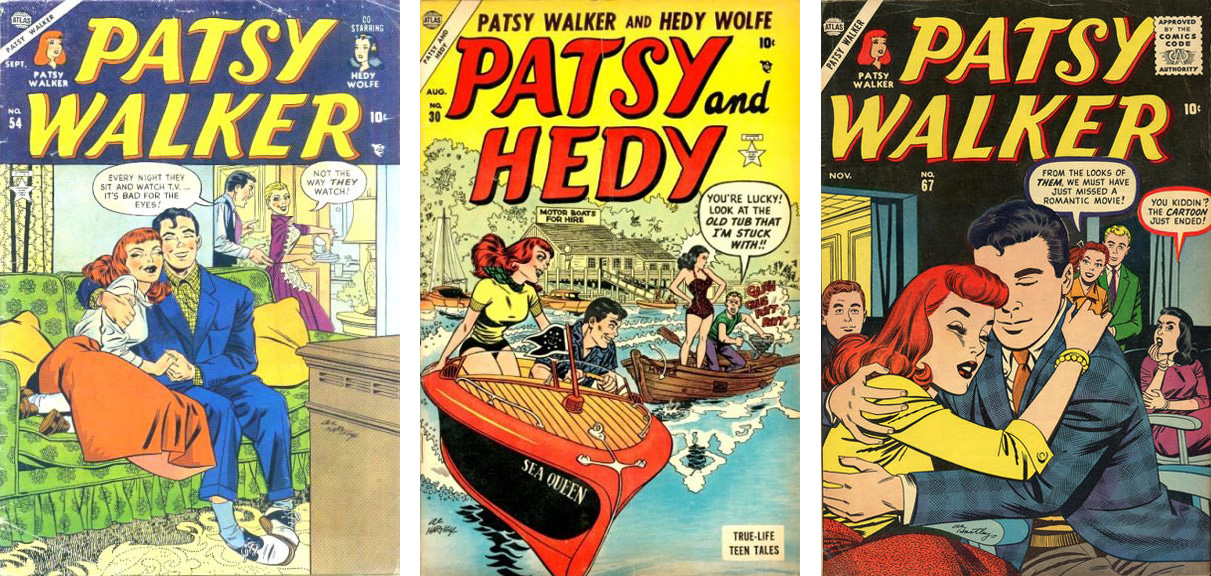
After a couple of covers in 1954, Al Hartley became the main artist of the Patsy Walker titles in 1956, supplying covers and interior art for both Patsy Walker and the companion spin-off Patsy and Hedy.
By 1953, Hartley was working almost exclusively on Atlas' burgeoning line of romance comics, like the long-running Love Romances, Girls' Life and Love at First Sight. Then in 1954, he produced his first work for the title he would be most associated with, Patsy Walker, a cover for the September issue, 54. But it would require another two years of toiling across the Atlas range before Hartley started drawing regularly for the Patsy Walker titles, starting with the November 1956 issue of Patsy Walker 67.

Under Al Hartley, Patsy Walker lasted 58 issues, and Patsy and Hedy running even longer at 61 issues. Hartley also wrote and drew the 1966 Marvel curiosity, Patsy Walker's Fashion Parade, an annual-size collection of one-page items showing Patsy in a range of different outfits.
Patsy Walker lasted until 1965, and its companion title Patsy and Hedy ran until 1967. Once the Patsy Walker books were cancelled, Hartley began working for Archie Comics. Shortly after, he became a committed Christian and founded Spire Comics, specialising in religious themed comics. He also entered into a deal with Archie owner John Goldwater to licence the use of the Archie characters in his Spire comics.

How Hartley ended up drawing the Thor strip in Journey into Mystery 90 is anyone's guess. Even Hartley couldn't remember. "Superheroes weren't really my forte," he told Alter Ego. "I don't recall the circumstances that led me to draw that story. At that stage of the game, I was mostly doing work that I was more comfortable with, mostly teenage and humor stories." 

Al Hartley: 25 October 1921 - 27 May 2003
Al Hartley was by no means a bad artist. Quite the opposite. He may not have preferred drawing superhero tales, but it's plain from his 1950s output for Atlas Comics that he could turn his hand, successfully, to any genre. While we'll never know the true circumstances behind the Hartley-drawn Thor story, it's likely that Stan needed a rush art job while he cast around for a replacement for the departing Jack Kirby. "Trapped by the Carbon Copy Man" has all the characteristics of a filler story, probably plotted, scripted and drawn in days. My best guess is that Stan's selected artist also had a tight deadline and Stan worried he wasn't going to make it, so commissioned this fill-in "just in case". After all, as I noted last time, Stan and the Bullpen weren't making history here, they were just making 12c comics.

In the end, though, the replacement artist Stan settled on was an interesting choice ...

THOR MK 2

Journey into Mystery 91 (Apr 1963) gave us the Thor tale, "Sandu, Master of the Supernatural", plotted by Stan, scripted by Larry and pencilled and inked by Joe Sinnott. In it, Loki increases the power of a sideshow mind-reader, Sandu, so that he can levitate and teleport any object. Advised by Loki, Sandu separates Thor from his hammer and, binding Thor with chains, buries him beneath a building. Thor only escapes when a deus ex machina, in the shape of Odin, sends two Valkyrie bearing Thor's magic Belt of Strength, enabling Thor to escape and defeat Sandu.

At the darkest point in Thor's battle with Loki's lieutenant Sandu, Odin despatches two Valkyrie to deliver Thor's Belt of Strength to help him escape from a seemingly inescapable death-trap.
As with earlier stories, the events here further cement Don Blake's real identity as Thor, son of Odin, as the monarch of Asgard has no qualms about sending Thor the Belt of Strength when his son's defeat seems imminent. Sandu's not the greatest villain, resembling in many ways the Miracle Man of Fantastic Four 3 (Mar 1962), but as the puppet of Loki, he'll do.

As an artist for Thor, Sinnott's not a bad choice from Stan's point of view. He's reliable and has a long association with Stan and Marvel Comics, going right back to the early 1950s. And of course, he'd become Marvel's premiere inker from 1965 on, providing consistency across Marvel's flagship titles as pencillers came and went.

WHO THE HECK IS JOE SINNOT?

Joe Sinnott was born on 16 October 1926 in Saugerties, New York. One of seven children, his father ran a successful cement manufacturing plant. Joe enlisted in the Navy in 1944 and served in Okinawa, driving a munitions truck. He was discharged in 1946 and worked for three years driving a cement truck for his father. In 1949, he enrolled in the Cartoonists and Illustrators School.

One of his instructors was Tom Gill, who asked Sinnott to assist on a range of Dell western comics. "Tom was paying us very well. I was still attending school and worked for Tom at nights and weekends," said Sinnott in a later interview. "We'd do the backgrounds and the figures, but since they were Tom's accounts, he'd do the heads so it looked like his work. I did this for about nine months. It was great learning," he said, adding, "I can never have enough good to say about Tom Gill. He gave me my start." Sometimes pencilling, sometimes inking, Sinnott would work with Gill on the early Atlas titles Kent Blake of the Secret Service and Red Warrior.

One of Joe Sinnott's early Atlas jobs, here inking over the pencils of Tom Gill for the second issue of Red Warrior (Mar 1951).
While still at the Cartoonists and Illustrators School, Sinnott wanted to branch out on his own so he approached Stan Lee separately and was put to work straight away. "I'd go down to the city on Friday," Sinnott told The Jack Kirby Collector, "and Stan would give me a script to take home. I'd start on Monday morning by lettering the balloons in pencil. Then I'd pencil the story from the script and ink it and leave the balloons penciled. I'd pencil a page in the morning, and ink it in the afternoon. I never burned the midnight oil; I'd start work at 7:45 in the morning, and I'd work until about 4:30 in the afternoon. I always figured if you couldn't make a living in eight hours a day, you shouldn't be in the business. I'd bring the story back on Friday and he'd give me another script. I never knew what kind of script I'd be getting. Stan had a big pile on his desk, and he used to write most of the stories himself in those days. You'd walk in, and he'd be banging away at his typewriter. He would finish a script and put it on the pile. Sometimes on his pile would be a western, then below it would be a science fiction, and a war story, and a romance. You never knew what you were getting, because he always took it off the top. And you were expected to do any type of story."

Three of Joe Sinnott's rare covers during Marvel's Atlas years. However, his interior art output was prodigious ... in excess of 1300 pages of pencilled and inked art from 1951 - 1957.
For the next six years, Sinnott would pencil and ink more than 250 stories for Atlas, in every genre - war, western, horror and crime -  contributing interior art to the company's mainstream titles like Marvel Tales, Battle Action, Wild Western, Spy Thrillers ... though very rarely covers. 

When the Great Atlas Implosion of 1957 hit, Sinnott had to find other work. "I was up to $46 a page for pencils and inks," said Sinnott, "and that was a good rate in 1956, when the decline started. I was down to $21 a page when Atlas stopped hiring me ... Stan called me and said, 'Joe, Martin Goodman told me to suspend operations because I have all this artwork in-house and have to use it up before I can hire you again.' It turned out to be six months, in my case. He may have called back some of the other artists later, but that's what happened with me."

Joe Sinnott during his Atlas Comics heyday, in the mid-1950s
During those lean six months, Sinnott took on any commercial art job going - record covers, billboard art, Charlton comic strips and even ghosting for DC Comics artists, before Stan called him back to resume work on the fledgling Marvel Comics. And with the January 1959 Marvel comics, Joe Sinnott was off and running again, pencilling and inking his first cover for Journey into Mystery 50 (Jan 1959).

On his return to Marvel in 1959, Sinnott seemed to pick up where he left off, pencilling and inking a variety of stories for the fledgling Marvel. Then, just as suddenly, he stopped and worked almost exclusively for Charlton, pencilling for Vince Colletta's inks.
Over the next year, Sinnott was back knocking out pencils and inks on four and five page stories for Stan Lee's mystery, western and war comics. Then he stopped working for Marvel and concentrated on his Charlton work for the next two years, till the end of 1961. I couldn't uncover a reason for this.

It would be two years before Sinnott returned to Marvel. His first inking job over Jack Kirby pencils during this period was for the Strange Tales 94 (Mar 1962) story, "I Was a Decoy for Pildorr: The Plunderer from Outer Space", though he had also inked the earlier "I Was Trapped By Titano the Monster That Time Forgot" in Tales to Astonish 10 (Jul 1960).
Then slowly, he began pencilling stories for Stan Lee again, starting with Gunsmoke Western 62 and Tales to Astonish 31 (both May 1962). He had also inked - over Jack Kirby pencils - Fantastic Four 5 (July 1962) and Journey into Mystery 83 and 84 (Aug - Sep 1962). "Before Stan called me to ink Jack on Fantastic Four 5, I never knew the Fantastic Four existed," Sinnott later recalled." I lived up here in the Catskill Mountains, and I never went down to the city at that time. Everything was done by mail and I didn't know what books were coming out, even. Stan called me up and said, 'Joe, I've got a book here by Jack Kirby and I'd like you to ink it, if you could. I can't find anybody to ink it. I was dumbfounded by the great art and the characters. I had a ball inking it. I remember when I mailed it back, Stan called me. He said, 'Joe, we liked it so much, I'm going to send you number 6.' But I had committed myself to another account at Treasure Chest ... and this was a 65-page story I was going to have to do on one of the Popes." This would have been "The Story Of Pope John XXIII, Who Won Our Hearts", in Treasure Chest vol 18, 1 - 9 (Sep 1962 - Jan 1963).

It was just a few months later that Joe Sinnott took on his short run, pencilling and inking the Thor stories in Journey into Mystery 91 - 96. "At the time, the rates at Marvel were terrible," recounted Sinnott, "and I was really rushing my work. Not that I wasn't trying my best at Marvel, but I did the best I could with the limited time we had. My main account artistically was Treasure Chest. Looking back I wish I'd done better work on Thor, but at the time it was just another job, and I certainly didn't think the character was going anyplace. At the time, I was probably penciling and inking one page of Thor a day, doing three or four pages of romance for Vince Colletta, and squeezing in some Archie after supper."

It was those poor rates that would keep Sinnott out of Marvel until the tail end of 1965, when he began inking Kirby in earnest with Fantastic Four 44 (Nov 1965).

AND BACK TO THOR

Journey into Mystery 92 (May 1963) presented an Asgard-heavy story, once again drawn by Joe Sinnott, but Lee had engaged DC writer Robert Bernstein to script the tale under the pen-name of "R. Berns" (though I can't imagine that fooled any of the DC editors).

"The Day Loki Stole Thor's Magic Hammer" is almost entirely an Asgard-bound tale, with guest appearances by Odin, his wife Frigga and Heimdall, guardian of the Rainbow Bridge. Oh, and Loki's the bad guy.
Stan's plot has Loki contrives to escape from his enchanted "uru" chains by attracting Thor's hammer with magical magnetism, reasoning that the hammer - made of the same material - will shatter the bonds. This leaves Thor to battle a succession of mystical menaces, hurled against him by Loki, without his hammer and, in typical DC style, Thor fashions first a hammer of wood, then a hammer of stone, as weapons of defence.

Joe Sinnot turns in a workmanlike job with the art, but Bernstein's script creaks badly at several points and has the inescapable odour of one of those Silver Age Superboy scripts that he'd been writing for Mort Weisinger. So much so that I wonder how much of a plot steer Stan had given him.

It's Stan's old friends the Communists again, this time making themselves all radioactive and hypnotising Thor to toss his hammer away ... it's not actually explained why Thor's hammer doesn't immediately return. There quite a neat scene at the end where Don Blake has to dive to the bottom of the Hudson River to retrieve the hammer, though.
Journey into Mystery 93 (Jun 1963) was a bit of a change of pace. Despite the art team of Jack Kirby and Chic Stone, the story had no Asgard at all and instead concentrated on a scientific menace, The Radioactive Man, a Red Chinese scientist who turns his body into a living atomic pile. Exactly why Kirby was assigned the art on this story in the middle of the Joe Sinnott run has been lost in the mists of time. It's unlikely it was deadline problems, as Sinnott has always been very clear about his methodical working habits. It's unlikely it was a pencilling "lesson" for Sinnott set by Stan, else he'd have had Sinnott ink it - and Stan wouldn't have been using Jack that way this early in Marvel's development.

It's a workmanlike story that seems separate from the Thor adventures on either side of it, as it doesn't in any way advance the development of the Thor concept. And Bernstein's scripting is a little careless. In one scene he has Thor, hypnotised by the Radioactive Man, throw his hammer away. Of course, the enchanted mallet should return under its own power, but it doesn't. Turning back to Don Blake, our hero invents a TV scanner to trace the whereabouts of the hammer, even though Blake is a medical doctor not an electronics expert.

The plot device of having Thor struck on the head to cause his personality shift is just the kind of story Mort Weisinger was commissioning over at DC Comics. I have no idea why Stan thought this would be a better approach for Thor what what Larry Lieber had been doing.
With Journey into Mystery 94 (Jul 1963), Sinnott was back, along with Loki and Asgard. Again scripted by Bernstein, this story had Loki cause Thor to be struck on the head by his own hammer, causing a personality shift that makes Thor evil. The two brothers then team up to cause havoc in Midgard, ultimately confronting the United Nations to demand the surrender of Odin. But second blow on the head restores Thor to normal and Loki is recaptured. It struck me as I was reading this that it scanned like a DC Comics story of the same period, hardly surprising since Bernstein had scripted almost exclusively for DC from 1957 onwards.

In "The Demon Duplicators" Thor battles standard issue mad scientist Prof Zaxton, who creates an evil duplicate of Thor, with two hammers. 
Journey into Mystery 95 (Aug 1963) trod a similar path to the previous issue. While Sinnott's art was workmanlike, the Robert Bernstein script used to time-honoured cliche of the hero's evil duplicate. Prof Zaxton is demonstrating Dr Don Blake's new android before an invited audience, with the aid of Thor. We know Zaxton must be evil because his name starts with a Z. Due to a mistake by Zaxton, the android announces he's malfunctioning and will explode within seconds. Only Thor's quick thinking prevents a catastrophe, as he flings the android high into the sky where it detonates harmlessly.

When Thor transforms back to Dr Blake and returns to his office, he finds Zaxton has arrived ahead of him and is holding Nurse Foster hostage. Zaxton demands that Blake help him modify his duplicating machine so it can replicate living creatures, specifically humans. But when Blake changes to Thor to try to stop Zaxton, the crazy scientist duplicates Thor, and a battle ensues. But because the evil duplicate isn't worthy to possess the power of Thor, the original defeats him relatively easily. The payoff is that Zaxton duplicates himself to confuse Thor, but the original accidentally perishes, leaving the good duplicate to carry on.
In another contrived Robert Bernstein scripted story, we see a magic battle over Washington DC, a cameo appearance by Robert F. Kennedy and the denouement where Thor scares Merlin into surrender by transforming from his Thor identity to Dr Don Blake.
Joe Sinnott's last issue as Thor artist would be Journey into Mystery 96 (Sep 1963), a tale which pits Thor against the magician Merlin. Archeologists have discovered the tomb of Merlin and have shipped the sarcophagus to the U.S. to put on display in a museum. But when they open the coffin, they're surprised to see Merlin looking as though he were asleep rather than dead. In fact he is only asleep and soon revives to begin menacing America, beginning with sending a rocket off course. Thor soon catches up with Merlin in Washington DC and the two engage in a magic duel, until Thor demonstrates his "superior" magic by transforming back to Dr Blake. The terrified Merlin surrenders and goes back to sleep in his coffin.

I told the story of how Stan replaced Larry Leiber as scripter on Journey into Mystery, Strange Tales and Tales to Astonish with Robert Bernstein and Ernie hart, and later admitted to Larry that he'd been wrong, in an earlier post, so I won't rehash it here. But suffice it to say that Stan had become pretty disillusioned with his hired-gun scripters by mid-1963 and with the October and November issues of the anthology titles, took over scripting Iron Man, Ant-Man, Human Torch and Thor himself, and gave each of them a boost in the form of a new gimmick in the process.

So the October issue of Journey into Mystery would see the return of Jack Kirby for one issue, to set up Don Heck as regular penciller, Stan Lee taking full control of the writing and the introduction of a Kirby-drawn back-up feature, "Tales of Asgard", which would feature the adventures of Thor alongside his fellow gods, away from the realm of men. 

But that's a story for next time ...

Next: What the Heck is going on with Thor?