Showing posts with label Thor. Show all posts

Wednesday, 6 November 2024

Thor - The Legend Years: Part 3

FOR MOST OF 1965, Journey into Mystery, Marvel's vehicle for the adventures of Thor, had increasingly come to focus on Thor the Thunder God rather than on Thor the Superhero. Starting with "The Trial of the Gods" in Journey into Mystery 116 (May 1965) we would see a lot more of Odin, Balder and the ever-machinating machinations of Thor's foster-brother and arch enemy Loki, God of Mischief.

Though mostly reprints, the first Marvel Annual to feature Thor gave us an all-new 15-page battle between the Asgardian God of Thunder and Hercules, son of Zeus.

Around the same time, Stan and Jack threw us another curve-ball and, in the first Journey into Mystery Annual (Aug 1965), introduced Hercules and the pantheon of Greek Gods.

There are some odd plotting decisions in this story, which lead me to think this was largely Kirby's work. To begin with, if I had an adopted brother who'd already tried to kill me several times, I doubt I'd be socialising with him, especially unaccompanied by witnesses. And even if this were a good idea, I'd have picked somewhere other than Jotunheim, shown to be home of the diabolical Snake Men in JiM 113.

The story title, "When Titans Clash" is pretty much the whole thing. Out for a pony trek with his evil kid brother, Thor comes across a couple of Storm giants up to no good. Thor casually mentions that they're trying to dig their way back to Olympus home of the Greek Gods, from whence they were banished centuries before. After a bit of argy-bargy, Thor falls down a hole and emerges in Olympus.

The first meeting of Thor and Hercules is straight out of the Sherwood Forest playbook, when Robin and Little John both refuse to give way on a narrow bridge. The ensuing eight pages of carnage all seem a bit pointless ... like a WWF wrestling match.

Pretty much the first person he meets is Hercules, son of Zeus. For no reason that makes any sense, the pair start fighting an escalating battle of godly super-strength, until Zeus shows up and boxes their ears for them. Thor is sent back to Asgard, but decides to keep the existence of Olympus to himself, for fear Loki will attempt to make mischief with the knowledge - though doesn't Loki already know that was the entrance to Olympus because Thor told him so at the start of the story? That's it.

Astonishingly, Zeus finds the Thor-Hercules battle to be "honorable", when he should actually be paddling the pair of them for being arrogant, thick-headed idiots ...

As Marvel Annuals go, this one isn't in the league of those of the previous year. Of the 15-page new story, eight pages are just panel after panel of punching, without a whiff of motivation. And with just a two-page panorama of Asgard as the bonus feature and reprints of some key earlier Thor stories, the thrill factor is a bit lacking.

What is important - and probably accounts for the very high prices being asked for even tatty reading copies of this book - is that it introduces Hercules and Olympus to the Thor canon. And, as you'll see, Stan and Jack would be quick to capitalise on that, and starting to downplay the mortal persona of Don Blake (not even mentioned in the Annual story) and to minimise the use of Earth as a backdrop for the next round of Thor's adventures.

I'm doubtful that a regular Earth steel furnace would be strong enough to repair Thor's broken Mjolnir ... shouldn't he have taken it to Asgard to have it serviced by trolls or something?

After the sidebar of the JiM Annual, the main storyline continued in Journey into Mystery 120 (Sep 1965) without missing a beat. While repairing his hammer damaged in the battle against The Destroyer, Thor enjoys a macho male-bonding moment with some steel workers before heading out into the country side to commune with nature and check that he has all the magic pebbles he confiscated from sneaky Loki.

To show what a mensch Thor is, Stan has him plead with his father to go easy on Loki. After all, he can't help being a douche.

But, unnoticed by the Thunder God, he drops one of the Norn Stones, important because this will come back to bite him later. Meanwhile, Loki is in a bit of a huff, after being demoted by Odin to assistant to Asgardian mage Ularic and is already plotting his revenge.

So, Thor nips back to Earth to check up on his love interest Nurse Jane Foster but finds Don Blake's surgery all closed up and the landlord knocking on the door demanding rent. Where has Jane disappeared to? In a bit of a panic, Thor starts combing the city, even considering enlisting the newly-formed Avengers v2.0 in his quest. I guess Thor can be forgiven for not recognising Hawkeye, Scarlet Witch and Quicksilver as he has been a bit busy since the lineup changed in Avengers 16 (May 1965).

This is what you get for taking your eye off the ball. While you're trying to find your girlfriend (could she have ditched you for someone else, like she did once before?) your brother has teamed up with your worst enemy to mess you up for good.

Even as a kid, I found the whole "romantic" sub-plot of Thor-pining-for-Jane-Foster a bit tiresome. I'm sure Stan was going for Shakespearian tragedy here, but to my ten-year old sensibilities, it just seemed that Thor was being a whiney little wimp. Anyhow, while the Thunder God's acting like a lovesick teenager, Loki is getting his game on and planning the mother of all comebacks for the foe that nearly defeated Thor last time ... ladies and gentlemen, Crusher Creel, The Absorbing Man.

A rare instance in Marvel Comics where the stature of the villain on the cover is literal instead of symbolic. Yes, Crusher Creel really is thirty feet tall in the story.

Journey into Mystery 121 (Oct 1965) is where Stuff Gets Real. Essentially a 13-page slugfest between Thor and Crusher Creel, the Kirby action barely pauses to take a breath. Yet the 13 pages pivot on Creel's ability to absorb the properties of his surroundings: bricks, Thor's uru hammer, Thor himself, concrete and steel of buildings, glass(!), and the iron of a bank vault.

The Absorbing Man is a great villain to pit against Thor (despite the daft name). As an antagonist he was less effective against other heroes, like his later appearance in Avengers 183-184 (May-Jun 1979).

The only three non-battle pages in the entire episode reveal a little of the sly plottings of Loki behind the whole drama and a glimpse of Jane Foster's captivity at the hands of a mysterious hooded figure. As with the recent Journey into Mystery Annual story, the persona of Don Blake isn't mentioned, though he would be back in Journey into Mystery 122, as the mystery of the hooded man is resolved.

Only three of the pages in JiM 121 carry the plot forward, and one of those doesn't do much except remind us that Thor has dropped one of the Norn Stones in the middle of a forest somewhere, where it still lies.

It's an enjoyable episode, though there's little in the way of bones to hang an actual story on. Kirby always excels at this kind of action-oriented tale and it does kind of feel that Stan Lee was already starting to leave Jack a bit to his own devices. I don't really mind that here, but page 12 does feel like it was tossed in for a bit of padding at the last minute.

Great cover, interestingly not inked by the hackmanlike Vince Colletta, but by former EC superstar and Marvel newcomer Wally Wood. Wood was also contributing art to Daredevil around this period and inks on Avengers 22 (Nov 1965).

As the story continues in Journey into Mystery 122 (Nov 1965), we get to see Loki's masterplan unfold. Where in the past - for example in the battle he'd engineered between The Destroyer and Thor - he'd been a little wary of incurring the wrath of Odin, this time he's about to challenge his adoptive father head-on.

Even as Crusher Creel thinks he has Thor beaten, the Thunder God's fighting spirit causes him to redouble his efforts and suddenly the Absorbing Man sees his fortunes take a downward turn. But Loki, monitoring all this from Asgard, snatches his pawn away from the battle just as Creel's defeat looks inevitable, transporting the thug to Asgard itself. This is a pretty risky move by Loki ... if his plan to wrest control of Odin's throne doesn't pan out, he's going to get a lot worse than a spell of indentured servitude to Ularic.

Isn't it lucky that Asgardian sorcerer Ularic has this handy Attractor Beam in his workshop so that Loki can rescue his proxy warrior Crusher Creel from near-defeat by Thor and haul his thuggish carcass to Asgard?

Thor, being nobody's fool, recognises that Creel's vanishment can only mean that Loki has transported his henchperson to Asgard. But before he can set out in pursuit, a disturbance from above attracts his attention. In the mother of all coincidences, it's the captured Jane Foster. Thor smashes his way into the apartment then, despite not knowing just who Jan's captor is, transforms into his mortal identity of Don Blake. Astonishingly, the abductor simply takes a picture of Don Blake, then reveals his identity as reporter Harris Hobbs, whom Thor had befriended in an earlier battle against Crusher Creel.

Now, I have more than a few problems with this plot twist.

  1. Why would Hobbs ever think Thor had a mortal identity?
  2. Even if he did suspect such a thing, why would he - from past experience a decent and honest journalist - put his friend Thor on the spot by threatening to expose his dual identity? Especially when Thor saved his life (JiM114)


  3. Why would Hobbs terrorise an innocent young woman just to get a story - especially when kidnapping and false imprisonment is a pretty serious crime, regardless of the intention.

It's the worst kind of plot-driven storytelling, so I strongly suspect we can lay this one at Jack Kirby's door, though I couldn't say why Editor Stan didn't get this "reveal" redrawn into something more plausible. Deadline problems?

Faced with either saving Asgard from Loki and Creel or saving Jane Foster, Thor goes with Jane ... I think Stan and Jack missed a trick here by not making it more of an agonising decision.

Even as Loki and his attack dog Creel are invading Asgard, Thor is still on Earth, playing patty fingers with Jane Foster. He doesn't seem in much of a hurry to tear himself away to deal with Loki's threat to Asgard, but drops everything when he gets a call from reporter Hobbs. By the time Thor agrees to return to Asgard - taking Hobbs along for the story of the century - Loki and Creel have already reached Odin's throne room ... and things aren't looking too great for the monarch of the gods.

Even more surprising, Don Blake hangs around on Earth to minister to Jane, as Asgard is being systematically demolished by Creel and his wrecking ball.

Yet, as bad as things may seem right now, they're about to get even worse when, in the next issue, we get to learn the fate of the missing Norn Stone.

As mentioned in my May 2021 blog entry, this cover shows signs of art department tampering. The original drawing by Jack Kirby had no floating heads. The added vignettes were lifted from interior art panels from this and the previous issue.

Journey into Mystery 123 (Dec 1965) ties up the "Absorbing Man in Asgard" storyline and introduces a new menace ... the Norn Stone powered Demon. Interestingly, until now, I'd forgotten that Kirby had drawn this earlier version of The Demon seven years before his DC Comics character of the same name.

This whole sequence - with Thor surprised by Loki and Creel's attack on Asgard - indicates that Stan hadn't re-read JiM 122 before embarking on the script for this issue.

When Thor arrives in Asgard with his unwelcome companion reporter Harris Hobbs, he seems a little surprised that Crusher Creel is already there. Yet, in the previous issue, Thor recognised the beam that transported the Absorbing Man away from almost certain defeat to be the Attractor Beam of Asgardian court magician Ularic. Judging from Stan's recap of the story so far on the first page of JiM 123, I'd say that Editor Stan just forgot that Thor did in fact suspect that Loki has transported Creel to Asgard.

In setting up the next menace to threaten Thor, some ramshackle plotting is manfully papered over by Stan, asking us to accept that the dropped Norn Stone (see issue 120) is flitting about the planet under its own power.

But just as The Absorbing Man begins his attack on Odin himself, we cut away to the jungles of Mongolia, where the Norn Stone has mysteriously dropped within the grasp of an un-named village shaman. Thor had examined the Stones shortly after leaving Pittsburg (JiM 120), inadvertently dropping a stone in some woodland just outside the city. Stan deftly scripts over this creaking plot-hole by telling us that the Norn Stone cannot remain in one place for very long and randomly transports itself to new locations.

The stone charges the shaman with Asgardian power and he sets about beating the tar out of his communist oppressors, then returns to his panic-stricken village congregation.

Loki and Crusher Creel are so busy bickering over who will wield Odin's sceptre of power that they fail to recognise its status is merely ceremonial. And for all his scheming, Hobbs discovers that fate has a way of punishing the deserving.

Back in Asgard, Loki and his attack dog appear to be on a roll. Every force Odin hurls at them, Crusher Creel simply hurls back. Though Thor pleads with his father to be allowed to deal with the evil pair, Odin seems unruffled and calmly hands over his sceptre of power when Loki demands it. Of course, simply holding the Supreme Sceptre isn't enough to rule Asgard, as Loki finds out when Odin propels him - and his thuggish ally - into the endless depths of space.

But this doesn't mean that Thor's troubles are over. There's still the Demon to deal with ... and Stan and Jack will bring back Hercules to further complicate things.

Hercules must have been a hit with readers in Journey into Mystery Annual 1 (1965), as Stan and Jack waste no time in bringing him back, making him the main focus of the cover and adding Thor's battle with the Demon almost as an afterthought.

The first Journey into Mystery of the new year is 124 (Jan 1966) and starts with a few pages of Thor on Earth and some unnecessary comedy shtick - a policeman orders Thor now to swing his hammer on a crowded street as he doesn't have a permit. But there's a telling scene in which a little girl tells Thor her daddy is fighting in Viet Nam and Thor delivers a speech about "brave patriots" like her daddy "holding aloft the torch of liberty".

This sequence of Thor interacting with the public still has glimmers of Marvel's strong anti-communist position that ran through their comics from the mid 1950s to the mid-1960s.

I think Stan and Jack can be forgiven for this 1965 viewpoint. Both had served in the US Army during World War II, when the enemy was far more clearly identifiable. But Viet Nam was a murkier situation and with no direct threat to the United States, public opinion was turning against America's involvement in South-East Asia. Just a few short years later Stan, along with the rest of the country, was taking a less hawkish stance regarding the Viet Nam war. In an unaired 1968 television talk show, Stan declared, “I would never defend the war in Viet Nam. I think it’s an utterly indefensible war. I think it’s a ridiculous war.”

But on with the story ...

Thor's next stop is to check up on the wellbeing of Jane Foster who - mysteriously - does not seem to be responding to medical treatment. The problem appears to be to strange and frequent disappearances of Don Blake ... so Thor does the only sensible thing. He reveals his double identity to Jane. And as you might imagine, Odin is not best pleased at this development. Now, I think that's a pretty big plot development and I'm kind of surprised that Stan didn't trumpet it on the cover. But for whatever reason, the return of Hercules seemed more important.

Thor's decision to reveal his secret to Jane Foster does seem a little abrupt and unheralded. I would have thought Stan and Jack might have strung it out a little more to milk the drama, perhaps making it the cliff-hanger of the issue ...

While all this is going on, The Demon is gathering an army in Asia and increasing his grip in the region. So despite his promise to not leave Jane Foster again, Thor decides duty comes first and sets off to stop the unstoppable Demon ... and at the same time Zeus despatches Hercules to look into these strange, unprecedented occurrences on Earth.

I'm still not sure why it's such a big issue for Odin that Thor reveals his mortal identity. As with Superman, it's the civilian person that's the false construct, so what's the harm? Regardless, there will be consequences.

The scene is set for a monumental three-handed confrontation ... but surprisingly, that's not what happens.

It's a strangely cryptic cover ... no mention of the villain of the piece The Demon, and just the barest hint of Hercules' presence is depicted, even though he'd been the main part of the previous issue's cover.

In Journey into Mystery 125 (Feb 1966) - the last of the title before it officially changed to The Mighty Thor - Hercules is finally given something to do. But it's not related to the ongoing villain of the last couple of issues, The Demon. In fact, Thor's dispatch of the holder of the Norn Stone is a little underwhelming, in that it happens so quickly and easily ...

It's a bit like Bugs Bunny in a Warner Bros cartoon. Thor plugs the end of the bad guy's cannon which backfires, leaving The Demon with a sooty face.

The Demon's power is no match for Thor's, so the former village shaman tries to use heavy artillery instead. Thor jams the muzzle of the cannon, which explodes, taking out The Demon and a few of his henchmen. The Norn Stone is recovered and that's the end of that plot-thread.

For daring to reveal his true self to Don Blake's nurse Jane Foster, Thor is sentenced to undergo the Ritual of Steel, which he may or may not survive. Boy, that Odin's strict.

However, back in Asgard, Thor must now face the anger of Odin for revealing his true identity to the love of his life Jane Foster. Thor is forced to fight the elite of Asgard's warriors ... but rather than battle to the inevitable outcome, Thor chooses to flee to Earth, where more drama awaits.

If you just substituted Superman for Thor and Lois Lane for Jane Foster, this scene would play like a Weisinger-era DC comic.

While Thor is trying to avoid the rather over-the-top punishment meted out by Odin, Hercules has arrived in New York and has wasted no time in attracting the attention of Jane Foster ... there follows some clunky plotting, driven by jealousy and misunderstanding, leading to another battle between the two evenly-matched heroes ... though we'd be made to wait till the following issue to see any actual scrapping between Thor and Herc.

As you can see, my copy is a little tanned around the edges. Removing the "Journey into Mystery" part of the logo does have the added benefit of giving us a bit more space for Kirby's art.

With issue 126 (Apr 1966), Journey into Mystery became The Mighty Thor, or just Thor for short. But the story carried on as if nothing had happened.

Once again, most of the issue is taken up with endless pages of typical Kirby action. It's great stuff, but I kind of wonder why Kirby was squabbling over plotting credits when there isn't a great deal of plotting going on.

Essentially, the two gods bash the living heck out of each other for ten of the sixteen pages of this episode. And while that's happening, Odin is stroking his beard, wondering how he can punish his wayward son for wanting to date a girl he doesn't approve of. 

While Odin is removing half of Thor's power, Hercules drops an apartment building on the Thunder God ... which does seem like the definition of excessive force.

In the end, he decides to remove half of Thor's power ... but unable to do it himself, he relinquishes his "Odin power" to a dodgy-looking advisor called Seidring (and you just know that's not going to end well).

With half his strength gone, Thor is no match for the son of Zeus, who wins by a knock-out in the final round. Then, in a surprising turnaround, Odin admits to Jane that he may have over-reacted, and sends her after Thor.

Seidring obliges and half Thor's strength is removed ... whereupon Hercules pounds him into the dust. Yet Odin surprises us by showing a little sympathy, and tells Jane that Thor needs her support right now.

That's a pretty powerful cover - one of the best of the era. It certainly made me pick up that issue in 1966 when it hit the spinner racks.

The second issue of The Mighty Thor, 127 (May 1966), polishes off the Seidring story arc and foreshadows the next adventure by introducing us to Pluto, Greek God of the Underworld. I'll save my recounting to the Pluto saga for another time and stick with Seidring for the moment.

We start off with Thor feeling a bit sorry for himself, after his defeat at the hands of Hercules. He even rails against Jane, saying that in defeat he now feels unworthy of her love. Nothing Jane says can convince Thor that he has no reason to be ashamed, but Thor won't take a telling and hurtles off into the sky.

The story starts off with Thor being a bit churlish about having his head handed to him by Hercules - not through cowardice or stupidity, but because his father removed half his strength.

Meanwhile, in Asgard, Odin is also feeling a bit ashamed - as well he might. So much so that he seems to forget that he's given over his godly power to sneaky advisor Seidring, who grabs the opportunity to defy Odin with both hands.

A few mystic bolts later, Odin is on the floor with his former advisor gloating over him. Not even Balder and the other Asgardian warriors are much help. However, Thor has chosen the right time to return to Asgard.

So, of course Seidring - who we'd never seen before this story arc - turns on his king and uses Odin's own power against him. Yet even as that is happening Thor is rushing to his father's aid, the recent punishment all but forgotten.

Though Thor possesses just half his normal power, he not only faces off against Seidring, but through sheer willpower and indomitable spirit, claws his way to the legendary Odin-Sword and threatens to draw it - thereby precipitating Ragnarok - unless Seidring relinquishes the Odin-Power.

Realising that Thor is not bluffing, Odin's senior counsellor doesn't have the stomach to call Thor's bluff, and Odin's power is restored to him ... but at great cost. Thor collapses over the Odin Sword, his strength spent.

Heedless for his own safety, and ignoring the fact that he possesses only half his strength, Thor hurls himself at Odin's attacker, using cunning and willpower to force Seidring to surrender the Odin-Power.

The final scene has Odin gather up his son, remorseful over judging him so harshly.

From here on in, the Thor title would move the God of Thunder away from Earth-bound adventures and focus on other worlds and realities. After this Asgard-set story, the next arc would take place in Olympus and related realms (Thor 128-131). Then Stan and Jack would turn their attention to other galaxies and have Thor thwart an invasion of Earth by Coloniser Tana Nile and her felow Rigellians (Thor 132-133).

But this can wait till another time ...

Next: The Shadow of the Bat


Wednesday, 31 January 2018

What the Heck's going on with Thor?

THE EARLY YEARS OF THOR, like the earliest Hulk stories, were a succession of false starts and reinventions. After the first run of Kirby issues, Stan tried to bring in more mythic elements with the help of his brother Larry Lieber on scripting and veteran Atlas penciller Joe Sinnott on art chores. But he wasn't happy with the way Journey into Mystery - and for that matter Strange Tales, Astonish and Suspense - were going and took the drastic step of taking over the writing of these titles himself, and then giving each a meaningful facelift. That this all happened in the same month means it wasn't a coincidence, but a plan.

The July 1963 on-sale issues of the four anthology titles were the last written by Stan's hired gun scripters. Starting with the following month's issues, Stan transformed almost the entire Marvel line...

This was what Marvel's assault on the newsstands looked like during the summer vacation period of 1963. Four major revamps, more Spider-Man, the all-new Fantastic Four Annual, The Avengers, The X-men ... and limping along in the rear, Daredevil, courtesy of the tardy Bill Everett. It was like Stan had declared war on DC.
Strange Tales 114 (cover-dated Nov 1963) offered a trial appearance of Captain America in the Human Torch strip, and Dr Strange as a permanent back-up feature. Tales of Suspense 47 & 48 (Nov/Dec 1963) showcased Steve Ditko art and a new costume for Iron Man. In Tales to Astonish 49 (Nov 1963), Ant-Man became Giant-Man (or Giant Man, it varies).

And it wasn't just the anthology titles. Amazing Spider-Man became a monthly with issue 4 (Sep 1963). Strange Tales Annual 2 (Sep 1963) was published, alongside Fantastic Four Annual 1 (Sep 1963). Also on the stands that month, Avengers 1 and X-Men 1. And I'll also venture that Daredevil would have been part of the same flurry of launches if Bill Everett hadn't taken so long to draw issue 1.

Some of these transformations I've already looked at in-depth, some I've still to cover, but this time we're here to look at the third and ultimately unsuccessful version of Thor in Journey into Mystery, before Jack Kirby became a fixture on the title.

JACK'S BACK ... FOR A MOMENT

As with the above-mentioned anthology titles, Journey into Mystery received its Stan Lee makeover with the Oct 1963 cover-dated issue 97 (on sale in August). Lee brought back Jack Kirby for the main strip and instituted a back-up, Tales of Asgard, which he had Kirby draw and which he himself also scripted.

The main thrust of the plot in Journey into Mystery 97 seems to be the failed romantic designs Don Blake/Thor has on his nurse, Jane Foster. I was never a fan of this storyline, as I found Jane a bit whiney, and couldn't figure out what on midgard Thor ever saw in her.
Though the credits on Journey into Mystery's Thor strip give Jack Kirby as the penciller and Don Heck as the inker, the pencils provided by Kirby could have been no more than layouts, presumably to get Heck - on temporary secondment from Iron Man - up to speed with how Stan wanted Thor to be depicted. All of the faces here are very much in Heck's style, though the figures are very obviously strongly influenced by Kirby.

Stan also shifts the focus of the story, placing more emphasis on the love life of Don Blake, which had been merely background noise during the first year of the strip's run. To my mind this is a typical Lee trademark, spotlighting the romantic heartache of his heroes. He was doing the same schtick with Spider-Man (the Peter Parker-Betty Brant-Liz Allen triangle) and Iron Man (the Tony Stark-Pepper Potts-Happy Hogan triangle), and would later apply the formula to Daredevil.

In this Thor story, Blake begs leave of Odin to romance Jane Foster. Odin refuses and Foster - the flibbertigibbet - loses interest and wanders off with another handsome doctor she's found, Basil or Bruce (take your pick) Andrews.

Almost incidental to all this is Thor's battle with the Lava Man, a villain that's a step up from Thor's usual calibre of foe. If you look at the way Stan would handle the other B-characters during this period, it's as though he made a conscious effort to improve the villains faced by his heroes. In the few months that followed, Iron Man got The Mandarin and The Black Widow, Giant-Man got The Human Top and The Black Knight and the Human Torch got ... well, okay, maybe not so much The Human Torch. But The Lava Man did well enough to come back, menacing Thor and his Avengers buddies in Avengers 5 (May 1964).

The Human Cobra (and his partner Mr Hyde, whom we'll meet in the very next issue) was one of the key villains of the early Thor stories, every bit as slippery and creepy as his namesake.
Journey into Mystery 98 (Nov 1963) provided Thor with an even better super-villain, The Human Cobra, another in Stan's long line of animal villains. And, not wanting to stray too far from plausibility, Lee had his baddy Klaus Vorhees gain his power by ... being bitten by a radioactive cobra. And when The Cobra menaces Jane Foster and her new boss Basil-or-Bruce, the suave medico shows his true colours by refusing to resist the villain's demands. Jane - perhaps a little unrealistically - takes issue with this and deserts Basil/Bruce and returns to Don Blake, right after Thor rescues her and lets the Cobra escape ...

We never hear from Basil/Bruce again, but the Cobra would return before too long, partnered by the villain of the very next Thor tale ... Mr Hyde.

The cover of Journey into Mystery 99 is quite a bit misleading ... there's no scene with Don Blake worrying about an unforeseen menace he'll be unable to fight.
The last Journey into Mystery with a 1963 cover date was issue 99 (Dec 1963), and featured another "new" villain. Inspired by the Robert Louis Stevenson story, disgruntled medical worker Calvin Zabo is turned down for a job by Don Blake. Seeking revenge, Zabo fiddles about in a laboratory and comes up with a serum that replicates the work of Dr Jekyll and turns him into the inhumanly powerful Mr Hyde. Zabo is delighted with his new persona, and gloats that he'll be able to commit crime as Hyde, then transform back into Zabo to escape justice - though I don't believe we ever see him as Zabo again.

In between bouts with Hyde, Thor is also petitioning Odin to allow him to marry Jane Foster, though the ruler of Asgard seems less than convinced. This plot thread would continue for a few years before eventually being resolved on Jack Kirby's watch.

Personally, I kind of agreed with Odin. I didn't think Jane Foster was worthy of Thor, either. She seemed too much of a damsel in distress, quite lacking in the kind of mental strength you'd expect from a prospective goddess.

In the event, Mr Hyde pulls the old stunt of impersonating the hero and committing bank robberies, so Thor will be blamed. Quite why he needs to do this, I do not know, as he's already established that he can just switch from Hyde to Zabo and no one would be able to find him.

The tales closes with Mr Hyde in, erm, hiding and a promise from Stan that Thor will again pick up the chase the following month.


Usually reliable Don Heck appeared to be phoning in his artwork for this short run of issues. What is going on with that Thor figure in panel 4 of page 7?
Journey into Mystery 100 (Jan 1964) was a relatively low-key milestone issue, as it wraps up the Mr Hyde story with no great fanfare. As the tale opens, the citizens and police of New York are still convinced Thor's a bank robber. The thinking behind this is pretty shakey. It doesn't seem especially logical that the God of Thunder would feel compelled to turn to petty crime. After all, what does a god need with bundles of U.S. currency? 

Thor figures out pretty quickly that it was Hyde behind the robberies and retreats to his Don Blake identity while he figures out what to do. Recklessly, he goes out to dinner with Jane Foster, as though he's forgotten that it's Blake Mr Hyde has the problem with, rather than Thor. It's no surprise, then, that Hyde kidnaps Blake and his nurse and holds them captive in his ruined castle, just outside New York.

Hyde's masterplan is to steal a nuclear submarine and sail the seven seas with Jane as his reluctant companion. But Don Blake escapes his bonds, transforms to Thor and is soon giving Mr Hyde a hammering.

Worried that Hyde will somehow make good his threat to kill Blake if anything were to happen to him, Jane tries to delay Thor's defeat of Hyde by, erm, hiding his hammer. Odin sees this well-meant treachery and this is to colour his opinion of the girl for the foreseeable future. Hyde escapes so Thor hurriedly leaves to "rescue" Don Blake.

This short run of Don Heck artwork on Thor was marginally better than Joe Sinnott's efforts, but far from Heck's best work. The stories looked like they were drawn to short deadlines, with Heck only putting in as much background art as he thought he needed to. And Stan's scripts seem rushed, as well, with some story stumbles that normally wouldn't have gotten past Stan the Editor.

Thor is furious that his father won't recognise his love for Jane Foster and storms about the city, wrecking municipal property and other people's trucks, so the Avengers try, unsuccessfully, to talk him down. Watching this, Odin decides to punish his son by taking away half his strength.
So it didn't come as a great surprise that Stan brought Jack Kirby back with Journey into Mystery 100 (Feb 1964) as permanent artist on both the five-page Tales of Asgard back-up and the main Thor strip. Yet, the two-part story would read quite a bit like the last story that Stan had prepared for Don Heck, with Jack Kirby drafted in to draw it, rather than looking like a proper Lee-Kirby production. While quite a bit of plot happens in Asgard - four pages of JiM101's running time is taken up with Asgardian manouevrings - and The Avengers stage an intervention when Thor's bad mood puts the city at risk, the main part of the story concerns the return of Zarrko the Tomorrow Man, who'd first menaced Thor way back in Journey into Mystery 86 (Nov 1962).

This time, the future foe's memory is restored, remotely, by Loki and the Tomorrow Man travels to the 20th Century with a giant robot and embarks on a rampage of destruction to bring Thor out. But without his full strength, Thor is no match for the robot and has to agree to obey Zarrko to save the city from inevitable automaton destruction.

Zarrko transports Thor back to the future to help him subdue the 23rd Century. My question is, if Zarrko has control of giant robot that can lay waste to a city, what does he need Thor for? But that's not important right now ... and we leave Thor, on his way to the far-flung future, with Loki gloating that Odin will never forgive the Thunder God for aiding the future criminal.

Kirby's art for this issue is a marked improvement over Don Heck's efforts, though the inking is by one of my least favourite of Kirby's Silver age embellishers, George Roussos. But Kirby's art would step up to another level with the following issue ...

Even though this feels like the tail end of the Don Heck era of Thor, Jack Kirby is here inked by the mighty Chic Stone, who would go on to produce some of the best embellishment of Kirby's art throughout 1964.
The following month Journey into Mystery 102 (Mar 1964) concludes Thor's struggle against the Tomorrow Man with only half his strength to call upon. First there's a two-page recap of the story so far ... which seems a tad excessive. Then it's on with the story. Thor, sworn to aid Zarrko conquer the 23rd Century, tries to limit his destructiveness as much as possible. Battling one future machine after another, Thor finally prevails and travels with Zarrko to the secret location of the all-controlling robot, the point at which he's technically free from his promise and can again battle Zarrko directly. Thor contrives to re-enable the controlling robot's defences and Zarrko is trapped in an energy field and turned over to the authorities.

In my opinion, despite the presence of Chic Stone as Kirby's newest (and best) inker during this period, this is still really the end of the Don Heck era. The Lee-Kirby period of Thor wouldn't start until the next issue of Journey into Mystery.

But that's a story for another time ...

The real Kirby-era of Thor would begin with Journey into Mystery 103, when Jack got his feet under the table and began to influence where the character would be going over the next five years.

Next: Comic Books on the Big Screen


Sunday, 31 December 2017

Thor: The Wilderness Years

THE EARLIEST THOR STORIES have always been associated with the grand art of Jack Kirby. But it wasn't actually that way. While the first seven issues of Journey into Mystery that featured the Thunder God were drawn by Kirby, these tales had none of the epic sweep the Silver Age version of the character is remembered for. Thor would battle Commies and gangsters and we'd rarely see more than tantalising glimpses of Odin and the fabled realm of Asgard. Then, all too soon, Kirby was off the title, re-assigned by Editor Stan Lee to other more pressing projects, like the epic first Fantastic Four Annual (Oct 1963), as well as new titles X-Men and The Avengers. 

Working over a plot by Stan Lee and a script by Larry Lieber, Al Hartley turned in his only superhero story of the Silver Age, "Trapped by the Carbon Copy Man". The result was less than legendary.
Another artist had to be found for Journey into Mystery 90 (Mar 1963, on sale January) ... and for that task, Stan selected Al Hartley.

The tale begins with Dr Don Blake resolving to tell his nurse, Jane Foster, that he is really The Mighty Thor and that he loves her. This would be an ongoing sub-plot for the first few years of the Thor strip. Stan seemed to want a romantic undercurrent - usually an unsuccessful one - in every title he wrote. As a ten-year old I found this a little tiresome. The Reed and Sue relationship I didn't mind, as they were a couple from the get-go. Even Hank and Jan were all right, because they too quickly became an item. But could I have been the only one who thought it was a bit creepy that Professor X was secretly mooning over Jean Grey in those early X-Men issues?

Al Hartley's art in Journey into Mystery 90 is a real anomaly, and has all the hallmarks of a rush job. The main figures seem crude and cartoony and the backgrounds are sparse and often absent altogether.
Just as Blake is about to reveal his true identity, Thor's father Odin intervenes and forbids him to say any more. But when Blake goes out to walk it off, he finds all kinds of strange behaviour. Cars driving on the sidewalks, polkadot bridges and advertising posters pasted over apartment windows.

The explanation for the madness is that aliens with designs on conquering Earth have substituted duplicates for important decision-makers (and Jane Foster) in an effort to make the Earthlings confused and frightened and so easier to conquer. Yes, I thought was was a bit lame, too. So Blake offers to betray Thor to the aliens - much to the captured Jane Foster's horror - then turns the tables by giving the aliens a darn good thrashing.

It's probably the least of the early Thor stories, not helped by an especially hokey script and the inappropriate artwork of Al Hartley

WHO THE HECK IS AL HARTLEY?

Henry Allan Hartley, born 25 October 1921 in New Jersey, was the son of Congressman Frederick Allan Hartley. His father, said Hartley in a later interview, "encouraged me. He knew I wanted to draw from the time I could hold a crayon ... My father wanted me to pursue my own dreams and never attempted to steer me in any other direction."

Hartley drew for his local newspaper while still in high school, and sold a Western comic-book story to the pulp publisher Street & Smith. When the Second World War broke out, Hartley enlisted in the Army Air Corps and flew 20 missions as a B-17 bomber pilot over Europe.

On leaving the Service in 1945, Hartley began looking for work as a cartoonist, and quickly landed work with Stardard Comics, drawing his first regular assignment, "Rodger Dodger" in Exciting Comics 51-67 (Sep 1946 - May 1949), gag strips like "Zippy" and "Henry" in Fighting Yank, and a range of short humour strips for America's Best Comics. Hartley also produced art for Ace Comics and ACG.

Al Hartley went quickly from one and two-page fillers for Standard Comics, to six-page stories for Ace Comics and ACG, before landing at Timely Comics, where he produced work in many genres for Stan Lee.
It wasn't long before he found work at Timely Comics, as Hartley related to Alter Ego magazine: "I'd developed enough of a reputation that it wasn't difficult to get a job at Timely in 1949. Stan Lee knew my work and hired me. When I started working with Stan, he wrote most of my stories, although I later wrote all of my own stories. We did all kinds of genres: war, Westerns, detective, science-fiction - you name it. We’d take a theme, and I’d illustrate the story. There were no typed scripts, just a very loose plot line. It was my job to draw the story with as much excitement, surprise, and suspense as I could. Then, Stan would write the dialogue. It's hard to put a time frame on it, but I'd guess we started working that way in the mid-1950s."

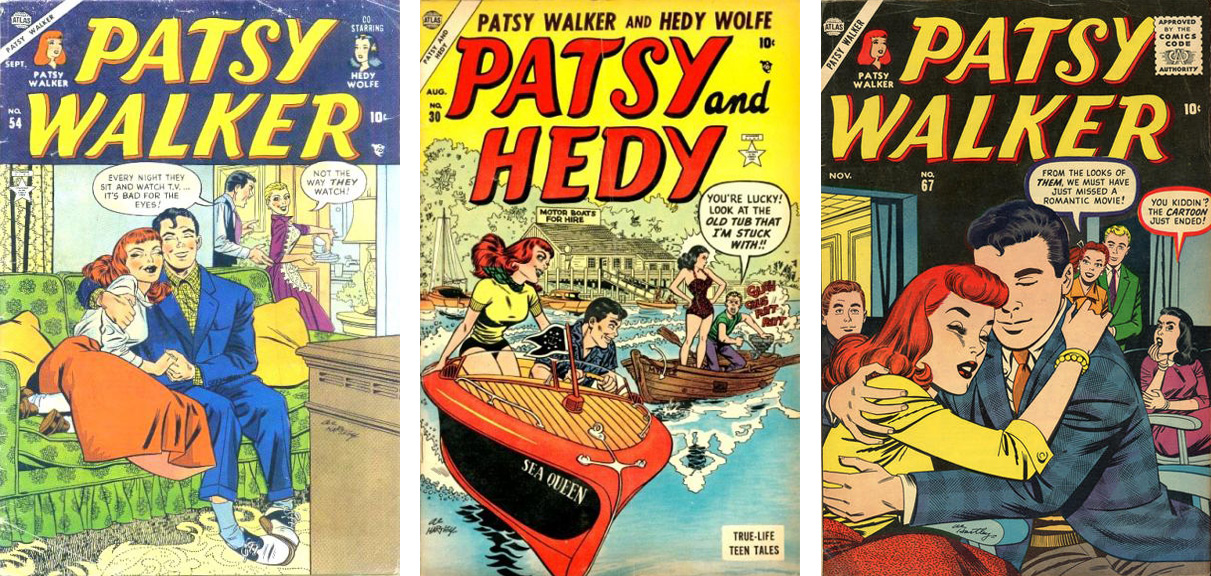
After a couple of covers in 1954, Al Hartley became the main artist of the Patsy Walker titles in 1956, supplying covers and interior art for both Patsy Walker and the companion spin-off Patsy and Hedy.
By 1953, Hartley was working almost exclusively on Atlas' burgeoning line of romance comics, like the long-running Love Romances, Girls' Life and Love at First Sight. Then in 1954, he produced his first work for the title he would be most associated with, Patsy Walker, a cover for the September issue, 54. But it would require another two years of toiling across the Atlas range before Hartley started drawing regularly for the Patsy Walker titles, starting with the November 1956 issue of Patsy Walker 67.

Under Al Hartley, Patsy Walker lasted 58 issues, and Patsy and Hedy running even longer at 61 issues. Hartley also wrote and drew the 1966 Marvel curiosity, Patsy Walker's Fashion Parade, an annual-size collection of one-page items showing Patsy in a range of different outfits.
Patsy Walker lasted until 1965, and its companion title Patsy and Hedy ran until 1967. Once the Patsy Walker books were cancelled, Hartley began working for Archie Comics. Shortly after, he became a committed Christian and founded Spire Comics, specialising in religious themed comics. He also entered into a deal with Archie owner John Goldwater to licence the use of the Archie characters in his Spire comics.

How Hartley ended up drawing the Thor strip in Journey into Mystery 90 is anyone's guess. Even Hartley couldn't remember. "Superheroes weren't really my forte," he told Alter Ego. "I don't recall the circumstances that led me to draw that story. At that stage of the game, I was mostly doing work that I was more comfortable with, mostly teenage and humor stories." 

Al Hartley: 25 October 1921 - 27 May 2003
Al Hartley was by no means a bad artist. Quite the opposite. He may not have preferred drawing superhero tales, but it's plain from his 1950s output for Atlas Comics that he could turn his hand, successfully, to any genre. While we'll never know the true circumstances behind the Hartley-drawn Thor story, it's likely that Stan needed a rush art job while he cast around for a replacement for the departing Jack Kirby. "Trapped by the Carbon Copy Man" has all the characteristics of a filler story, probably plotted, scripted and drawn in days. My best guess is that Stan's selected artist also had a tight deadline and Stan worried he wasn't going to make it, so commissioned this fill-in "just in case". After all, as I noted last time, Stan and the Bullpen weren't making history here, they were just making 12c comics.

In the end, though, the replacement artist Stan settled on was an interesting choice ...

THOR MK 2

Journey into Mystery 91 (Apr 1963) gave us the Thor tale, "Sandu, Master of the Supernatural", plotted by Stan, scripted by Larry and pencilled and inked by Joe Sinnott. In it, Loki increases the power of a sideshow mind-reader, Sandu, so that he can levitate and teleport any object. Advised by Loki, Sandu separates Thor from his hammer and, binding Thor with chains, buries him beneath a building. Thor only escapes when a deus ex machina, in the shape of Odin, sends two Valkyrie bearing Thor's magic Belt of Strength, enabling Thor to escape and defeat Sandu.

At the darkest point in Thor's battle with Loki's lieutenant Sandu, Odin despatches two Valkyrie to deliver Thor's Belt of Strength to help him escape from a seemingly inescapable death-trap.
As with earlier stories, the events here further cement Don Blake's real identity as Thor, son of Odin, as the monarch of Asgard has no qualms about sending Thor the Belt of Strength when his son's defeat seems imminent. Sandu's not the greatest villain, resembling in many ways the Miracle Man of Fantastic Four 3 (Mar 1962), but as the puppet of Loki, he'll do.

As an artist for Thor, Sinnott's not a bad choice from Stan's point of view. He's reliable and has a long association with Stan and Marvel Comics, going right back to the early 1950s. And of course, he'd become Marvel's premiere inker from 1965 on, providing consistency across Marvel's flagship titles as pencillers came and went.

WHO THE HECK IS JOE SINNOT?

Joe Sinnott was born on 16 October 1926 in Saugerties, New York. One of seven children, his father ran a successful cement manufacturing plant. Joe enlisted in the Navy in 1944 and served in Okinawa, driving a munitions truck. He was discharged in 1946 and worked for three years driving a cement truck for his father. In 1949, he enrolled in the Cartoonists and Illustrators School.

One of his instructors was Tom Gill, who asked Sinnott to assist on a range of Dell western comics. "Tom was paying us very well. I was still attending school and worked for Tom at nights and weekends," said Sinnott in a later interview. "We'd do the backgrounds and the figures, but since they were Tom's accounts, he'd do the heads so it looked like his work. I did this for about nine months. It was great learning," he said, adding, "I can never have enough good to say about Tom Gill. He gave me my start." Sometimes pencilling, sometimes inking, Sinnott would work with Gill on the early Atlas titles Kent Blake of the Secret Service and Red Warrior.

One of Joe Sinnott's early Atlas jobs, here inking over the pencils of Tom Gill for the second issue of Red Warrior (Mar 1951).
While still at the Cartoonists and Illustrators School, Sinnott wanted to branch out on his own so he approached Stan Lee separately and was put to work straight away. "I'd go down to the city on Friday," Sinnott told The Jack Kirby Collector, "and Stan would give me a script to take home. I'd start on Monday morning by lettering the balloons in pencil. Then I'd pencil the story from the script and ink it and leave the balloons penciled. I'd pencil a page in the morning, and ink it in the afternoon. I never burned the midnight oil; I'd start work at 7:45 in the morning, and I'd work until about 4:30 in the afternoon. I always figured if you couldn't make a living in eight hours a day, you shouldn't be in the business. I'd bring the story back on Friday and he'd give me another script. I never knew what kind of script I'd be getting. Stan had a big pile on his desk, and he used to write most of the stories himself in those days. You'd walk in, and he'd be banging away at his typewriter. He would finish a script and put it on the pile. Sometimes on his pile would be a western, then below it would be a science fiction, and a war story, and a romance. You never knew what you were getting, because he always took it off the top. And you were expected to do any type of story."

Three of Joe Sinnott's rare covers during Marvel's Atlas years. However, his interior art output was prodigious ... in excess of 1300 pages of pencilled and inked art from 1951 - 1957.
For the next six years, Sinnott would pencil and ink more than 250 stories for Atlas, in every genre - war, western, horror and crime -  contributing interior art to the company's mainstream titles like Marvel Tales, Battle Action, Wild Western, Spy Thrillers ... though very rarely covers. 

When the Great Atlas Implosion of 1957 hit, Sinnott had to find other work. "I was up to $46 a page for pencils and inks," said Sinnott, "and that was a good rate in 1956, when the decline started. I was down to $21 a page when Atlas stopped hiring me ... Stan called me and said, 'Joe, Martin Goodman told me to suspend operations because I have all this artwork in-house and have to use it up before I can hire you again.' It turned out to be six months, in my case. He may have called back some of the other artists later, but that's what happened with me."

Joe Sinnott during his Atlas Comics heyday, in the mid-1950s
During those lean six months, Sinnott took on any commercial art job going - record covers, billboard art, Charlton comic strips and even ghosting for DC Comics artists, before Stan called him back to resume work on the fledgling Marvel Comics. And with the January 1959 Marvel comics, Joe Sinnott was off and running again, pencilling and inking his first cover for Journey into Mystery 50 (Jan 1959).

On his return to Marvel in 1959, Sinnott seemed to pick up where he left off, pencilling and inking a variety of stories for the fledgling Marvel. Then, just as suddenly, he stopped and worked almost exclusively for Charlton, pencilling for Vince Colletta's inks.
Over the next year, Sinnott was back knocking out pencils and inks on four and five page stories for Stan Lee's mystery, western and war comics. Then he stopped working for Marvel and concentrated on his Charlton work for the next two years, till the end of 1961. I couldn't uncover a reason for this.

It would be two years before Sinnott returned to Marvel. His first inking job over Jack Kirby pencils during this period was for the Strange Tales 94 (Mar 1962) story, "I Was a Decoy for Pildorr: The Plunderer from Outer Space", though he had also inked the earlier "I Was Trapped By Titano the Monster That Time Forgot" in Tales to Astonish 10 (Jul 1960).
Then slowly, he began pencilling stories for Stan Lee again, starting with Gunsmoke Western 62 and Tales to Astonish 31 (both May 1962). He had also inked - over Jack Kirby pencils - Fantastic Four 5 (July 1962) and Journey into Mystery 83 and 84 (Aug - Sep 1962). "Before Stan called me to ink Jack on Fantastic Four 5, I never knew the Fantastic Four existed," Sinnott later recalled." I lived up here in the Catskill Mountains, and I never went down to the city at that time. Everything was done by mail and I didn't know what books were coming out, even. Stan called me up and said, 'Joe, I've got a book here by Jack Kirby and I'd like you to ink it, if you could. I can't find anybody to ink it. I was dumbfounded by the great art and the characters. I had a ball inking it. I remember when I mailed it back, Stan called me. He said, 'Joe, we liked it so much, I'm going to send you number 6.' But I had committed myself to another account at Treasure Chest ... and this was a 65-page story I was going to have to do on one of the Popes." This would have been "The Story Of Pope John XXIII, Who Won Our Hearts", in Treasure Chest vol 18, 1 - 9 (Sep 1962 - Jan 1963).

It was just a few months later that Joe Sinnott took on his short run, pencilling and inking the Thor stories in Journey into Mystery 91 - 96. "At the time, the rates at Marvel were terrible," recounted Sinnott, "and I was really rushing my work. Not that I wasn't trying my best at Marvel, but I did the best I could with the limited time we had. My main account artistically was Treasure Chest. Looking back I wish I'd done better work on Thor, but at the time it was just another job, and I certainly didn't think the character was going anyplace. At the time, I was probably penciling and inking one page of Thor a day, doing three or four pages of romance for Vince Colletta, and squeezing in some Archie after supper."

It was those poor rates that would keep Sinnott out of Marvel until the tail end of 1965, when he began inking Kirby in earnest with Fantastic Four 44 (Nov 1965).

AND BACK TO THOR

Journey into Mystery 92 (May 1963) presented an Asgard-heavy story, once again drawn by Joe Sinnott, but Lee had engaged DC writer Robert Bernstein to script the tale under the pen-name of "R. Berns" (though I can't imagine that fooled any of the DC editors).

"The Day Loki Stole Thor's Magic Hammer" is almost entirely an Asgard-bound tale, with guest appearances by Odin, his wife Frigga and Heimdall, guardian of the Rainbow Bridge. Oh, and Loki's the bad guy.
Stan's plot has Loki contrives to escape from his enchanted "uru" chains by attracting Thor's hammer with magical magnetism, reasoning that the hammer - made of the same material - will shatter the bonds. This leaves Thor to battle a succession of mystical menaces, hurled against him by Loki, without his hammer and, in typical DC style, Thor fashions first a hammer of wood, then a hammer of stone, as weapons of defence.

Joe Sinnot turns in a workmanlike job with the art, but Bernstein's script creaks badly at several points and has the inescapable odour of one of those Silver Age Superboy scripts that he'd been writing for Mort Weisinger. So much so that I wonder how much of a plot steer Stan had given him.

It's Stan's old friends the Communists again, this time making themselves all radioactive and hypnotising Thor to toss his hammer away ... it's not actually explained why Thor's hammer doesn't immediately return. There quite a neat scene at the end where Don Blake has to dive to the bottom of the Hudson River to retrieve the hammer, though.
Journey into Mystery 93 (Jun 1963) was a bit of a change of pace. Despite the art team of Jack Kirby and Chic Stone, the story had no Asgard at all and instead concentrated on a scientific menace, The Radioactive Man, a Red Chinese scientist who turns his body into a living atomic pile. Exactly why Kirby was assigned the art on this story in the middle of the Joe Sinnott run has been lost in the mists of time. It's unlikely it was deadline problems, as Sinnott has always been very clear about his methodical working habits. It's unlikely it was a pencilling "lesson" for Sinnott set by Stan, else he'd have had Sinnott ink it - and Stan wouldn't have been using Jack that way this early in Marvel's development.

It's a workmanlike story that seems separate from the Thor adventures on either side of it, as it doesn't in any way advance the development of the Thor concept. And Bernstein's scripting is a little careless. In one scene he has Thor, hypnotised by the Radioactive Man, throw his hammer away. Of course, the enchanted mallet should return under its own power, but it doesn't. Turning back to Don Blake, our hero invents a TV scanner to trace the whereabouts of the hammer, even though Blake is a medical doctor not an electronics expert.

The plot device of having Thor struck on the head to cause his personality shift is just the kind of story Mort Weisinger was commissioning over at DC Comics. I have no idea why Stan thought this would be a better approach for Thor what what Larry Lieber had been doing.
With Journey into Mystery 94 (Jul 1963), Sinnott was back, along with Loki and Asgard. Again scripted by Bernstein, this story had Loki cause Thor to be struck on the head by his own hammer, causing a personality shift that makes Thor evil. The two brothers then team up to cause havoc in Midgard, ultimately confronting the United Nations to demand the surrender of Odin. But second blow on the head restores Thor to normal and Loki is recaptured. It struck me as I was reading this that it scanned like a DC Comics story of the same period, hardly surprising since Bernstein had scripted almost exclusively for DC from 1957 onwards.

In "The Demon Duplicators" Thor battles standard issue mad scientist Prof Zaxton, who creates an evil duplicate of Thor, with two hammers. 
Journey into Mystery 95 (Aug 1963) trod a similar path to the previous issue. While Sinnott's art was workmanlike, the Robert Bernstein script used to time-honoured cliche of the hero's evil duplicate. Prof Zaxton is demonstrating Dr Don Blake's new android before an invited audience, with the aid of Thor. We know Zaxton must be evil because his name starts with a Z. Due to a mistake by Zaxton, the android announces he's malfunctioning and will explode within seconds. Only Thor's quick thinking prevents a catastrophe, as he flings the android high into the sky where it detonates harmlessly.

When Thor transforms back to Dr Blake and returns to his office, he finds Zaxton has arrived ahead of him and is holding Nurse Foster hostage. Zaxton demands that Blake help him modify his duplicating machine so it can replicate living creatures, specifically humans. But when Blake changes to Thor to try to stop Zaxton, the crazy scientist duplicates Thor, and a battle ensues. But because the evil duplicate isn't worthy to possess the power of Thor, the original defeats him relatively easily. The payoff is that Zaxton duplicates himself to confuse Thor, but the original accidentally perishes, leaving the good duplicate to carry on.
In another contrived Robert Bernstein scripted story, we see a magic battle over Washington DC, a cameo appearance by Robert F. Kennedy and the denouement where Thor scares Merlin into surrender by transforming from his Thor identity to Dr Don Blake.
Joe Sinnott's last issue as Thor artist would be Journey into Mystery 96 (Sep 1963), a tale which pits Thor against the magician Merlin. Archeologists have discovered the tomb of Merlin and have shipped the sarcophagus to the U.S. to put on display in a museum. But when they open the coffin, they're surprised to see Merlin looking as though he were asleep rather than dead. In fact he is only asleep and soon revives to begin menacing America, beginning with sending a rocket off course. Thor soon catches up with Merlin in Washington DC and the two engage in a magic duel, until Thor demonstrates his "superior" magic by transforming back to Dr Blake. The terrified Merlin surrenders and goes back to sleep in his coffin.

I told the story of how Stan replaced Larry Leiber as scripter on Journey into Mystery, Strange Tales and Tales to Astonish with Robert Bernstein and Ernie hart, and later admitted to Larry that he'd been wrong, in an earlier post, so I won't rehash it here. But suffice it to say that Stan had become pretty disillusioned with his hired-gun scripters by mid-1963 and with the October and November issues of the anthology titles, took over scripting Iron Man, Ant-Man, Human Torch and Thor himself, and gave each of them a boost in the form of a new gimmick in the process.

So the October issue of Journey into Mystery would see the return of Jack Kirby for one issue, to set up Don Heck as regular penciller, Stan Lee taking full control of the writing and the introduction of a Kirby-drawn back-up feature, "Tales of Asgard", which would feature the adventures of Thor alongside his fellow gods, away from the realm of men. 

But that's a story for next time ...

Next: What the Heck is going on with Thor?