Showing posts with label Larry Lieber. Show all posts

Tuesday, 19 December 2017

When did Don Blake become the real Thor?

IT'S EASY TO FORGET, with almost sixty years of Marvel Comics behind us, that in the earliest days Marvel Editor Stan Lee and his rag-tag band of writers and artists were simply trying to put out comic books every month in genres they - and their Publisher Martin Goodman - thought would sell. There was no plan to take over the comics world, or create multi-million dollar movie franchises. They just wanted to make a living and perhaps have a little fun doing it.

So when Fantastic Four began selling a little better than expected, in the first half of 1962, Stan began looking for other ideas he thought might click with the readers. But because these were superhero comics, a trend that had died in the late 1940s and had failed again in the mid-1950s, when Atlas had tried to revive Captain America, Human Torch and Sub-Mariner, Stan didn't really give them his full attention. While he was busy scripting FF and The Incredible Hulk, and refining the concept of Spider-Man which would soon appear in Amazing Fantasy, he was also focussing on the long-running title that were proven best-sellers - his western titles Gunsmoke Western, Kid Colt Outlaw and Rawhide Kid; his Millie books Millie the Model, Life with Millie, Patsy Walker and Patsy and Hedy; and his generic romance titles Love Romances, Linda Carter and Teenage Romances. So when Martin Goodwin wanted more superheroes, Stan was in no hurry to write them himself, but began casting around for other costumed character concepts that might work.

"How do you make someone stronger than the strongest person?" Stan wrote in his 2002 autobiography, Excelsior: The Amazing Life of Stan Lee. "It finally came to me: Don't make him human — make him a god. I decided readers were already pretty familiar with the Greek and Roman gods. It might be fun to delve into the old Norse legends ... I pictured Norse gods looking like Vikings of old, with the flowing beards, horned helmets, and battle clubs  ... Journey into Mystery needed a shot in the arm, so I picked Thor ... to headline the book. After writing an outline depicting the story and the characters I had in mind, I asked my brother, Larry, to write the script because I didn't have time ... and it was only natural for me to assign the penciling to Jack Kirby ..."

OK, so Kirby's interpretation of Thor didn't have a flowing beard, and there were no horns on his helmet (we were fobbed off with wings, instead. Probably because Kirby really liked drawing wings on the sides of his characters heads.) But for all that, Thor's costume was a pretty cool design.
Though, later on, Jack Kirby would claim he was the instigator of Thor, it seems that Stan's version of events is more plausible and is corroborated by Lieber who always said he wrote full scripts for Kirby. “Stan made up the plot, and then he'd give it to me, and I'd write the script. Tudor City had a park, and when it was nice I'd sit there and break the story down picture by picture. I was unsure of myself just sitting down to write a script. Since I knew how to draw, I'd think, 'Oh, this shot will have a guy coming this way ... this shot will have a guy looking down on him,' and later I'd sit at the typewriter and type it up. After a while, I'd just go to the typewriter ... These were all scripts in advance … Jack I always had to send a full script to." (My italics.)

Now, I had always had it in my head that the character of Thor was a bit directionless for the first year or so while Larry Lieber was scripting them, and that later, when Jack Kirby returned to the title with Journey into Mystery 97, the whole idea of Don Blake being Thor - as opposed to simply wielding Thor's power - became cemented in the Marvel mythos. But that doesn't appear to be the case.

Looking back over the first year or so of the Journey into Mystery Thor stories, it seems quite apparent that it was either Stan or Larry who began to change their view of just who Don Blake was.

THE POWER OF THOR

When Thor first appeared in Journey into Mystery 83 (Aug 1962, on sale in May that year), the story held that a holidaying American, Dr Don Blake, chanced across a gnarled walking stick in a cave in Norway. If you think it's pretty implausible that a U.S. citizen would be on vacation in Norway in 1962, you're not going to believe the next bit. While out walking around the Scandanavian countryside, Dr Blake stumbles, literally, upon an alien invasion. Giant "Stone Men from Saturn" have decided that Norway is not just the perfect holiday destination, but it's also exactly where rocky aliens should start their conquest of Earth. All of this is just a McGuffin to drive Dr Blake into the cave where he discovers the magic walking stick.

In many ways, the origin of Thor is similar to that of the original Captain Marvel. Billy Batson and Don Blake are both slight of stature. Both transform into their god-like alter ego in a flash of lightning. Both are granted their powers by a white bearded Higher Authority. (Click on the image to enlarge)
It's pretty clear from the above scene that Stan and Larry initially wanted to imbue a human being - in this case the disabled Doctor - with the power of Thor. There's no intention here I can see that Blake actually is Thor. The inscription on the hammer actually says, "Whosoever holds this hammer, if he be worthy, shall possess the power of Thor". 

Once Blake escapes from the cave, he sits down in the forest to consider what's happened to him. He even has to pause to search his schoolboy memories of Norse mythology to list Thor's characteristics and powers. So Don Blake is definitely not Thor at this point.

Smashing trees in half, calling down extreme weather - surely there should some more environmentally friendly way for Dr Don Blake to explore his newfound Thor-y abilities?
The middle third of the story, has Don Blake trying out his new abilities, to great destructive effect. He also figures out that he can fly by whirling his hammer, releasing and hanging onto the thong to rocket through the sky behind the flying hammer. I don't ever remember the Thor of legend being able to do this - and there must be a more comfortable way to fly - but it has become part of the Thor ouevre and we all now accept it without question.

Of course, Don Blake uses the power of Thor the Mighty to send the "Stone Men from Saturn" packing, but while researching this blog entry, I came across a couple of interesting similarities to earlier stories. Jack Kirby has claimed on several occasions that he created Marvel's Thor and cited as evidence an earlier story in Tales of the Unexpected 16 (Aug 1957). But I looked that story out and found very little in it that resembles the Marvel version in any way, except perhaps the way Kirby draws Thor's hammer in both stories.

The DC version of Thor lasted just six pages in an early issue of Tales of the Unexpected, drawn by Jack Kirby and written by an unknown scriptwriter. While the hammer in this tale does look like the Marvel hammer, that's about all the resemblance I could find between the two stories.
And Kirby was a notorious recycler of ideas - as was Stan, to be fair. So it's fascinating to dig back into the earlier Marvel fantasy stories and look for the roots of some of the later super-hero tales. I'm no big fan of the Marvel "prototype" theory, that allows dealers to charge twice as much for old fantasy comics just because one of Ditko's old lady characters bears a passing resemblance to Peter Parker's Aunt May, but the appearance of a stonelike alien call "Thorr" must surely raise the odd eyebrow.

Meet the "Stone Sentinels of Giant Island". They look pretty much like "Thorr, the monster who waited a million years to destroy the world", wouldn't you say? Any resemblance to the Stone Men from Saturn must be a coincidence ...
It's quite uncanny that the alien called Thorr looks pretty much exactly like the Stone men from Journey into Mystery 83. Even more uncanny that an almost identical cover first appeared on House of Mystery 85 (Apr 1959), also drawn by ... Jack Kirby. 

But for me, the crowning coincidence of the lot is when somehow, the letterer managed to misspell Thor's name in the last panel of the Journey into Mystery 83 story and Stan the editor failed to catch it.

Notice how Don Blake refers to himself as a mortal man. And how about that humdinger of a mistake with the misspelling of Thor's name? Interestingly, the published lettering is a pasteover. Kid Robson provided the above right scan of what's under the pasteover, and I've added it as an edit.
With Thor's origin and the introduction to his powers out of the way, Stan and Larry could get down to the business of pitting him against The Communists. So it was that the globe-trotting Dr Blake found himself at the mercy of a military firing squad in Thor the Mighty's very next adventure, in Journey into Mystery 84 (Sep 1962).

In Journey into Mystery 84, Thor (now The Mighty Thor) is still essentially Dr Don Blake wielding the power of Thor, despite a couple of lines of "godly" monologue. And he has an unaccountable urge to protect his "most precious secret" identity.
With a civil war underway in the South American country of San Diablo, Dr Don Blake and his nurse Jane Foster volunteer to treat the casualties. But the boat taking them down the coast is attacked by fighter jets (bearing a hammer and sickle emblem, so there's no doubts about who the bad guys are). What's not so clear is exactly who Thor is. When Thor takes to the air to destroy a flight of jets bent on sinking the medical ship, Thor shouts, "Now shall the attackers feel the wrath of the Thunder God." That speech pattern has the feel of the way the later Thor would speak - all sort of mock-Shakespeare. Yet just a couple of pages later, his work done, Thor thinks to himself, "Now I shall change back to my rightful self underwater, where none can see me." So at this point he still considers his Don Blake identity the true one.

The remainder of the story doesn't shed any further light on whether this is the real Thor we're seeing. But Journey into Mystery 85 (Oct 1962) would be something of a game-changer for the character.

Journey into Mystery 85 shows us, for the first time, that Asgard does exist and that there are others like Thor ... real, honest-to-gods gods. Even Thor seems a bit confused by the revelation.
For the third appearance of Thor, we were treated to a glimpse of Asgard, and for the first time got to see some of the other inhabitants of the legendary realm of the Norse gods. Here, Loki god of mischief contrives to escape from the tree where he's been imprisoned by the other gods, though he blames Thor most of all. When Loki travels to Earth to search out his mortal enemy, Thor doesn't seem to recognise him. And in the magic battle that follows, it's revealed that no one but Thor can lift the hammer.

At the beginning of the story in Journey into Mystery 85, Thor doesn't seem to know who Loki, later revealed as his half-brother, is. Perhaps being confronted by a fellow Asgardian has begun to restore Thor's memory, but by the end of the story, he not only knows where Asgard is, but knows how to return Loki there using his hammer.
After Thor defeats Loki, he knows enough to hurl the God of Mischief back to Asgard using his hammer, so he now has some godly awareness. But given that Stan was plotting and Larry was supplying the full scripts that Kirby required at this point in Marvel history, it seems safe to say that it was Stan who was slowly changing Thor from frail Dr Blake into the real God of Thunder.

By the time we get to the fourth Thor story, Don Blake knows enough to call on his father Odin when things get tough. This is also the first time the hammer is referred to as "The Uru Hammer", a term that Larry Leiber just made up.
Journey into Mystery 86 (Nov 1962) continued Don Blake's transformation into the real Thor. The story is a simple "super-scientist from the future threatens our present", a plot device that Stan would return to more than once, notably with Kang the Conquerer, but "On the Trail of the Tomorrow Man" was the first time that Thor calls on his father Odin for help and Odin responds. That's important, because if Blake wasn't really Thor, then surely Odin would be saying something like, "Hey, who are you, and where did you get my son's hammer from?" This more than anything else confirms for me that Blake is now the actual Thor.

Does Thor mean he is the actual real immortal Thor, or does he just mean that the man in the trap is a decoy Thor? I like to think it's the former.
But all of this does set up something of a conundrum, doesn't it? I mean, if Don Blake is really Thor, why is he also Don Blake? Was Don Blake born? Does he have parents? Did he really go to medical school for six years? I know Roy Thomas would later try to resolve these apparent contradictions, but I've always wondered what was Stan's thought process during these early formative months of Thor's existence. Perhaps he didn't really think about it too much at all. After all, they're just comic stories, right?

And while it's perfectly possible that Kirby was making suggestions and alterations during this period, there's no evidence to support this. To me, it's clear that it's Stan, with a bit of help from his brother Larry, that was the driving force behind this transformation, not Kirby as I'd earlier thought.

Amongst a fairly standard early Marvel story portraying the Russians as the bad guys, there's one bit where Thor called on his Asgardian father Odin to smite the baddies with the lightning of wrath.
Journey into Mystery 87 (Dec 1962) was another of Stan's standard Red-bashing stories, which would be pretty much rehashed in the Ant-Man yarn in Tales to Astonish 41 (Mar 1963). Communists are kidnapping American scientists to work on an unspecified project. So Don Blake arranges to have himself kidnapped so Thor can deal with the situation. That's it. There is, however, one scene in the story where Thor calls upon Odin to reduce the commies' castle to rubble.

Unusually, Steve Ditko had a hand in this issue. His inking is very apparent on the cover art. Also on the cover, Odin claims Loki for his son. Meanwhile inside the book Odin tries, unsuccessfully, to control Loki.
Journey into Mystery 88 (Jan 1963) features Loki, Odin and Asgard once more, establishing that Loki is also a son of Odin ... right there on the cover. The tale starts with Loki being returned to Asgard by Thor's hammer (as seen in JiM85), and Odin sending him to his room without his tea. But Loki sneaks out of Asgard to return to Earth, now armed with the knowledge that Don Blake is Thor. The middle bit has Loki using Jane Foster as a decoy to separate Thor from his hammer. Of course, Thor manages to get his hammer back and return Loki to Asgard, where once again Odin acknowledges this Thor as his son.

Behind a great pinup cover of Thor striking a heroic pose lies a fairly ordinary story of gangsters holding innocent folks against their will, a kind of comic-book Desperate Hours. That and a one-page recap of Thor's origin.
The following month's issue, Journey into Mystery 89 (Feb 1963) featured a fairly generic gangster tale, where Thug Thatcher is wounded in a battle with the police and forces Dr Blake and Nurse Foster at gunpoint to treat him. Blake can't transform into Thor in case the crooks learn his identity. Just why this would be a problem is never really discussed. Given that Don Blake now realises that he's actually Thor, why would he need his Don Blake identity any more?

Secret identities are a conceit of the superhero business I've never quite understood. Yes, some superheroes might need to keep their real names confidential. Spider-Man, perhaps, as he was a teenager with a frail aunt before he was ever a superhero and because the Daily Bugle has branded him a menace. Maybe Batman ... but Thor? Not so much. And don't even get me started on Superman.

Tellingly, Stan kicks off the tale with a one-page re-telling of Thor's origin and names the main players - Odin and Jane Foster (Blake's unrequited love interest) - "for the benefit of those readers who might have missed the earlier issues of Journey into Mystery." That indicates to me that the sales of JiM must have increased rapidly over the first six months' worth of Thor stories and that Marvel were getting a lot of requests for back issues. The published sales figures bear this out, with the title averaging 132,000 per month in 1962 and 188,000 a month the following year.

Overall, a fairly unremarkable issue, Journey into Mystery 89 would be the last Kirby-drawn Thor for a while. Unknown to the readers, Stan had several major projects on his schedule for 1963 that would require Kirby's time - the monumental Fantastic Four Annual 1, Strange Tales Annual 2, The Avengers and The Uncanny X-Men. So Jack had to step away from Thor and Ant-Man with JiM89 and Tales to Astonish 40 (both Feb 1963).

For the rest of 1963, Stan would struggle with staffing up to meet the creative needs of his burgeoning super-hero comics line, drafting in additional scripters Robert Bernstein and Ernie Hart. The following month, Thor would have a new and unexpected artist, and for the next half a year Journey into Mystery would struggle artistically, though its sales would maintain a meteoric rise.

Next: Thor - The Wilderness Years


Monday, 30 May 2016

Ant-Man Antics: More Astonishing Tales

BACK IN 1964, the first Marvel comic I ever saw was Tales to Astonish 51, with Giant man battling The Human Top on the cover. Up until that point, I'd survived on a steady diet of Mort Wiesinger's Superman family comics and Julius Schwartz's Flash and Green Lantern titles. But here was something new and different and within a few months I was working hard to track down every Marvel comic I could get my hands on.

But what I didn't realise until much later was that Giant-Man had quite the back story. He hadn't just suddenly sprung to 2D life that moment I set eyes on him in early 1964. He'd been around for a couple of years, and had originally been smaller. A lot smaller.

ANTS IN YER PANTS

It’s no secret that small boys like creepy-crawlies. When I was a kid, I was endlessly fascinated by ants. I’d often spend time on sunny summer afternoons watching the little critters marching in straight lines from their nests, stopping to talk to each other, or struggling under the weight of a bit of twig twice their own size. And in the comic books of the period, I’d often see ads for ant-farms, a bargain at $2.98.

The Ant-Farm was a common mail order item in the American comic books of the 1950s and 1960s. If only I'd been able to lay my hands on $2.98, something that was bit hard to come by in the South-East London of the early 1960s.
The ant farm wasn’t a new idea. Invented in 1932 by French entomologist Charles Janet, but popularised by Milton Levine, the “Ant Farm” was a familiar toy sold by mail order in the comics of the 1950s and 1960s. Levine had been an engineer with the US military during WWII. On returning to civilian life, he formed a company with his brother-in-law and began selling “100 toy soldiers for $1” through mail order ads in the comic books of the period. In the mid-1950s, Levine had the idea to manufacture and sell plastic antariums under the name “Ant Farm”. For (originally) $1.98, the customer got just the ant farm. Ants were extra …

Ant-Man's beginnings were a bit more convoluted. Over the decades a legend has evolved that Marvel editor Stan Lee was casting around for a follow-up super-character to his successful Fantastic Four comic and his slightly less-successful Incredible Hulk book. The official version goes that Stan tried out two insect heroes in his anthology titles Tales to Astonish and Tales of Suspense to see which the readers reacted to better. However, looking at the timings of the issues that "Man in the Anthill" and "Man in the Beehive" were published in, I seriously doubt that story.

The "Man in the Beehive" story appeared nine months after Henry Pym's debut in Tales to Astonish. The stories were quite different and it's hard to see how the premise of the Tales of Suspense story could have translated into a superhero concept, though it does contain one of Stan's earliest uses of the term "mutant".
Fantastic Four 1 was cover dated November 1961 and was on the newsstands three months earlier in August. The “Man in the Anthill” story in Tales to Astonish appeared in issue 27 (Jan 1962). The vaguely similar “Man in the Beehive” seven-pager was published in Tales of Suspense 32 (Aug 1962, on sale May 1962). And the debut of Ant-Man in costume was in Tales to Astonish 35 (Sep 1962), on sale just a month after the Beehive story. If Stan really was trying out insect heroes, why would he leave publishing the Beehive story until after the decision to go with Ant-Man had already been made?

Quality's Doll Man was the first of the vertically challenged superheroes. The character was a hit and ran for six years in Feature Comics and was awarded his own book. The Atom debuted in Showcase 34 (Sep 1961) and went on to be one of the mainstays of DC's stable of B-team characters.
There has also been speculation that Stan rushed Ant-Man into Astonish to cash in on the success of DC's similar small hero, The Atom, another theory that I don't think holds water. Besides, The Atom wasn't the first height-challenged hero in comics. Will Eisner's creation for Quality Comics, Doll-Man appeared in December 1939 in issue 27 of Feature Comics and enjoyed a long and successful run, eventually getting his own title in the autumn of 1941.

It's doubtful either Stan or Jack thought of "The Man in the ant hill" as anything other than a throwaway fantasy filler for their most successful anthology title. Jack's artwork looks as though it's had less attention than Kirby normally lavished on the giant monster tales like Fin-Fang Foom and Groot.
The story in Tales to Astonish 27 that established Dr Henry Pym and his ability to shrink to insect size was similar to the standard O Henry style fantasy tales Stan had been filling out his anthology titles with. Plotted by Stan, pencilled by Jack Kirby and scripted by Stan’s brother Larry Lieber, the story was never intended as anything other than a throwaway filler, despite its cover-feature status. The art by Kirby looks rushed and certainly couldn’t be held up as a stellar example of his work during that period.

In the story, Henry Pym is working on a chemical that can reduce the size of objects. In time-honoured mad-scientist tradition, he tests it on himself. He shrinks to the size of an insect, then manages to fall out a window into the garden, where he’s chased around by a bunch of ants. One ant inexplicably takes a shine to our hero, and helps him get back to his lab, where he’s able to restore himself to normal size. Pym destroys his formula as it’s “far too dangerous to ever be used by any human again.”

And with that, the story was forgotten for the next few months.


THE RETURN OF ANT-MAN

But with the strong reader reaction to the Fantastic Four comic, and The Thing being singled out as a fan favourite, Stan and Jack Kirby came up with a story about scientist Bruce Banner being accidentally irradiated by gamma rays and transforming into a massively strong anti-hero, The Hulk, and put the character out in his own comic Incredible Hulk 1 (May 1962), on sale in February. Then, without waiting to see how either FF or The Hulk were faring sales-wise, Stan pressed on with two new heroes, The Mighty Thor and Ant-Man.

Stan Lee's brother, Larry Lieber.
Already busy with his scripting work on much of the Marvel line, Stan drafted his brother Larry in to write the dialogue for the new characters over his plots and Jack Kirby’s pencils. Though many have made a case for attributing Jack Kirby as the main author on these early superhero stories, Lieber described a different scenario in a 1999 interview for Alter Ego magazine: “Stan made up the plot, and then he'd give it to me, and I'd write the script. Tudor City had a park, and when it was nice I'd sit there and break the story down picture by picture. I was unsure of myself just sitting down to write a script. Since I knew how to draw, I'd think, 'Oh, this shot will have a guy coming this way ... this shot will have a guy looking down on him,' and later I'd sit at the typewriter and type it up. After a while, I'd just go to the typewriter ... These were all scripts in advance … Jack I always had to send a full script to. Also, what Stan liked was that I made up names. As a matter of fact, I made up the name ‘Henry Pym’.”

Stan has been quoted many times as saying that he liked to give his characters alliterative names as that made them easier for him to remember. So The Fantastic Four had Reed Richards and Sue Storm and the Hulk’s human identity was Bruce Banner. It wasn’t foolproof, however, as Stan referred to Banner as “Bob” in Avengers 3. Larry Lieber evidently didn’t need that trick. His characters’ civilian names were Don Blake, Tony Stark and Henry Pym.

In this first adventure, Henry Pym shrank and grew by sloshing his formula all over himself. Over the next few years this would change to gas, then pills and finally he was able to change size just by thinking about it.
Ant-Man returned, fully costumed, in Tales to Astonish 35 (Sep 1962), which hit the newsstands in June 1962, the same month as Journey into Mystery 83. Ant-Man’s costume featured a cleverly rendered stylised ant silhouette as a chest emblem and a really cool helmet, with antennae and ant mandibles, all of which was made of “unstable molecules”. Where Henry Pym gets his hands on proprietary technology invented by The Fantastic Four’s Reed Richards isn’t revealed.

Over and above his shrinking ability, Ant-Man’s Unique Selling Point was that he could communicate and work with the ants as allies in his fight against communism and other forms of injustice. So when a gang of commie agents tries to steal an anti-radiation formula that Henry Pym is working on, he turns into Ant-Man once again and battles to save his colleagues from the dastardly foreign agents.

As with the story in Tales to Astonish 27, “The Return of The Ant-Man” is not one of Jack Kirby’s more inspired art jobs. Kirby has often said on record that he always strived to come up with the best ideas and artwork in order to “make sales” and guarantee his continued employment, yet his work on Ant-Man was decidedly lacklustre compared to what he was doing on The Fantastic Four at the same time … as though he didn’t much care for the character and was just knocking out the pencils for the page rate.

Once the series was off and running, it seemed to lack a clear sense direction that The Fantastic Four had, and that we’d also see in later creations like Spider-Man. The biggest problem that Ant-Man had as a feature was that there wasn’t a single iconic villain. Villains help define the heroes in the minds of the fans. Batman wasn’t a massive success until he battled The Joker. The Fantastic Four already had The Skrulls, Sub-Mariner and Doctor Doom in their first five issues. While, without a defining villain, The Hulk struggled to establish himself.

These earliest Ant-Man tales lacked a clear sense of direction. And Jack Kirby would often as not, struggle with finding interesting ways to frame a cover to make the most of the tiny hero.
So the earliest stories in the Ant-Man run were largely unmemorable, with the hero battling more communists in his second adventure, a local protection racket crook in his third and the mediocre Egghead in his fourth outing.

The second proper Ant-Man adventure also gave us an insight into how a diminutive character is able to exit and enter his regular-sized laboratory and how he doesn't get smeared on the pavement after being fired out of a catapult.
Tales to Astonish 36 was cover-dated October 1962 and gave us the menace of Comrade X. The surprise denouement of the tale has the villain being revealed to be female. No adequate reason is given for this drag act, and it may be that it’s more of a reflection of the times, where women were mostly viewed as mothers and home-makers rather than as real people with their own ambitions for either good or ill. However, there is a neat explanation of Ant-Man’s “human cannonball” catapult device he uses to get across the city quickly and quite a nice schematic of the secret exit/entrance to his laboratory.

Finding traces of machine oil where The Protector had been standing earlier, Ant-Man is able to deduce that he's using a mechanical exoskeleton to appear larger and stronger than he actually is.
Issue 37 was a little more prosaic, and had Ant-Man battling a criminal who’s been extorting money from neighbourhood jewellery businesses. In the end, Ant-Man deduces that the Protector is actually one of the jewellers who’s being extorted and turns the culprit over to the police. The adventure ends with a single panel ad for the rest of the Growing line of Marvel superhero comics.

One interesting aspect of Kirby's art on Ant-Man is the use of these forced perspective shots to put the reader down at Ant-Man's eye level. Really not sure about the spring-loaded boots, though.
Astonish 38 (Dec 1962) had the first proper “super-villain” for Ant-Man to fight. Egghead is an unnamed, disgruntled crooked scientist who’s fired from government employment for allegedly selling secrets to rival nations. The scientist joins forces with some gangsters and attempts to carry out a plot to turn the ants against Ant-Man. The plan backfires when it’s revealed that the ants are willing allies of Ant-Man in his battle against crime rather than helpless slaves, and Egghead is left a mumbling basketcase at the shock of learning that the ants are smarter than he is.

Although Egghead is the first recurring villain of the Ant-Man series, he’s just not a very good one. There were better villains ahead, unfortunately, the readers had to wait just a little too long for them to show up.

My views on Tales to Astonish 39 (Jan 1963) are documented in one of the first blog entries in this series. It was the first Ant-Man comic I ever saw back in the day, and it is one of the most popular of the early Ant-Man stories. It does use a variation on the old “hero’s doppelganger” plotline so commonly seen in DC comics of the Silver Age (Green Lantern’s Sinestro and Flash’s Professor Zoom), but this one had a twist. Stan pits his insect-sized human against a human-size insect, and I think it’s that aspect that resonated with so many fans. Unfortunately, Stan failed to capitalise on the idea and by the next issue, we were back to run-of-the-mill adversaries.

Despite some changes in personnel, these early Ant-Man stories still struggled to find a distinctive style. The problem was lack-lustre villains and no clear rhythm to the writing.
Tales to Astonish 40 (Feb 1963) had Ant-Man try to solve the mystery of a spate of armoured truck hijackings, where the trucks vanish and the guards have no memory of what happened. As with the earlier Protector story, Ant-Man uses his powers of deduction to uncover the villain, rather than his powers of ant-ness, which might go some way to explaining why the wider readership was failing to connect with the character.

There's quite a different feel to this Kirby artwork, inked by Sol Brodsky. This would be the last Ant-Man story in Astonish to be pencilled by Kirby.
Unusually, the Kirby pencils were inked by Sol Brodsky, who usually confined himself to production duties in the early Marvell Bullpen. The result is markedly different to the finish frequent Kirby collaborator Dick Ayers had been doing on the title, but I really like Brodsky’s inks on Kirby’s art.

Incoming penciller Don Heck brought a different feel to the Ant-Man strip. Heck's lightness of touch works better for me that Kirby's sometimes bombastic pencil art.
Astonish 41 (Mar 1963) featured the first change in personnel … Jack Kirby was replaced on pencils by Don Heck. Some commentators have tried to paint this as a negative – in a particularly spiteful interview, even for The Comics Journal, Harlan Ellison once called Don Heck "the worst artist in the field” – but I strongly disagree. Heck, especially when he inked his own pencils, was a subtle and delicate artist. If you’re not sure, then take a minute to look back at some of the work he did on earlier Marvel fantasy stories. And of course, he was the signature artist on The Avengers from issues 9-40, a career defining run.

In this page from the fantasy backup story in Tales to Astonish 38, "I Found the Impossible World", Don Heck demonstrates how he makes even a talking page interesting. Perhaps some fans found his superhero art unsatisfying because Heck himself preferred fantasy tales to action yarns.

WHO THE HECK IS DON HECK?

Donald L. Heck began his comics career in 1949, when he joined the staff of Harvey Comics, re-arranging the panels of of Milton Caniff newspaper strips into comic book pages, a process we would call "bodging" in the UK. While there, Heck became friends with Pete Morisi, who would later create Thunderbolt for Charlton Comics. When Morisi left Harvey to join a comics startup, Comic Media, he took Heck with him.

Don Heck did many covers for Comic Media and even designed the cover logo for Horrific. Later in the 1950s, Heck drew the tv-tie-in comic for Captain Gallant, a book that was very common in the back issue bins of 1970s comic marts, after a warehouse find.
At Comic Media, Heck began drawing early horror comics like Weird Terror as well as romance and war stories. But in 1954, Morisi had been showing art samples to Atlas editor Stan Lee. In Morisi's portfolio were a couple of Heck's pages. Lee pointed to the Heck samples and said, "This is the way you should have drawn it." Morisi testily suggested that if Stan wanted Heck's style he should hire Heck. Lee said that if he saw Heck he might have a story for him. "So I went up there on a Wednesday afternoon" Heck later recalled. "Stan never saw anybody on Wednesdays, and he never saw anybody in the afternoon. But he came out. He looked at the first two pages and said, 'Aw, hell, I know what your stuff looks like. Come on in. I got a story for you'." Heck joined the staff of Atlas and worked on a variety of titles until the Great Atlas Implosion of 1957, when he and just about every other artist was let go.

Heck drew one of the rare non-Kirby Marvel covers of the late 1950s/early 1960s, Tales of Suspense 1. It must've been an omen, as Heck would later pencil a long run on Suspense's signature superhero, Iron Man.
Within a couple of years, though, Heck was back at Atlas, which was in the process of transforming into Marvel Comics. Unusually, Heck drew the cover for Tales of Suspense 1 (Jan 1963), as a time when just about every Marvel cover was drawn by Kirby or Ditko. Later in the series run, Heck provided the art for the first (and subsequent) instalments of Iron Man. Legend had it that Kirby did pencil breakdowns for the origin story, but "that's not true," Heck said in a 1985 interview for Comics Feature. "I did it all. They just didn't bother to call me up and find out when they wrote up the credits. It doesn't really matter. Jack Kirby created the costume, and he did the cover for the issue. In fact the second costume, the red and yellow one, was designed by Steve Ditko. I found it easier than drawing that bulky old thing. The earlier design, the robot-looking one, was more Kirbyish."

As Marvel developed, Heck was one of the mainstay artists, pencilling (and often inking) runs on top Marvel titles: Tales of Suspense 39-72, designing Happy Hogan and Pepper Potts, Black Widow, Hawkeye and The Mandarin, and missing only a couple of issues; The Avengers 9-40, co-creating The Swordsman and Power-Man; and of course, his run on Ant-Man in Tales to Astonish.

Towards the end of the 1960s Heck was getting less work from Marvel as tastes - and editors - changed. But he landed a lucrative gig, ghosting art for Lee Falk's The Phantom from 1966 to 1971, and provided a lot of pencil art for DC strips like Batgirl and Rose and Thorn, probably because he drew especially glamorous girls.

The great Don Heck at his drawing board, during his 1960s heyday.
Don Heck died of lung cancer on 23 February 1995.

AND BACK TO ANT-MAN ...

The same month he drew the Ant-Man story in Tales to Astonish 41, Heck also provided pencils and inks for the “Iron Man is Born” story in Tales of Suspense 39. If I have any criticism of Heck's art on Ant-Man it’s that he didn’t seem as engaged with the character as he did with Iron Man. But it’s still better quality work than Kirby was turning in on the strip.

The Ant-Man uniform in the interior of Astonish 35 shows a stylised ant, the mandibles around Henry Pym's throat, the antennae across his shoulders and the mid-legs around Pym's waist. On the cover, usually drawn after the interior, the antennae have disappeared and Kirby would continue to draw the uniform this way from Astonish 36 on. When Heck began drawing the character, he went back to a design similar to that in Kirby's original version.
What is interesting is that Don Heck’s version of the Ant-Man uniform is very similar to the one Kirby drew in Astonish 35. With Astonish 36, Kirby had revised the design slightly (this is also the version that appears on Astonish 35’s cover). And the revised version was the one Kirby drew until his last Ant-Man story in Astonish 40. Heck must have been given Astonish 35 for reference, because that’s the version of the uniform he drew through his entire run, even while Kirby was drawing the revised version on the covers.

“Prisoner of the Slave World” has Henry Pym investigating the disappearances of fellow scientists. He discovers that a small-time crook is working with aliens from another dimension to abduct the technicians. So Pym arranges to have himself kidnapped then changes to Ant-Man to defeat the baddies. And the traitorous human ends up in jail in the alien dimension.

I really like Heck's page design in Tales to Astonish 42. He really gets across the sense of scale from Ant-Man's perspective and contrary to what some fans think, I rate his action art pretty highly.
The Ant-Man adventure in Tales to Astonish 42 (Apr 1963) also resembled one of the fantasy yarns Stan was turning out that the time. Radio announcer Jason Cragg is involved in a freak microphone accident that gives him a fantastically persuasive voice so he decides to use his new ability to turn the general population against Ant-Man. There’s no rationale given in the tale as to why he would use such an awesome power for such a mundane ambition – and this is also symptomatic of why these early Ant-Man tales weren’t more successful. In the end, Ant-Man defeats Cragg by giving him laryngitis which causes him to lose his powers of persuasion.

Tales to Astonish 43 has one of the earlier instances of Stan Lee's abiding crusades - the battle against discrimination in all its forms. Here he makes a very good case against the then-common practice of age discrimination, which elevates an otherwise-mundane tale.
“The Mad Master of Time” in Astonish 43 (May 1963) is unfortunately another fantasy tale masquerading as a superhero story. In this one, elderly scientist Prof Elias Weems is fired from his job for the simple sin of being too old. Seeking revenge, he concocts an aging ray and begins firing it indiscriminately at members of the public. Ant-Man investigates and discovers the cause of the mysterious aging malady afflicting random citizens.

Once the misguided man is captured, Ant-Man pleads on his behalf in court. The one interesting aspect of this story is that Stan and Larry – this would be his last scripting job on Ant-Man – mount an effective case against age discrimination at a time when this sort of thing was the standard way of doing business. These days we have laws against this type of practice, but back in the early 1960s, workers were routinely discriminated against for their age.

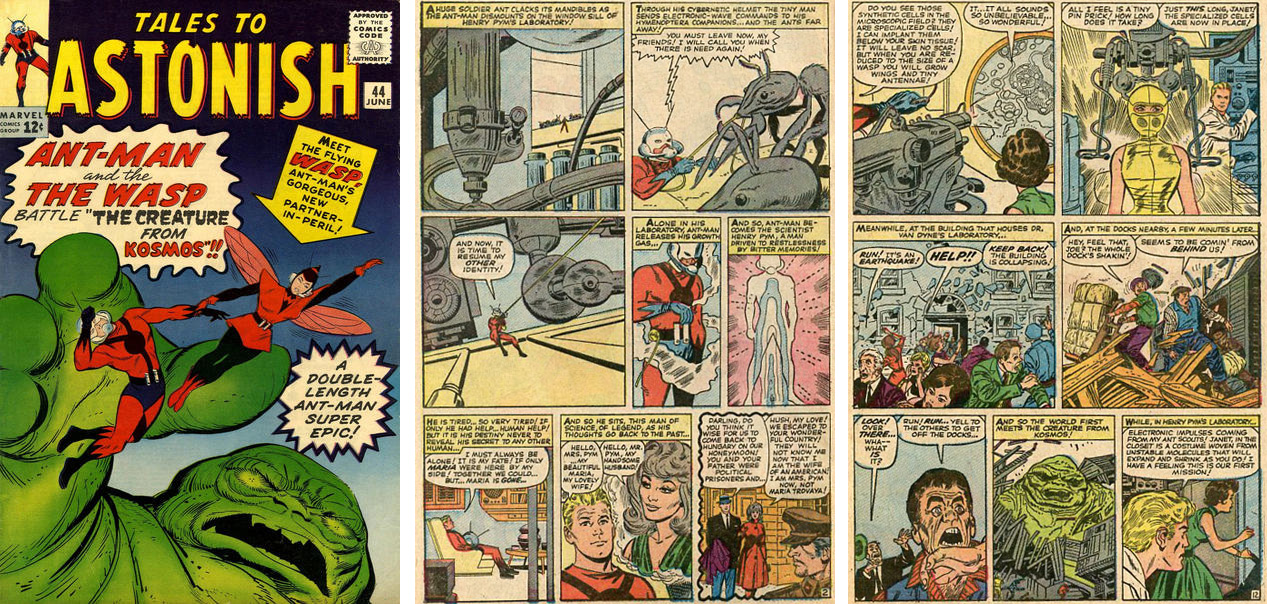
In Tales to Astonish 44 we learn about a major event in Henry Pym's past - the death of his wife Maria, depicted here as a beautiful mature woman with fetching iron-grey hair. On first seeing Janet van Dyne, Pym is struck by how much she resembles a much younger version of his dead wife.
Tales to Astonish 44 (Jun 1963) ushers in some more changes – both in the creative team and in the Ant-Man concept. Stan must have felt that there was something lacking in the scripting and replaced his brother Larry with old-time Atlas editor Ernie Hart, who was credited as “H. E. Huntley”. In a 2007 interview, Leiber said that Stan “wasn't always the most patient person and I had problems [writing] the dialogue and he said, 'Why did you say that? You could have said it this way, or this way or that way,' and I’m realizing, yeah, I don't think of it that way or this way. So at any rate finally I think at one point he got a little exasperated and he said, 'I’m going to hire some of the old pros’.”

Hart had been a staff editor at Timely Comics during the 1940s, sharing an office with Al Jaffee. He remained on staff through the Atlas years, and was brought on as a scripter on the Human Torch strip in Strange Tales and the Ant-Man series, presumably to give it a shot in the arm.

That shot in the arm was the introduction of a partner for Ant-Man. “The Creature from Kosmos” opens with Henry Pym musing about his long-dead wife, Maria Trovaya, a Hungarian national. On a trip back to Mrs Pym’s mother country, she’s arrested by communist secret police and is later found murdered. This incident might go some way to explaining why Pym fought so many communists during his formative years as Ant-Man. Back in the present, Pym is visited by fellow scientist Vernon van Dyne who is experimenting with gamma ray beams to detect signals from other planets. Van Dyne has brought his daughter Janet along, though she seems more interested in taking in the city nightlife than listening to scientific theory. Pym is struck by the uncanny resemblance of Janet to his dead wife, but is also aware of how much younger she is. In the flashback, Maria is shown with grey hair and could conceivably be in her mid-to late thirties, so it’s likely that Pym is supposed to be about 40 here. Perhaps Janet van Dyne is supposed to be about 20.

Pym is unable to help, so Van Dyne continues with his work alone, only to unwittingly unleash a criminal alien on Earth, whose first act is to murder Doctor van Dyne. Pym investigates as Ant-Man and learns the truth. Then in his guise as Pym, reveals his secret identity to Janet, offers her super-powers and asks her to join him in the hunt for her father’s killer.

Rather than simply enabling her to shrink and grow, Pym implants – somewhat recklessly – wasp cells in Janet’s back, so that she’ll grow natural wings when she reduces in size. Putting on a uniform of unstable molecules, Janet shrinks to insect size and sets out with Ant-Man to defeat the alien.

As they battle with the creature, Pym is thinking that Janet is so like Maria, but also that he must avoid falling in love with her as she’s too young. The adventure closes with Wasp gazing at Pym and thinking that, “someday I will make you realise that you love me as I love you.” Later in the series, Stan would play down the age difference. Even here, it sounds a little creepy.

Tales to Astonish 45 featured the return of an old villain, Egghead, the first such repeat appearance in the series so far. It also had The Wasp use a needle to mimic a wasp's sting. She would't get her compressed air Wasp's Sting until much later in the series, in Tales to Astonish 57.
Tales to Astonish 45 (Jul 1963) featured the return of Egghead, Ant-Man’s first recurring villain. This time, Egghead plans to use The Wasp as bait to trap Ant-Man. But far from being the helpless victim, it’s The Wasp who saves the day, using a needle to sting Egghead and his henchmen into submission.

Ant-Man shows up as a guest star in Fantastic Four 16, a quite clever piece of plotting that follows up on Doctor Doom's disappearance into the microworld at the conclusion of Fantastic Four 10.
The same month (though actually on sale a week later on 9 Apr 1963), Ant-Man appears, drawn once again by Jack Kirby, as a guest star in Fantastic Four 16. At the end of Fantastic Four 10, Doctor Doom was cast into a microworld, the very fate he intended for the FF. Still there six months later, Doom devises a way to shrink his arch-enemies to his size. After a couple of random shrinking incidents, Reed Richards contacts Ant-Man for help. The tiny hero gives Mr Fantastic a few drops of his shrinking/growing gas so the FF can counteract any further attempts to shrink them. However, The Fantastic Four still find themselves in Doom’s microworld and have to rely on Ant-Man’s help to defeat Doom.

Clearly this was an attempt on Stan’s part to boost the visibility of Ant-Man with fans of other, more popular Marvel comics. Yet, when you look at the sales of Tales to Astonish, it wasn’t faring any worse than its companion title Tales of Suspense and was actually doing better than Journey into Mystery and Strange Tales.

The sales figures for 1962 show Suspense at an average monthly sale of 126,000 with Astonish at 140,000. Strange Tales is at 136,000 and Journey into Mystery is selling an average of 132,000.

The following year, Suspense has risen to 188,000 with Astonish at 189,000, with Strange Tales also at 189,000 and Journey into Mystery average at 188,000. Did Stan think that Astonish should be doing better than the rest? He wasn’t guest-starring Iron Man or Thor in FF during 1963, so I can’t see what he was worrying about.

The last couple of Ant-Man adventures aren't a huge improvement over what had come before. Stan Lee was very obviously dissatisfied with how the character was turning out and planned some really big changes right after this trio of issues.
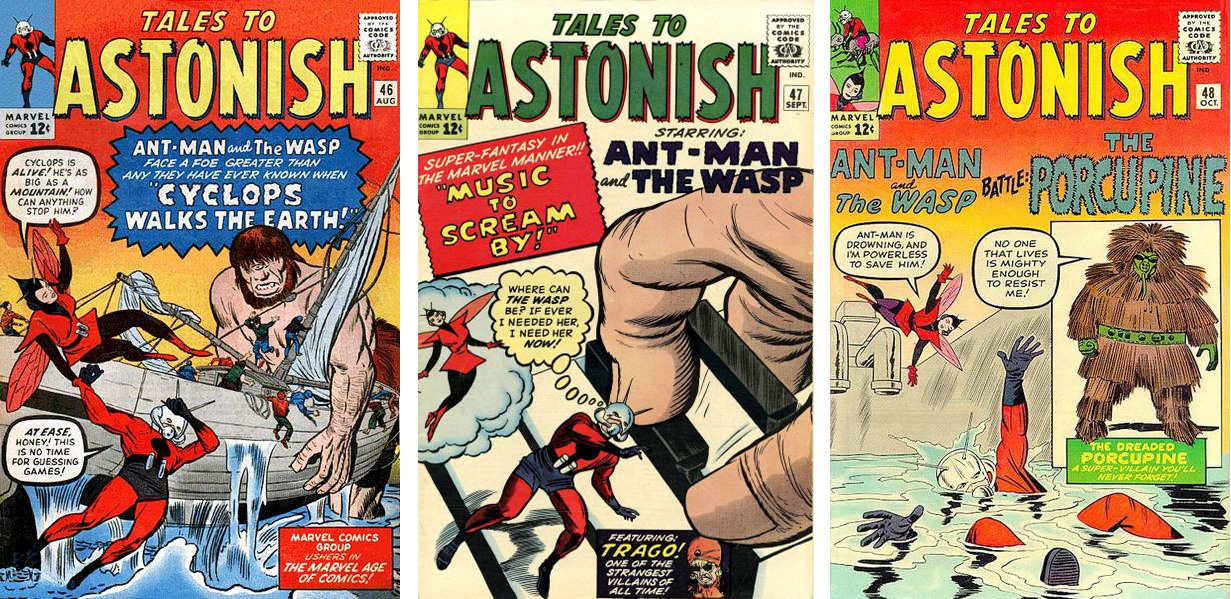
For all that, the next three issues of Astonish continued in a similar vein. In issue 46 (Aug 1963), Ant-Man and the Wasp battle a giant Cyclops monster while on holiday in Greece. The monster turns out to be a giant robot, constructed by invading aliens to scare away the locals, which does, admittedly, sound a bit like a Scooby-Doo plot.

Tales to Astonish 47 had a villain called Trago (Spanish for "drink" by the way), a sort of bargain basement Ringmaster, who hypnotises his audiences and robs them. Ant-Man and The Wasp make short work of him.
Tales to Astonish 47 (Sep 1963) has Ant-Man and The Wasp fight against a musician called Trago, who is able to use his trumpet music to mesmerise his audience so he can rob them. Scripter Ernie Hart does introduce a bit of banter into Janet's relationship with Henry, calling him "Hank" and teasing him for not wanting to relax and for not knowing anything about jazz music. That aspect would be developed more fully later in the series.

The Porcupine in Tales to Astonish 48 was probably the most memorable Ant-Man villain to date - though that's not really saying very much.
Astonish 48 (Oct 1963) introduces another villain who would return to plague Henry Pym and Janet van Dyne at a later date – The Porcupine. When I first read this story, as a kid, I thought The Porcupine was quite sinister. His mask is very creepy, and it’s a tribute to Don Heck’s skill that he’s able to render a credible villain out of such a ridiculous idea. Scientist Alex Huntley constructs a porcupine costume loaded with ingenious weapons and uses it to rob a bank. But Ant-Man and The Wasp devise a way to neutralise his weapons. While The Wasp distracts the villain by stinging him with a pin, Ant-Man sprays him with quick-drying cement. Though the controls of his suit are useless, Porcupine manages to escape to fight another day.

Avengers 1: Scripted by Stan Lee and pencilled by Jack Kirby, Ant-Man and the Wasp's characterisations here foreshadowed the chemistry they would have in the yet-to-debut Giant-Man series over in Tales to Astonish.
The same day that Tales to Astonish 48 hit the newsstands, Ant-Man and the Wasp made their debut as charter members of The Avengers. Martin Goodman had long wanted a team comic, starring Captain America, Sub-Mariner and The Human Torch, to rival DC's Justice League of America. Stan Lee had ducked that one and given him The Fantastic Four instead. But at last, with a larger roster of superheroes to draw on, Lee was finally able to field a team that matched the JLA in power, if not in sales.

The plot involves Thor's long-time enemy Loki trying to manufacture a battle between The Thunder God and The Incredible Hulk. When Rick Jones tries to contact The Fantastic Four for help with an apparently out-of-control Hulk, Loki diverts the radio message to Dr Don Blake's radio instead. Unknown to Loki, the SOS message is also received by Henry Pym and Tony Stark, and the four heroes converge on the Teen Brigade HQ. One of Ant-Man's ants sights The Hulk, hiding out with a travelling circus and the superheroes set off to track him down. Ant-Man and The Wasp play a decisive role in the battle, first undermining (with the help of ants) the ground on which The Hulk stands then, when the fighting's done, suggesting they team up regularly to battle large-scale menaces ... and it's The Wasp who gives them their name: The Avengers. But this would be Ant-Man's only appearance with the team. By issue 2, he would have a change of name and powers and by issue 16 left The Avengers, both team and comic.

While Ant-Man was never a fan-favourite with hardcore Marvel readers, at least he managed a longer run than The Hulk. The weakest aspect to the character was that the dialogue wasn't written by Stan Lee, and thus lacked the light touch and banter between characters that was very much Lee's trademark. Larry Lieber admitted that this style wasn't for him in that 1999 Alter Ego interview with Roy Thomas: "I didn't do enough of the superheroes to know whether I'd like them. What I didn't prefer was the style that was developing. It didn't appeal to me. ... Maybe there was just too much humor in it, or too much something ... I remember, at the time, I wanted to make everything serious. I didn't want to give a light tone to it."

Still, for whatever reason, Stan was dissatisfied with how the Tales to Astonish stories had been shaping up and began preparing a Really Big change for Ant-Man. He was going to take over scripting and add two letters to Ant-Man's name.


Next: Big things ahead for Ant-Man.