Showing posts with label Roy Thomas. Show all posts

Friday, 5 April 2024

Yet more Marvel Cowboys - Ghost Rider: Part 2

THE GHOST RIDER HAD ENJOYED A LONG RUN at his original home, Vin Sullivan's Magazine Enterprises, from late 1949 right through to the spring of 1955, in a variety of titles: Tim Holt (which became Red Mask), Best of the West, Bobby Benson and, of course, his own title The Ghost Rider. Dick Ayers, later to be one of Jack Kirby's most important Marvel inkers during the early 1960s, was the artist on every single episode of the character. So when comics fan Roy Thomas landed a job at Marvel Comics in 1965 as Stan Lee's assistant, he brought with him a broad knowledge of characters from earlier periods of comics, some of which he'd revive over his first few years at Marvel.

Marvel version of The Ghost Rider was pretty much identical to the Magazine Enterprises original, including the artist Dick Ayers.

The Ghost Rider had been one of Thomas' favourite comics when he was a kid so, figuring that the character had fallen out of copyright, Thomas pitched the idea of a revival to Stan, with Dick Ayers as the artist. It was a bit of a no-brainer.

WHO THE HECK IS ROY THOMAS?

Roy William Thomas Jr was born in Jackson, Missouri on 22 November 1940. An enthusiastic comic fan from his earliest years, Thomas would write and drawn his own strips and circulate them to friends. While studying for his degree at Southeast Missouri State University, he became involved in organised comic fandom through pioneer fanzine publisher Jerry Bails. The burgeoning DC superhero revival of the early 1960s led to Bails' fanzine Alter Ego, which Thomas took over in 1964. During those first years of the 1960s, Thomas had letters published in Green Lantern 1 (Aug 1960), The Flash 116 (Nov 1960), Fantastic Four 5 (Jul 1962), Fantastic Four 15 (Jun 1963) and Fantastic Four 22 (Jan 1964).

Alter Ego, then and now: The first issue appeared in 1961, edited by Jerry Bails with cover art by Roy Thomas. The fanzine went through a few stops and starts, but is still published today.

In 1965, Roy Thomas was offered a trial position as editorial assistant to DC's Dark Overlord Mort Weisinger. It wasn't a happy experience. Weisinger was notorious for being rude and abrasive and, coming from a background in education, this wasn't what Thomas was expecting. After a day's haranguing from Weisinger, Thomas told The Comics Journal in 1981 that, "I actually remember going to my dingy little room at the George Washington Hotel in Manhattan, during that second week, and actually feeling tears well into my eyes, at the ripe old age of 24. I've never done that over a job, before or since, but Mort really got to me."

That same week, Thomas wrote a letter to Stan Lee at Marvel Comics. "Not applying for a job or anything ... I just said that I admired his work." Stan remembered Thomas from his work on the Alter Ego fanzine and called Roy the next day. "He just asked me - on the phone - if I'd be interested in trying a writers' test Marvel gave." So Thomas went up to the Marvel office and collected the test pages from Flo Steinberg. That evening "I returned to my hotel room and banged out a few pages of dialogue for some Fantastic Four pages - they were from the conclusion of Annual 2, as I recall - and turned them in the next day."

Thomas got a call from Flo asking him if he could stop by the Marvel offices and meet Stan. "The previous day or so, Mort had been in rare form, so I guess I was ripe without knowing it. Ten minutes after I met Stan, he asked me what he had to do to get me away from DC. I was surprised to find myself telling him that all he had to do was offer me the $110 a week Mort had offered me when I was back in Missouri, but which had dropped to $100 a week, mysteriously, when I actually showed up. I also told Stan I'd have to give Mort indefinite notice, since I didn't want to leave him in the lurch. As it turned out, that was beside the point, because the minute I told Mort he ordered me out of the DC offices. I was back at Marvel less than an hour after I first left, and had a Modelling with Millie assignment (44, Dec 1965) to do over the weekend. It was a Friday."

Though earlier, Stan Lee seemed reluctant to release Marvel staples like Millie (and the westerns) to other scripters, as he became more confident of the success of the superheroes he handed the teen titles over to other writers.

From there, Roy Thomas became a staff writer at Marvel, starting with a few issues of Millie the Model, Modelling with Millie and Patsy and Hedy. "I wasn't hired as an editor or assistant editor." Thomas wrote in Marvel Age of Comics, in 2022. "I was supposed to come in 40 hours a week and write scripts on staff. I sat at this corrugated metal desk with a typewriter in a small office with production manager Sol Brodsky and corresponding secretary Flo Steinberg. Everybody who came up to Marvel wound up there, and the phone was constantly ringing, with conversations going on all around me. Almost at once, even though Stan proofed all the finished stories, he and Sol started having me check the corrections before they went out, and that would break up my concentration still further [and] they kept asking me to do this or that, or questions like in which issue something happened, or Stan would come in to check something, because I knew a lot about Marvel continuity up to that time. It quickly became apparent to them, too, that the staff writer thing wasn't working, and Stan segued me over to being an editorial assistant, which immediately worked out better for all concerned."

Once Stan was confident that Thomas was able to mimic the Marvel style, he moved Thomas up to Sgt Fury, starting with issue 29 (Apr 1966), and X-Men from issue 20 (May 1966).

Thomas would script just a year's worth of issues of Sgt Fury, but he stuck with The X-Men for the rest of the run, and was instrumental in reviving the team as The New X-Men in 1975.

It wouldn't be long before Thomas started his legendary run scripting The Avengers, starting with issue 35 (Aug 1966), which would last till issue 104 (Oct 1972). During those six years, Thomas added Hercules to the lineup, created The Red Guardian (The Black Widow's husband), introduced a new Black Knight, revived the Golden Age hero The Vision, added the Black Panther to the lineup, and gave us the Kree-Skrull war. Artists that Thomas managed to attract to the title included John Buscema (notably the run between 55 and 62, with sublime inks from George Klein), Barry Smith and Neal Adams.

Though Thomas would work with many super-star artists during his run scripting The Avengers, I still have a real soft-spot for Don Heck's work on the title.

Back in 1966, Thomas had been scouting around, looking for other writers to bring in to Marvel. His first success was in getting Stan to hire Gary Friedrich. Thomas then went after Denny O'Neill, who had been writing a series on the burgeoning comics industry for a local Missouri newspaper. Roy pretty quickly handed Millie the Model off to Denny and Sgt Fury to Gary. And it was probably about this time that Thomas started pitching the idea of a Ghost Rider revival to Stan.

THE GHOST RIDER HAS RISEN FROM THE GRAVE

Fast forward ten years and with the co-creator of Ghost Rider, Dick Ayers, safely ensconced at Marvel Comics, Roy Thomas pitched his first revival idea at Stan Lee. The Magazine Enterprises character The Ghost Rider hadn't been maintained as property by ME owner Vin Sullivan and, legally at least, was up for grabs. With a green light from Stan. Roy got together with his own protege Gary Friedrich and concocted a revised version of the classic western hero.

By this point in his career, Dick Ayers had developed into a very slick artist, even if he wore his Kirby influences on his sleeve. Shame about the unsympathetic Vince Colletta inks, though.

This Ghost Rider starts out as teacher Carter Slade, who's been hired to educate the children of Pitchfork, Missouri. As he approaches the town he witnesses an attack on a homestead by "indians". He does his best to fight them off, managing to reveal them as white men in disguise, but is shot and left for dead by his attackers. However, the homesteaders' young son, Jamie Jacobs, has survived the attack and tries valiantly to get the injured Slade to the town doctor. On the point of collapse, Jamie is discovered by genuine Indians and taken back to their medicine man Flaming Star. Against all odds Slade survives and Flaming Star takes this as a sign that Slade has been spared by the spirits for some greater destiny as "He Who Rides the Night Winds".

In the space of a few pages, Carter Slade tames an untameable wild bronco, adopts Jamie and demonstrates his new glowing meteor dust ... which I suppose from a health and safety point of view is better than Rex Fury's phosphorous powder.

And with that, Flaming Star gives Carter Slade a Cloak of Brightest Night, some glowing meteor dust and then guides him to a wild white stallion that Carter must tame for himself. It just remains for Slade to deal with Jason Bartholomew, the illegal sponsor of the "indians" who are trying to drive the homesteaders away.

That's some wordy exposition page right there. I have to wonder how much cutting up of the art board did the Marvel production department have to do to fit in all that verbiage.

It's an okay origin story, which pretty much follows the debut of the 1950s version, land-grabbing ranch-owner, fake indians and all. It is a bit dialogue heavy, but this is right at the start of Thomas' and Friedrich's writing careers, so they can be cut some slack for that. The inclusion of the kid sidekick indicates to me that Marvel was still chasing the ten-year old audience, and the addition of a love interest in the shape of the lovely Natalie Brooks - coincidentally the sister of the socially hostile Ben Brooks - has Stan Lee's fingerprints all over it.

Ladies and gentlemen, the lovely Natalie Brooks.

The 17-page Ghost Rider story is topped up with a six-page reprint from Kid Colt Outlaw 105 (Jul 1962), and Stan takes a paragraph on the Bullpen age to plug Ghost Rider and the other three Marvel western titles.

The Bullpen Bulletin page for February 1967, with an illustrated plug for the first issue of Ghost Rider - click image to enlarge.

It does seem a bit cautious to invest in only 17 pages of new script and art in the debut issue as though Stan, or more likely publisher Martin Goodman, isn't confident the book will sell enough copies. Though the Ghost Rider page count would increase later, the caution wasn't altogether unfounded.

As if the concept of The Ghost Rider wasn't gimmicky enough in the first pace, Marvel decided to pit him against equally gimmicky villains. The Tarantula was the first in a line of several, and would even return in a later issue.

With the second issue, Ghost Rider began to feature costumed or super-powered foes. The story starts with the Ghost Rider running off a gang of cattle rustlers using his customary tactics of pretending to be a headless horseman, making spooky talk ("Begone, servants of evil, lest you taste the vengeance of he who rides the night winds.") then fading into the night. After that skelping, Bart and his gang of rustlers decide it's better to find another territory, where the pickings might be a little easier. As they're packing up, another mysterious figure, The Tarantula, appears and tells them that they are running from a fake ghost. If they join him, he'll finish The Ghost Rider and they can run the entire state. 

The next night, The Tarantula and his gang show up in the town of Bison Bend and demand $100 per family for his "protection". Only Natalie's brother Ben stands up to the gang and is knocked down by one of their horses for his trouble. But as The Tarantula and his gang ride off, The Ghost Rider appears and shoots the guns from their hands. And even though The Tarantula uses his whip to bring down a building on top of The Ghost Rider, our hero emerges unscathed. In desperation, The Tarantula grabs Natalie as a hostage, but The Ghost Rider frees her with his near-invisible Lariat of Darkness, making look like the girl is flying from the villain's grasp. With young Jamie projecting an image of The Ghost Rider from the shadows so GR appears to be in two places at once, The Tarantula finally admits defeat and flees.

There were a couple of other interesting details in the issue. We're briefly introduced to Clay Rider, Natalie's fiance. He pops up in one scene and then disappears from the story, leading me to suspect that he may be The Tarantula - or at least that Gary Friedrich wanted us to think he might be. Next, Friedrich lines up Ben Brooks - who we know is deeply sceptical of The Ghost Rider's motives - to be the new sheriff of Bison Bend, which could spell trouble for Carter Slade. And, of course, in the darkness The Tarantula gives The Ghost Rider the slip, teeing him up for a return match.

Calling the villain The Cougar is doubly misleading. For one thing, he's not a costumed villain in the traditional sense and, for another, he's not actually the bad guy ... his brother in law is.

The Ghost Rider 3 (Jun 1967) gave us a new novelty villain, The Cougar, in reality circus trainer Adano Adriani, who comes complete with a Chico Marx comedy Italian accent. Adriani is a reformed crook now working for Mr Barton the owner of the Barton Brothers Circus, though it's never made clear which Barton Brother he is. When Barton is killed and the box office takings pilfered, Adriani inevitably becomes the prime suspect. But The Ghost Rider doesn't believe the animal trainer to be guilty and breaks him out of jail to try to prove his innocence. It's not really clear why The Ghost Rider needs Adriani out of jail. He could quite as easily investigate the case with Adriani safe from harm in his jail cell. Anyway, Sheriff Ben Brooks believes the Ghost Rider to be involved, despite the compete lack of evidence. The real culprit turns out to be the no-good brother, Philip, of Adriani's adoring wife. Killer unmasked, The Ghost Rider fades into the night, leaving Sheriff Brooks gnashing his teeth and the lovely Natalie wishing her brother would go easier on The Ghost Rider.

We also get to see Natalie's sketchy fiance again in one scene, his name now mysteriously changed from Clay Rider to Clay Riley, though Friedrich doesn't give him anything to do apart from hang around and look smarmy. I sure hoped Gary was going somewhere with this ...

This issue gives us two costumed baddies for the price of one. Main villain The Stingray fought Rawhide Kid the previous month under the name The Scorpion ... then a old foe turns up to save The Ghost Rider from the Sheriff's gunfire.

The fourth (Aug 1967) issue of The Ghost Rider featured the return of The Scorpion, actually an old villain who had appeared the previous month in Rawhide Kid 57, but now under a new name, The Stingray.

Bison Bend teacher Carter Slade is hosting a dance to raise money for school textbooks, when The Stingray grabs the takings and flees, pursued by Sheriff Ben Brooks' posse. But instead of chasing the real thief, stubborn Brooks leads his deputies in pursuit of The Ghost Rider instead, letting The Scorpio get away. The next night, while the posse set out in search of the Ghost Rider (again), The Scorpion takes the lovely Natalie Brooks hostage (again). But The Ghost Rider has witnessed the abduction and captures The Stingray, unmasking him as the town druggist, Jim Evans (unnamed here, but I looked it up in Rawhide Kid 57). At that very moment, the Sheriff and his posse show up, forcing The Ghost Rider to flee. Then just as the Sheriff aims at the Ghost Rider's back, The Tarantula shows up and disarms Brooks, claiming to be protecting his "friend", further deepening Brooks' distrust of The Ghost Rider.

He's back ... the man with the fake Spanish accent. This time claiming that he and The Ghost Rider are partners. Just what is his game? Will we ever find out?

As readers might have suspected, the fifth issue (Sep 1967) of The Ghost Rider features the return of the whip-wielding Tarantula, still claiming to be the partner of GR. In the opening scene, The Tarantula robs the Bison Bend bank and rides off after shouting that he has to go and divide his take with his partner The Ghost Rider. The townsfolk, disappointed that Sheriff Brooks didn't stop the robbery decide to offer a reward for the capture of The Ghost Rider. For some reason this really upsets the lovely Natalie Brooks. Later that night, The Tarantula finally uncovers the location of The Ghost Cave, and ponders that it's only a matter of time before he figures out who The Ghost Rider really is.

Back at Bison Bend, Sheriff Brooks has a surprise visitor - Federal Marshall Lance Sterling, who says he's been sent to help track down The Ghost Rider ... and if you think Brooks is obsessed with catching The Ghost Rider, well you just haven't met Lance Sterling yet. Later that night, The Ghost Rider confronts Sheriff Brooks trying to convince him that they're on the same side. But the conversation is interrupted when The Tarantula sets fire to the town jail. The distraction allows Brook to draw on the Ghost Rider, but the lovely Natalie tries to protect The Ghost Rider and is shot by her own brother. 

Though this is a book-length story, I strongly suspect it was drawn first as a 17-pager and Stan just had Dick Ayers add these two pages to extend the story to full-length.

The showdown between The Tarantula and The Ghost Rider is a bit of a let down. Though The Tarantula defeats The Ghost Rider, he develops sudden amnesia and rides off without unmasking his fallen foe. We don't learn who The Tarantula really is, though some of the things he says indicate that he is a citizen of Bison Bend, and none of them in a Spanish accent.

The sixth issue of The Ghost Rider takes us back to the village where Carter Slade first received his mission from Indian medicine man, Flaming Star.

The Ghost Rider 6 (Oct 1967) is a bit of a change in direction. Summoned to the Indian village by his benefactor Flaming Star, the Ghost Rider is given a powerful amulet - The Spirit Stone, a piece of the meteor that foretold of his coming - which bestows great strength on the wearer. But as he leaves the village, The Ghost Rider is shot in the back by disgruntled brave, Towering Oak, who covets The Spirit Stone for himself. Towering Oak takes the Stone then, back at the Indian village, confronts Flaming Star and the other braves. Though he claims to be The Stone's rightful owner, Flaming Star tells him that the ownership can only be determined via trial by combat, setting the stage for a showdown.

Meanwhile, Carter Slade is riding to find out how the lovely Natalie Brooks is doing, after being accidentally shot by her brother in the last issue. But he's flagged down by one of the Indian braves with a summons from Flaming Star. Putting his visit to Natalie on hold, he changes to The Ghost Rider and heads for the Indian village and his showdown with Towering Oak. Of course Towering Oak is defeated when The Spirit Stone extracts its toll on his body and kills him mid-battle. The Stone will be interred with Towering Oak's remains, never to be used by mortal man again.

Thankfully, no Vince Colletta inking this issue but, to be fair, George Roussos isn't much of an improvement. I think I preferred this story over the costumed villain tales Gary Friedrich had been pitching us since issue 2. This explores the native American lore behind the Ghost Rider a bit more, even though it's not exactly The Teachings of Don Juan.

This was the last issue of The Ghost Rider, though the next story "Hurricane" was announced below the story's final panel. "Hurricane" would be published, two years later, and another Marvel western title.

The final issue, Ghost Rider 7 (Nov 1967), opens with the lovely Natalie Brooks making the perilous journey to Denver for the operation that might allow her to walk again, accompanied by two of the three men in the world who love her most - her brother Ben and her fiance Clay Rider/Riley. Even now, Ben is a bit twisted out of shape, blaming The Ghost Rider for Natalie's shooting. But, Ben mate ... you pulled the trigger. Take some accountability, for goodness sake.

Shadowing the covered wagon is Carter Slade, aka The Ghost Rider. Like Ben Brooks, he's also a bit confused about who's responsible for Natalie's condition. Suddenly, Slade is set upon by a crazed "Mountain Man", who doesn't care much for intruders, and is taken prisoner. Meanwhile, Ben and Clay decide to take shelter in a nearby cave against the gathering snowstorm. It's not long before Mountain Man arrives to take care of these intruders, too. But when he sees Natalie, he has a meltdown, mistaking her for his long-lost love, Melinda.

There's an unnecessary scene where The Ghost Rider tries to convince Ben to work with him against Mountain Man to save Natalie - it doesn't go well. The Ghost Rider returns to Mountain Man's shack, reveals the crazed hermit's real name - Zebediah Jones - and his back story. The old man's mind had become unhinged when his wife was killed in an Indian massacre years before. Zebediah dies saving Natalie when the roof of his cabin collapses. The Ghost Rider takes over the transporting of Natalie to Denver for her operation.

It's a very odd story, full of forced coincidences and random events that exist only to move the plot forward. The scene where The Ghost Rider tries to convince Ben to put their differences to one side for Natalie's sake seems awfully like padding to fill out the 17-page tale to length.

Not sure what's going on with Herb Trimpe's inking here, but it looks like he did it in the dark with a ballpoint pen.

The cancellation of the title must have been sudden, because not only does the final panel of the story trail the next adventure, "Hurricane", but there's also no mention that this is the last issue on the letters page, usually one of the last items to be prepared for press.

So, it's a mystery ... we can only guess that Ghost Rider was cancelled suddenly and because of poor sales, despite the claim in one of the replies that the title is a "smash sensation". Click image to expand.

While I loved the concept (pretty much identical to the original Magazine Enterprises series from the 1950s), I have to admit that the stories and scripting could have been a lot better. Gary Friedrich was very likely directed to pit The Ghost Rider against costumed villains to give the series a superhero slant, but I think that's at odds with the core premise of the character. I think it would have been more effective if at least some of the stories had used fake supernatural menaces, in the same way that the ME original did, so we could enjoy the spectacle of a fake supernatural character exposing other "supernatural" characters as fakes.

When The Ghost Rider returns, the lovely Natalie has been lying in a hospital bed for two years. A series of unlikely plot twists bring us to the point where The Ghost Rider unmasks an unconscious Tarantula, and ...

But what I didn't know, until I did the research for this blog entry, was that The Ghost Rider did rise from the grave one more time, in the Bronze Age title Western Gunfighters, with the advertised story "Hurricane" appearing in issue 3. Quite why editor Stan Lee decided not to pick up exactly where The Ghost Rider title had left off I couldn't say. Perhaps he thought the resolution of The Tarantula storyline was a bigger pull. Anyhow, the lovely Natalie Brooks is recovering in her hospital bed in Denver while brother Ben and fiance Clay stand anxiously by. A little later, in the shadows outside Natalie's room, lurks Carter Slade, and we're reminded that all three men blame themselves for Natalie's plight. Suddenly - everything seems to happen suddenly in this strip - The Tarantula appears, knocks Carter to the ground and then flees.

"An hour later" The Ghost Rider has tracked The Tarantula down to his hotel room - no explanation is given for how Carter found The Tarantula. There's a five page fight in which The Tarantula is knocked out and The Ghost Rider unmasks him to reveal ... well, we'll have to wait for the next issue to discover the identity of The Ghost Rider's only recurring villain. I mean, I guessed ages ago - did you?

The Great Unmasking is a bit of a damp squib. I'm pretty sure the readers were way ahead of the scripters in this case. Especially if they'd read Amazing Spider-Man 39 (Aug 1966).

The Ghost Rider story in Western Gunfighters 2 (Oct 1970) picks up a the exact moment where the last episode finished. The Ghost Rider is standing over the unconscious form of Clay Riley, who's just been unmasked as The Tarantula. Suddenly Sheriff Ben Brooks crashes through the door and ... refuses to believe the evidence of his own eyes. His friend Clay could never be a criminal. It must be some sort of frame-up ...

Realising his case is hopeless, The Ghost Rider shoots out the oil lamp in the room (again? He already did that last episode), loads Riley onto a horse and disappears into the night. Once clear of town, The Ghost Rider pauses to reflect on his best course of action. It'll be hard to prove to a Marshall that Riley is really the Tarantula. Momentarily distracted by his pondering The Ghost Rider fails to notice that Riley has recovered and is now springing at him, despite Clay's hands being tied behind his back. A tussle ensues.

Meanwhile back at the hospital, perhaps alerted by some sixth sense, the lovely Natalie Brooks awakes from her coma, calling Clay's name. The doctors confirm that not only is she awake but the operation to restore her ability to walk has been a success. Back at the fight, Clay doesn't fare so well. Knocked off a handy cliff by The Ghost Rider, Clay lands on his head and appears to forget that he is The Tarantula.

Though the artwork by Dick Ayers and Tom Sutton is a big improvement over the Ayers/Colletta combination seen in GR's own book, this scripting is tired, coincidence- driven stuff - Gary Friedrich is capable of much better work than this. It's as though his heart wasn't in it. Perhaps this was a filler mandated by Stan to bring readers up to speed before continuing with the actual next story in the series, "Hurricane", announced at the end of Ghost Rider 7.

Harry Kane the Hurricane, for all his speed, isn't much of a threat to the mighty Ghost Rider. In fact, you could say he's a bit of a pushover ...

It would have been scheduled for at least 17 pages if it had appeared as originally intended in The Ghost Rider 8, but in this incarnation, it ended up as a 10-pager. Consequently, Gary Friedrich gallops through the plot every bit as quickly as the story's villain Hurricane. Not that there's a great deal of plot to gallop through.

Stan doesn't seem to recall which issue of Two-Gun Kid that The Hurricane originally appeared in ... but we know, don't we, readers? It was issue 70 (Jul 1964).

While Harry Kane, aka The Hurricane, is trying out his powers in the desert, he's spotted by Carter Slade, who's taking the lovely Natalie Brooks to Denver for her operation (it's a flashback, you see). Kane doesn't want any witnesses to his powers so decides to find out how much Carter knows. There's a bit of pushing and shoving and Kane discovers the Ghost Rider costume hidden in Carter's wagon. No match for Kane's speed, Carter is trussed up with rope and hurled off a handy cliff. Kane then turns his murderous attention on the lovely Natalie Brooks. Just as he's about to shoot the helpless girl, The Ghost Rider appears (isn't his costume still hidden in the wagon?) ... Kane charges at The Ghost Rider at full speed and right over the cliff he'd chucked GR over just moments before.

I'd rather have seen Friedrich spend a little more time on this and perhaps present it as a two-parter. As it stands, The Hurricane has hardly made an appearance before he's despatched by The Ghost Rider, which gives the whole thing the feel of a filler.

The story's padded out with three splash pages, which leaves us just seven pages for actually telling the story. Nice image of The Ghost Rider by Ayers, though.

Western Gunfighters 4 (Feb 1971) pits The Ghost Rider again another of Marvel's b-western heroes, The Gunhawk. When a low-rent gunman tries to bushwhack The Gunhawk, The Ghost Rider intervenes and sends the ambusher packing. That takes up the first eight pages of the story. The Gunhawk isn't fooled by The Ghost Rider's spook act and announces that he's in the area to claim the bounty on The Ghost Rider's head. The final page shows us the return of Ben Brooks and the now-amnesiac Clay Riley (aka The Tarantula) to the small town of Bison Bend. Fortunately, this is a two-parter, so we should get some more story next time.

With art by a pre-Conan Barry Smith and a script by Steve Parkhouse (better known now as the artist on Resident Alien), Outcast is an intriguing concept that never got a second outing.

One interesting aside about Western Gunfighters 4 is the inventory story "Outcast"  drawn by Barry Smith back in 1968 and scripted by my old friend and collaborator Steve Parkhouse. It's an interesting premise about the nameless protagonist, raised by native Americans after his parents are killed during an Indian raid, searching for his identity.

The wind-up of the confrontation between The Ghost Rider and The Gunhawk ends as you might expect, with each man finding a level or respect for the other. At least The Gunhawk won't let Ben Brooks shoot The Ghost Rider in the back.

Marvel made us wait four months for the next instalment in the Ghost Rider/Gunhawk battle. But the Ghost Rider story in Western Gunfighters 5 (Jun 1971) wasn't written by Gary Friedrich. For some reason he left it to Len Wein to resolve the tale. Though it's not unsatisfying for that. The Gunhawk arrives in Bison Bend looking to collect the town's bounty on GR. Even so, Sheriff Ben Brooks doesn't want any gunplay in his town and warns The Gunhawk off the rough stuff. Inevitably, the two antagonists face off in the main street in the middle of the night. But before a shot can be fired, some crooks dynamite the town bank. The Ghost Rider is the first on the scene and exchanges gunfire with the bad guys. The Gunhawk and Sheriff Brooks arrive and join the battle. But after The Ghost Rider saves his life by shooting one of the bad guys, The Gunhawk decides that he'll leave GR be, as he appears to be not such a bad guy after all.

You don't have to be Sherlock Holmes to figure out who's behind all the kidnappings of influential citizens in Bison Bend. Not with a character called Reverend Reaper around.

Len Wein continues as the script in Western Gunfighters 6 (Sep 1971). The plot is fairly straightforward. Someone is kidnapping the officials of Bison Bend. When they try to abduct Carter Slade, the attempt is foiled by the timely arrival of Carter's big brother Lincoln, now a federal marshal. The only one not kidnapped so far is the town pastor, Reverend Reaper. That name and the fact we've never seen him before should tip you off to who is behind the kidnappings. Lincoln keeps watch on the parson, until he sees him ride off with some rough-looking characters. He follows, reasoning that the kidnappers will lead him to the rest of the captives. Lincoln trails them to an abandoned mine and goes in for a rescue. The Ghost Rider also turns up (though it's not explained how he found the mine) and in the battle, Sheriff Ben Brooks leads the captives to safety while Lincoln and The Ghost Rider polish off the bad guys. With the parson revealed as the mastermind, he kicks away the timbers supporting the mine roof and The Ghost Rider is buried in the cave-in.

Not a dream, not a hoax, not an imaginary story. The Ghost Rider really is dead in this issue. Though there would be more Ghost Riders ...

In the normal course of things, we'd expect that somehow The Ghost Rider would survive and continue his battle against wrong-doers. But The Ghost Rider tale in Western Gunfighters 7 (Jan 1972) was more of an epilogue than a continuation. What we actually get is the funeral of Carter Slade (yes, he really is dead) and a bit of back story from Jamie Jacobs (I was wondering whatever happened to him).

There would be other versions of The Ghost Rider later, but for this incarnation, that was it. Overall I enjoyed the series, both now and then. Often the execution didn't live up to the concept and in that respect, the series was let down by the writing which swerved between adequate and sub-par. Perhaps if editor Stan Lee had spent a little more time nurturing his apprentice scripters we might have seen a better result.

But coming right at the start of Marvel expansionist phase of the late 1960s, it's likely that Stan just didn't have the time. So we can just file The Ghost Rider under "interesting curiosities" and move on.

Next: The Split Covers of Marvel Comics


Monday, 1 May 2023

Captain Marvel: Part 3

A YEAR ON FROM THE GREAT MARVEL EXPLOSION OF 1968 and it was becoming noticeable that Martin Goodman's grand plan to increase Marvel's output wasn't going to be sustainable.

When Marvel's total monthly page output went up from around 280 pages per month to about 400 pages, Editor Stan Lee needed to find more creators to produce the extra 120 pages of original story art he'd need just to keep the Marvel machine fed. He already had Roy Thomas and Gary Friedrich helping out on scripting. He'd added Archie Goodwin and Arnold Drake in 1968 - both looked great on paper, Goodwin with long experience at Warren magazines and Drake with a wealth of experience at DC, but by mid-1969, Drake had left Marvel and Captain Marvel needed a new writer.

As it turned out, Gary Friedrich was able to step in for a few issues, while editor Stan cast around for a permanent replacement. Also incoming was new Marvel recruit, Frank Springer, replacing Dick Ayers who'd pencilled the last couple of issues. Springer had pencilled at Dell until the end of 1967, then joined DC for about eight months - I'd particularly enjoyed his work on Secret Six - before hopping over to Marvel to draw SHIELD 4 (Sep 1968).

Though my 14 year old self wasn't best pleased to see Frank Springer take over from SHIELD artist Jim Steranko, I had enjoyed his work on DC's Secret Six. He also delivers a splendid job on Captain Marvel, diminished only a little by Vince Colletta's indifferent inking.

Captain Marvel 13 (May 1969) kind of re-hashes issue 12, with an unnecessary second battle against the Manslayer and a punch-up between Mar-Vell and Yon-Rogg. Incredibly, Yon-Rogg knocks Mar-Vell down during the fight, despite Captain Marvel's hugely enhanced physical strength (courtesy of the cosmic entity Zo). It's almost as if Friedrich hadn't read the previous issue. Or maybe he was just dialoguing an Arnold Drake plot ... either way, it added up to an unmemorable story.

Although touted as a crossover with Avengers 64 and Sub-Mariner 14, Iron Man's appearance in this issue of Captain Marvel seemed more like marketing opportunity than a story necessity.

Captain Marvel 14 (Jun 1969) featured a guest-appearance by Iron Man, a sure sign that sales on Mar-Vell's book weren't all that Editor Stan Lee had been hoping for. But this shouldn't have been much of surprise for Stan. Both art and scripts on the title had been distinctly second-tier up till this point ... and something had to be done. The introduction of Iron Man didn't make a great deal of sense, as guest villain. The Puppet Master (not looking like a ventriloquist's dummy any more, he had plastic surgery in Strange Tales 133, Jun 1965) takes possession of Iron Man and forces him to seek out and battle Captain Marvel for no reason that is ever explained.

But for me, now as then, the plot ("Captain Marvel battles Iron Man") is the least important part. The character development has always been more interesting to me. This issue moves it forward a little. Captain Marvel returns to the orbiting Kree ship and has a showdown with Yon Rogg - though Mar-Vell inexplicably allows his enemy to live - and then Zo decides Mar-Vell has had enough freedom and must now return to the Kree homeworld, for reasons yet to be explained.

Tom Sutton had been working steadily at Warren for a couple of years, then drew quite a bit of the later issues of Not Brand Echh. This was one of his few superhero jobs for Marvel. He'd later carve a niche on Marvel's Planet of the Apes, and at Charlton.

And that's exactly what happens in Captain Marvel 15 (Aug 1969). Working with incoming newcomer Tom Sutton, Gary Friedrich takes Mar-Vell off in a far more cosmic direction. It's almost a foretaste of what Jim Starlin would do with the character just a few years later. Zo begins by showing Mar-Vell his past and his future, revealing that Mar-Vell is destined to destroy his own people. Unable to accept that his fate is inevitable, Mar-Vell resolves to follow the path set out by Zo but plans to thwart Zo's predictions at the first opportunity. When he does arrive on the Kree homeworld, he's embroiled in a battle against the invading followers of Tam-Bor.

I quite like Sutton's groovy, cosmic layouts here, but you can see that his draftsmanship isn't quite as slick as more seasoned artists like his predecessors Dick Ayers and Frank Springer. Even Dan Adkins' usually deft inks can't quite punch this up.

Then, just when it looks like Gary Friedrich is taking this book in an interesting direction, he's replaced by incoming scripter Archie Goodwin, who makes a pretty good fist of tying up all the disparate events and situations created by all the previous scripters on the series.

Captain Marvel 16 (Sep 1969) is a complicated issue, as Goodwin tries to sort out and make sense of the various plot threads dangling since the beginning of the series.

So ... it turns out that the Kree Supreme Intelligence (introduced in this issue) is behind almost everything that's happened. Two Kree traitors have been scheming to take over the Kree Empire, second-in-command Zarek - who also posed as cosmic entity Zo - and his henchman Ronan the Accuser. The appointment of Yon-Rogg as Mar-Vell's superior officer was all part of the plot, and Mar-Vell - because he was a straight-arrow hero-type - was selected by Zarek as the fall-guy to blame it all on. Poor Medic Una was just so much collateral damage. The Supreme Intelligence was aware of the plot and simply bided his time till it came to a head, knowing that Mar-Vell would do the right thing. For his heroic actions, Captain Marvel is promoted to warrior and is given a new uniform. And he gets to keep his Zo-given cosmic powers. Yes, some of the resolutions are wobbly, but it's pretty obvious that this is a clearing-of-the-decks for a major change in direction.

It's great to see Heck back on pencils, with some fine finishing by Syd Shores on inks. But it's only for a moment, as next issue, Editor Stan brings in the big guns to try to get the title up on its hind legs, assigning Roy Thomas as scripter and DC Comics stalwart Gil Kane as artist.

WHO THE HECK IS GIL KANE?

Gil Kane (born Eli Katz, 6 Apr 1926) began his career at MLJ (later Archie Comics) in 1942 where he worked in the production department erasing pencils, ruling panel borders and outlining speech balloons. Fired after three weeks, Kane got a job at the Jack Binder Studio doing pencilling work. "They weren't terribly happy with what I was doing. But when I was rehired by MLJ three weeks later, not only did they put me back into the production department and give me an increase, they gave me my first job, which was Inspector Bentley of Scotland Yard in Pep Comics, and then they gave me a whole issue of The Shield and Dusty, one of their leading books," he told The Comics Journal in 1996. By 1944 he was freelancing for Simon and Kirby, who were supplying material to DC, and drawing for other publishers like Hillman, Rural Home and Aviation Press. Kane was drafted into the Army the same year, not returning to civilian life until 1945. He began drawing directly for DC under editor Sheldon Mayer, while contributing art to a range of Prize Comics titles. By 1949 Kane was working on Julius Schwatz's stable of titles, notably Jimmy Wakely, Rex the Wonder Dog and All-Star Western.

Western comics were big sellers for DC during the 1950s and Kane's work was much in demand. Later, he'd also draw sf and romance strips for the company.

Kane continued at DC throughout the 1950s, drawing anything he was asked to - science fiction, romance and westerns - but as these genres began to flounder, DC was looking for other avenues and turned their attention to superheroes once more. 

With the DC superhero revival in full swing, Kane was their star artist on two important books, but even the occasional job on DC mystery titles wasn't enough to fill his schedule.

Kane got the job of pencilling the revived Green Lantern, but found with the loss of his other titles, he hadn't enough work to keep him busy. "By the end of the '50s, everything began to collapse and, little by little, I lost all of my work," Kane told The Jack Kirby Collector in 1998. "I lost Rex, the Wonder Dog and all the westerns. I lost everything and had nothing going. I would occasionally get a science-fiction story from Julie. I went over to Western/ Gold Key and worked with Russ Heath as a partner for a while; I penciled and he inked. So I picked up work wherever I could. Green Lantern filled in a lot but not completely; it was every six weeks and not a monthly book." Kane pitched a revival of The Atom to DC and began pencilling that, as well. "I designed the character and the costume and everything else, and showed them my drawings and sketches and they decided to build a magazine around it," said Kane in an interview with Comic-Art.com. "It was very much like a character done by my favourite artists Louie Fine and Reed Crandall [Doll Man] ... I must admit that it was sort of boring doing it. I really didn't enjoy it ... because I longed to ink my own pencils, which they wouldn't let me do."

Stan started Gil Kane off on covers, but soon found some interior pencilling for him on The Hulk and Captain America.

Towards the end of 1966, after trying to get in at Tower Comics, Kane went to Stan Lee and picked up some work pencilling The Hulk in Tales to Astonish, where he was allowed to ink his own work. A month or two later, Kane was also pencilling and inking Captain America in Tales of Suspense. That and some cover work from Stan seemed to help, but Kane's first Marvel tenure only lasted a short while. After about three months, Kane was back at DC. 

Maybe the prospect of losing one of their star artists focussed DC's attention and they found him more work, adding regular work on Detective Comics. Throughout 1968 and 1969, Kane was also pencilling on Hawk and Dove, Captain Action, Batman and Teen Titans. The Atom was merged with Hawkman in mid-1968, but Kane didn't draw the new title. Then, in mid-1970, Neal Adams took over the art on Green Lantern, and although Kane drew The Flash for a few months, it was looking like DC were struggling to hang on to Gil Kane. 

Gil Kane: 6 Apr 1926 - 31 Jan 2000

By mid 1971, Gil Kane was working pretty much exclusively for Marvel, drawing Amazing Spider-Man and most of their covers.

AND BACK TO CAPTAIN MARVEL

Captain Marvel 17, cover dated Oct 1969, was on the newsstands 15 Jul 1969. It was pretty obvious that this was a completely different approach to the character.

The whole idea of a youngster miraculously transforming into a superhero on demand did seem awfully familiar. Rick Jones was even given Billy Batson's signature blue trousers and red top.

Roy Thomas ditched most of the backstory and re-tooled Marvel's Captain Marvel to vaguely resemble the classic Fawcett version. Rick Jones, former partner of both The Hulk and Captain America, was drafted in as the Billy Batson stand-in. Rick only had to clash his wristbands together to swap places with Captain Marvel in the Negative Zone. And their first order of business is to rescue Carol Danvers, who we saw kidnapped by Yon-Rogg in the previous issue. 

The only slight glitch I saw was where Captain Marvel claims that he now has no powers, except for those that the Nega-wristbands give him (Rick's wristbands don't give him any powers). Yet in Captain Marvel 16, Captain Marvel explicitly tells us he retains the power bestowed on him by "Zo". I'm confused ...

But whatever powers Captain Marvel now has, they're not enough to keep Yon-Rogg from making off with his captive, Carol Danvers. And hot on his trail ... Rick Jones.

This issue, Captain Marvel battles another monster-on-the-month and Rick meets Mordecai P. Boggs, who bears a passing resemblance to Uncle Dudley Marvel, I think. Oh, and Carol Danvers gets genetically altered ...

Captain Marvel 18 (Nov 1969) takes a little time to get going. First there's an unexplained incident where Rick Jones is nearly run over by a random motorist. Then there's a strange sequence at a diner in a nearby town where Rick sings a song, gets into a bar-fight and is offered a recording contract by Mordecai P. Boggs. Captain Marvel then "deduces" where Yon-Rogg is hanging out, though no explanation is ever given as to how he did it. The confrontation with Mar-Vell's mortal enemy is drawn by John Buscema, and during the fracas Carol Danvers is exposed to radiation from a Kree Psyche-Magnitron ... this is important because this is what causes the genetic transformation that allows Carol to gain super-powers and become Ms (later, Captain) Marvel.

Captain Marvel is at the mercy of a mad sociologist, trapped in a death-trap apartment block with hundreds of terrified tenants. Not your usual superhero tale.

The following month, Captain Marvel 19 (Dec 1969) finally gave us a story that wasn't just tying up loose ends from previous issues and setting the scene for this new version of Mar-Vell. Rick Jones needs a job and somewhere to live and answers an ad in The Daily Bugle offering accommodation in a luxury high-rise. But the landlord Cornelius Webb is a crazed sociologist who wants test the work of behavourist Burrhus Skinner to see if humans can be conditioned in the same way that rats can. As Webb conjures up illusions and deadly physical traps, Captain Marvel tries to protect the tenants while finding and stopping Webb. But it's Auschwitz survivor, the kindly Mr Weiss, who literally pulls the plug on Webb and causes his downfall.

It's a little heavy-handed in places, but it does seem to be a genuine attempt to offer a slightly different take on Marvel's usual super-hero tale. The letters page of the issue reveals that the plot came from Gil Kane. And though there's no advance warning on this issue's letters page, the title would be going on hiatus for six months, though no reason was ever given.

Strangely, there's no mention of The Hulk on the over of Captain Marvel 20 (Jun 1970), which is odd, considering it's been six months since the last issue came out, and the title can probably use all the hype it can get.

When Captain Marvel did return in late March 1970, it was the same creative team and the story picked up without a blip. Rick and Mar-Vell decide that the one person who can help them both out of the Negative Zone trap is Dr Bruce Banner, and the pair resolve to track him down. There is a side plot with some organised looters taking advantage of a natural disaster, but the main part of the tale is the inevitable collision with The Hulk.

There's still no satisfying explanation given by Marvel for just why the title went on a break. On the letters page, Roy insisted that the last few issues were "sales blockbusters" (really, Roy?) ... but it doesn't seem terribly likely that Marvel would suspend a successful title on a whim.

Also, I don't think it likely that Gil Kane sat around waiting for Captain Marvel to start up again. My guess would be that all the Kane issues were drawn at the same time and the art to Captain Marvel just sat in a drawer until they were ready to publish it.

In attempt to beef up interest in the title, Roy and Gil feature The Incredible Hulk for the final two issues of the title's second "trial period", but ass it turns out, this wouldn't be enough to convince Marvel to continue the series.

Captain Marvel 21 (Aug 1970) would signal the swansong of the title for a while. The entire issue is pretty much a battle royale with the mighty Hulk. Mar-Vell is outmatched from the get-go and the fighting only comes to an end when Rick returns to our universe and confronts The Hulk. Some part of the monster remembers his young friend and the creature's anger evaporates ...

The idea of asking for Banner's help in freeing Captain Marvel from the Negative Zone is left unresolved - deliberately according to Roy Thomas' comment in the issue's letter column - so there wouldn't be a change to the concept of Rick Jones and Mar-Vell trading atoms in the immediate future.

Marvel kept Captain Marvel in front of readers by making him an important player in the classic Kree-Skrull war storyline in The Avengers ... much of it drawn by superstar artist Neal Adams.

Roy Thomas wasn't about to give up on Captain Marvel ... he reintroduced the character in a pivotal role in the Kree-Skrull war that would play out in The Avengers from issue 89 (Jun 1971) to 97 (Mar 1972). This would give Marvel the confidence to re-start the Captain Marvel title a couple of months later with Thomas editing Gerry Conway on script and veteran Superman artist Wayne Boring on pencils. 

Quality-wise, the third stab at reviving the Captain Marvel title just sort of matched what had gone before. But the bi-monthly was just setting up the debut of writer-artist Jim Starlin who would shake things up with the introduction of uber-villain Thanos.

In the haitus, though, DC Comics must have sensed an opportunity. Thinking Marvel's Captain Marvel gone for good - at least in his own title - they entered into a licensing agreement with Fawcett to start publishing a new Captain Marvel comic, on sale just before Christmas 1972, and managed to get the original creator C. C. Beck out of retirement to draw the book. Marvel got wind of their plans and made sure DC didn't nurse any notions of calling the book "Captain Marvel". So DC titled the comic Shazam, and used the Captain Marvel name smaller on the cover. On paper it might have seemed like a great workaround, but Marvel hit DC with a cease and desist order pretty promptly and though the litigation dragged on a bit, by Shazam 14 (Nov 1973), DC were forced to remove the "Original Captain Marvel" sub-line from the Shazam covers.

I'm not sure what DC were thinking ... the project feels more like a spoiler than a serious attempt to revive a character whose time was up two decades earlier.

Meanwhile, back at Marvel's Captain Marvel book, it was just more of the same with a not-great storyline and art from a skilled but ultimately unsuitable artist. If Marvel was going to make a go of Marvel, something drastic had to happen. Fortunately, a newcomer, Jim Starlin was just a couple of months way from making his debut pencilling the series, then plotting and finally writing and drawing the whole thing himself. He brought his Thanos character with him and that run was to set the character up for a hugely successful six-year run in his own title and numerous spinoffs, including making Carol Danvers a superhero, first as Ms Marvel, then as Captain Marvel in her own right.

Now it gets good ... Jim Starlin brought a fresh and different take to the character of Captain Marvel and pretty much made it his own.

But that all took place in the Bronze Age of Marvel Comics and is a subject for another time ... and probably another blog.

Next: Classical Art and Comic Covers


Saturday, 4 March 2023

Captain Marvel: Part 2

MARVEL COMICS MIGHT HAVE OWNED THE NAME CAPTAIN MARVEL, but I'm not entirely sure writer Stan Lee quite knew what to do with the character, after publisher Martin Goodman insisted the superhero be added to the company's lineup. After writing the first appearance himself, with the ever-capable Gene Colan on art, he handed the reins over to Roy Thomas, for me an indication that Stan didn't have a great deal of faith or interest in the project.

The first appearance of Captain Marvel in Marvel Super-Heroes 12 was scripted by Stan Lee. With the second appearance, Roy Thomas took over as writer.

For the origin and background of Captain Mar-Vell, Stan drew on the concepts of the Kree, an alien race first mentioned in Fantastic Four 64 (Jul 1967). And in setting up the background for Mar-Vell's story, he fell back on one of his favourite devices, the three-way romantic triangle - The Captain, his love interest Medic Una and the dastardly commanding officer Colonel Yon-Rogg. 

There's not a great deal of plot in the first Captain Marvel story ... what there is is pretty well outlined in the above two pages.

The Captain's here to investigate the destruction of Kree Sentry 459 at the hands of the Fantastic Four, and if necessary, punish the guilty. But the Captain's presence inadvertently interferes with a missile test and within moments he has the US Army hunting him. He disguises himself as a human and registers at a nearby seedy motel under the name of "Marvel" ... and that's pretty much it. Make something of that, if you can, Roy Thomas.

There's a lot more going on in Roy Thomas' take on Captain Marvel - Mar-Vell gets a secret identity, we meet Carol Danvers and witness the return of Sentry 459.

And to be fair, Roy does a bit better than that. Though he has an expanded page count (increased to 20 from the previous issue's 15), he still manages to pack every page with action, plot advancement and menace ...

Colonel Yon-Rogg's enmity towards Mar-Vell accidentally becomes the means by which Captain Marvel acquires the human persona of Walter Lawson. Yon-Rogg tries to blast Mar-Vell with the Kree ship's laser cannon, only to destroy the light aircraft bringing Lawson to the US Army missile base to take up a post as head of research. Lawson is killed in the blast, allowing Mar-Vell to assume his identity. Entering the base as Lawson, Mar-Vell meets Carol Danvers, who will loom large in later iterations of the Captain Marvel saga. It's also revealed that the remains of Sentry 459 have been transported to the base from the Pacific island where it had its fatal encounter with The Fantastic Four.

The only thing I wasn't mad keen on was Paul Reinman's inking, ill-suited to Colan's punchy and atmospheric pencils and not a patch on Frank Giacoia's inks in the previous issue.

If you bought Marvel Super-Heroes 14 for the next episode of Captain Marvel, then you were destined for disappointment. You got an inventory Spider-Man story from Ross Andru and Bill Everett instead.

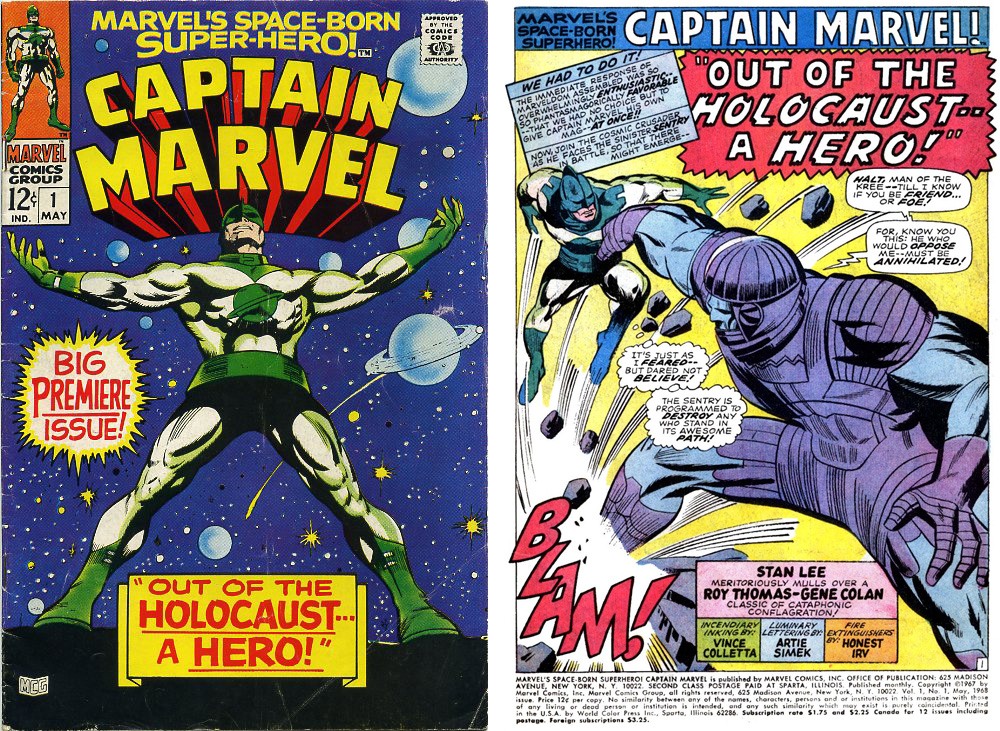
At the end of the instalment, there's the standard Next Issue blurb, telling us to expect more of the same in Marvel Super-Heroes 14 ... except that's not what we got. With the sudden and dramatic expansion of the Marvel line in the spring of 1968, Martin Goodman evidently felt that boosting Captain Marvel into his own title would further reinforce his claim to the character's name (and he was also looking to expand the comics line so he could get more money from the prospective new owner of Marvel, Marty Ackerman) ... so that's what happened. I've discussed the 1968 Marvel explosion elsewhere in this blog, so I won't go over the same ground again, but instead of putting the next Captain Marvel story in Marvel Super-Heroes, Goodman ordered Editor Stan Lee to prepare an additional title, Marvel's Space-Born Super-hero, Captain Marvel, which debuted on 8 Feb 1968, cover-dated May 1968, the same month that Iron Man and Sub-Mariner got their own titles.

Despite having a full two months to prepare Captain Marvel 1 (May 1968) for publication, the whole affair feels very rushed, both storywise and artwise.

Roy Thomas and Gene Colan continued the story started in Marvel Super-Heroes, though this time, Colan's pencils were inked by Vince Colletta, probably one of the least sympathetic inkers on Marvel's roster. But somehow, this time, there doesn't seem to be enough story the fill the 21 pages allocated to the last chapter of the story. Essentially, it mostly a battle against the Sentry, peppered with jump-the-shark lines like "He doesn't realise I modified my [jet] belt." and "I did indeed modify the uni-beam". There's also a quick scene back on the mother-ship where Medic Una tries and fails to escape her bonds, and in the latter half of the battle outside the missile base, Captain Mar-Vell once again meets Carol Danvers, the base's Head of Security.

Despite 16 pages out of the 21 pages being taken up with battle action, Roy Thomas still manages to squeeze in scenes with the two important female characters.

Needless to say, The Sentry is defeated, Mar-Vell is accepted as a hero and the title is on the schedule as a monthly. Given that Colan's art does looked awfully hurried , you have to wonder what issue 2 is going to look like.

Tick,tick,tick ... Mar-Vell must defeat the Super Skrull if he's to prevent his own nuclear briefcase from annihilating the US Army missile base and everyone on it.

Well, to be honest, it looked a lot like the previous issue. Vinnie Colletta was still there on inks, doing as little as he could get away with, but Roy Thomas was gamely trying to include more story and less fighting. The plot had the nosey night clerk from the motel "Walter Lawson" was staying at - the one who was snooping around in Mar-Vell's room and finding the standard-issue Kree attache case - deciding that he should turn the case over to the military. What he doesn't know is that in fiddling with the case, he's armed a nuclear device that will destroy everything in a ten mile radius within two hours. Meanwhile, the Skrulls are wondering what a high-profile Kree warrior like Mar-Vell is doing on a backwater planet like Earth, and despatch the Super-Skrull to find out. Yes, you guessed it ... the Super-Skull tries to force Mar-Vell to explain himself, preventing our hero from disarming the nuclear explosive in his attache case. So Roy wasn't altogether unsuccessful here. Penciller Gene Colan does some great action sequences, but there's a lot of three and four-panel pages, to stretch the still rather thin material out to 20 pages.

Mar-Vell finally defeats the Super-Skrull by using the same method Mr Fantastic used in FF2 ... (spoiler alert!) he hypnotises the alien into forgetting who he is ...

Captain Marvel 3 (Jul 1968) has more of the same ... capturing Mar-Vell, the Super-Skrull takes his prisoner to his Skrull ship and tries to extract the secret of Mar-Vell's mission - though it's little more than a three-page recap of the previous chapters of the Kree warrior's story. But Mar-Vell breaks free and leads his enemy up to the edge of Earth's atmosphere, where Mar-Vell's jet-belt begins to fail. Thinking his foe doomed, the Super-Skrull returns to Earth to recover Mar-Vell's attache case (remember that?), while Mar-Vell manages to reach the invisible Kree ship. There's some more obligatory argy-bargy with the mean Yon-Rogg, then Mar-Vell wins permission to return to Earth and beat down on the Super-Skrull some more.

Captain Marvel finally defeats the Super-Skrull - using the time-worm hypnosis trick -and disarms his nuclear briefcase. And that's it for another month.

The following month, in Captain Marvel 4, our hero finds himself trapped in an almost identical plot, except this time the one preventing him from saving the Earth is Prince Namor, the Sub-Mariner.

My guess is that at the beginning of the Captain Marvel run, Stan had mandated that he battle a few established Marvel characters first to help with sales and to show the readers where in the power pecking-order Mar-Vell stood ...

Namor is on his way to seek help tracking down his enemy Destiny from, of all people, Reed Richards (see Sub-Mariner 3, Jul 1968). At the same time, a test missile is being launched from the base where Mar-Vell poses as Dr Walter Lawson. The missile will carry bacteria into orbit to test their resilience to cosmic rays. But the missile goes off-course and crashlands in the sea close to New York. Mar-Vell hurries to destroy the payload before all of New York is drenched in deadly microbes, and The Sub-Mariner sort of gets in the way.

These last few issues have seemed a bit "by-the-numbers", as though Thomas and Colan were just trying to get a task off their to-do list as quickly as possible. I suspect Stan Lee may have mapped out the course for the first few issues, which Thomas just had to follow. Likewise, it's far from Colan's best work. Compare what he was doing over on Daredevil at the same time (issue 43 came out the same month as CM4) and it's a very different kettle of artwork. And adding to the pressure was the 25 pages of artwork Colan turned in for the Madame Medusa story in Marvel Super-Heroes 15 (Jul 1968). Colan had already dropped Iron Man from his workload a couple of months earlier, and Captain Marvel 4 would be his last issue. The following month he'd take over Doctor Strange from Dan Adkins and that was an assignment that really played to Colan's strengths. Besides, it would have sublime Tom Palmer inking.

Just some of the highlights of Drake's stint at DC ... the Jerry Lewis comic with camp counsellors as Nazis caused less furore than you might imagine.

Captain Marvel was not to be stopped, though. Issue 5 came with a change of personnel. The scripting was assumed by Arnold Drake, who'd toiled for 15 years at DC on strips like Challengers of the Unknown, Bob Hope, Jerry Lewis and most notably Doom Patrol. It was Drake who had confronted Irwin Donenfeld back in the early 1960s, when Marvel was making inroads on DC's sales. Drake had tried to explain to the DC Editorial Director that times were changing and so were the comic audiences. DC needed to change with them if they were going to complete with Marvel Comics. The DC management still weren't listening as Marvel Comics overtook them in sales, and Drake left DC - quit or was shoved, accounts vary - and started working for Marvel around the beginning of 1968.

On paper, Drake probably looked like a good fit to Stan, who was in dire need of experienced writers to help with Marvel's virtually doubled-overnight output. But as I noted in my earlier piece, Drake had realised that Marvel were doing something right, but he struggled to articulate exactly what that was. "Pitch the books at an older readership" is a manifesto, not an instruction manual.

Experienced though Arnold Drake was, he couldn't quite put his (typing) finger on the authentic-sounding Marvel "tone", and as a result, his third scripting job under Stan's editorship rings a little bland.

So it's not surprising to me that Captain Marvel 5 (Sep 1968) could easily have been published by DC. I mean, there's nothing wrong with it ... the story moves along and the dialogue is serviceable, if a little ponderous in places, like a not-very-good pastiche of Stan's writing. But Drake is just finding his feet here - this is his third script for Marvel after Captain Savage 5 and X-Men 47 - so it wouldn't be fair to be too harsh, at this point.

On the other hand, the Don Heck art job was extremely serviceable. At this point in Marvel's history, poor Don had been abandoned to a certain extent. After losing his regular Avengers gig to John Buscema with issue 40 (May 1967), probably under the pretext that he had the 54 pages of Avengers Annual 1 (Sep 1967) to pencil. He returned to Avengers for a fill-in on issue 45 (Oct 1967) and was then assigned to X-Men, one of Marvel's poorest selling titles, from 37 - 55. We know this because when Marvel managed to hire Neal Adams, he asked Stan, "which is your worst selling title?" ... and when Stan said, "X-Men", Adams said, "I'll draw that, then." When Adams took over X-Men, Heck was left with pencilling Amazing Spider-Man 57-64 & 66 (Feb - Nov 1968) over John Romita layouts, Captain Marvel (reassigned to Gil Kane with issue 17, Oct 1969), Captain Savage (reassigned with issue 17, Nov 1969). It's almost as if someone had decided that Heck's services were no longer needed at Marvel. So by the end of 1969, Heck would pack up his pencil and head off to DC where he was better appreciated, drawing great female characters like Batgirl, Rose & Thorn and Wonder Woman.

The monsters come thick and fast in Captain Marvel 6 ... it reads a little like Drake delivered a story synopsis front-loaded with too much story and Stan added the action sequence to kick things off.

The following month, Captain Marvel 6 (Oct 1968) gave us not one, but two monsters of the month, behind the Don Heck cover. The first was featured in a spurious action sequence opener for the issue where Mar-Vell battled a simulated monster in a Kree virtual battle exercise. The second is the solar energy generated Solam, and energy beast created by a visiting scientist's ill-considered "tampering with the unknown" style experiment. Captain Marvel defeats the second monster by over-feeding it with energy, a tactic that's been used before in the Marvel Universe ... a No-Prize for the first reader who can identify where.

Captain Marvel's persistent thwarting of evil Yon-Rogg's plan are a bit more interesting than the battle with the obligatory monster ... this month, Quasimodo.

Captain Marvel 7 (Nov 1968) cover-starred Quasimodo (last seen battling the Silver Surfer in Fantastic Four Annual 5 (Nov 1967) drawn by John Romita, but Drake's script brought a bit more of Mar-Vell's melodrama to the proceedings. First, Captain Marvel faces the accusations of Yon-Rogg (again) for helping the Earthlings defeat last issue's Monster-of-the-Month. Yet, even Ronan the Accuser is unable to make the charges stick. Next up, Yon-Rogg, tiring of Carol Danvers' ongoing investigation of "Walter Lawson" resolves to disintegrate her with a blast of cosmic rays from his ship's cannons ... but Mar-Vell contrives to save her. The rest of the issue has Mar-Vell battle Quasimodo and thwart Yon-Rogg's orders to wipe out a random Earth community with a deadly virus, by appearing to "kill" Quasimodo's humanoid robots with the bacterial sample ...

This was the first issue where I felt that Drake was daring to develop the characters and the backstory a bit ... exposing the real Walter Lawson as a bit of a shady character. Nice to see Gene Colan back on the cover art.

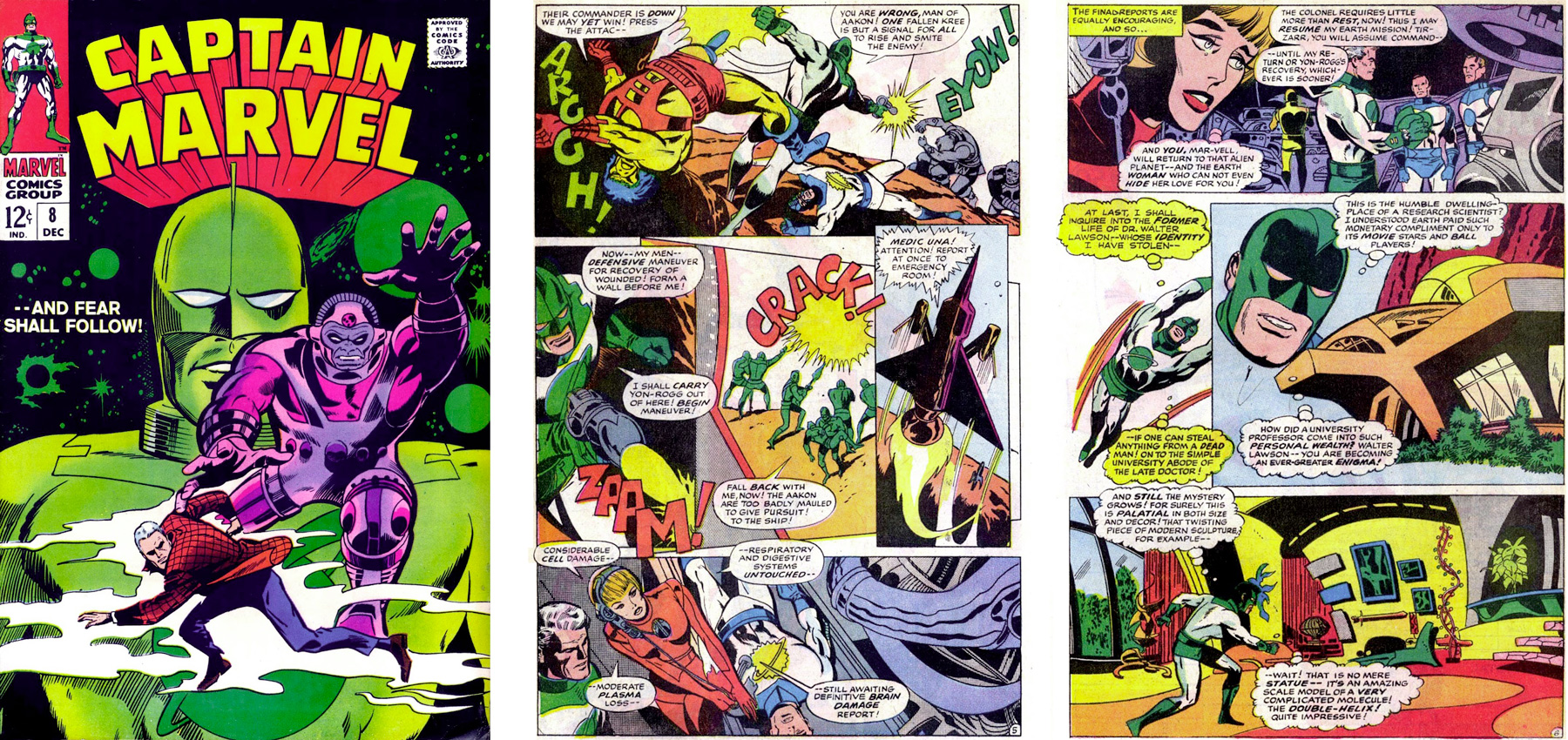
Captain Marvel 8 (Dec 1968) opens with a battle between an interloping alien species called The Aarak and Yon-Rogg's Kree expeditionary force. Though Yon-Rogg is wounded in the battle and is recovered by Captain Mar-Vell, he shows little gratitude, relentlessly pursuing his vendetta against his junior officer. After the battle, Mar-Vell returns to Earth and begins to investigate the life of the Earth man he's impersonating, Dr Walter Lawson. Lawson's home is more lavish than a research scientist could aspire to. And beneath the house, Captain Marvel discovers an extensive and well-equipped laboratory. The evidence suggests Lawson had created a large robot, though for what purpose is not disclosed. The mystery deepens when two costumed gunmen enter Lawson's home and start shooting at Captain Marvel. It appears that Lawson had created the robot for some criminal organisation and now the murderous machine is on the loose, cuing up yet another battle between Captain Marvel and a monster. Inevitably, a five-page battle ensues and Captain Marvell apparently destroys the giant robot

Last issue the giant robot didn't seen to have a name, being referred to as "robot" or "cyberton" This time out, he calls himself "Cyberex" and everyone else follows suit. Sounds like an editorial correction to me. And another nice Colan cover.

But we're not done with the Aakon - or the robot - yet ... they're all back in the following issue. And because of Yon-Rogg's reckless attack, a retaliation by the Aakon threatens to expose Mar-Vell's Kree mission on Earth. So, here's an abbreviated version of the plot ... Carol Danvers goes snooping around "Walter Lawson's" motel room. The giant robot turns up and takes her as bait for "Lawson". The robot reveals that Lawson is not his creator. Inexplicably. Captain Marvel knows that the robot is holding Carol captive and rushes to rescue her. Yon-Rogg remotely activates Mar-Vell's wrist monitor so the Aakon know where he is ... and of course they attack. Cue the three-way battle between Captain Marvel, the Aakon and the giant robot (who now calls himself Cyberex) lasting a slightly excessive nine pages. It's all a bit humorless and po-faced. I'm not getting the sense, here, that Arnold Drake was able to grasp what it was that made Stan's scripts so memorable. Interestingly, that issue's Bullpen Bulletins bigs up the new Marvel scripters, Archie Goodwin and Arnold Drake. Stan (or maybe Roy) even touts some forthcoming work by Atlas veteran Ernie Hart. In the end that turns out to be the solitary dialoguing job Hart did on Nick Fury 8 (Jan 1969), before disappearing from Marvel for the final time.

Captain Marvel 10 plods its way through Arnold Drake's plot. But Heck delivers some nice work here. I really like his layout on page 10.

In Captain Marvel 10 (Feb 1969), we begin to learn a bit more about The Organisation, the criminal outfit that sent the Cyberex robot after "Walter Lawson", and its leader, Number One. Mar-Vell, too, is destined to discover more about his underhanded foes, as Ronan the Accuser orders him to gather information on The Organisation in case The Kree have to "deal with" them one day. However, The Organisation captures Carol Danvers and invites "Walter Lawson" to surrender to them. Captain Marvel goes in his place and initially pretends to be interested in an alliance, but slips a gas capsule to Carol that she can use to escape. Then all heck breaks loose and Mar-Vell finds himself facing an aging ray, apparently created by the real Lawson. Mar-Vell turns the ray on The Organisation and pretty much cleans their clock. But there's unexpected fallout from his victory. Yon-Rogg orders Captain Marvel's immediate execution.

And that pretty much closes the door on The Organisation, a kind of bargain-basement AIM, without the interesting bee-keeper outfits. I wasn't terribly sorry to see the back of them. I was a bit sorry to see Heck leave the book, though ...

Why the Barry Smith cover and the rushed Dick Ayers interior art? I'd speculate that the inexperienced Barry was supposed to do the insides but ran into scheduling problems and Ayers had to bail Marvel out. But pure guesswork on my part.

Captain Marvel 11 (Mar 1969) sported an interesting Barry Smith cover, one of his first works at Marvel. Channelling Kirby, Smith's art is is even more extreme, and it might have been more interesting if Smith had drawn the interior art. But what we got was a very rushed-looking Dick Ayers pencil job, not helped by Vinnie Colletta's usual slapdash inking. Arnold Drake's script takes Mar-Vell in a completely new direction. I don't know what went on behind the scenes. Perhaps sales weren't all that Stan was hoping for, but with this issue Drake brings in some sweeping changes. He kills off Medic Una, which I think was for the best. That storyline wasn't going anywhere. He also gets rid of Mar-Vell's weapon, the Uni-Beam, and gives our hero actual superpowers - through the agency of Zo and his conveniently lovely gaggle of handmaidens.

The way in which Captain Marvel gets a makeover is all a bit contrived ... can it be a coincidence that "Zo" is Oz backwards? Pay no attention to that man behind the curtain ...

The catch is that going forward, Captain Marvel will become a tool of the alien intelligence Zo and that may or may not involve some tough moral choices ... but I'm getting ahead of myself.

A hugely better art job from Dick Ayers in Captain Marvel 12, almost as if he's trying to blot out reader's memories of last month's lacklustre art, but the pace of Arnold Drake's storytelling is glacial.

So, as Captain Marvel 12 (Apr 1969) gets under way, Mar-Vell returns to Earth and tries to resume his Walter Lawson identity. I'm not sure why, as he's no longer under any obligation to carry out his Kree mission. And posing as Walter Lawson won't conceal his presence from Yon-Rogg .. but as "Lawson" returns to the missile base a plastic robot, The Manslayer, attacks and Captain Marvel ventures forward to defend the base. In another location, Natasha Romanova, The Black Widow, is stalking the controller of the robot, presumably on a SHIELD mission. Though The Widow manages to stop the robot, she's captured by the bad guy controlling the robot, to be held as a hostage against some future threat.

This would be the last issue from Arnold Drake and Dick Ayers. In fact, shortly after this, Drake would finish up his run of Captain Savage, with issue 16 (Sep 1969), pack up his typewriter and move over to Gold Key. It wasn't a memorable run, and I don't think Drake ever really understood the Marvel way of doing things.

Arnold Drake: 1 Mar 1924 - 12 Mar 2007

Drake would spend the rest of his comics career writing a variety of titles for Gold Key, contributing a long and memorable run on Little Lulu, and even returning to DC where he scripted Phantom Stranger and wrote a few stories to DC's war titles, most notably Weird War Tales. Drake had pretty much retired from comics around 1985, and died in 2007 after a short battle with pneumonia.

But that wasn't the end of Captain Marvel's publishing troubles. Marvel Comics would continue to struggle to find a strong commercial direction for Mar-Vell, and I'll be looking at the rest of his rocky early progress in the next instalment of this blog.

Next: A superhero in search of a USP