Monday, 1 May 2023

Captain Marvel: Part 3

A YEAR ON FROM THE GREAT MARVEL EXPLOSION OF 1968 and it was becoming noticeable that Martin Goodman's grand plan to increase Marvel's output wasn't going to be sustainable.

When Marvel's total monthly page output went up from around 280 pages per month to about 400 pages, Editor Stan Lee needed to find more creators to produce the extra 120 pages of original story art he'd need just to keep the Marvel machine fed. He already had Roy Thomas and Gary Friedrich helping out on scripting. He'd added Archie Goodwin and Arnold Drake in 1968 - both looked great on paper, Goodwin with long experience at Warren magazines and Drake with a wealth of experience at DC, but by mid-1969, Drake had left Marvel and Captain Marvel needed a new writer.

As it turned out, Gary Friedrich was able to step in for a few issues, while editor Stan cast around for a permanent replacement. Also incoming was new Marvel recruit, Frank Springer, replacing Dick Ayers who'd pencilled the last couple of issues. Springer had pencilled at Dell until the end of 1967, then joined DC for about eight months - I'd particularly enjoyed his work on Secret Six - before hopping over to Marvel to draw SHIELD 4 (Sep 1968).

Though my 14 year old self wasn't best pleased to see Frank Springer take over from SHIELD artist Jim Steranko, I had enjoyed his work on DC's Secret Six. He also delivers a splendid job on Captain Marvel, diminished only a little by Vince Colletta's indifferent inking.

Captain Marvel 13 (May 1969) kind of re-hashes issue 12, with an unnecessary second battle against the Manslayer and a punch-up between Mar-Vell and Yon-Rogg. Incredibly, Yon-Rogg knocks Mar-Vell down during the fight, despite Captain Marvel's hugely enhanced physical strength (courtesy of the cosmic entity Zo). It's almost as if Friedrich hadn't read the previous issue. Or maybe he was just dialoguing an Arnold Drake plot ... either way, it added up to an unmemorable story.

Although touted as a crossover with Avengers 64 and Sub-Mariner 14, Iron Man's appearance in this issue of Captain Marvel seemed more like marketing opportunity than a story necessity.

Captain Marvel 14 (Jun 1969) featured a guest-appearance by Iron Man, a sure sign that sales on Mar-Vell's book weren't all that Editor Stan Lee had been hoping for. But this shouldn't have been much of surprise for Stan. Both art and scripts on the title had been distinctly second-tier up till this point ... and something had to be done. The introduction of Iron Man didn't make a great deal of sense, as guest villain. The Puppet Master (not looking like a ventriloquist's dummy any more, he had plastic surgery in Strange Tales 133, Jun 1965) takes possession of Iron Man and forces him to seek out and battle Captain Marvel for no reason that is ever explained.

But for me, now as then, the plot ("Captain Marvel battles Iron Man") is the least important part. The character development has always been more interesting to me. This issue moves it forward a little. Captain Marvel returns to the orbiting Kree ship and has a showdown with Yon Rogg - though Mar-Vell inexplicably allows his enemy to live - and then Zo decides Mar-Vell has had enough freedom and must now return to the Kree homeworld, for reasons yet to be explained.

Tom Sutton had been working steadily at Warren for a couple of years, then drew quite a bit of the later issues of Not Brand Echh. This was one of his few superhero jobs for Marvel. He'd later carve a niche on Marvel's Planet of the Apes, and at Charlton.

And that's exactly what happens in Captain Marvel 15 (Aug 1969). Working with incoming newcomer Tom Sutton, Gary Friedrich takes Mar-Vell off in a far more cosmic direction. It's almost a foretaste of what Jim Starlin would do with the character just a few years later. Zo begins by showing Mar-Vell his past and his future, revealing that Mar-Vell is destined to destroy his own people. Unable to accept that his fate is inevitable, Mar-Vell resolves to follow the path set out by Zo but plans to thwart Zo's predictions at the first opportunity. When he does arrive on the Kree homeworld, he's embroiled in a battle against the invading followers of Tam-Bor.

I quite like Sutton's groovy, cosmic layouts here, but you can see that his draftsmanship isn't quite as slick as more seasoned artists like his predecessors Dick Ayers and Frank Springer. Even Dan Adkins' usually deft inks can't quite punch this up.

Then, just when it looks like Gary Friedrich is taking this book in an interesting direction, he's replaced by incoming scripter Archie Goodwin, who makes a pretty good fist of tying up all the disparate events and situations created by all the previous scripters on the series.

Captain Marvel 16 (Sep 1969) is a complicated issue, as Goodwin tries to sort out and make sense of the various plot threads dangling since the beginning of the series.

So ... it turns out that the Kree Supreme Intelligence (introduced in this issue) is behind almost everything that's happened. Two Kree traitors have been scheming to take over the Kree Empire, second-in-command Zarek - who also posed as cosmic entity Zo - and his henchman Ronan the Accuser. The appointment of Yon-Rogg as Mar-Vell's superior officer was all part of the plot, and Mar-Vell - because he was a straight-arrow hero-type - was selected by Zarek as the fall-guy to blame it all on. Poor Medic Una was just so much collateral damage. The Supreme Intelligence was aware of the plot and simply bided his time till it came to a head, knowing that Mar-Vell would do the right thing. For his heroic actions, Captain Marvel is promoted to warrior and is given a new uniform. And he gets to keep his Zo-given cosmic powers. Yes, some of the resolutions are wobbly, but it's pretty obvious that this is a clearing-of-the-decks for a major change in direction.

It's great to see Heck back on pencils, with some fine finishing by Syd Shores on inks. But it's only for a moment, as next issue, Editor Stan brings in the big guns to try to get the title up on its hind legs, assigning Roy Thomas as scripter and DC Comics stalwart Gil Kane as artist.

WHO THE HECK IS GIL KANE?

Gil Kane (born Eli Katz, 6 Apr 1926) began his career at MLJ (later Archie Comics) in 1942 where he worked in the production department erasing pencils, ruling panel borders and outlining speech balloons. Fired after three weeks, Kane got a job at the Jack Binder Studio doing pencilling work. "They weren't terribly happy with what I was doing. But when I was rehired by MLJ three weeks later, not only did they put me back into the production department and give me an increase, they gave me my first job, which was Inspector Bentley of Scotland Yard in Pep Comics, and then they gave me a whole issue of The Shield and Dusty, one of their leading books," he told The Comics Journal in 1996. By 1944 he was freelancing for Simon and Kirby, who were supplying material to DC, and drawing for other publishers like Hillman, Rural Home and Aviation Press. Kane was drafted into the Army the same year, not returning to civilian life until 1945. He began drawing directly for DC under editor Sheldon Mayer, while contributing art to a range of Prize Comics titles. By 1949 Kane was working on Julius Schwatz's stable of titles, notably Jimmy Wakely, Rex the Wonder Dog and All-Star Western.

Western comics were big sellers for DC during the 1950s and Kane's work was much in demand. Later, he'd also draw sf and romance strips for the company.

Kane continued at DC throughout the 1950s, drawing anything he was asked to - science fiction, romance and westerns - but as these genres began to flounder, DC was looking for other avenues and turned their attention to superheroes once more. 

With the DC superhero revival in full swing, Kane was their star artist on two important books, but even the occasional job on DC mystery titles wasn't enough to fill his schedule.

Kane got the job of pencilling the revived Green Lantern, but found with the loss of his other titles, he hadn't enough work to keep him busy. "By the end of the '50s, everything began to collapse and, little by little, I lost all of my work," Kane told The Jack Kirby Collector in 1998. "I lost Rex, the Wonder Dog and all the westerns. I lost everything and had nothing going. I would occasionally get a science-fiction story from Julie. I went over to Western/ Gold Key and worked with Russ Heath as a partner for a while; I penciled and he inked. So I picked up work wherever I could. Green Lantern filled in a lot but not completely; it was every six weeks and not a monthly book." Kane pitched a revival of The Atom to DC and began pencilling that, as well. "I designed the character and the costume and everything else, and showed them my drawings and sketches and they decided to build a magazine around it," said Kane in an interview with Comic-Art.com. "It was very much like a character done by my favourite artists Louie Fine and Reed Crandall [Doll Man] ... I must admit that it was sort of boring doing it. I really didn't enjoy it ... because I longed to ink my own pencils, which they wouldn't let me do."

Stan started Gil Kane off on covers, but soon found some interior pencilling for him on The Hulk and Captain America.

Towards the end of 1966, after trying to get in at Tower Comics, Kane went to Stan Lee and picked up some work pencilling The Hulk in Tales to Astonish, where he was allowed to ink his own work. A month or two later, Kane was also pencilling and inking Captain America in Tales of Suspense. That and some cover work from Stan seemed to help, but Kane's first Marvel tenure only lasted a short while. After about three months, Kane was back at DC. 

Maybe the prospect of losing one of their star artists focussed DC's attention and they found him more work, adding regular work on Detective Comics. Throughout 1968 and 1969, Kane was also pencilling on Hawk and Dove, Captain Action, Batman and Teen Titans. The Atom was merged with Hawkman in mid-1968, but Kane didn't draw the new title. Then, in mid-1970, Neal Adams took over the art on Green Lantern, and although Kane drew The Flash for a few months, it was looking like DC were struggling to hang on to Gil Kane. 

Gil Kane: 6 Apr 1926 - 31 Jan 2000

By mid 1971, Gil Kane was working pretty much exclusively for Marvel, drawing Amazing Spider-Man and most of their covers.

AND BACK TO CAPTAIN MARVEL

Captain Marvel 17, cover dated Oct 1969, was on the newsstands 15 Jul 1969. It was pretty obvious that this was a completely different approach to the character.

The whole idea of a youngster miraculously transforming into a superhero on demand did seem awfully familiar. Rick Jones was even given Billy Batson's signature blue trousers and red top.

Roy Thomas ditched most of the backstory and re-tooled Marvel's Captain Marvel to vaguely resemble the classic Fawcett version. Rick Jones, former partner of both The Hulk and Captain America, was drafted in as the Billy Batson stand-in. Rick only had to clash his wristbands together to swap places with Captain Marvel in the Negative Zone. And their first order of business is to rescue Carol Danvers, who we saw kidnapped by Yon-Rogg in the previous issue. 

The only slight glitch I saw was where Captain Marvel claims that he now has no powers, except for those that the Nega-wristbands give him (Rick's wristbands don't give him any powers). Yet in Captain Marvel 16, Captain Marvel explicitly tells us he retains the power bestowed on him by "Zo". I'm confused ...

But whatever powers Captain Marvel now has, they're not enough to keep Yon-Rogg from making off with his captive, Carol Danvers. And hot on his trail ... Rick Jones.

This issue, Captain Marvel battles another monster-on-the-month and Rick meets Mordecai P. Boggs, who bears a passing resemblance to Uncle Dudley Marvel, I think. Oh, and Carol Danvers gets genetically altered ...

Captain Marvel 18 (Nov 1969) takes a little time to get going. First there's an unexplained incident where Rick Jones is nearly run over by a random motorist. Then there's a strange sequence at a diner in a nearby town where Rick sings a song, gets into a bar-fight and is offered a recording contract by Mordecai P. Boggs. Captain Marvel then "deduces" where Yon-Rogg is hanging out, though no explanation is ever given as to how he did it. The confrontation with Mar-Vell's mortal enemy is drawn by John Buscema, and during the fracas Carol Danvers is exposed to radiation from a Kree Psyche-Magnitron ... this is important because this is what causes the genetic transformation that allows Carol to gain super-powers and become Ms (later, Captain) Marvel.

Captain Marvel is at the mercy of a mad sociologist, trapped in a death-trap apartment block with hundreds of terrified tenants. Not your usual superhero tale.

The following month, Captain Marvel 19 (Dec 1969) finally gave us a story that wasn't just tying up loose ends from previous issues and setting the scene for this new version of Mar-Vell. Rick Jones needs a job and somewhere to live and answers an ad in The Daily Bugle offering accommodation in a luxury high-rise. But the landlord Cornelius Webb is a crazed sociologist who wants test the work of behavourist Burrhus Skinner to see if humans can be conditioned in the same way that rats can. As Webb conjures up illusions and deadly physical traps, Captain Marvel tries to protect the tenants while finding and stopping Webb. But it's Auschwitz survivor, the kindly Mr Weiss, who literally pulls the plug on Webb and causes his downfall.

It's a little heavy-handed in places, but it does seem to be a genuine attempt to offer a slightly different take on Marvel's usual super-hero tale. The letters page of the issue reveals that the plot came from Gil Kane. And though there's no advance warning on this issue's letters page, the title would be going on hiatus for six months, though no reason was ever given.

Strangely, there's no mention of The Hulk on the over of Captain Marvel 20 (Jun 1970), which is odd, considering it's been six months since the last issue came out, and the title can probably use all the hype it can get.

When Captain Marvel did return in late March 1970, it was the same creative team and the story picked up without a blip. Rick and Mar-Vell decide that the one person who can help them both out of the Negative Zone trap is Dr Bruce Banner, and the pair resolve to track him down. There is a side plot with some organised looters taking advantage of a natural disaster, but the main part of the tale is the inevitable collision with The Hulk.

There's still no satisfying explanation given by Marvel for just why the title went on a break. On the letters page, Roy insisted that the last few issues were "sales blockbusters" (really, Roy?) ... but it doesn't seem terribly likely that Marvel would suspend a successful title on a whim.

Also, I don't think it likely that Gil Kane sat around waiting for Captain Marvel to start up again. My guess would be that all the Kane issues were drawn at the same time and the art to Captain Marvel just sat in a drawer until they were ready to publish it.

In attempt to beef up interest in the title, Roy and Gil feature The Incredible Hulk for the final two issues of the title's second "trial period", but ass it turns out, this wouldn't be enough to convince Marvel to continue the series.

Captain Marvel 21 (Aug 1970) would signal the swansong of the title for a while. The entire issue is pretty much a battle royale with the mighty Hulk. Mar-Vell is outmatched from the get-go and the fighting only comes to an end when Rick returns to our universe and confronts The Hulk. Some part of the monster remembers his young friend and the creature's anger evaporates ...

The idea of asking for Banner's help in freeing Captain Marvel from the Negative Zone is left unresolved - deliberately according to Roy Thomas' comment in the issue's letter column - so there wouldn't be a change to the concept of Rick Jones and Mar-Vell trading atoms in the immediate future.

Marvel kept Captain Marvel in front of readers by making him an important player in the classic Kree-Skrull war storyline in The Avengers ... much of it drawn by superstar artist Neal Adams.

Roy Thomas wasn't about to give up on Captain Marvel ... he reintroduced the character in a pivotal role in the Kree-Skrull war that would play out in The Avengers from issue 89 (Jun 1971) to 97 (Mar 1972). This would give Marvel the confidence to re-start the Captain Marvel title a couple of months later with Thomas editing Gerry Conway on script and veteran Superman artist Wayne Boring on pencils. 

Quality-wise, the third stab at reviving the Captain Marvel title just sort of matched what had gone before. But the bi-monthly was just setting up the debut of writer-artist Jim Starlin who would shake things up with the introduction of uber-villain Thanos.

In the haitus, though, DC Comics must have sensed an opportunity. Thinking Marvel's Captain Marvel gone for good - at least in his own title - they entered into a licensing agreement with Fawcett to start publishing a new Captain Marvel comic, on sale just before Christmas 1972, and managed to get the original creator C. C. Beck out of retirement to draw the book. Marvel got wind of their plans and made sure DC didn't nurse any notions of calling the book "Captain Marvel". So DC titled the comic Shazam, and used the Captain Marvel name smaller on the cover. On paper it might have seemed like a great workaround, but Marvel hit DC with a cease and desist order pretty promptly and though the litigation dragged on a bit, by Shazam 14 (Nov 1973), DC were forced to remove the "Original Captain Marvel" sub-line from the Shazam covers.

I'm not sure what DC were thinking ... the project feels more like a spoiler than a serious attempt to revive a character whose time was up two decades earlier.

Meanwhile, back at Marvel's Captain Marvel book, it was just more of the same with a not-great storyline and art from a skilled but ultimately unsuitable artist. If Marvel was going to make a go of Marvel, something drastic had to happen. Fortunately, a newcomer, Jim Starlin was just a couple of months way from making his debut pencilling the series, then plotting and finally writing and drawing the whole thing himself. He brought his Thanos character with him and that run was to set the character up for a hugely successful six-year run in his own title and numerous spinoffs, including making Carol Danvers a superhero, first as Ms Marvel, then as Captain Marvel in her own right.

Now it gets good ... Jim Starlin brought a fresh and different take to the character of Captain Marvel and pretty much made it his own.

But that all took place in the Bronze Age of Marvel Comics and is a subject for another time ... and probably another blog.

Next: Classical Art and Comic Covers


Saturday, 4 March 2023

Captain Marvel: Part 2

MARVEL COMICS MIGHT HAVE OWNED THE NAME CAPTAIN MARVEL, but I'm not entirely sure writer Stan Lee quite knew what to do with the character, after publisher Martin Goodman insisted the superhero be added to the company's lineup. After writing the first appearance himself, with the ever-capable Gene Colan on art, he handed the reins over to Roy Thomas, for me an indication that Stan didn't have a great deal of faith or interest in the project.

The first appearance of Captain Marvel in Marvel Super-Heroes 12 was scripted by Stan Lee. With the second appearance, Roy Thomas took over as writer.

For the origin and background of Captain Mar-Vell, Stan drew on the concepts of the Kree, an alien race first mentioned in Fantastic Four 64 (Jul 1967). And in setting up the background for Mar-Vell's story, he fell back on one of his favourite devices, the three-way romantic triangle - The Captain, his love interest Medic Una and the dastardly commanding officer Colonel Yon-Rogg. 

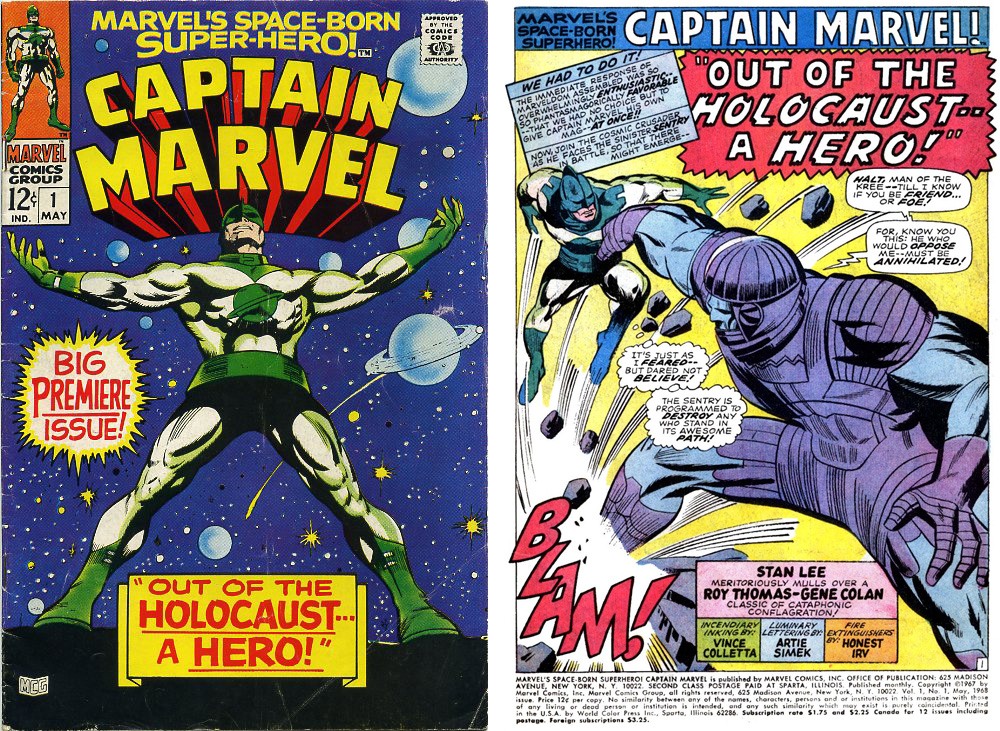
There's not a great deal of plot in the first Captain Marvel story ... what there is is pretty well outlined in the above two pages.

The Captain's here to investigate the destruction of Kree Sentry 459 at the hands of the Fantastic Four, and if necessary, punish the guilty. But the Captain's presence inadvertently interferes with a missile test and within moments he has the US Army hunting him. He disguises himself as a human and registers at a nearby seedy motel under the name of "Marvel" ... and that's pretty much it. Make something of that, if you can, Roy Thomas.

There's a lot more going on in Roy Thomas' take on Captain Marvel - Mar-Vell gets a secret identity, we meet Carol Danvers and witness the return of Sentry 459.

And to be fair, Roy does a bit better than that. Though he has an expanded page count (increased to 20 from the previous issue's 15), he still manages to pack every page with action, plot advancement and menace ...

Colonel Yon-Rogg's enmity towards Mar-Vell accidentally becomes the means by which Captain Marvel acquires the human persona of Walter Lawson. Yon-Rogg tries to blast Mar-Vell with the Kree ship's laser cannon, only to destroy the light aircraft bringing Lawson to the US Army missile base to take up a post as head of research. Lawson is killed in the blast, allowing Mar-Vell to assume his identity. Entering the base as Lawson, Mar-Vell meets Carol Danvers, who will loom large in later iterations of the Captain Marvel saga. It's also revealed that the remains of Sentry 459 have been transported to the base from the Pacific island where it had its fatal encounter with The Fantastic Four.

The only thing I wasn't mad keen on was Paul Reinman's inking, ill-suited to Colan's punchy and atmospheric pencils and not a patch on Frank Giacoia's inks in the previous issue.

If you bought Marvel Super-Heroes 14 for the next episode of Captain Marvel, then you were destined for disappointment. You got an inventory Spider-Man story from Ross Andru and Bill Everett instead.

At the end of the instalment, there's the standard Next Issue blurb, telling us to expect more of the same in Marvel Super-Heroes 14 ... except that's not what we got. With the sudden and dramatic expansion of the Marvel line in the spring of 1968, Martin Goodman evidently felt that boosting Captain Marvel into his own title would further reinforce his claim to the character's name (and he was also looking to expand the comics line so he could get more money from the prospective new owner of Marvel, Marty Ackerman) ... so that's what happened. I've discussed the 1968 Marvel explosion elsewhere in this blog, so I won't go over the same ground again, but instead of putting the next Captain Marvel story in Marvel Super-Heroes, Goodman ordered Editor Stan Lee to prepare an additional title, Marvel's Space-Born Super-hero, Captain Marvel, which debuted on 8 Feb 1968, cover-dated May 1968, the same month that Iron Man and Sub-Mariner got their own titles.

Despite having a full two months to prepare Captain Marvel 1 (May 1968) for publication, the whole affair feels very rushed, both storywise and artwise.

Roy Thomas and Gene Colan continued the story started in Marvel Super-Heroes, though this time, Colan's pencils were inked by Vince Colletta, probably one of the least sympathetic inkers on Marvel's roster. But somehow, this time, there doesn't seem to be enough story the fill the 21 pages allocated to the last chapter of the story. Essentially, it mostly a battle against the Sentry, peppered with jump-the-shark lines like "He doesn't realise I modified my [jet] belt." and "I did indeed modify the uni-beam". There's also a quick scene back on the mother-ship where Medic Una tries and fails to escape her bonds, and in the latter half of the battle outside the missile base, Captain Mar-Vell once again meets Carol Danvers, the base's Head of Security.

Despite 16 pages out of the 21 pages being taken up with battle action, Roy Thomas still manages to squeeze in scenes with the two important female characters.

Needless to say, The Sentry is defeated, Mar-Vell is accepted as a hero and the title is on the schedule as a monthly. Given that Colan's art does looked awfully hurried , you have to wonder what issue 2 is going to look like.

Tick,tick,tick ... Mar-Vell must defeat the Super Skrull if he's to prevent his own nuclear briefcase from annihilating the US Army missile base and everyone on it.

Well, to be honest, it looked a lot like the previous issue. Vinnie Colletta was still there on inks, doing as little as he could get away with, but Roy Thomas was gamely trying to include more story and less fighting. The plot had the nosey night clerk from the motel "Walter Lawson" was staying at - the one who was snooping around in Mar-Vell's room and finding the standard-issue Kree attache case - deciding that he should turn the case over to the military. What he doesn't know is that in fiddling with the case, he's armed a nuclear device that will destroy everything in a ten mile radius within two hours. Meanwhile, the Skrulls are wondering what a high-profile Kree warrior like Mar-Vell is doing on a backwater planet like Earth, and despatch the Super-Skrull to find out. Yes, you guessed it ... the Super-Skull tries to force Mar-Vell to explain himself, preventing our hero from disarming the nuclear explosive in his attache case. So Roy wasn't altogether unsuccessful here. Penciller Gene Colan does some great action sequences, but there's a lot of three and four-panel pages, to stretch the still rather thin material out to 20 pages.

Mar-Vell finally defeats the Super-Skrull by using the same method Mr Fantastic used in FF2 ... (spoiler alert!) he hypnotises the alien into forgetting who he is ...

Captain Marvel 3 (Jul 1968) has more of the same ... capturing Mar-Vell, the Super-Skrull takes his prisoner to his Skrull ship and tries to extract the secret of Mar-Vell's mission - though it's little more than a three-page recap of the previous chapters of the Kree warrior's story. But Mar-Vell breaks free and leads his enemy up to the edge of Earth's atmosphere, where Mar-Vell's jet-belt begins to fail. Thinking his foe doomed, the Super-Skrull returns to Earth to recover Mar-Vell's attache case (remember that?), while Mar-Vell manages to reach the invisible Kree ship. There's some more obligatory argy-bargy with the mean Yon-Rogg, then Mar-Vell wins permission to return to Earth and beat down on the Super-Skrull some more.

Captain Marvel finally defeats the Super-Skrull - using the time-worm hypnosis trick -and disarms his nuclear briefcase. And that's it for another month.

The following month, in Captain Marvel 4, our hero finds himself trapped in an almost identical plot, except this time the one preventing him from saving the Earth is Prince Namor, the Sub-Mariner.

My guess is that at the beginning of the Captain Marvel run, Stan had mandated that he battle a few established Marvel characters first to help with sales and to show the readers where in the power pecking-order Mar-Vell stood ...

Namor is on his way to seek help tracking down his enemy Destiny from, of all people, Reed Richards (see Sub-Mariner 3, Jul 1968). At the same time, a test missile is being launched from the base where Mar-Vell poses as Dr Walter Lawson. The missile will carry bacteria into orbit to test their resilience to cosmic rays. But the missile goes off-course and crashlands in the sea close to New York. Mar-Vell hurries to destroy the payload before all of New York is drenched in deadly microbes, and The Sub-Mariner sort of gets in the way.

These last few issues have seemed a bit "by-the-numbers", as though Thomas and Colan were just trying to get a task off their to-do list as quickly as possible. I suspect Stan Lee may have mapped out the course for the first few issues, which Thomas just had to follow. Likewise, it's far from Colan's best work. Compare what he was doing over on Daredevil at the same time (issue 43 came out the same month as CM4) and it's a very different kettle of artwork. And adding to the pressure was the 25 pages of artwork Colan turned in for the Madame Medusa story in Marvel Super-Heroes 15 (Jul 1968). Colan had already dropped Iron Man from his workload a couple of months earlier, and Captain Marvel 4 would be his last issue. The following month he'd take over Doctor Strange from Dan Adkins and that was an assignment that really played to Colan's strengths. Besides, it would have sublime Tom Palmer inking.

Just some of the highlights of Drake's stint at DC ... the Jerry Lewis comic with camp counsellors as Nazis caused less furore than you might imagine.

Captain Marvel was not to be stopped, though. Issue 5 came with a change of personnel. The scripting was assumed by Arnold Drake, who'd toiled for 15 years at DC on strips like Challengers of the Unknown, Bob Hope, Jerry Lewis and most notably Doom Patrol. It was Drake who had confronted Irwin Donenfeld back in the early 1960s, when Marvel was making inroads on DC's sales. Drake had tried to explain to the DC Editorial Director that times were changing and so were the comic audiences. DC needed to change with them if they were going to complete with Marvel Comics. The DC management still weren't listening as Marvel Comics overtook them in sales, and Drake left DC - quit or was shoved, accounts vary - and started working for Marvel around the beginning of 1968.

On paper, Drake probably looked like a good fit to Stan, who was in dire need of experienced writers to help with Marvel's virtually doubled-overnight output. But as I noted in my earlier piece, Drake had realised that Marvel were doing something right, but he struggled to articulate exactly what that was. "Pitch the books at an older readership" is a manifesto, not an instruction manual.

Experienced though Arnold Drake was, he couldn't quite put his (typing) finger on the authentic-sounding Marvel "tone", and as a result, his third scripting job under Stan's editorship rings a little bland.

So it's not surprising to me that Captain Marvel 5 (Sep 1968) could easily have been published by DC. I mean, there's nothing wrong with it ... the story moves along and the dialogue is serviceable, if a little ponderous in places, like a not-very-good pastiche of Stan's writing. But Drake is just finding his feet here - this is his third script for Marvel after Captain Savage 5 and X-Men 47 - so it wouldn't be fair to be too harsh, at this point.

On the other hand, the Don Heck art job was extremely serviceable. At this point in Marvel's history, poor Don had been abandoned to a certain extent. After losing his regular Avengers gig to John Buscema with issue 40 (May 1967), probably under the pretext that he had the 54 pages of Avengers Annual 1 (Sep 1967) to pencil. He returned to Avengers for a fill-in on issue 45 (Oct 1967) and was then assigned to X-Men, one of Marvel's poorest selling titles, from 37 - 55. We know this because when Marvel managed to hire Neal Adams, he asked Stan, "which is your worst selling title?" ... and when Stan said, "X-Men", Adams said, "I'll draw that, then." When Adams took over X-Men, Heck was left with pencilling Amazing Spider-Man 57-64 & 66 (Feb - Nov 1968) over John Romita layouts, Captain Marvel (reassigned to Gil Kane with issue 17, Oct 1969), Captain Savage (reassigned with issue 17, Nov 1969). It's almost as if someone had decided that Heck's services were no longer needed at Marvel. So by the end of 1969, Heck would pack up his pencil and head off to DC where he was better appreciated, drawing great female characters like Batgirl, Rose & Thorn and Wonder Woman.

The monsters come thick and fast in Captain Marvel 6 ... it reads a little like Drake delivered a story synopsis front-loaded with too much story and Stan added the action sequence to kick things off.

The following month, Captain Marvel 6 (Oct 1968) gave us not one, but two monsters of the month, behind the Don Heck cover. The first was featured in a spurious action sequence opener for the issue where Mar-Vell battled a simulated monster in a Kree virtual battle exercise. The second is the solar energy generated Solam, and energy beast created by a visiting scientist's ill-considered "tampering with the unknown" style experiment. Captain Marvel defeats the second monster by over-feeding it with energy, a tactic that's been used before in the Marvel Universe ... a No-Prize for the first reader who can identify where.

Captain Marvel's persistent thwarting of evil Yon-Rogg's plan are a bit more interesting than the battle with the obligatory monster ... this month, Quasimodo.

Captain Marvel 7 (Nov 1968) cover-starred Quasimodo (last seen battling the Silver Surfer in Fantastic Four Annual 5 (Nov 1967) drawn by John Romita, but Drake's script brought a bit more of Mar-Vell's melodrama to the proceedings. First, Captain Marvel faces the accusations of Yon-Rogg (again) for helping the Earthlings defeat last issue's Monster-of-the-Month. Yet, even Ronan the Accuser is unable to make the charges stick. Next up, Yon-Rogg, tiring of Carol Danvers' ongoing investigation of "Walter Lawson" resolves to disintegrate her with a blast of cosmic rays from his ship's cannons ... but Mar-Vell contrives to save her. The rest of the issue has Mar-Vell battle Quasimodo and thwart Yon-Rogg's orders to wipe out a random Earth community with a deadly virus, by appearing to "kill" Quasimodo's humanoid robots with the bacterial sample ...

This was the first issue where I felt that Drake was daring to develop the characters and the backstory a bit ... exposing the real Walter Lawson as a bit of a shady character. Nice to see Gene Colan back on the cover art.

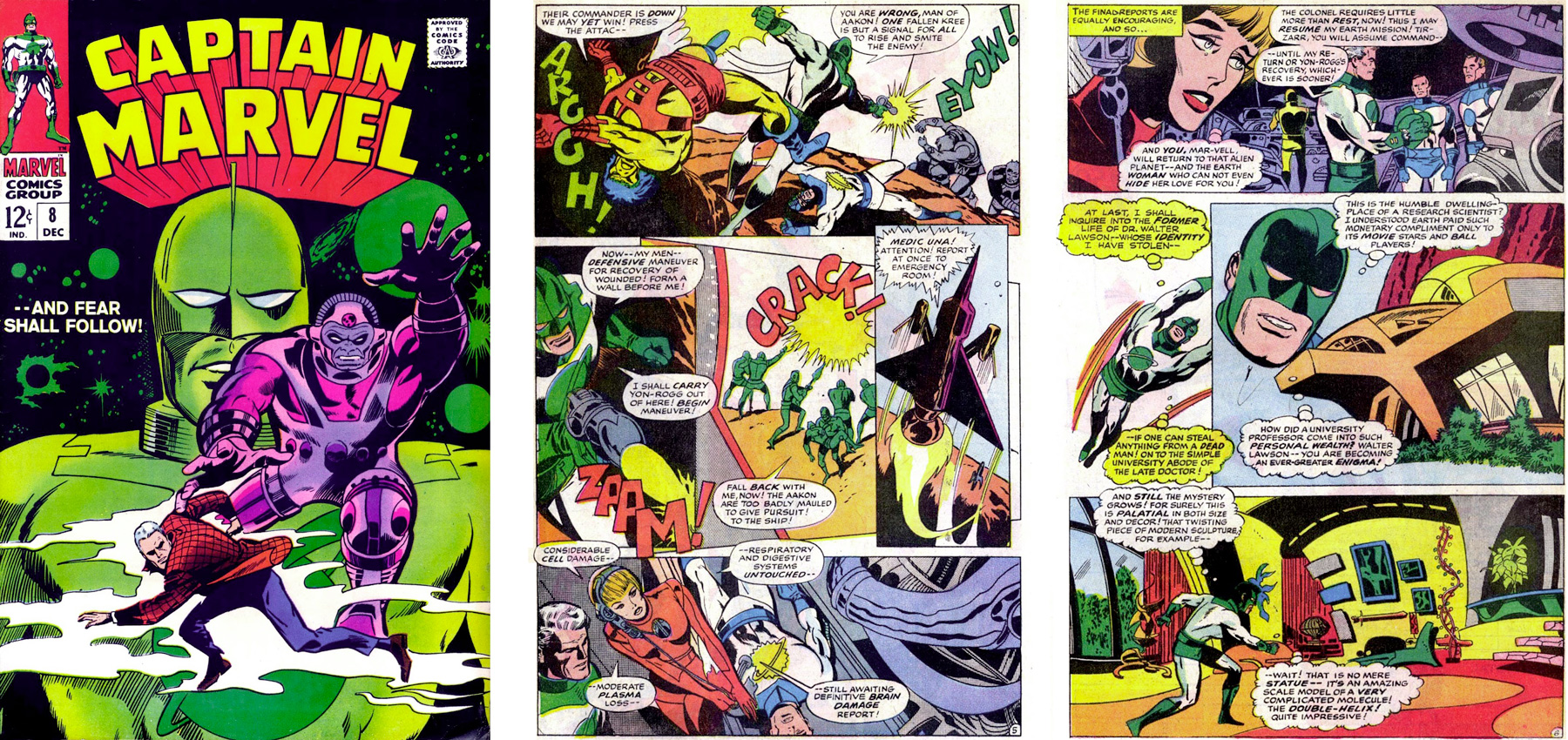
Captain Marvel 8 (Dec 1968) opens with a battle between an interloping alien species called The Aarak and Yon-Rogg's Kree expeditionary force. Though Yon-Rogg is wounded in the battle and is recovered by Captain Mar-Vell, he shows little gratitude, relentlessly pursuing his vendetta against his junior officer. After the battle, Mar-Vell returns to Earth and begins to investigate the life of the Earth man he's impersonating, Dr Walter Lawson. Lawson's home is more lavish than a research scientist could aspire to. And beneath the house, Captain Marvel discovers an extensive and well-equipped laboratory. The evidence suggests Lawson had created a large robot, though for what purpose is not disclosed. The mystery deepens when two costumed gunmen enter Lawson's home and start shooting at Captain Marvel. It appears that Lawson had created the robot for some criminal organisation and now the murderous machine is on the loose, cuing up yet another battle between Captain Marvel and a monster. Inevitably, a five-page battle ensues and Captain Marvell apparently destroys the giant robot

Last issue the giant robot didn't seen to have a name, being referred to as "robot" or "cyberton" This time out, he calls himself "Cyberex" and everyone else follows suit. Sounds like an editorial correction to me. And another nice Colan cover.

But we're not done with the Aakon - or the robot - yet ... they're all back in the following issue. And because of Yon-Rogg's reckless attack, a retaliation by the Aakon threatens to expose Mar-Vell's Kree mission on Earth. So, here's an abbreviated version of the plot ... Carol Danvers goes snooping around "Walter Lawson's" motel room. The giant robot turns up and takes her as bait for "Lawson". The robot reveals that Lawson is not his creator. Inexplicably. Captain Marvel knows that the robot is holding Carol captive and rushes to rescue her. Yon-Rogg remotely activates Mar-Vell's wrist monitor so the Aakon know where he is ... and of course they attack. Cue the three-way battle between Captain Marvel, the Aakon and the giant robot (who now calls himself Cyberex) lasting a slightly excessive nine pages. It's all a bit humorless and po-faced. I'm not getting the sense, here, that Arnold Drake was able to grasp what it was that made Stan's scripts so memorable. Interestingly, that issue's Bullpen Bulletins bigs up the new Marvel scripters, Archie Goodwin and Arnold Drake. Stan (or maybe Roy) even touts some forthcoming work by Atlas veteran Ernie Hart. In the end that turns out to be the solitary dialoguing job Hart did on Nick Fury 8 (Jan 1969), before disappearing from Marvel for the final time.

Captain Marvel 10 plods its way through Arnold Drake's plot. But Heck delivers some nice work here. I really like his layout on page 10.

In Captain Marvel 10 (Feb 1969), we begin to learn a bit more about The Organisation, the criminal outfit that sent the Cyberex robot after "Walter Lawson", and its leader, Number One. Mar-Vell, too, is destined to discover more about his underhanded foes, as Ronan the Accuser orders him to gather information on The Organisation in case The Kree have to "deal with" them one day. However, The Organisation captures Carol Danvers and invites "Walter Lawson" to surrender to them. Captain Marvel goes in his place and initially pretends to be interested in an alliance, but slips a gas capsule to Carol that she can use to escape. Then all heck breaks loose and Mar-Vell finds himself facing an aging ray, apparently created by the real Lawson. Mar-Vell turns the ray on The Organisation and pretty much cleans their clock. But there's unexpected fallout from his victory. Yon-Rogg orders Captain Marvel's immediate execution.

And that pretty much closes the door on The Organisation, a kind of bargain-basement AIM, without the interesting bee-keeper outfits. I wasn't terribly sorry to see the back of them. I was a bit sorry to see Heck leave the book, though ...

Why the Barry Smith cover and the rushed Dick Ayers interior art? I'd speculate that the inexperienced Barry was supposed to do the insides but ran into scheduling problems and Ayers had to bail Marvel out. But pure guesswork on my part.

Captain Marvel 11 (Mar 1969) sported an interesting Barry Smith cover, one of his first works at Marvel. Channelling Kirby, Smith's art is is even more extreme, and it might have been more interesting if Smith had drawn the interior art. But what we got was a very rushed-looking Dick Ayers pencil job, not helped by Vinnie Colletta's usual slapdash inking. Arnold Drake's script takes Mar-Vell in a completely new direction. I don't know what went on behind the scenes. Perhaps sales weren't all that Stan was hoping for, but with this issue Drake brings in some sweeping changes. He kills off Medic Una, which I think was for the best. That storyline wasn't going anywhere. He also gets rid of Mar-Vell's weapon, the Uni-Beam, and gives our hero actual superpowers - through the agency of Zo and his conveniently lovely gaggle of handmaidens.

The way in which Captain Marvel gets a makeover is all a bit contrived ... can it be a coincidence that "Zo" is Oz backwards? Pay no attention to that man behind the curtain ...

The catch is that going forward, Captain Marvel will become a tool of the alien intelligence Zo and that may or may not involve some tough moral choices ... but I'm getting ahead of myself.

A hugely better art job from Dick Ayers in Captain Marvel 12, almost as if he's trying to blot out reader's memories of last month's lacklustre art, but the pace of Arnold Drake's storytelling is glacial.

So, as Captain Marvel 12 (Apr 1969) gets under way, Mar-Vell returns to Earth and tries to resume his Walter Lawson identity. I'm not sure why, as he's no longer under any obligation to carry out his Kree mission. And posing as Walter Lawson won't conceal his presence from Yon-Rogg .. but as "Lawson" returns to the missile base a plastic robot, The Manslayer, attacks and Captain Marvel ventures forward to defend the base. In another location, Natasha Romanova, The Black Widow, is stalking the controller of the robot, presumably on a SHIELD mission. Though The Widow manages to stop the robot, she's captured by the bad guy controlling the robot, to be held as a hostage against some future threat.

This would be the last issue from Arnold Drake and Dick Ayers. In fact, shortly after this, Drake would finish up his run of Captain Savage, with issue 16 (Sep 1969), pack up his typewriter and move over to Gold Key. It wasn't a memorable run, and I don't think Drake ever really understood the Marvel way of doing things.

Arnold Drake: 1 Mar 1924 - 12 Mar 2007

Drake would spend the rest of his comics career writing a variety of titles for Gold Key, contributing a long and memorable run on Little Lulu, and even returning to DC where he scripted Phantom Stranger and wrote a few stories to DC's war titles, most notably Weird War Tales. Drake had pretty much retired from comics around 1985, and died in 2007 after a short battle with pneumonia.

But that wasn't the end of Captain Marvel's publishing troubles. Marvel Comics would continue to struggle to find a strong commercial direction for Mar-Vell, and I'll be looking at the rest of his rocky early progress in the next instalment of this blog.

Next: A superhero in search of a USP


Saturday, 7 January 2023

Captain Marvel: Part 1

THE ORIGINS OF CAPTAIN MARVEL ARE MIRED in a minefield of trademark and copyright legal battles, some ill-advised, most poorly handled. But that acrimonious history between DC Comics' Harry Donefeld and Jack Liebowitz, sleaze publisher Myron Fass and Marvel publisher Martin Goodman ultimately brought us to the Carole Danvers version of the character.

Marvel's version of Captain Marvel has undergone a long and complicated evolution before becoming the female warrior best-known to modern audiences, starting in 1967 with the alien spy Captain Mar-Vell.

It was 1967, and Marvel publisher Martin Goodman had noticed a superhero comic on the newsstands called "Captain Marvel". Though Goodman had no legal case against "Captain Marvel" publisher Myron Fass, it must have irked him to see his by-then hugely success "Marvel" trademark being used by a low-level bottom-feeder like Fass ... especially given the involvement of Carl Burgos, who was engaged in suing Goodman over the ownership the Human Torch character.

Captain Marvel ceased in 1953, after losing the will to battle DC's lawsuit that claimed Captain Marvel was a copy of Superman. In 1966 opportunist publisher Myron Fass figured he'd use the name for his comic character. Marvel's Martin Goodman launched his Captain Marvel in 1967.

So Goodman first tried to negotiate with Fass to see if he could acquire the name legally. Fass turned down Goodman's offer of $6000. It's hard to know why because Fass later admitted to the Wall Street Journal that the comic was selling an average of 100,000 per issue from a 250,000 print run, a rather poor 40% sell-through (and significantly below breakeven).

In any event, Goodman wasn't deterred and, probably thinking that Fass didn't have any trademark on the character, ordered Marvel Stan Lee to come up with a Marvel take on the character name. Still strait-jacketed by the unfavourable distribution deal he'd been forced to sign with Jack Liebowitz and Independent News, Goodman had nowhere to park his Captain Marvel except within the pages of his reprint title Fantasy Masterpieces. Hastily rebranded as Marvel Super-Heroes, a title he'd published a year earlier to tie-in with the Marvel Super-Heroes animated tv show, the new Captain Marvel hit the stands in October 1967. Fass must've gotten wind of Goodman's plans and had quickly printed the final issue of his Captain Marvel ("... Presents the Terrible Five") in September 1967, exactly a year after the character had last been on the stands.

As it turned out, Fass had taken out a trademark registration, and sued Goodman (also naming Marvel Comics, Stan Lee, Gene Colan and Eastern Color Printing, along with Independent News) for infringement. The matter was finally resolved out of court, with Goodman paying Fass $4,500 for the Captain Marvel trademark. Shoulda taken the six grand, Myron ...

THE BIG RED CHEESE

The acrimony surrounding the comic character name of "Captain Marvel" goes back a lot further than Martin Goodman and Myron Fass. Dial back to 1938. A new character from Detective Comics Inc, Superman, was already setting the publishing world alight. Sales were booming, despite the doubts of Detective Comics publisher Harry Donenfeld, who had ordered the character off the covers of Action Comics after issue 1. By the time he realised his mistake, Action Comics was already up to issue 7 (Dec 1938)

The first few covers on Action Comics depicted rather mundane subject matter without, it has to be said, much action. But when National Publisher Harry Donenfeld saw the sales figures, he ordered Superman be on every cover going forward.

If the other comics publishers needed some sort of sign that the future was in long-underwear characters, Donenfeld had just given them one. Even so, Detective Comics was slow to act on its own intelligence. Superman didn't return to Action covers until issue 13 (Jun 1939). It was that same month that Superman 1 appeared. The character next showed up on the cover of Action 15 (Aug 1939), and with 16 (Sep 1939), Superman began appearing in the top left corner of every Action cover. And that was likely the catalyst that galavanised Fawcett Publications into pulling together their own answer to Superman.

There had already been a couple of Superman copycats ... earlier in 1939, Will Eisner had cobbled together a quickie rip-off character for Fox Comics, Wonder Man. The character managed one appearance in Wonder Comics 1 (May 1939, on sale in mid-March) before the wrath of Harry Donenfeld came crashing down upon them, and Wonder Man was never seen again.

You could probably make a case for Will Eisner's Wonder Man being a swipe of Superman, but it's a bit of stretch to claim the same of Bill Everett's Amazing Man, whose powers seem more like The Shadow's than Superman's.

The other superhero from around this time was Amazing Man, often mentioned as another Superman clone, though I don't see it. Created by Bill Everett, for Centaur Comics, with some input from art director Lloyd Jacquet, Amazing Man first appeared in Amazing Man Comics 5 (Sep 1939, on sale mid-August). The character's origin sounds more like Doctor Strange than Superman (trained to superhuman level by Tibetan monks) and his power seems to be just invisibility. The claim that he was a Superman clone probably comes from a quote from a letter written by Everett's mother Grace that says, "I’m going to spend all day tomorrow at the Public Library, doing some research work for Bill. He has a new character, for a strip which Jacquet wants him to do in competition with the new one now being syndicated – called the 'Superman' I think. We’ve wracked our brains for a new kind of character; and all I can think of now is to back over some old folk tales, foreign ones if necessary, and try to find some unusual character around which we can build an unusual story for these modern times." Amazing Man would continue, undisturbed by Donenfeld's litigious Detective Comics until Amazing Man Comics 26 (Jan 1942). Fawcett's stab at a superhero wouldn't be quite so lucky ...

Fawcett Publications was founded in 1919 by by Wilford "Capt Billy" Fawcett, with their first publication, Capt Billy's Whiz Bang. Pretty soon, the company had a monthly circulation of 10 million per month, spread across several publications, including Mechanix Illustrated, Family Circle and True Confessions. And in 1939, Fawcett decided to get into the comics business.

Newly-installed staff writer Bill Parker began mapping out a roster of characters that would feature in the company's first 64-page anthology title, tentatively titled Flash Comics. The initial lineup included Dan Dare (no relation), Scoop Smith, The Golden Arrow and Lance O'Casey, along with costumed characters Ibis the Invincible and Spy Smasher. But for the lead slot, Parker planned to showcase a team of superheroes, the first in comics, each granted his single power from one of the mythical Greek gods. Fawcett Executive Director Frank Daigh wasn't keen, preferring to have just the one hero with multiple powers, so Parker re-tooled his team into a single character, Captain Thunder, and Charles Clarence "C.C." Beck was hired to create a look for the character.

"When Bill Parker and I went to work on Fawcett's first comic book in late 1939, we both saw how poorly written and illustrated the superhero comic books were," Beck told Tom Heintjes in a 1980s interview. "We decided to give our reader a real comic book, drawn in comic-strip style and telling an imaginative story, based not on the hackneyed formulas of the pulp magazine, but going back to the old folk-tales and myths of classic times." And that's an important point for later ... Superman was very much a science fiction character and Captain Marvel was rooted in myth and magic.

And ashcan copy of the new Flash Comics, sporting Captain Thunder on the cover, was prepared to secure copyrights on the titles and characters, but DC beat Fawcett to the punch by getting their ashcan of Flash Comics out first.

Back in the early days of comics, "ashcan" editions were published, sometimes just the single copy, to secure a legal claim to a title by virtue of being first.

Undeterred, Fawcett revamped their Flash Comics into Thrill Comics and tried again. But guess what? Yup, another publisher, Ned Pines' Better Publications, came out with Thrilling Comics.

Though different, Fawcett management probably thought Thrill Comics was too close to Thrilling Comics and, ironically, wanted to avoid a lawsuit.

But third time's a charm, right? Another change of logo and artwork and Fawcett finally came out with Whiz Comics, featuring Captain Marvel on the cover in an alternate take on the famous Action Comics 1 cover art.

Accident or design? Both characters' first appearances involved them hurling automobiles, a surefire way of letting readers know that the character was stronger than any normal human.

The early Superman stories in Action Comics concentrated on societal ills. Superman was shown slapping a wife-beater around in the very first ever story. By contrast, Captain Marvel went with whimsy and this fresh take was an instant hit with younger readers.

The first issue of Captain Marvel Adventures was unnumbered and hastily drawn by Jack Kirby, presumably because Beck was tied up with the art for Whiz Comics. Issue 2 followed three months later. By issue 6, it was monthly.

Six months in and Captain Marvel had his own title, something it took Superman nearly twice as long to achieve. Captain Marvel Adventures went monthly with its sixth issue (Jan 1942). Superman remained bi-monthly until the beginning of 1954, when it went to eight times a year. So you can see why National Periodicals might feel a bit threatened by this upstart.

Even more galling for DC/National ... when Republic Studios came looking for a superhero to feature in one of their Saturday morning chapterplays, DC were playing hard-to-get, so what should have been a Superman serial became The Mysterious Dr Satan, featuring a substitute hero, Copperhead.

DC/National clearly had an unrealistic view of the importance of Superman in the real world. After two attempts to bring Superman to the screen, Hollywood studio Republic gave up on DC and went with Fawcett's Captain Marvel instead.

Strangely undeterred, Republic took another swing at a Superman serial, but DC/National's executive editor Whitney Elsworth proved as difficult to deal with as ever and, finally losing patience altogether, Republic simply approached Fawcett and licenced Captain Marvel for a serial instead ... and that, more than anything else I think, triggered the start of the DC lawsuits in 1941.

Fawcett also created spin-off characters - Captain Marvel Jr and Mary Marvel were the most successful - but there were also the Three Lieutenants Marvel, Uncle Dudley Marvel and even Hoppy the Marvel Bunny.

After a lot of back and forth - and probably thousands in legal fees - the case came to trial in 1948. In 1951, the presiding judge decided that because DC/National had failed to secure the correct copyrights on their newspaper strips of Superman, they were deemed to have abandoned the ownership of the Superman character, and Fawcett were free to continue with Captain Marvel.

National appealed, of course, and in reviewing the case a new judge ruled that though he didn't consider Captain Marvel, per se, an infringement on Superman, some of Marvel's super-feats could be, and sent the matter back to the lower courts for retrial.

It took him a few years, but Superman editor Weisinger did transform his Superman franchise into the kind of multi-book affair that the Marvel Family had commanded in the previous decade.

But with sales in post-war decline, Fawcett took the decision to settle with National and withdrew Captain Marvel - and the legion of spin-offs and related characters - from the newsstands in 1953. Could it be coincidence that around the same time, DC's Dark Overlord Mort Weisinger began expanding the Superman mythos to include super-pets and super relations, like Krypto, Supergirl, and giving supporting characters Jimmy Olsen and Lois Lane their own books?

DC/National eventually bought the rights to publish Captain Marvel themselves, but when they brought out the revived character in 1973, they couldn't call the book "Captain Marvel" as Marty Goodman's Marvel Comics owned the trademark on that name.

Which sort of brings us full circle ...

Next: Will the real Captain Marvel please stand up?