Monday, 30 May 2016

Ant-Man Antics: More Astonishing Tales

BACK IN 1964, the first Marvel comic I ever saw was Tales to Astonish 51, with Giant man battling The Human Top on the cover. Up until that point, I'd survived on a steady diet of Mort Wiesinger's Superman family comics and Julius Schwartz's Flash and Green Lantern titles. But here was something new and different and within a few months I was working hard to track down every Marvel comic I could get my hands on.

But what I didn't realise until much later was that Giant-Man had quite the back story. He hadn't just suddenly sprung to 2D life that moment I set eyes on him in early 1964. He'd been around for a couple of years, and had originally been smaller. A lot smaller.

ANTS IN YER PANTS

It’s no secret that small boys like creepy-crawlies. When I was a kid, I was endlessly fascinated by ants. I’d often spend time on sunny summer afternoons watching the little critters marching in straight lines from their nests, stopping to talk to each other, or struggling under the weight of a bit of twig twice their own size. And in the comic books of the period, I’d often see ads for ant-farms, a bargain at $2.98.

The Ant-Farm was a common mail order item in the American comic books of the 1950s and 1960s. If only I'd been able to lay my hands on $2.98, something that was bit hard to come by in the South-East London of the early 1960s.
The ant farm wasn’t a new idea. Invented in 1932 by French entomologist Charles Janet, but popularised by Milton Levine, the “Ant Farm” was a familiar toy sold by mail order in the comics of the 1950s and 1960s. Levine had been an engineer with the US military during WWII. On returning to civilian life, he formed a company with his brother-in-law and began selling “100 toy soldiers for $1” through mail order ads in the comic books of the period. In the mid-1950s, Levine had the idea to manufacture and sell plastic antariums under the name “Ant Farm”. For (originally) $1.98, the customer got just the ant farm. Ants were extra …

Ant-Man's beginnings were a bit more convoluted. Over the decades a legend has evolved that Marvel editor Stan Lee was casting around for a follow-up super-character to his successful Fantastic Four comic and his slightly less-successful Incredible Hulk book. The official version goes that Stan tried out two insect heroes in his anthology titles Tales to Astonish and Tales of Suspense to see which the readers reacted to better. However, looking at the timings of the issues that "Man in the Anthill" and "Man in the Beehive" were published in, I seriously doubt that story.

The "Man in the Beehive" story appeared nine months after Henry Pym's debut in Tales to Astonish. The stories were quite different and it's hard to see how the premise of the Tales of Suspense story could have translated into a superhero concept, though it does contain one of Stan's earliest uses of the term "mutant".
Fantastic Four 1 was cover dated November 1961 and was on the newsstands three months earlier in August. The “Man in the Anthill” story in Tales to Astonish appeared in issue 27 (Jan 1962). The vaguely similar “Man in the Beehive” seven-pager was published in Tales of Suspense 32 (Aug 1962, on sale May 1962). And the debut of Ant-Man in costume was in Tales to Astonish 35 (Sep 1962), on sale just a month after the Beehive story. If Stan really was trying out insect heroes, why would he leave publishing the Beehive story until after the decision to go with Ant-Man had already been made?

Quality's Doll Man was the first of the vertically challenged superheroes. The character was a hit and ran for six years in Feature Comics and was awarded his own book. The Atom debuted in Showcase 34 (Sep 1961) and went on to be one of the mainstays of DC's stable of B-team characters.
There has also been speculation that Stan rushed Ant-Man into Astonish to cash in on the success of DC's similar small hero, The Atom, another theory that I don't think holds water. Besides, The Atom wasn't the first height-challenged hero in comics. Will Eisner's creation for Quality Comics, Doll-Man appeared in December 1939 in issue 27 of Feature Comics and enjoyed a long and successful run, eventually getting his own title in the autumn of 1941.

It's doubtful either Stan or Jack thought of "The Man in the ant hill" as anything other than a throwaway fantasy filler for their most successful anthology title. Jack's artwork looks as though it's had less attention than Kirby normally lavished on the giant monster tales like Fin-Fang Foom and Groot.
The story in Tales to Astonish 27 that established Dr Henry Pym and his ability to shrink to insect size was similar to the standard O Henry style fantasy tales Stan had been filling out his anthology titles with. Plotted by Stan, pencilled by Jack Kirby and scripted by Stan’s brother Larry Lieber, the story was never intended as anything other than a throwaway filler, despite its cover-feature status. The art by Kirby looks rushed and certainly couldn’t be held up as a stellar example of his work during that period.

In the story, Henry Pym is working on a chemical that can reduce the size of objects. In time-honoured mad-scientist tradition, he tests it on himself. He shrinks to the size of an insect, then manages to fall out a window into the garden, where he’s chased around by a bunch of ants. One ant inexplicably takes a shine to our hero, and helps him get back to his lab, where he’s able to restore himself to normal size. Pym destroys his formula as it’s “far too dangerous to ever be used by any human again.”

And with that, the story was forgotten for the next few months.


THE RETURN OF ANT-MAN

But with the strong reader reaction to the Fantastic Four comic, and The Thing being singled out as a fan favourite, Stan and Jack Kirby came up with a story about scientist Bruce Banner being accidentally irradiated by gamma rays and transforming into a massively strong anti-hero, The Hulk, and put the character out in his own comic Incredible Hulk 1 (May 1962), on sale in February. Then, without waiting to see how either FF or The Hulk were faring sales-wise, Stan pressed on with two new heroes, The Mighty Thor and Ant-Man.

Stan Lee's brother, Larry Lieber.
Already busy with his scripting work on much of the Marvel line, Stan drafted his brother Larry in to write the dialogue for the new characters over his plots and Jack Kirby’s pencils. Though many have made a case for attributing Jack Kirby as the main author on these early superhero stories, Lieber described a different scenario in a 1999 interview for Alter Ego magazine: “Stan made up the plot, and then he'd give it to me, and I'd write the script. Tudor City had a park, and when it was nice I'd sit there and break the story down picture by picture. I was unsure of myself just sitting down to write a script. Since I knew how to draw, I'd think, 'Oh, this shot will have a guy coming this way ... this shot will have a guy looking down on him,' and later I'd sit at the typewriter and type it up. After a while, I'd just go to the typewriter ... These were all scripts in advance … Jack I always had to send a full script to. Also, what Stan liked was that I made up names. As a matter of fact, I made up the name ‘Henry Pym’.”

Stan has been quoted many times as saying that he liked to give his characters alliterative names as that made them easier for him to remember. So The Fantastic Four had Reed Richards and Sue Storm and the Hulk’s human identity was Bruce Banner. It wasn’t foolproof, however, as Stan referred to Banner as “Bob” in Avengers 3. Larry Lieber evidently didn’t need that trick. His characters’ civilian names were Don Blake, Tony Stark and Henry Pym.

In this first adventure, Henry Pym shrank and grew by sloshing his formula all over himself. Over the next few years this would change to gas, then pills and finally he was able to change size just by thinking about it.
Ant-Man returned, fully costumed, in Tales to Astonish 35 (Sep 1962), which hit the newsstands in June 1962, the same month as Journey into Mystery 83. Ant-Man’s costume featured a cleverly rendered stylised ant silhouette as a chest emblem and a really cool helmet, with antennae and ant mandibles, all of which was made of “unstable molecules”. Where Henry Pym gets his hands on proprietary technology invented by The Fantastic Four’s Reed Richards isn’t revealed.

Over and above his shrinking ability, Ant-Man’s Unique Selling Point was that he could communicate and work with the ants as allies in his fight against communism and other forms of injustice. So when a gang of commie agents tries to steal an anti-radiation formula that Henry Pym is working on, he turns into Ant-Man once again and battles to save his colleagues from the dastardly foreign agents.

As with the story in Tales to Astonish 27, “The Return of The Ant-Man” is not one of Jack Kirby’s more inspired art jobs. Kirby has often said on record that he always strived to come up with the best ideas and artwork in order to “make sales” and guarantee his continued employment, yet his work on Ant-Man was decidedly lacklustre compared to what he was doing on The Fantastic Four at the same time … as though he didn’t much care for the character and was just knocking out the pencils for the page rate.

Once the series was off and running, it seemed to lack a clear sense direction that The Fantastic Four had, and that we’d also see in later creations like Spider-Man. The biggest problem that Ant-Man had as a feature was that there wasn’t a single iconic villain. Villains help define the heroes in the minds of the fans. Batman wasn’t a massive success until he battled The Joker. The Fantastic Four already had The Skrulls, Sub-Mariner and Doctor Doom in their first five issues. While, without a defining villain, The Hulk struggled to establish himself.

These earliest Ant-Man tales lacked a clear sense of direction. And Jack Kirby would often as not, struggle with finding interesting ways to frame a cover to make the most of the tiny hero.
So the earliest stories in the Ant-Man run were largely unmemorable, with the hero battling more communists in his second adventure, a local protection racket crook in his third and the mediocre Egghead in his fourth outing.

The second proper Ant-Man adventure also gave us an insight into how a diminutive character is able to exit and enter his regular-sized laboratory and how he doesn't get smeared on the pavement after being fired out of a catapult.
Tales to Astonish 36 was cover-dated October 1962 and gave us the menace of Comrade X. The surprise denouement of the tale has the villain being revealed to be female. No adequate reason is given for this drag act, and it may be that it’s more of a reflection of the times, where women were mostly viewed as mothers and home-makers rather than as real people with their own ambitions for either good or ill. However, there is a neat explanation of Ant-Man’s “human cannonball” catapult device he uses to get across the city quickly and quite a nice schematic of the secret exit/entrance to his laboratory.

Finding traces of machine oil where The Protector had been standing earlier, Ant-Man is able to deduce that he's using a mechanical exoskeleton to appear larger and stronger than he actually is.
Issue 37 was a little more prosaic, and had Ant-Man battling a criminal who’s been extorting money from neighbourhood jewellery businesses. In the end, Ant-Man deduces that the Protector is actually one of the jewellers who’s being extorted and turns the culprit over to the police. The adventure ends with a single panel ad for the rest of the Growing line of Marvel superhero comics.

One interesting aspect of Kirby's art on Ant-Man is the use of these forced perspective shots to put the reader down at Ant-Man's eye level. Really not sure about the spring-loaded boots, though.
Astonish 38 (Dec 1962) had the first proper “super-villain” for Ant-Man to fight. Egghead is an unnamed, disgruntled crooked scientist who’s fired from government employment for allegedly selling secrets to rival nations. The scientist joins forces with some gangsters and attempts to carry out a plot to turn the ants against Ant-Man. The plan backfires when it’s revealed that the ants are willing allies of Ant-Man in his battle against crime rather than helpless slaves, and Egghead is left a mumbling basketcase at the shock of learning that the ants are smarter than he is.

Although Egghead is the first recurring villain of the Ant-Man series, he’s just not a very good one. There were better villains ahead, unfortunately, the readers had to wait just a little too long for them to show up.

My views on Tales to Astonish 39 (Jan 1963) are documented in one of the first blog entries in this series. It was the first Ant-Man comic I ever saw back in the day, and it is one of the most popular of the early Ant-Man stories. It does use a variation on the old “hero’s doppelganger” plotline so commonly seen in DC comics of the Silver Age (Green Lantern’s Sinestro and Flash’s Professor Zoom), but this one had a twist. Stan pits his insect-sized human against a human-size insect, and I think it’s that aspect that resonated with so many fans. Unfortunately, Stan failed to capitalise on the idea and by the next issue, we were back to run-of-the-mill adversaries.

Despite some changes in personnel, these early Ant-Man stories still struggled to find a distinctive style. The problem was lack-lustre villains and no clear rhythm to the writing.
Tales to Astonish 40 (Feb 1963) had Ant-Man try to solve the mystery of a spate of armoured truck hijackings, where the trucks vanish and the guards have no memory of what happened. As with the earlier Protector story, Ant-Man uses his powers of deduction to uncover the villain, rather than his powers of ant-ness, which might go some way to explaining why the wider readership was failing to connect with the character.

There's quite a different feel to this Kirby artwork, inked by Sol Brodsky. This would be the last Ant-Man story in Astonish to be pencilled by Kirby.
Unusually, the Kirby pencils were inked by Sol Brodsky, who usually confined himself to production duties in the early Marvell Bullpen. The result is markedly different to the finish frequent Kirby collaborator Dick Ayers had been doing on the title, but I really like Brodsky’s inks on Kirby’s art.

Incoming penciller Don Heck brought a different feel to the Ant-Man strip. Heck's lightness of touch works better for me that Kirby's sometimes bombastic pencil art.
Astonish 41 (Mar 1963) featured the first change in personnel … Jack Kirby was replaced on pencils by Don Heck. Some commentators have tried to paint this as a negative – in a particularly spiteful interview, even for The Comics Journal, Harlan Ellison once called Don Heck "the worst artist in the field” – but I strongly disagree. Heck, especially when he inked his own pencils, was a subtle and delicate artist. If you’re not sure, then take a minute to look back at some of the work he did on earlier Marvel fantasy stories. And of course, he was the signature artist on The Avengers from issues 9-40, a career defining run.

In this page from the fantasy backup story in Tales to Astonish 38, "I Found the Impossible World", Don Heck demonstrates how he makes even a talking page interesting. Perhaps some fans found his superhero art unsatisfying because Heck himself preferred fantasy tales to action yarns.

WHO THE HECK IS DON HECK?

Donald L. Heck began his comics career in 1949, when he joined the staff of Harvey Comics, re-arranging the panels of of Milton Caniff newspaper strips into comic book pages, a process we would call "bodging" in the UK. While there, Heck became friends with Pete Morisi, who would later create Thunderbolt for Charlton Comics. When Morisi left Harvey to join a comics startup, Comic Media, he took Heck with him.

Don Heck did many covers for Comic Media and even designed the cover logo for Horrific. Later in the 1950s, Heck drew the tv-tie-in comic for Captain Gallant, a book that was very common in the back issue bins of 1970s comic marts, after a warehouse find.
At Comic Media, Heck began drawing early horror comics like Weird Terror as well as romance and war stories. But in 1954, Morisi had been showing art samples to Atlas editor Stan Lee. In Morisi's portfolio were a couple of Heck's pages. Lee pointed to the Heck samples and said, "This is the way you should have drawn it." Morisi testily suggested that if Stan wanted Heck's style he should hire Heck. Lee said that if he saw Heck he might have a story for him. "So I went up there on a Wednesday afternoon" Heck later recalled. "Stan never saw anybody on Wednesdays, and he never saw anybody in the afternoon. But he came out. He looked at the first two pages and said, 'Aw, hell, I know what your stuff looks like. Come on in. I got a story for you'." Heck joined the staff of Atlas and worked on a variety of titles until the Great Atlas Implosion of 1957, when he and just about every other artist was let go.

Heck drew one of the rare non-Kirby Marvel covers of the late 1950s/early 1960s, Tales of Suspense 1. It must've been an omen, as Heck would later pencil a long run on Suspense's signature superhero, Iron Man.
Within a couple of years, though, Heck was back at Atlas, which was in the process of transforming into Marvel Comics. Unusually, Heck drew the cover for Tales of Suspense 1 (Jan 1963), as a time when just about every Marvel cover was drawn by Kirby or Ditko. Later in the series run, Heck provided the art for the first (and subsequent) instalments of Iron Man. Legend had it that Kirby did pencil breakdowns for the origin story, but "that's not true," Heck said in a 1985 interview for Comics Feature. "I did it all. They just didn't bother to call me up and find out when they wrote up the credits. It doesn't really matter. Jack Kirby created the costume, and he did the cover for the issue. In fact the second costume, the red and yellow one, was designed by Steve Ditko. I found it easier than drawing that bulky old thing. The earlier design, the robot-looking one, was more Kirbyish."

As Marvel developed, Heck was one of the mainstay artists, pencilling (and often inking) runs on top Marvel titles: Tales of Suspense 39-72, designing Happy Hogan and Pepper Potts, Black Widow, Hawkeye and The Mandarin, and missing only a couple of issues; The Avengers 9-40, co-creating The Swordsman and Power-Man; and of course, his run on Ant-Man in Tales to Astonish.

Towards the end of the 1960s Heck was getting less work from Marvel as tastes - and editors - changed. But he landed a lucrative gig, ghosting art for Lee Falk's The Phantom from 1966 to 1971, and provided a lot of pencil art for DC strips like Batgirl and Rose and Thorn, probably because he drew especially glamorous girls.

The great Don Heck at his drawing board, during his 1960s heyday.
Don Heck died of lung cancer on 23 February 1995.

AND BACK TO ANT-MAN ...

The same month he drew the Ant-Man story in Tales to Astonish 41, Heck also provided pencils and inks for the “Iron Man is Born” story in Tales of Suspense 39. If I have any criticism of Heck's art on Ant-Man it’s that he didn’t seem as engaged with the character as he did with Iron Man. But it’s still better quality work than Kirby was turning in on the strip.

The Ant-Man uniform in the interior of Astonish 35 shows a stylised ant, the mandibles around Henry Pym's throat, the antennae across his shoulders and the mid-legs around Pym's waist. On the cover, usually drawn after the interior, the antennae have disappeared and Kirby would continue to draw the uniform this way from Astonish 36 on. When Heck began drawing the character, he went back to a design similar to that in Kirby's original version.
What is interesting is that Don Heck’s version of the Ant-Man uniform is very similar to the one Kirby drew in Astonish 35. With Astonish 36, Kirby had revised the design slightly (this is also the version that appears on Astonish 35’s cover). And the revised version was the one Kirby drew until his last Ant-Man story in Astonish 40. Heck must have been given Astonish 35 for reference, because that’s the version of the uniform he drew through his entire run, even while Kirby was drawing the revised version on the covers.

“Prisoner of the Slave World” has Henry Pym investigating the disappearances of fellow scientists. He discovers that a small-time crook is working with aliens from another dimension to abduct the technicians. So Pym arranges to have himself kidnapped then changes to Ant-Man to defeat the baddies. And the traitorous human ends up in jail in the alien dimension.

I really like Heck's page design in Tales to Astonish 42. He really gets across the sense of scale from Ant-Man's perspective and contrary to what some fans think, I rate his action art pretty highly.
The Ant-Man adventure in Tales to Astonish 42 (Apr 1963) also resembled one of the fantasy yarns Stan was turning out that the time. Radio announcer Jason Cragg is involved in a freak microphone accident that gives him a fantastically persuasive voice so he decides to use his new ability to turn the general population against Ant-Man. There’s no rationale given in the tale as to why he would use such an awesome power for such a mundane ambition – and this is also symptomatic of why these early Ant-Man tales weren’t more successful. In the end, Ant-Man defeats Cragg by giving him laryngitis which causes him to lose his powers of persuasion.

Tales to Astonish 43 has one of the earlier instances of Stan Lee's abiding crusades - the battle against discrimination in all its forms. Here he makes a very good case against the then-common practice of age discrimination, which elevates an otherwise-mundane tale.
“The Mad Master of Time” in Astonish 43 (May 1963) is unfortunately another fantasy tale masquerading as a superhero story. In this one, elderly scientist Prof Elias Weems is fired from his job for the simple sin of being too old. Seeking revenge, he concocts an aging ray and begins firing it indiscriminately at members of the public. Ant-Man investigates and discovers the cause of the mysterious aging malady afflicting random citizens.

Once the misguided man is captured, Ant-Man pleads on his behalf in court. The one interesting aspect of this story is that Stan and Larry – this would be his last scripting job on Ant-Man – mount an effective case against age discrimination at a time when this sort of thing was the standard way of doing business. These days we have laws against this type of practice, but back in the early 1960s, workers were routinely discriminated against for their age.
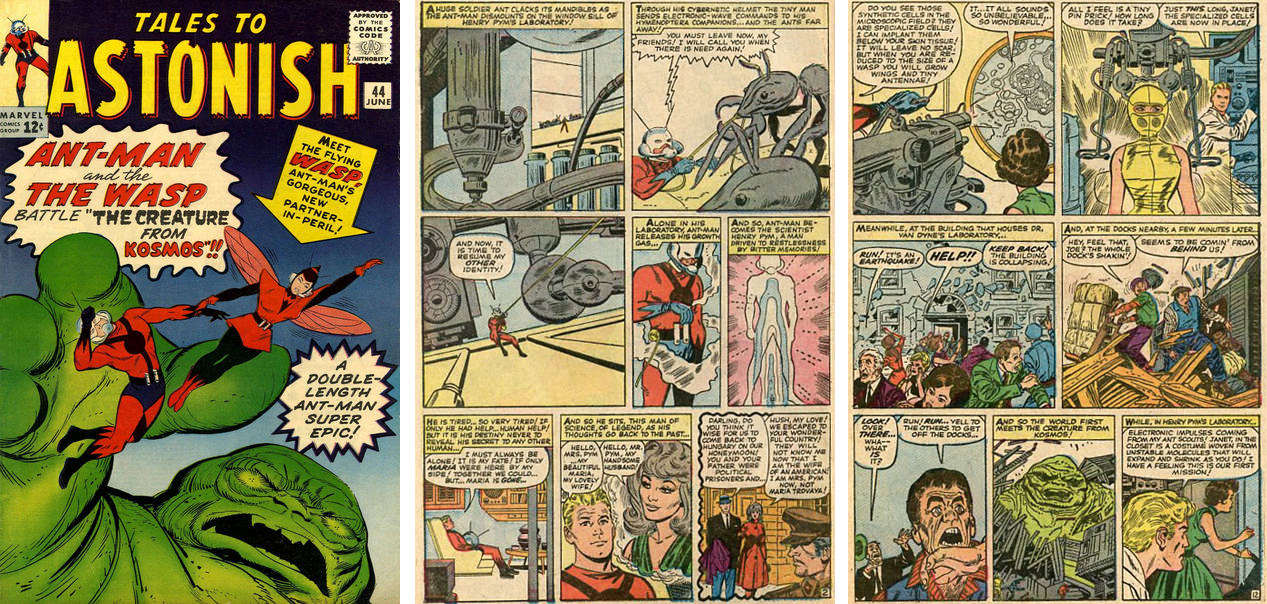
In Tales to Astonish 44 we learn about a major event in Henry Pym's past - the death of his wife Maria, depicted here as a beautiful mature woman with fetching iron-grey hair. On first seeing Janet van Dyne, Pym is struck by how much she resembles a much younger version of his dead wife.
Tales to Astonish 44 (Jun 1963) ushers in some more changes – both in the creative team and in the Ant-Man concept. Stan must have felt that there was something lacking in the scripting and replaced his brother Larry with old-time Atlas editor Ernie Hart, who was credited as “H. E. Huntley”. In a 2007 interview, Leiber said that Stan “wasn't always the most patient person and I had problems [writing] the dialogue and he said, 'Why did you say that? You could have said it this way, or this way or that way,' and I’m realizing, yeah, I don't think of it that way or this way. So at any rate finally I think at one point he got a little exasperated and he said, 'I’m going to hire some of the old pros’.”

Hart had been a staff editor at Timely Comics during the 1940s, sharing an office with Al Jaffee. He remained on staff through the Atlas years, and was brought on as a scripter on the Human Torch strip in Strange Tales and the Ant-Man series, presumably to give it a shot in the arm.

That shot in the arm was the introduction of a partner for Ant-Man. “The Creature from Kosmos” opens with Henry Pym musing about his long-dead wife, Maria Trovaya, a Hungarian national. On a trip back to Mrs Pym’s mother country, she’s arrested by communist secret police and is later found murdered. This incident might go some way to explaining why Pym fought so many communists during his formative years as Ant-Man. Back in the present, Pym is visited by fellow scientist Vernon van Dyne who is experimenting with gamma ray beams to detect signals from other planets. Van Dyne has brought his daughter Janet along, though she seems more interested in taking in the city nightlife than listening to scientific theory. Pym is struck by the uncanny resemblance of Janet to his dead wife, but is also aware of how much younger she is. In the flashback, Maria is shown with grey hair and could conceivably be in her mid-to late thirties, so it’s likely that Pym is supposed to be about 40 here. Perhaps Janet van Dyne is supposed to be about 20.

Pym is unable to help, so Van Dyne continues with his work alone, only to unwittingly unleash a criminal alien on Earth, whose first act is to murder Doctor van Dyne. Pym investigates as Ant-Man and learns the truth. Then in his guise as Pym, reveals his secret identity to Janet, offers her super-powers and asks her to join him in the hunt for her father’s killer.

Rather than simply enabling her to shrink and grow, Pym implants – somewhat recklessly – wasp cells in Janet’s back, so that she’ll grow natural wings when she reduces in size. Putting on a uniform of unstable molecules, Janet shrinks to insect size and sets out with Ant-Man to defeat the alien.

As they battle with the creature, Pym is thinking that Janet is so like Maria, but also that he must avoid falling in love with her as she’s too young. The adventure closes with Wasp gazing at Pym and thinking that, “someday I will make you realise that you love me as I love you.” Later in the series, Stan would play down the age difference. Even here, it sounds a little creepy.

Tales to Astonish 45 featured the return of an old villain, Egghead, the first such repeat appearance in the series so far. It also had The Wasp use a needle to mimic a wasp's sting. She would't get her compressed air Wasp's Sting until much later in the series, in Tales to Astonish 57.
Tales to Astonish 45 (Jul 1963) featured the return of Egghead, Ant-Man’s first recurring villain. This time, Egghead plans to use The Wasp as bait to trap Ant-Man. But far from being the helpless victim, it’s The Wasp who saves the day, using a needle to sting Egghead and his henchmen into submission.

Ant-Man shows up as a guest star in Fantastic Four 16, a quite clever piece of plotting that follows up on Doctor Doom's disappearance into the microworld at the conclusion of Fantastic Four 10.
The same month (though actually on sale a week later on 9 Apr 1963), Ant-Man appears, drawn once again by Jack Kirby, as a guest star in Fantastic Four 16. At the end of Fantastic Four 10, Doctor Doom was cast into a microworld, the very fate he intended for the FF. Still there six months later, Doom devises a way to shrink his arch-enemies to his size. After a couple of random shrinking incidents, Reed Richards contacts Ant-Man for help. The tiny hero gives Mr Fantastic a few drops of his shrinking/growing gas so the FF can counteract any further attempts to shrink them. However, The Fantastic Four still find themselves in Doom’s microworld and have to rely on Ant-Man’s help to defeat Doom.

Clearly this was an attempt on Stan’s part to boost the visibility of Ant-Man with fans of other, more popular Marvel comics. Yet, when you look at the sales of Tales to Astonish, it wasn’t faring any worse than its companion title Tales of Suspense and was actually doing better than Journey into Mystery and Strange Tales.

The sales figures for 1962 show Suspense at an average monthly sale of 126,000 with Astonish at 140,000. Strange Tales is at 136,000 and Journey into Mystery is selling an average of 132,000.

The following year, Suspense has risen to 188,000 with Astonish at 189,000, with Strange Tales also at 189,000 and Journey into Mystery average at 188,000. Did Stan think that Astonish should be doing better than the rest? He wasn’t guest-starring Iron Man or Thor in FF during 1963, so I can’t see what he was worrying about.
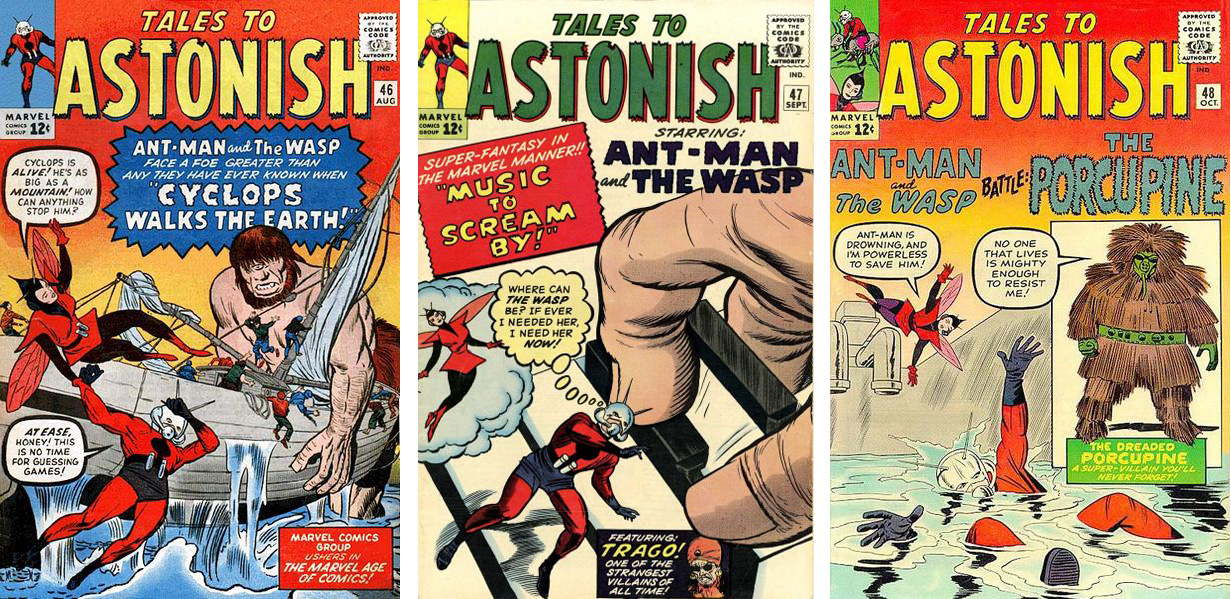
The last couple of Ant-Man adventures aren't a huge improvement over what had come before. Stan Lee was very obviously dissatisfied with how the character was turning out and planned some really big changes right after this trio of issues.
For all that, the next three issues of Astonish continued in a similar vein. In issue 46 (Aug 1963), Ant-Man and the Wasp battle a giant Cyclops monster while on holiday in Greece. The monster turns out to be a giant robot, constructed by invading aliens to scare away the locals, which does, admittedly, sound a bit like a Scooby-Doo plot.

Tales to Astonish 47 had a villain called Trago (Spanish for "drink" by the way), a sort of bargain basement Ringmaster, who hypnotises his audiences and robs them. Ant-Man and The Wasp make short work of him.
Tales to Astonish 47 (Sep 1963) has Ant-Man and The Wasp fight against a musician called Trago, who is able to use his trumpet music to mesmerise his audience so he can rob them. Scripter Ernie Hart does introduce a bit of banter into Janet's relationship with Henry, calling him "Hank" and teasing him for not wanting to relax and for not knowing anything about jazz music. That aspect would be developed more fully later in the series.

The Porcupine in Tales to Astonish 48 was probably the most memorable Ant-Man villain to date - though that's not really saying very much.
Astonish 48 (Oct 1963) introduces another villain who would return to plague Henry Pym and Janet van Dyne at a later date – The Porcupine. When I first read this story, as a kid, I thought The Porcupine was quite sinister. His mask is very creepy, and it’s a tribute to Don Heck’s skill that he’s able to render a credible villain out of such a ridiculous idea. Scientist Alex Huntley constructs a porcupine costume loaded with ingenious weapons and uses it to rob a bank. But Ant-Man and The Wasp devise a way to neutralise his weapons. While The Wasp distracts the villain by stinging him with a pin, Ant-Man sprays him with quick-drying cement. Though the controls of his suit are useless, Porcupine manages to escape to fight another day.

Avengers 1: Scripted by Stan Lee and pencilled by Jack Kirby, Ant-Man and the Wasp's characterisations here foreshadowed the chemistry they would have in the yet-to-debut Giant-Man series over in Tales to Astonish.
The same day that Tales to Astonish 48 hit the newsstands, Ant-Man and the Wasp made their debut as charter members of The Avengers. Martin Goodman had long wanted a team comic, starring Captain America, Sub-Mariner and The Human Torch, to rival DC's Justice League of America. Stan Lee had ducked that one and given him The Fantastic Four instead. But at last, with a larger roster of superheroes to draw on, Lee was finally able to field a team that matched the JLA in power, if not in sales.

The plot involves Thor's long-time enemy Loki trying to manufacture a battle between The Thunder God and The Incredible Hulk. When Rick Jones tries to contact The Fantastic Four for help with an apparently out-of-control Hulk, Loki diverts the radio message to Dr Don Blake's radio instead. Unknown to Loki, the SOS message is also received by Henry Pym and Tony Stark, and the four heroes converge on the Teen Brigade HQ. One of Ant-Man's ants sights The Hulk, hiding out with a travelling circus and the superheroes set off to track him down. Ant-Man and The Wasp play a decisive role in the battle, first undermining (with the help of ants) the ground on which The Hulk stands then, when the fighting's done, suggesting they team up regularly to battle large-scale menaces ... and it's The Wasp who gives them their name: The Avengers. But this would be Ant-Man's only appearance with the team. By issue 2, he would have a change of name and powers and by issue 16 left The Avengers, both team and comic.

While Ant-Man was never a fan-favourite with hardcore Marvel readers, at least he managed a longer run than The Hulk. The weakest aspect to the character was that the dialogue wasn't written by Stan Lee, and thus lacked the light touch and banter between characters that was very much Lee's trademark. Larry Lieber admitted that this style wasn't for him in that 1999 Alter Ego interview with Roy Thomas: "I didn't do enough of the superheroes to know whether I'd like them. What I didn't prefer was the style that was developing. It didn't appeal to me. ... Maybe there was just too much humor in it, or too much something ... I remember, at the time, I wanted to make everything serious. I didn't want to give a light tone to it."

Still, for whatever reason, Stan was dissatisfied with how the Tales to Astonish stories had been shaping up and began preparing a Really Big change for Ant-Man. He was going to take over scripting and add two letters to Ant-Man's name.


Next: Big things ahead for Ant-Man.


Saturday, 23 April 2016

The Hulk on TV (and Jack vs Stan, again)

THE INCREDIBLE HULK was one of the first Marvel characters to make it to the small screen. Back in 1966, with the quite terrible Batman tv show inexplicably topping the ratings, others were looking around for comic book properties to option. A company called Grantray-Lawrence approached Marvel with a proposal for a syndicated cartoon tv show collectively called The Marvel Superheroes

Though the ads called the show "Marvel Super-heroes", the actual on-screen title was "The Marvel Superheroes". The featured characters were the stars of Journey into Mystery, Tales of Suspense and Tales to Astonish.
The show would be very cheaply produced and use artwork from the comics with very limited animation. Marvel publisher Martin Goodman probably looked at the massive sales boost DC's Batman titles had gained from the Adam West show and figured that with his characters on tv, he too would get a big increase in circulation.

I won't dwell long here on how well or badly the cartoon producers adapted the Hulk comic stories for tv. I covered that process pretty extensively when I wrote about the Captain America cartoons a couple of blogs back. I have to say, though, that the theme tune for The Hulk is way more annoying than the Captain America one ... here's the lyrics:

Doc Bruce Banner,
Belted by gamma rays,
Turned into the Hulk.

Ain’t he unglamor-ous!

Wreckin’ the town
With the power of a bull,

Ain’t no monster clown
Who is as lovable

As ever-lovin’ Hulk! HULK! HULK!

The animators reached back into the vaults and used the story and art from the entire run of the original 1962 run of Incredible Hulk comics, with varying degrees of success.

The DVD of The Incredible Hulk that I have includes a booklet with an episode guide and a breakdown of which comics the cartoons are adapted from.
The remaining cartoons adapted Tales to Astonish 60-62 (Episode 6), 63-65 (Episode 3) 65-68 (Episode 4), 68-71 (Episode 5), 73-74 (Episode 7), 75-77 (Episode 12), 81-83 (Episode 13) and Avengers 2 (Episode 8).

The first episode used the artwork from The Incredible Hulk 1 largely unchanged, though The Hulk is coloured green throughout rather than the grey of the original comic.
The first episode is a pretty straightforward adaptation of Incredible Hulk 1 (May 1962), though for some reason, the communist villain The Gargoyle appears here as "The Gorgon".

The second episode uses the startling Ditko-inked artwork from The Incredible Hulk 2 (Jul 1962). As noted last month, I thought this art looked like there was more Ditko in there than Kirby, and I've always liked this interpretation, though I could see how Stan might think it a bit too fearsome for his then-intended audience of ten-year olds.

Steve Ditko's version of The Hulk, despite working over Kirby pencils, was much more monsterish than seen in the issues on either side.
There was then a smattering of stories from Tales to Astonish before viewers would see an adaptation of one of my all-time favourite Steve Ditko art jobs, The Incredible Hulk 6 (Mar 1963).


The ninth episode of the Hulk cartoon adapts The Incredible Hulk 6, albeit in truncated form, to fit the 13 minute running time.
It's an okay adaptation, but there's the occasional shot where they've dropped in a Kirby Hulk face, then in the very next shot, it's back to the Ditko version again. It must have been a little disconcerting, especially for non-Marvel fans, seeing The Hulk changing in appearance from scene to scene.

The other really weird thing the animators did was to colour the old, clunky Iron Man armour from Avengers 2 (Nov 1963) in the style the newer red-and-yellow Iron Man Armour ... wouldn't it just have been easier to frame the whole episode as a flashback and leave the armour yellow?

The old style Iron Man coloured up to match the newer colour scheme. Is it me, or is that just plain wrong?
But as I don't want to spend an entire blog entry dwelling on the peculiarities of each cartoon, here's a scan of Ditko's original artwork for the for the story's splash page (not owned by me, unfortunately) from that classic Hulk issue ... and then we can move on to something I've been thinking a lot about since last time.

The incredible splash page from The Incredible Hulk 6, as pencilled and inked by Steve Ditko who would go on to revitalise the character during his Tales to Astonish run.

JACK KIRBY - A SLIGHT RETURN

If you're regular reader of this blog, you'll recall I mentioned I had doubts that Jack Kirby could fairly be called the sole creator of The Hulk, as he has claimed in interviews. My main area of concern was that many of the main "distinguishing characteristics" of The Hulk couldn't really be attributed to Jack Kirby, as they hadn't been present during old Greenskin's first appearances in the original run of The Incredible Hulk (1962). Just so we're clear, I think these are:
  • Banner changing to The Hulk while under stress (which is related to)
  • The angrier the Hulk gets, the stronger he gets
  • Hulk always talking about himself in the third person ("Hulk smash!")
  • The Hulk's distinctive green skin
Granted the last one is a little debatable, as Jack Kirby rarely was responsible for a character's colours. I only include it here because Hulk's green-ness is a major part of his Unique Selling Point.

Thinking about it over the last few weeks, I realised that what my assertion boils down to is that Jack Kirby's Hulk wasn't the successful one, and it took major intervention by Stan Lee and Steve Ditko to turn the character round from cancellation to a cornerstone of the Marvel Universe.

An angry - and very long - interview with Jack and Roz Kirby was published in this issue of The Comics Journal at the beginning of 1990. I still have my original copy somewhere.
A cursory search of the Internet will turn up many differences of opinion around who actually created the Marvel Universe. Mostly, those with a view line up either in the Stan Lee camp or with team Jack Kirby. What is surprising is just how polarised opinions are. And I think Stan Lee has come in for a lot of criticism that isn't actually deserved, based mostly on the assertions that Jack made in his now-notorious interview in The Comics Journal 134 (Feb 1990).

In it, Jack says that Stan made no contribution to the Marvel lineup and that Jack created just about all the Marvel characters alone and that he also wrote all the stories he drew. I found the anger and mean-spiritedness of the interview quite upsetting at the time, as I had always admired both Stan Lee - I'd met him a few times while I worked at Marvel UK during the 1980s - and Jack Kirby, whose work I had actively collected during the 1970s, including all those terrible Archie titles and the pre-hero Marvels.

Jack Kirby, pictured in 1970, and Stan Lee some time in the mid to late 1970s.
How could Jack said such terrible things about Stan Lee, who had always been so generous in giving credit to Jack in both the Bullpen Bulletins and Origins of Marvel Comics for doing most of the creating? Especially given that Jack Kirby had the reputation for being one of the kindest people in the business. For a long time I wondered if Journal editor Gary Groth was taking advantage of Kirby and egging him on to the level of bitterness we see in the interview. But I don't now think that's the case, either.

I do think that from Jack's point of view he actually did create much of the material during the early days of Marvel, but equally, I don't accept that Stan did nothing and just hogged all the glory. I think the issue is that Jack and Stan had very different ideas about what constitutes "creating" a character ... and as a writer and editor myself, I naturally have a little more sympathy for Stan's viewpoint.


BACK TO BASICS

Obviously, when we're talking about things that happened in 1961 and the couple of years that followed, you have to bear in mind that memories get hazy, and all us have a tendency to re-write history with ourselves as the hero. Just look at Future Shock: The 2000AD Story for an example of that. But what is certain is that Stan Lee was the editor at the fledgling Marvel Comics and a story or an idea would not have gone in the comics if Stan hadn't approved. Yes, publisher Martin Goodman had the power of veto, and decided whether titles lived or died, but while a series was running, Stan got to say what saw print and what didn't.

For that alone, even if you don't want to give Stan credit for anything else, you have to admit he had at least the good taste to publish Jack Kirby's (and Steve Ditko's) work. Just what the exact nature of that work was, I will try to ascertain in the paragraphs that follow.

The problem with being ("just") an editor is that when things go wrong, you get all the blame and when things are going swimmingly, you get none of the credit. I learned that hard lesson in the period immediately after my short tenure as editor of 2000AD. My friend Philip de Sausmarez calls it "having all of the accountability and none of the authority". It's also characterised by the phrase, "Success has a thousand fathers but failure is an orphan". And that's a phenomenon you'll see in just about any business that has a P&L sheet.

Superman was the first "superhero", as you might infer from his name. Immediately he appeared, others scrambled to put out their own versions. Wonder Man was created by Will Eisner and was quickly sued out of business. Captain Marvel on the other hand managed to survive for fifteen years before DC lawyers were finally able to close him down.
To begin to understand how the argument over "creatorship" brewed in the first place, you first have to consider how comics were made and consumed back at the dawn of the industry and how that changed once Marvel Comics evolved new audiences for illustrated storytelling. It's related to the old show business anecdote of the Whistling Dog, the idea behind it being that booking agents were so enthusiastic about the idea of a dog that could whistle that none of them stopped to ask whether the dog was any good at whistling. It was the same with comics. When Superman first appeared in 1938, there was such a scramble among publishers to get their hands on superhero characters that they didn't stop to consider whether the material they were buying was any good or not.

During 1973 and 1974, DC Comics published a number of 100-page editions of their comics. Most of these had just the regular twenty or so pages of new material and padded out the rest with reprints from the Golden Age.
This helps me to understand why it was that I didn't care much for Golden Age comics, while people whose opinions I respected - Roy Thomas and my friend, uber-collector Mike Hill - thought there was nothing better than a Golden Age comic and variously built their careers riffing off those old books or spent hundreds and thousands acquiring the original comics. When DC started publishing their 100-Page Super-Spectacular comics in the early 1970s I grabbed as many as I could to read the wealth of Golden Age material they reprinted. The sad fact was that I found most of those old tales pretty much unreadable. Badly written and crudely drawn, they just didn't have the entertainment value I could find in any Stan Lee comic I cared to pick up.

In the years since, I've thought on-and-off about why that might be. Was it a generational thing? No, because I love movies of the 1930s and 1940s. Okay, is it just that writers were just better thirty years later? Again, no ... movies produced inside the studio system both pre- and post-WWII were always at least competent - some positively shone, when they used writers of the calibre of Billy Wilder & Charles Brackett, Ben Hecht and William Faulkner. These days it doesn't take too much effort to uncover a contemporary movie stinker - just take a gander at SyFy or The Horror Channel ...

Though both Fighting Yank and The Red Bee were reasonably successful comics during the 1940s, hardly anyone remembers them today.
And when you look at the comics that surrounded Marvel on the newsstands during Marvel's formative and glory years, including the DC Comics, you could see that they were still being produced under the same mindset that gave us such long-forgotten characters as Fighting Yank and The Red Bee. And that mindset took the view that The Idea was enough.

In the mad scramble to publish long-underwear characters that vaguely resembled Superman, the publishers and editors didn't much care whether their characters were competently written and drawn, they were just looking to publish something that looked a bit like Superman. Then once the furore died down (and once National got done with suing those who sailed a little too close to the Man of Steel), more skilled creators like Will Eisner and, of course, Simon and Kirby were able to pitch new ideas to editors for characters that were more than just Superman clones.

Though the cover of Jumbo Comics 15 was drawn by Sheena-creator Will Eisner, the interior story was by Bob Powell. The cover and interior art for the Blackhawk story was by Chuck Cuidera, with Eisner supplying only the script.
But again, because this stuff was all so new, packagers like Eisner were able to create concepts, then turn them over to lesser talented journeymen and be confident that the concept was strong enough to carry the books forward, even without the original creator's input. So Eisner (and his partner Jerry Iger) created franchises like Sheena Queen of the Jungle and Blackhawk, and turned them over to competent craftsmen like Mort Meskin, Bob Powell and Chuck Cuidera to do the actual heavy lifting. And through the 1940s, that was enough.

Young Romance, created by Simon and Kirby in 1947, was the first of a boom in "love comics". A few years later, Bill Gaines and Al Feldstein started a deluge of horror comics with Crypt of Terror (later Tales from the Crypt).
As the Atomic Age rolled around, readers began to tire of superheroes and sales began to dip. Publishers panicked and began replacing the costumed characters with different ideas. Simon and Kirby invented the romance comic and everyone scrambled to get aboard the love boat. In 1950, Bill Gaines and Al Feldstein created the first ongoing horror comics and set off another gold rush. But all were still convinced that it was the concept that sold their books. And as far as their existing target audiences were concerned, they were more or less right.

Right at the beginning of the first entry in this blog, I quoted the famous saying, "the Golden Age of science fiction is twelve", which can easily be paraphrased as, "the Golden Age of comics is ten". The point is that the median age of comic readers was traditionally always ten. That held true on both sides of the Atlantic. And ten-year olds are not the most sophisticated of consumers. So while comics were catering to that age demographic, there was no pressure on the publishers to do any more than keep coming up with new concepts. If a book was well-written or drawn, that was all well and good, and would probably contribute to a title's longevity, but the quality of the delivered material was never a deal-breaker. 

I'll admit to reading the occasional Charton comic back in the 1960s. The strips drawn by Steve Ditko, like Gorgo and Captain Atom weren't too bad, but the rest of the company's output was for the most part below average.
Look at Charlton Comics ... the occasional Ditko story notwithstanding, most of their output was pretty terrible and regularly sold 100,000-plus copies per month per title. Heck, Martin Goodman's Atlas comics were routinely a couple of notches below adequate and they too were selling similar numbers. Not even DC (formerly National Periodicals) paid much heed to quality of the material they were publishing. The much-feared and reviled DC editor Mort Weisinger was famously quoted in Steranko's History of Comics as saying of Superman, "He's invulnerable, he's immortal; even bad scripts can't hurt him."

Much as I enjoyed the Julius Schwarz edited DC comics when I was eight, looking back now it's easy to see they had no real humanity about them. No one ever got angry or irritated or sad in a Schwarz book ...
And it was into that exact environment that Stan Lee thought he could launch his own take on superheroes, a view that tried to present super-heroes as real people and have them react to their situations as you or I (or Stan) might react. Now, of course, we take that approach for granted, but back in 1961, no one had thought of that before. Over at DC, Weisinger, and his colleague, editor Julius Schwarz, were still ploughing the furrows that had been marked out during the 1940s, using many of the same writers and artists. Yes, Schwartz's retoolings of The Flash and Green Lantern had a modernistic patina to them, courtesy of the sleek pencils of Carmine Infantino and Gil Kane - and, arguably more important, the glossy inking styles of Joe Giella and Murphy Anderson - but the editors were using the same old writers they'd always used. Gardner Fox and John Broome were still churning out the same old-school, plot-driven stories they had during the 1940s.


PLOT-DRIVEN vs CHARACTER-DRIVEN

It took me years to understand the difference between plot-driven and character-driven stories, though I'll happily admit I can be a bit slow on the uptake. Even though I worked extensively with gifted writers like Alan Moore, Grant Morrison and, most notably, Steve Parkhouse, I didn't think too closely about the mechanics of creating a story. I first heard the phrase "character-driven" uttered by Steve Parkhouse. And I had no idea what he meant. But after a while of trying - and for the most part, failing - to create workable fiction, it began to dawn on me that the best stories don't have characters manipulated like puppets to serve the necessities of the plot. You have to have the characters decide the plot turns, based on what the character would do in a given situation.

If you are ever reading a story or watching a tv show or movie and you think to yourself, "Why on earth would he do that?" ... that's an example of a plot-driven story. It means that the character is acting out-of-character in order to help the writer get where he wants to story to get to.

That's what those old Silver Age DC comics were doing, month after month after month. And that works just fine when you're in a marketplace where the customers are young and unsophisticated and are more interested in the novelty of the concepts than they are in the quality of the storytelling. To be fair, it worked just fine for DC pretty much from 1938 right through to about 1965. And as my old Fleetway publisher Jon Davidge was very fond of saying, "If it ain't broke, don't fix it."

Comics was just about the only area of creative writing where you could get away with that stuff. Okay, there's a special place reserved in Poor Storytelling hell for writers of 1960s and 1970s tv shows ... and now I come to think of it, 1940s radio shows were pretty awful, too. But in the 1940s and 50s, the comic was the nadir of storytelling.

But the problem was that the comic book marketplace was changing thanks, in no small part, to the efforts of Stan Lee. Pretty soon, the old way of creating comics was not going to work. Audiences were becoming smarter, not necessarily good news for the comics industry. Perhaps Stan actually recognised that or perhaps his different approach to how characters were written was just a lucky coincidence. Either way, it lead to an elevation in the average age of Marvel Comics readers and ultimately, to the average age of all comic readers. And that wasn't necessarily good news for the comic industry, either.


WHAT JACK DID

So what exactly was Jack Kirby's contribution to the Marvel Universe and why did he say those terrible things about Stan Lee in that notorious interview in The Comics Journal 134?


After parting company with Martin Goodman over arguments about Captain America royalty payments, Joe Simon and Jack Kirby went over to National where they produced Manhunter and Sandman for Adventure Comics, Newsboy Legion for Star Spangled and Boy Commandos for Detective Comics.
The old school guys, who had come up through the 1940s, really did believe that the Concept was enough. So Simon and Kirby were able to produce Captain America and The Vision for Timely, then move over to National where they first revamped Sandman, then pumped out Boy Commandos and Newsboy Legion, while Captain America Comics continued as one of Timely's best-selling titles.

After the war, Simon and Kirby struck out on their own and published their own comics in partnership with established publishers, starting with Young Romance, Black Magic with Prize and Boys' Ranch with Harvey.
Even as late as the 1950s, Simon and Kirby were coming up with hit concepts, like Boys Ranch, Black Magic and Young Romance, and were well-respected in the industry for it. Towards the end of the 1950s, Kirby took over Green Arrow in 1958 for National after creating Challengers of the Unknown in 1956, neither of which would resemble the Marvel characters that would emerge just a couple of years later.

This was the strip that effectively finished Jack Kirby's relationship with National Comics. Challengers editor Jack Schiff claimed royalties from Jack and the Wood brothers for not very much work (it seems) and the creators fought him in court, resulting in Kirby being blacklisted at National.
Even though he claims not to remember the reasons for his departure from National at the end of 1958 in the Comics Journal Interview, the fact is that Jack Kirby got into a legal battle with National editor Jack Schiff over whether Schiff was entitled to a payment for his minimal involvement with Dick & Dave Wood and Jack Kirby's syndicated newspaper strip, "Sky Masters of the Space Force". And even though Kirby eventually lost and Schiff got his money, National closed ranks and by the beginning of 1959 Jack Kirby had no one else to sell his pencil to but Atlas.

At Atlas, Kirby was content to coast along on the monster books for almost three years before he or anyone else thought about doing superhero characters. It's fairly well-documented that Martin Goodman wanted something that would cash-in on the rising success of National's Justice League of America comic and instructed Stan to produce a team-up book with Captain America, Human Torch and Sub-Mariner. What happened next would change the course of Martin Goodman's, Stan Lee's and Jack Kirby's lives.

And this is where accounts vary.

Jack Kirby has always maintained that he and he alone came up with the concepts for The Fantastic Four. And let's allow for a moment that that's true. But if, as Jack claims, Stan did nothing, why is it that everything Kirby did both before and after Marvel doesn't read like his Marvel stuff?

I think it was because in Jack Kirby's mind, The Concept was all that mattered. He didn't understand character-driven stories, and so provided concepts (and plots) along with his art, but didn't bother with stuff like motivation and characterisation.

The perfect example of why it matters how a comic is written is The X-Men. When the title began in the early 1960s, it sold well enough and after running for two years, was finally stable enough to go monthly. First Kirby stepped back, then Stan handed the reins to Roy Thomas ... and then the title began to founder. Three years later, it was cancelled. If the title was succeeding on the strength of its concept alone, it should have lasted longer. The problem was that it was a great idea, just not very well done - and by the mid-1960s, you just couldn't get away with that any more.

By the late 1960s, The X-Men was selling the lowest number of copies of all the Marvel super-hero titles. Even Sgt Fury was selling better than X-Men. The new X-Men revamp of the mid-1970s was a whole different story, though.
When The X-Men was revived in 1975, it was pretty much re-tooled from the ground up to be very much character-driven, with new X-Men members who were written much more in a Stan Lee than in a Jack Kirby style. And we all know how the title performed after that.


WHAT STAN DID

When Stan worked with Jack on those early comics, Stan brought something to the table that didn't appear in the mags of other publishers at that time - emotions. For the most part, Superman, Batman, Flash and Green Lantern were deadpan and emotionless in every adventure. If Superman experienced any emotion, it was because of Red Kryptonite. Certainly Kirby's Green Arrow or Challengers never expressed annoyance or fear. Jealously was something that only Lois Lane displayed.

These two DCs are cover-dated the same month as Fantastic Four 1 (Nov 1961). Seems that Superman's toughest day is because his robot's melting fingers might give away that Clark Kent is Superman. I'm not sure how Lois would get from A to B with that one, but never mind. Over in Lois's own title, her big problem is she's inexplicably acting like a ... umm ... hussy.
The Fantastic Four, however, were a big bundle of unrepressed emotions. The Torch was playful and irritating, and The Thing was irritated, morose and short-tempered. Mr Fantastic was boring, pompous and over-protective of Sue, and Invisible Girl was solicitous, caring and yes, even occasionally, jealous.

Not only that, but those elements of emotion appeared all the way through the Marvel line, whether Jack was drawing the comics or not.

And, most importantly, the effect was that it attracted readers older than that traditional ten-year-old demographic. So readers stayed with Marvel Comics past the age when boys normally gave up comics and got interested in sport or girls. And that's what shaped the comics industry right up until the present day.


HOW MARVEL CHANGED THE COMICS INDUSTRY

Today, the audience for comics is largely a nostalgic one. Very few young readers are coming in at the bottom end of the age-range. There have been many discussions about why that should be, though few have been able to offer a solid explanation. My own view is that it's a collision of several factors. 

The tv versions of Sheena, Superman and Flash Gordon. Comic sales began their long, slow decline in the late 1950s. Many kids of comic reading age were able to get their comics fix (and other similarly themed entertainment) on television ... for free.
Television was certainly a big one. In the late 1950s, kids could watch the dramatised adventures of Superman, Flash Gordon and Sheena Queen of the Jungle right there in their own living rooms. For free. And tv made audiences lazy. Why go to the bother of reading when you can lie on the floor and have the actors talk out of the television to you?

As the Sixties rolled into the Seventies, kids' toys got more sophisticated, then computer games came along, and by the end of the 1970s newstand comic sales had tanked. So the industry came up with a new plan ... and serviced the aging fans via comic shops and the direct market.

And all that time, with Marvel offering stories aimed at older readers, and DC trying to follow that trend, and with continuity becoming ever-more involved, it's no wonder that new readers in that 7-8 age range weren't getting into comics to replace the readers lost at the top of the age range.

So for the last forty odd years comics have come to rely more on retaining the readers they already had, catering to them past the teenage years and well into adulthood. 


... AND BACK TO THE MAIN POINT

All the time that the comic industry was changing, because of what Stan was doing with the stories in Marvel Comics, Jack Kirby seemed oblivious. He didn't realise that the audience demographic was changing and that the readers were buying Stan's stories because of the emotional connection they felt with the characters and their situations.

Much of the time, Kirby didn't even look at the finished comics, so maybe he was assuming that the stilted dialogue he was scribbling in the page margins of his pencils was being faithfully lettered by Sam Rosen. And even if he had read Stan's dialogue, I doubt he would have understood how Stan had made it better.

Of course, sometimes, Stan wanted the story to be slightly different to how Kirby, or Ditko, had drawn it, and would get other artists to make changes, so the art would conform to Stan's dialogue. But that's what most editors do. Some are more considerate about it than others, but essentially, editors regularly change stuff before it goes to print. Even book editors who are dealing with sole authors and actual copyright holders. I don't think that could have been a surprise to Kirby.

Here's an extract from the New York Herald-Tribune article by Ned Freedland. The full article was reprinted in The Collected Jack Kirby Collector 4.
I think Jack Kirby's bitterness towards Marvel, and especially Stan, in the late Sixties was a combination of Jack simply not understanding that the audience for comics had moved on since the 1940s and 1950s and a Big Idea was no longer enough, plus Jack not appreciating the enormous contribution Stan's humanistic dialogue was making to the finished product. What finally tipped Jack over the edge was that 1966 article in the New York Herald-Tribune by Ned Freedland that made Stan out to be the driving force behind Marvel and Jack to be like the "assistant foreman in a girdle factory". Jack - somewhat unreasonably - blamed Stan for the tone of the article and their relationship was never the same again.


WHAT A SHAME

It's a real pity that Jack Kirby reached the end of his life believing that Stan Lee screwed him over. Because when you look at the evidence and listen to what others, who were there at the time, say ... well, that just doesn't hold water.

Stan pretty much invented credits on comic books. At the time, no one else did it. Occasionally, artists would sign their work - and more often than not the production department would white the signatures out - but it wasn't common. If Stan really was the egotistical maniac Kirby made him out to be, Lee would have credited just himself or left the artist's name off. In fact, Stan went all out to create a star system at Marvel and freely talked about how the Marvel Method worked in his Bullpen Bulletins.

John Romita told the Comic Book Artist, "I had heard all of the inside stuff, like from the Herald-Tribune article that insulted Jack, that he thought Stan was a part of. Stan could not convince him of that, and certainly could not convince Roz that Stan hadn’t encouraged the writer to make fun of Jack. I know for a fact that Stan would rather bite his tongue than say such a thing, because Jack’s success would've been his success. There’s no reason to run Jack down. Stan had the position; he didn’t have to fight Jack for it. I don’t think Jack ever wanted the editorial position; if he wanted credit, he deserved credit. Stan used to give him credit all the time; he used to say most of these ideas are more than half Jack's."

If anyone screwed Jack, it was Martin Goodman. But even then, Marty was just following industry practice. Original artwork was never returned. In fact, the companies went as far as supplying pre-printed art boards to the artists so the pencillers couldn't claim they owned the physical bristol boards. And Marty thought credits were a courtesy, one he'd never have extended without Stan's urging.

Should Marvel have paid Kirby and his family when the characters made millions in other media? Well, yes ... it would have been the decent thing to do. But when have you ever heard of a big company paying anyone unless it absolutely has to? And Stan had asked Jack many times to join the Marvel staff as Art Director, but he always refused. Perhaps if Jack had taken the company shilling, he too might have end up with a million-dollar pension for doing the occasional promotional appearance.

But it wasn't to be, and Jack Kirby went to his grave believing that Stan Lee had betrayed him, which doesn't seem to be the case at all. And that is the real tragedy here.

Next: Some Astonishing Tales