Sunday, 28 May 2017

Daredevil ... and other disabled defenders

LATE TO THE PARTY in the mid-1960s was the final addition to Stan Lee's classic superhero lineup, Daredevil. And with this one, Stan took his concept of "a hero with a flaw" even further and gave Matthew Murdock a disability: he made him blind.

I've mentioned in an earlier entry in this blog that in 1965 I marvelled at the idea of a blind superhero. Maybe because losing one's sight is one of our great primal fears - often the cover subject of the more extreme 1950s horror comics - and certainly something that scared me silly when I was a kid. Perhaps because of that, that issue of Daredevil, where he battles the Matador, made quite an impression on my ten year old self.

Nowhere on the cover does it mention Daredevil's Unique Selling Point. However, Stan does mention that the interior art is by Wally Wood. Is this the first time Stan cover credited an artist?
Though I'm quite sure that Daredevil 5 (Dec 1964) was the first issue of that title I saw, I don't really remember the order of the issues that led me to being a fan of the character. Certainly, the guest appearances in Fantastic Four 39 and 40 (Jun & Jul 1965) are in there somewhere and there's little doubt that Daredevil 7 (Apr 1965) is one of the great superhero stories of the 1960s ... but what I hadn't realised back then was that, as astonishing as the idea of a disabled superhero was, it was by no means unique in the history of comics.


BATTLING TOUGH ODDS

In fact, the concept of a blind superhero was first used back in the pre-comic days of the pulps. The Black Bat (the second character to bear that name - the first was a plain-clothes, Saint-style detective debuting in 1934) was the alter-ago of crusading district attorney Tony Quinn, who is blinded when acid is thrown in his face in a revenge attack by mobsters. Quinn puts on a bat-like costume and fights crime, beginning in the June 1939 issue of Black Book Detective. It seems likely that DC's Batman, who hit the stands shortly afterwards, bore just a coincidental similarity, as Thrilling Publications and DC entered into an amicable arrangement where both characters could exist on the newsstands side-by-side.

The Black Bat's costume bears more than a passing resemblance to Batman's, though in fairness it should be pointed out that both characters appeared on the stands at around the same time.
Actually, more similar to The Black Bat than Batman was DC's later hero Dr. Mid-Nite, both attacked by vengeful gangsters - both rendered blind in the attack, both becoming masked vigilantes waging a war on criminals. Dr. Mid-Nite's special ability is that though essentially blind in daylight, he can see perfectly in pitch black. 

Though he was very much the second attraction in the long-running All-American Comics, after Green Lantern, Dr Mid-Nite never rated a cover appearance. The first time he was cover-featured was on All-Star 8 when he was inducted into The Justice Society of America.
Dr. Mid-Nite enjoyed a long run in All-American, lasting until the title was cancelled with issue 102 (Oct 1948), and was a long-serving member of the Justice Society, appearing in most issues of All-Star Comics, from 8 (Dec 1941), his first appearance, through to the end of the Justice Society's run in the final issue, 57 (Feb 1951).

Another Golden Age character who battled against tough odds was the original Daredevil, who first appeared in Lev Gleason's Silver Steak Comics 6 (Sep 1940) and went on to have a long and successful run in his own title, Daredevil Comics, starting in July 1941. Though the character was created by Jack Binder for editor Jack Cole, it was legendary creator Charles Biro who took over and wrote and drew the character for the rest of his ten year run.

Though Daredevil started off in Silver Streak Comics in a yellow and blue leotard, by the time he got his own title, the costume had transformed into red and blue and his inability to speak had been dropped without explanation. Comics, eh?
Bart Hill became Daredevil after a childhood trauma, where he witnessed his father's murder by criminals and was himself branded. The boomerang-shaped scar drove the youngster to develop his facility with boomerangs, though the experience left him mute. Adopting a blue and red costume and the name Daredevil, he waged a vigilante war against crime and criminals.

By the January 1950 issue, with superheroes in a sharp decline, Daredevil had been edged out of his own book by his kid side-kicks, The Little Wiseguys, and there was little scope for any further disabled heroes until super-characters made a return towards the end of the decade.


AND ... YOU'RE BACK IN THE SIXTIES

At the beginning of the 1960s, in response to DC's burgeoning line of superheroes, Stan Lee had bucked boss Martin Goodman's trend and done something different rather than just copying what was selling. He created a line of superheroes with flaws, the first of which was the ever-popular Ben Grimm, also known as The Thing, who viewed his enormous strength and orange, lumpy skin very much as an affliction.

Ben Grimm saw his transformation into the Thing in Fantastic Four 1 (Nov 1961) as a disability, and Tony Stark's life-threatening heart condition, shown here in Tales of Suspense 40 (Apr 1963), would certainly class him as disabled. It wasn't immediately clear in X-Men 1 that Professor X is wheelchair-bound, and Stan and Jack don't show him in his wheelchair until page 8 - though given that he changes from armchair to wheelchair mid-sentence, this may have been a mistake on Jack's part. (Click image to enlarge)
Right behind him was Tony Stark, who in Tales of Suspense 39 (Apr 1963) took some shrapnel in the heart and was cursed to wear an iron chest plate to keep him alive and which also turned him into the superhero, Iron Man. Then, not six months later, Professor Xavier, wheelchair-bound leader of The X-Men debuted in X-Men 1 (Sep 1963), though the similarly afflicted Chief, leader of the Doom Patrol, had appeared three months earlier in My Greatest Adventure 80 (Jun 1963). I'm not including Dr Don Blake here, as his disability disappeared when he transformed into Thor, much like the earlier Freddie Freeman/Captain Marvel Jr.

So it's not like it was a giant step to introduce Daredevil in 1964, as the accidently-blinded Matt Murdock whose other senses are greatly enhanced by the radioactive cannister that struck him across the eyes. If, like me, you were unfamiliar with the unsighted heroes who had gone before, this was pretty radical concept.

All through the first issue of Daredevil (Apr 1964), Stan Lee plays cat and mouse with the reader, hinting that Daredevil is Matt Murdock, and suggesting that his blindness might be cured somehow some time, until finally revealing that Daredevil is, indeed a blind superhero.
Stan Lee cleverly withheld the secret of Daredevil's abilities until very late in the story. So we readers see the yellow and red costumed hero beat up on some shady gangster types, then we cut to Matt Murdock's back story. Where we learn that as a young boy, Matt idolised his father, a fading heavyweight boxer by the name of "Battling" Murdock (we never do learn his real name in this first issue). But Murdock senior wants to make sure his boy studies hard and makes a real success of his life, and so struggles to keep his son in law school, signing with a very shady promotor known as The Fixer. It all comes to a head as Murdock Sr rushes home to tell Matt of his newly "revitalised" boxing career, and at the same time, Matt is injured while trying to saving an elderly blind man from being run over. In the ensuing accident, Matt is struck by a container of radioactive material that tumbles from the truck, blinding him.

Stan throws in a red herring on page 9, where Murdock Sr suggests to Matt that his eyesight might be restored in a few years time, "after the tissues have healed". And of course, Battler Murdock has success after success in the ring, little realising that The Fixer has arranged for his opponents to take "dives". Finally, Murdock Sr has a shot at the title but is told by the Fixer that it's the end of the line and this time he'll be losing. A basically honest man, Murdock can't bring himself to deliberately throw the fight while his son is watching, and somehow manages to win. But The Fixer doesn't like not getting his own way, and has Murdock murdered right outside the boxing arena. And it's this that spurs the blind Matt Murdock to become a superhero and avenge his father's murder.
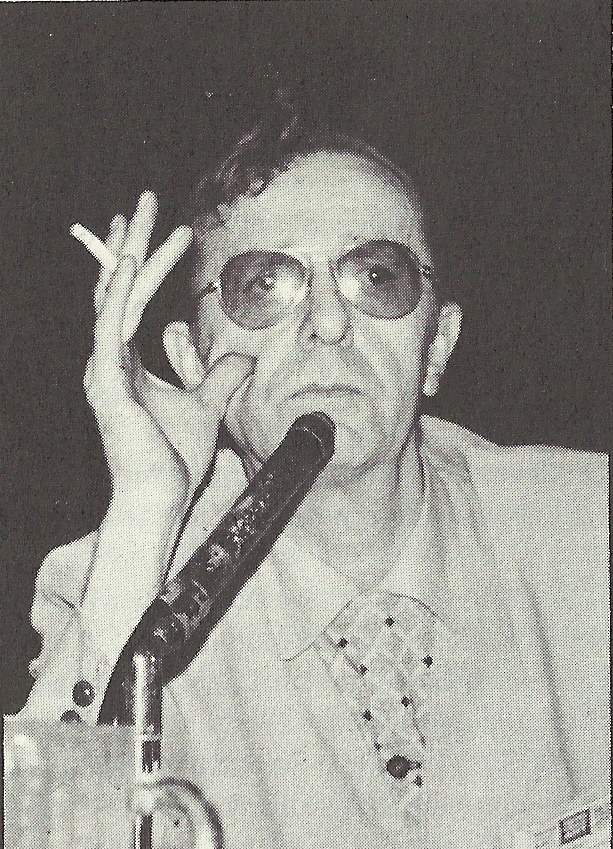
Bill Everett, pictured at the 1970 New York Comic Convention.
What is kind of curious is that Stan hired Bill Everett to draw the first issue of Daredevil. Everett had worked for Marvel on and off since 1939's Marvel Comics 1, creating, then writing and drawing, The Sub-Mariner for this and other Timely titles. 

As the Timely superheroes wound down at the end of the 1940s, the Sub-Mariner vehicle Marvel Mystery Comics became the horror title Marvel Tales and Everett switched seamlessly from one to the other. Everett also drew stories for Marvel's growing line of romance comics, and took over Timely's last stab at a superhero, Marvel Boy, from Russ Heath. Though he'd be a regular contributor to the Atlas mystery titles throughout the 1950s, Everett also drew briefly for Eastern Color (New Heroic Comics, Personal Love) and Orbit-Wanted (Wanted). 

Marvel Tales was a retitling of the Sub-Mariner vehicle Marvel Mystery Comics, and Everett provided the cover for the earliest issues. In the mid-1950s, The Sub-Mariner had a brief revival, still drawn by Everett and right at the end, there was Everett turning in one of the very last covers of the Atlas era.
Right up until the Great Atlas Implosion of 1957, Everett was one of Stan Lee's main artists, drawing mystery, romance and war tales with equal facility, reviving The Sub-Mariner for a short run between 1954 and 1955, turning in around 20 pages a month as well as two or three covers.

Once the Atlas work dried up, Everett left the comics field and took a managerial job at a paper company in Massachusetts. In an interview with Roy Thomas for Alter Ego in 1970, Everett revealed how he came to pencil the first issue of Daredevil: 

"I must have called Stan, had some contact with him, I don't know why. I know we tried to do it on the phone. I know he had this idea for Daredevil; he thought he had an idea ... With a long-distance phone call, it just wasn't coming out right, so I said, 'All right, I'll come down this weekend or something. I'll take a day off [from his job as art director at Eton Paper Corporation] and come down to New York' ... I did the one issue, but I found that I couldn't do it and handle my job, because it was a managerial job. I didn't get paid overtime but I was on an annual salary, so my time was not my own. I was putting in 14 or 15 hours a day at the plant and then to come home and try to do comics at night was just too much. And I didn't make deadlines – I just couldn't make them – so I just did the one issue and didn't do any more."

It seems that Bill Everett's art for Daredevil 1 was so late that it caused problems getting the book ready in time for press, according to latter-day Marvel publisher Joe Queseda: [Marvel Production Manager Sol Brodsky and Spider-Man artist Steve Ditko inked] "a lot of backgrounds and secondary figures on the fly [and] cobbled the cover and the splash page together from Kirby's original concept drawing."

The splash page of Daredevil 1 was pasted together in the Bullpen by Sol Brodsky, using a Jack Kirby drawing of Daredevil. It's not clear why Bill Everett didn't provide a splash page himself, as I'd have thought that would have been, for many reasons, the first thing he drew. Or perhaps he did and Stan Lee didn't like it.
And the idea that Jack Kirby designed the Daredevil costume was remembered by Mark Evanier in his blog, News From Me: "[Jack Kirby] seems to have participated in the design of Daredevil's first costume. ... Everett did tell me that Jack had come up with the idea of Daredevil's billy club ... Jack, in effect, drew the first page of that first Daredevil story. In the rush to get that seriously late book to press, there wasn't time to complete Page One, so Stan had Sol Brodsky slap together a paste-up that employed Kirby's cover drawing ... Everett volunteered to me that Jack had 'helped him' though he wouldn't – or more likely, couldn't – elaborate on that. He just plain didn't remember it well, and in later years apparently gave others who asked a wide range of answers."

When Everett returned to The Sub-Mariner in the mid-1950s after a five-year hiatus, his art style was even more polished than it had been - certainly one of my favourites of that era.
In the end, Bill Everett's art for that first issue is curiously old-fashioned and more than a little cartoon-y, quite unlike anything else Marvel was doing at the time. It was a world away from Everett's classically rendered Sub-Mariner art, especially the smoothly-polished style he was using in the 1950s. So I'm not sure it was such a bad thing that, with the second issue, Everett was replaced by EC mainstay Joe Orlando.

Behind a Jack Kirby/Vince Coletta cover, penciller Joe Orlando brought some creative and modern-looking storytelling to his first work for Marvel Comics.  The scene in which he breaks up the car-theft ring (centre) is dynamic, and Orlando's scenes of Matt Murdock's civilian life have the look of a romance comic.
Daredevil 2 (Jun 1964) was again written by Stan Lee and placed the character firmly in the burgeoning Marvel Universe, with a guest appearance by The Thing and the rest of the Fantastic Four and Spider-Man's old foe Electro for a villain. It's a pretty good second issue and, though Stan hasn't quite worked out what Daredevil's U.S.P. is, there's still a good balance between action and drama with a bit of comedy provided by Ben Grimm's guest appearance.

I'm sure Stan thought getting Joe Orlando on-board as penciller was a bit of a coup, but saddling the EC great with Vince Colletta as inker was a body blow that Orlando's pencils just couldn't recover from.


WHO THE HECK IS JOE ORLANDO?

Joe Orlando got into comics after being discharged from the US Army in 1948, when he started working on "Bob Brown of Notre Dame" in Charlton's Catholic Comics, a religion themed anthology, beginning with issue v3#1 (19, Jul 1948) and various strips for the same company's Cowboy Western. Then, for whatever reason, the work dried up at Charlton and Orlando didn't work for a few months, until he fetched up at Fox, where he contributed to the Jungle Lil (Apr 1950) and Jungle Jo (May 1950) one-shots, met Wally Wood and worked with him for the first time.

Joe Orlando's earliest work was for Charlton. Cowboy Western 23 (Jul 1949) featured his art on the cover. Jungle Lil 1 (Apr 1950) had one story pencilled and inked by Orlando. Avon's Rocket to the Moon one-shot (1951) was entirely pencilled by Orlando and inked by Wally Wood.
Orlando would continue to work with Wood at other companies, Orlando pencilling and Wood inking, first at Avon, on the one-off title Rocket to the Moon (1951), then at Youthful Publications on Captain Science 4 & 5 (Jun & Aug 1951), and Space Detective 1 & 2 (Jul & Nov 1951). But all this was just a prelude to a life-altering transition for both artists.

Captain Science 1 and Space Detective 1 were pencilled and inked by Orlando and Wood, covers and interiors. Then, mixing it up a little, Space Detective 2's cover was pencilled by Wood and inked by Orlando.
Wally Wood had already been working for Bill Gaines' legendary EC Comics. His first story for Gaines had been "The Living Corpse" in Crypt of Terror 18 (Jun-Jul 1950), followed very quickly by "The Black Arts" in Weird Fantasy 14 (Jul-Aug 1950). So it seems highly likely that it was Wood who introduced Joe Orlando to the EC editors. Orlando's first job for EC was "Forbidden Fruit" in Haunt of Fear 9 (Sep-Oct 1951), a grisly tale of the terrible fate awaiting a couple who fail to heed warnings and steal the food of a fellow desert island castaway.

Joe Orlando's art for the EC line, even in his debut story, "Forbidden Fruit", is slick and confident, with a gorgeous smooth inking style and strong pencilling and storytelling.
From there, Orlando worked almost exclusively for EC, becoming one of their mainstay artists and contributing to almost every EC title: Haunt of Fear, Panic, Shock Suspenstories, Vault of Horror, Weird Fantasy and Weird Science, as well as the later "New Direction" titles: Impact, M.D. and Valor, and the short-lived "Picto-Fiction" magazines: Crime, Confessions and Terror Illustrated.

Joe Orlando drew for every phase of EC Comics, right up to the end, contributing many classic stories for the line, but curiously few covers.
If Orlando deserves to be remembered for one stand-out EC story, then that must surely be "Judgment Day" in Weird Fantasy 18 (Mar 1953). At a time when comics were under scrutiny for being "subversive", Al Feldstein wrote a story where an interstellar ambassador from Earth, Tarlton, visits a planet of robots, and notices that the robots are divided into those with orange casings and those with blue. Yet while observing the manufacturing process of the inferior blue robots, he notes, "The internal units, my friend, the same designs, original designs. No improvement. No difference. Exactly like yours." One of the blue robots then comments, "The [blue] sheathings make that difference to the orange robots, Tarlton. It limits us to the rear of mobile-buses ... places us in different recharging stations ... forces us to live in a special section of the city."

At the end of the seven-page story, a saddened Tarlton tells the orange robots that they're not ready to join the Great Galactic Republic yet. Until they learn to live together as equals, as mankind has done, only then will real progress be possible. Then he boards his space craft and takes off his helmet, "... and the instrument lights made the beads of perspiration on his dark skin twinkle like stars."

Astonishingly, when Gaines and Feldstein sought to reprint this story in Incredible Science Fiction 33 (Jan 1956), the Comic Code administrator Judge Charles Murphy wanted the black astronaut changing to a white man. Gaines refused, saying that it would make nonsense of the story. The Judge then wanted the beads of sweat removed from the artwork, presumably because a black man's sweat may somehow give offence. Gaines again refused, threatening this time to sue the Comics Code. Judge Murphy backed down.

But it was the last colour comic Gaines would publish.

Probably the bravest thing I've ever seen in comics. Back in the 1950s, racism was a daily way of life. Anyone who railed against that risked being branded a "pinko" or worse. Yet in Weird Fantasy 18, of all places, Bill Gaines, Al Feldstein and Joe Orlando took a stand against discrimination, more than a decade before anyone else really dared to. And they were all white guys.
After the ignominious collapse of EC Comics in 1956, Orlando packed up his portfolio and moved across the street to Martin Goodman's Atlas Comics, where he cranked out stories for such titles as Astonishing, Battle, Journey into Mystery, Marvel Tales, Spellbound and Strange Tales for a much lower page rate, for the next two years. At the end of 1957, the great Atlas Implosion again left Orlando out of work, so he found pencilling work at Prize Comics, on All For Love, Black Magic and Justice Traps the Guilty, as well as contributing an increasing number of features to Mad Magazine. It was when Prize published its last comic book in 1963 that Joe Orlando washed up on the shores of Martin Goodman's Marvel Comics.


HE WHO DARES ...

Quite how Joe Orlando ended up at Marvel at the tail-end of 1963 isn't very clear. Stan Lee has always been very open about wanting artists who knew how to break down a story with minimum supervision, or even input, from him. Some artists liked that approach and some didn't. Some felt  the "Marvel Method" gave them enormous freedom to develop their strips that they wouldn't have had elsewhere, and some felt - wrongly in my opinion - that they were doing all the work and that Stan was getting paid for doing nothing. So Joe Orlando, with his enormous storytelling experience and artistic reputation must have seemed like an excellent recruit for Marvel Comics. And putting Orlando straight onto a new character like Daredevil was a big vote of confidence from the Marvel editor.

For his third outing, Daredevil faced The Owl, a Wall Street financier whose dodgy deals finally catch up with him. Rather than face court and disgrace, he becomes a fully paid-up supervillain and hides out in an inconspicuous owl-shaped house on a cliffside overlooking the city.
Daredevil 3 (Aug 1964) was Stan's chance to start giving the character his own style and identity. For a start, Daredevil wasn't up against any old Spider-Man castoff. He had his very own super-foe to play off, The Owl, another in Stan's long line of animal villains. And Stan had Orlando design a weird little napsack for the hero to carry his civilian clothes in, which unfortunately looked a bit daft.

After years of crooked deals and tax dodging in the financial industry, "The Owl" finds himself arrested and indicted. Seeking a lawyer at random to defend what he thinks is a flimsy case, The Owl, engages Nelson and Murdock. But The Owl doesn't bother turning up for court the next day, and is now a fugitive. The Owl hides out in an owl-shaped building a couple of miles outside the city to plot his next move ... which is recruiting a couple of thugs - "Sad Sam" Simms and "Ape" Horgon and underlings. Inexplicably, the next time we see The Owl and his henchmen, they're lurking in the office next door to Nelson and Murdock, in some kind of bizarre attempt to retain the services of Matt Murdock. Daredevil discovers them and a fight ensues. The noise attracts the attention of Karen Page and The Owl captures both of them, and places them in giant bird cages. Of course, Daredevil escapes and another battle ensues which ends with The Owl plunging into the waters of the Hudson and sinking without a trace.

It's all a bit creaky and the story has a couple of holes you could drive a truck through, but it was still a big improvement over issue 2. For me the biggest let-down was still the inking of Vince Colletta. Stan must have felt that putting a long-time Marvel inker like Colletta was just an insurance policy to make sure Orlando didn't go off in any unexpected directions ... and there was the problem.

Orlando had mostly inked his own stuff, apart from his very earliest pencils which were inked by Wally Wood, and his own inking style was polished and very smooth. Colletta either didn't understand Orlando's style or didn't care, and his scratchy style refused to mesh with Orlando's pencils, giving a very unsatisfying result. There are flashes of brilliance from Orlando, but for the most part his art is lost in a murky swamp of "hay".

Daredevil 4 (Oct 1964) had a better story, even if it was one of Stan's old plots recycled. But sadly, the art wasn't getting any better, with Orlando's delicate pencils being hammered by Colletta's heavy-handed inking.
Things got a bit better with the fourth issue of Daredevil, an issue I wouldn't see until much later as it had fallen victim to the great Thorpe & Porter distribution snafu of 1964. This time, Stan and Joe put Daredevil up against a more cerebral villain, Killgrave, The Purple Man, who has the ability to make people do what he tells them to.

Stan had used the idea before - most notably in the Ant-Man story in Tales to Astonish 44 (Apr 1963) and also in the Iron Man story in Tales of Suspense 41 (May 1963), where Dr Strange (no, not that one) takes mental control of Iron Man. But in DD4 it's done quite a bit better, with a more interesting resolution, as Daredevil figures a way to block The Purple Man's power because he's virtually immune to it himself.

But for whatever reason, the Orlando-Colletta team wasn't firing on all cylinders. I've not found any reasons given in any of the interviews I've read, but whether Orlando left or Stan wasn't happy has gone unrecorded anywhere. But I can make a best guess ...

In the new letters column in issue 5, "Let's Level with Daredevil", Stan explained that Bill Everett had drawn the first issue of Daredevil "as a personal favour for Stan. Then, another buddy of Stan's, valiant Vince Colletta, offered to ink the mag for a few issues if jovial Joe Orlando would pencil it. Both these guys gave up lots of their own free time to help out until we could find a steady artist."

That may well be true. If Stan had pushed Orlando out, then it's unlikely that his immediate successor, Wally Wood, would have accepted the gig, given Joe and Wally's history together. So it probably was a case of Orlando pinch-hitting for Stan until a permanent artist could be found.

In any event, Wally Wood's tenure on the title wouldn't be much longer that his EC stablemate's ... and the split between Wood and Marvel would be a mite more acrimonious. But that's a story for next time.

Next: Hooray for Wally Wood


Sunday, 16 April 2017

More DC Comics I Liked in the 1960s

IN THE FIRST HALF OF THE 1960s, I had been an avid follower of Flash, Green Lantern and The Justice League of America. I'd even been known to stray into the world of Superman and the other Mort Weisinger-edited titles. But all that changed when I discovered Stan Lee's Tales to Astonish and The Avengers. From that point on, I would dismiss DC's titles as "kids stuff" and scorn other kids who were still reading them. And I stuck steadfastly to that opinion until 1968, when DC began publishing some titles that caught my eye. 

First it was Beware the Creeper and The Hawk and the Dove, both drawn by Steve Ditko, who'd left Marvel in a huff a couple of years earlier. But then I'd begun noticing other titles, particularly Secret Six, from Marvel's arch-rival and my opinion of DC began to soften a little.

I really don't know why I picked up the first issue of DCs The Secret Six (May 1968) from a newsagent spinner rack. The cover is a bit uninspiring, and you wouldn't know until after you'd bought the comic that the cover is actually the first page of the story.
Also around this time, I was enjoying some imported American tv shows, like The Man from U.N.C.L.E. (1964 - 1968) and The Invaders (1967 - 1968) ... but a new programme on the schedules really captured my imagination - Mission: Impossible (1966 - 1973).

The classic Mission Impossible team - (back row) Barney Collier (Greg Morris), technical expert; Willy Armitage (Peter Lupus), strong man; (front row) Rollin Hand (Martin Landau), illusionist and makeup expert; Cinnamon Carter (Barbara Bain), international model; Jim Phelps (Peter Graves), leader.
Most will be familiar with the premise of Mission: Impossible after the success of the movie franchise which improbably cast Tom Cruise in the role of Ethan Hunt, a character not seen in the 1966 tv show. Every episode, the leader of the IM Force would receive a tape recording of instructions, from a never-identified person, offering him a task that no other government agency had been able to tackle. The details were delivered in a clipped voice, but did not constitute a direct order. For example:

"Good morning, Mr. Phelps. The man you are looking at is Alex Cresnic, one of the world's largest dealers in heroin. Recently, Cresnic made his biggest deal. He bought the entire heroin crop of an Asiatic country and smuggled it into Marseilles, where he plans to wholesale it to his major buyers. In order to get enough financing for such a big operation, Cresnic took in a partner. His name is Mark Walters, head of the Numbers Bank in Miami. The mission, Jim, should you decide to accept it, is to prevent Cresnic and Walters from selling their heroin and put them out of business permanently. As always, should you or any of your IM Force be caught or killed, the Secretary will disavow any knowledge of your actions. This recording will self-destruct in five seconds. Good luck, Jim." (S2, E1: "The Widow")

Then smoke would pour out of the tape recorder and Jim Phelps set about selecting the team for this mission. One of my favourite capers was "The Numbers Game" (S4 E2, 1969) where the IM Force convinces a deposed dictator there's been a nuclear holocaust in an effort to stop him invading his former country. But there were many fantasy-oriented episodes, with phoney spiritualists, fake cryo-feezing and false fountains of youth. All in all, it was pretty much tailor-made for this 14 year old comic fan.


IMPOSSIBLE MISSIONS OF THE SECRET SIX

I can't now recall whether I saw Mission: Impossible on tv before I picked up the first issue of Secret Six or after. I kind of think it was after, because I had been so taken with the premise of that new DC comic ... it seemed so fresh and original.

The setup of the Secret Six is strikingly similar to Mission: Impossible. Six experts in their fields - each with a shady past - are blackmailed into serving a mysterious, hooded character called Mockingbird. Each mission is righteous - none of the team are called upon to do anything immoral, though occasionally their actions may border on illegal - but it's always in the promotion of justice.

Most of the first issue is spent introducing the team, who all bear more than a passing resemblance to tv's Impossible Missions Force, or IMF as they're called in the show.

It's not subtle, but this scene does introduce us to the Secret Six team quickly and efficiently, using just about a single page to give the reader all the information they need.
King Savage is a movie stuntman, similar to tv's Willy Armitage strongman character. Crimson Dawn (yep!) is the Secret Six's Cinnamon Carter. Carlo di Rienzi is the comics version of Rollin Hand's illusionist aspect. Dr August Durant is the team's scientist, the equivalent of Barney Collier. Lili de Neuve is a high-end beautician and makeup whiz, who I'd say was fullfilling the other half of the Rollin Hand role. And Mike "Tiger Force" Tempest is an ex-heavyweight champion, who could also double for the IMF's Willy Armitage strongman character.

The big surprise, uncovered as they gather together for the first time, is that their mysterious leader is actually one of them. This shocking bit of news is delivered by August Durant, which made me immediately suspect him of being Mockingbird.

This is the comic's equivalent of the Mission: Impossible self-destructing tape, where the point of the mission is explained. What isn't explained, at least not at this stage, is where Mockingbird gets his (or her) information.
The rest of the plot has the team instructed to tackle the problem of Zoltan Lupus, an formerly wealthy figure, who feels that oxygen should not be free and has invented a plane with a giant hoover attached that sucks the oxygen out of the air. The Secret Six's mission, should they choose to accept it (oh, wait ... they have no choice) is to penetrate the ex-millionaire's impenetrable island fortress and ensure that the weapon fails to function during a scheduled demonstration for prospective financiers.

Of course, Zoltan's plan is thwarted and the Six escape the island in a pilfered motor launch, ruminating over the identity of Mockingbird and wondering how long this situation is going to go on for.

Once the team has been established, it cleared the way to fill all 23 pages with actual plot. Secret Six 2 (Jul 1968) has one of the most striking covers of the entire Silver Age and still one of my favourites to this day. There's probably an entire blog post to be written about Nick Cardy, one of the mostly unsung geniuses of the 1960s and 1970s and, likely, someone's already written it. I may even do a post on Cardy myself one day, but for now let's stick to the subject.

What made Nick Cardy such a terrific artist was that he was also a great designer. This arresting layout and colour scheme immediately grabs the attention. It's very much an image of the times, very "Pop-Art" and on that level, I think Cardy was every bit as influential as Jim Steranko.
"Plunder the Pentagon" was plotted by series creator E. Nelson Bridwell and again drawn by Frank Springer. Old Charlton Comics lag Joe Gill was drafted in to do the dialogue. I don't think the issue reads any better or worse than the last one, which written by Bridwell on his own. Perhaps it was a deadline thing ... more likely it was newly-ensconced, former Charlton editor Dick Giordano's suggestion.

GIORDANO - RENAISSANCE COMICS MAN

Richard Joseph Giordano began freelancing at Charlton Comics in 1952, pencilling mostly romance, racing and western comics like I Love You (1955 - 1976), Hot Rods & Racing Cars (1951 - 1973), and Billy the Kid (1957 - 1983).

Some of Giordano's earliest cover art for Charlton Comics: Space Adventures 3 (Nov 1952); Lawbreakers Suspense Stories 13 (Jul 1953); and Haunted 15 (Feb 1954). Even at this point in his career, Giordano's clean line and dynamic layout style is evident.
Around 1965, Giordano became Managing Editor at Charlton, under long-serving Executive Editor Pat Masulli. Giordano's first project in his new role was to supervise the revival of Charlton's dormant superhero comics as the "Action Hero" line, reinstating Captain Atom (with new art by Steve Ditko, after a short run of reprints), Peacemaker (drawn by Pat Boyette), JudoMaster (by Frank MacLaughlin), Thunderbolt (by Pete Morisi), as well as a revived Blue Beetle and The Question (both by Steve Ditko).

During his stint as Charlton editor, Giordano saw the success Marvel was having and instigated a line of super-hero books for Charlton, drawing on old favourites and creating new titles.
The new Charlton superheroes were only moderately successful, and by the end of 1967 were cancelled. However, during this (for Charlton) fertile period, Giordano had discovered and recruited talent like Jim Aparo, Denny O'Neill and Sam Grainger. And once the superhero revival was all done, so was Giordano. He left Charlton around the end of 1967, and accepted vice president Irwin Donenfeld's offer to join the staff of DC comics as an editor, taking over Teen Titans, Aquaman and a stable of other titles from George Kashdan and Jack Miller, with the May 1968 cover dates.

At DC, it seemed that Giordano had joined at an interesting time. I'd like to say that it was Giordano who'd brought in interesting artists like Nick Cardy and off-beat series like Deadman, but they were already in place when he was hired. Not quite sure where Young Love fits in, but I love the Jay Scott Pike cover.
Though I hadn't realised it at the time, I was an instant fan of Dick Giordano. I had taken a shine to his two Ditko titles at DC - The Creeper and The Hawk and the Dove - because they were Ditko, and thought Deadman in Strange Adventures was pretty good, too. It would be neat and make for a better story if I could have credited the brilliance of the Nick Cardy-drawn series Aquaman and Teen Titans to Giordano, but the fact is that Cardy had been involved in both series pretty much since their inception. 

Johnny Sheffield and Peggy Ann Garner starred in a series of low-budget Bomba movies during the 1950s. Just why the DC comic bills the character as "TV's Teen Jungle Star" I couldn't say. There's no evidence of a Bomba tv-series around 1968. Perhaps the films were showing on a loop on Saturday mornings in the US at the time.
Bomba was a strange choice. The character, a Tarzan Junior, had appeared in a successful series of books by "Roy Rockford", a house pseudonym of the book packager, Stratemeyer Syndicate. The film rights were picked up by poverty row studio Monogram and the 12-film series featured Tarzan's "Boy", Johnny Sheffield, in the title role. In 1968, I could have cared less about jungle characters.

Giordano had been handed Blackhawk at a weird time in its run, with issue 241 (Jun 1968). A year earlier, there had been an ill-advised attempt to turn the team into superheroes. Sales had been sinking and doubtless, the DC editors had looked at the burgeoning success of Marvel and their own superhero books and thought, "Hey, why not?"

Seemed like a good idea at the time - The Blackhawks were transformed into superheroes for the last year of their run. Not even Dick Giordano could save them.
Giordano quickly put a stop to all that nonsense, and returned The Blackhawks to their traditional blue uniforms in issue 242. But it was too little, too late and the title was cancelled with the following issue, 243.

The real odd-one-out in the stable is Young Love. Perhaps Giordano requested it, or perhaps it was thrust upon him. Whatever happened, Giordano decided to at least try to make the title his own.

The early Young Love covers were pencilled and inked by Jack Kirby. Then the covers sported photos for a large part of the run, presumably to make the comics look more like "real" magazines. The last part of the run featured many covers by Rip Kirby artist John Prentice.
Young Love had been one of the original pioneers of the Love Comic genre, started by Joe Simon and Jack Kirby back in the late-1940s for Crestwood's Prize Comics imprint. The title lasted under the team (Kirby left during the title's 1956 - 1960 hiatus) until 1963, when Prize went out of business and sold its remaining romance titles to DC. It was around that time that the Simon-Kirby partnership split up, though the two would continue to work together on occasional projects up until about 1960 or so.

Pretty quickly, Dick Giordano took over drawing the covers of Young Love (and of other DC romance titles) and overhauled the title's cover logo.
When Giordano took over Young Love, he first compiled a reprint issue in the 80-Page Giant format to give himself some breathing space, then took over drawing the covers himself. Within a few months, he'd redesigned the cover format, bringing a modern-looking logo and introducing an ongoing serial, "The Life and Loves of Lisa St Clair".

Over the next few years, Giordano introduced new titles like Date with Debbi (1969 - 1972), The Witching Hour (1969 - 1978) and Windy and Willy (1969), and took over editing the newly revamped House of Secrets (1969 - 1978) and the long-established romance title Secret Hearts (1949 - 1971). But by the end of 1970, Giordano was feeling constrained by the "lack of editorial opportunities" and left DC staff to become a freelance artist.

He'd go on to be the inker of choice for DC's super-penciller Neal Adams, though he contributed fewer inking jobs to the classic run of Green Lantern-Green Arrow than you'd think, just six of the 14-issue run.

Giordano returned to DC in 1983 as Managing Editor, was promoted to Executive Editor and remained with the company until 1993, when the untimely death of his wife - Marie Trapani sister of Sal - hastened his decision to return to freelance inking part-time.

It can't be a coincidence that the only DC books I'd countenance reading in 1968 were all edited by Giordano, even though I didn't know it at the time. And it was probably the hand of Giordano - as much as Steve Ditko - that brought me to the Charlton Action Hero line of the mid-1960s, albeit almost thirty years after the event.

Giordano died on 27 March 2010, but his influence on the industry has lived on long after him. He was an important figure, not just to the comics business but to me too, both for his editing skills and for the brilliant comics he illustrated with Neal Adams.

HOUSE OF SECRET

So with the introductions of the characters out of the way, and new scripter Joe Gill on board, Secret Six 2 (Jul 1968) was free to concentrate on the intricate caper-plot, which more than ever resembled an episode of Mission: Impossible.

The first part of the story in Secret Six 2 sets up the situation and has Durant plan how the team will solve the challenge facing them. The middle section reveals some background information on Durant and how he came to serve Mockingbird. The back half of the story has the team solve the problem in an ingenious way.
The Six are tasked by Mockingbird to sell plans for the top-secret aircraft the XB-107. But first they have to steal the plans to make enemy agents believe they have them. Then they'll sell fake plans to the agents and secretly return the real plans. With me so far? So Carlo and Lili walk brazenly into the Pentagon, disguised as a high ranking army officer and his secretary, accompanied by Dr Durant. Their chance discovery by a passing security man means they have to fight their way out. But it turns out that the military intelligence people knew the foreign agents were after the plans, and switched the real plans for fake plans. So Carlo and Lili snatched fake plans. So where, asks Durant are the real plans? Why right here in my drawer says the intelligence guy. Except they're not. In all the confusion, the enemy agents filched the real plans. Reviewing recent newspapers, Durant discovers that Soviet spy Nikolai Shokolov recently entered and left the US making him the prime suspect. The Secret Six resolve to go after him and retrieve the real plans. And we're not even halfway through the story.

I think it was this level of complexity that made me a fan of the title very quickly. I had to read the story a couple of times to figure out exactly what was going on, and that added up to Value for Money, to me.

The second half of the story reveals how Dr Durant came to be infected with a lethal virus and how Mockingbird supplies the drug which keeps the virus at bay. Did Mockingbird administer the virus in the first place? Why doesn't anyone else have an antidote? Is Durant even telling the truth?

In the end, with Shokolov distracted by Crimson's undeniable charms, the team manage to switch the real plans for the fake plans, which Shokolov then delivers to his Soviet masters. Needless to say, it doesn't end well for Shokolov.

This would be the formula for the series. Each issue would feature an impossible mission, and highlight the story of one of the team.

Secret Six 3 sported some pretty good artwork by Jack Sparling. The pages above feature what looks like Neal Adams-inspired layouts. Page 21 I especially like, as I used to own the original art for this page. Can't remember now whatever happened to it.
Secret Six 3 (Aug 1968)  saw a change of artist. Frank Springer was gone and in his place, reliable DC regular Jack Sparling was providing the art. I don't think I noticed the artist change at the time, and even now I think Springer's and Sparling's art styles are quite similar. However, I do think Sparling was paying attention to the rise of young artists like Neal Adams and was striving to make his art as dynamic. Look especially at the scan of Page 21 of SS3 above. That fore-shortened figure diving across the lower panel is quite Adams-like.

The story opens with each of the team surviving attempts on their lives. After speculating that one of the attempts may have been faked, the six decide to pair up, so each can keep an eye on the other. But that doesn't help, as Mike Tempest is abducted by The Mob under the very nose of stuntman King Savage. The team bust Mike out of the cell he's being held in and leave the disguised Mob heavy Hanrahan in his place. The Mob take Hanrahan out to be shot instead of Mike ... and as they do, the police show up and arrest the baddies, all except the Big Boss, who gets away.

Then we learn a bit about why the Mob wanted Tempest. It seems the ex-boxer didn't throw a fight when the Mafia wanted him to, and the gangsters want payback. And just as Tempest's story comes to a close, the Mafia Boss pops up brandishing a machine gun. There's a big fight and the Bad Guy gets his just desserts.

This plot is a little more straightforward than preceding issue's. By this point, the team seem to have accepted that one of their number is really Mockingbird, but when I traced it back, that view was just a theory expressed by Dr Durant in SS1, though there's no evidence to support that view. In the context of the story, it's just pure guess work, yet here we are two issues later and the team seem to have taken the idea as fact.

There's a bit of discussion about this development on the title's new letters page, "Listen to the Mockingbird". One reader suggests that Mike Tempest can't be Mockingbird because he was seen responding to Mockingbird's call on his wrist videophone. Another reader thinks it'd be a good idea to have one of the team killed on a mission and have a new member join. Dick Giordano's response to this is that then the rest of the team would know that the new member can't be Mockingbird, but I don't agree. It's not been demonstrated by any evidence that Mockingbird is one of the team. This discussion would continue ...

Secret Six 4 would be the last outing for the classic circular logo. The story fills in King Savage's biography and sends him to China to free the man who tortured him from the communist authorities.
The fourth issue of Secret Six (Nov 1968) has the team dispatched to China to liberate a double agent, General Pao, from a Red Guard jail. While Lili's applying makeup so the team can pass as Chinese, we get a flashback telling how King Savage was captured and tortured in Korea and gave away everything he knew to the communists. But Mockingbird was able to free him and Savage returned to his own lines a hero. When the team eventually reach the prison, we discover that General Pao is the same man who tortured Savage ten years earlier.

Not my favourite issue, but I was enjoying Jack Sparling's art.

WHO THE HECK IS JACK SPARLING?

John Edmond Sparling was born in Winnepeg, Canada in 1916, making him 52 when he was drawing Secret Six. His parents moved to the US when Sparling was a child. Around 1940 (sources vary) Sparling created the newspaper strip Hap Hopper, with writer William Laas. Sparling worked on the strip until 1943, when he was succeeded by Al Plastino. Sparling's next newspaper gig was Claire Voyant, which lasted five years, with some of the strips being collected in comic book form.

By the early 1960s, Jack Sparling was getting steady work from the DC editors, both fill-ins and regular series work, in the shape of Eclipso in House of Secrets.
For the next 20 years, Sparling freelanced for just about every comic book company, pencilling and inking in just about every genre  - Warfront and First Romance (Harvey), Tell It To The Marines and Danger Is Our Business (Toby), Gabby Hayes (Charlton) and various movie adaptations for Dell's Four Color series in the 1950s. Then in the early 1960s, Sparling fetched up at DC, drawing short stories for the anthology titles like Strange Adventures and House of Secrets, for which he also drew the ongoing Eclipso series, and even Green Lantern.

AND ... BACK TO THE COMICS

Secret Six 5 (Jan 1969) draws inspiration of sorts from The Prisoner of Zenda ... a character called Johnny Bright has filched the crown jewels from a small European country called Graustania, and there's a danger that if the coronation doesn't go ahead there could be a communist takeover or, worse, the Basil Rathbone-like Archduke Otto might usurp the throne.
Secret Six 5 allows the glamorous Crimson to take centre stage, playing a pivotal role in the takedown of Johnny Bright, and at the same time revealing how she came to be in the thrall of Mockingbird. I'm not sure why the logo was revamped, removing the distinctive spotlight circle which I'd quite liked.
The team are dispatched to recover the baubles. It turns out the Bright is the cad that married Crimson for her money and left her flat, back when she was frumpy Kim Dawn.

This allows Bridwell and Gill to give us the origin of Crimson, probably the most interesting of the Secret Six team. Raised as a dowdy kid by a military father who wanted a son, she was trained in sport and martial arts by her father. Trying to break away from his stern influence, she met and married chancer Johnny Bright, who stuck around until the money ran out, then ditched her. Mockingbird picked her up, delivered her to Lili, who turned chubby loser Kim into the international supermodel Crimson.

Of all the six, I think Crimson/Kim has the weakest reason to be bound to Mockingbird. Her big fear is that her family will find out she's Kim. And then what? Disinherit her? Didn't that already happen? OK, tell her off, then? Send her to bed with no tea? If Crimson were an internationally successful model, she's be pretty much beyond the reach of her family anyway, as she'd have her own funds, so her family has no hold over her. But why carp?

Secret Six 6 puts ex-movie star Lili de Neuve in the spotlight, for all the wrong reasons. The sub-plot with Crimson distracting villain Marcel Valory with her, er, charms doesn't really contribute anything to the plan, but is perhaps just in there so Jack Sparling can draw her in a bikini.
Secret Six 6 (Mar 1969) highlights Lili's story and makes her the centre of this issue. For the second time in her life, Lili finds herself framed for murder. Her arch enemy and the woman who stacked fake evidence against Lili first time round, Jeanne Gaultier, is murdered at Lili's spa, and all the evidence points to her. So the team take it upon themselves to investigate and help Lili out, this time without direct orders from Mockingbird. It doesn't take the Six long to figure out that the guilty party must be Gaultier's current paramour, Marcel Valory. They then devise an elaborate scheme to make Valory think that Jeanne is still alive, tricking him into confessing in front of an audience of hundreds. And Lili is off the hook again.

And on the subject of Mockingbird's true identity, there is a response, to a letter from future DC staffer Carl Gafford, on the letters page that says, "Remember, it was Doc, and no one else, who said Mockingbird was one of the group. There really hasn't been any documented proof that this is really so!" This just made me strongly suspect that the creative team probably hadn't actually decided who Mockingbird was, even at this point.

Secret Six 7 allowed Carlo di Renzi some closure after the murder of his wife and the near-fatal injury of his son at the hands of The Syndicate. But it failed to bring the series to a satisfactory close.
Secret Six 7 (May 1969) was the final issue.This meant that the sixth member of the team, escape artist and magician Carlo di Renzi was afforded his moment in the limelight. The Mafia is still looking for Mike Tempest, and kidnap Carlo so they can torture him and make him reveal where Tempest is. The thug who's been sent after Mike is Mario, a professional hitman from the old country, who was responsible for the death of Carlo's wife and the crippling injuries of his son. Carlo manages to contact the Six via his wrist vidphone and the team put a plan in motion to put a stop to the Syndicate once and for all.

And then, with that, the run of Secret Six was over. The last page bore no trailer for the next issue, simply a small "The End". While other hands would resurrect the series years later, there can be no doubt that it wouldn't be the real Secret Six.

The identity of Mockingbird would be revealed 20 years later in Action Comics Weekly 629 (6 Dec 1988), in a story written by Marty Pasko. I haven't read it. And even if I had, I wouldn't see it as the true resolution of the story that had been started (and never finished) by E. Nelson Bridwell and his collaborators Joe Gill, Dick Giordano, Frank Springer and Jack Sparling. For, in my mind, that Mockingbird would just be an impostor.

For the time being, that would end my brief flirtation with DC comics of the 1960s. It would take a few years and the release of Marvel's Conan before I'd once again take a look at any comics from Marvel's rivals. In the early 1970s, I'd notice DC putting out books like Green Lantern-Green Arrow, Swamp Thing and The Shadow ... but that's a story for another time.

Next: Daredevil and other Disabled Defenders