BY 1963, MARVEL'S TITLES WERE BEGINNING TO FEATURE MORE AND MORE SUPERHEROES, which resulted in steadily rising sales. At this point DC Comics were still outselling Marvel by a 86% margin, so if advertisers were looking for the best venue to reach millions of children, then an ad in a 12 cent DC comic seemed the sensible way to go. The Superman tv show was still in syndication across the US, making the character a household name, so you can see why advertising agencies would prefer to buy space in Superman comics than in Martin Goodman's lesser-known Fantastic Four or Spider-Man comics.
 |
| If you wanted to reach the maximum number of children in June 1963, would you choose the magazine featuring America's most famous hero, or the relatively obscure Marvel Comic character, Spider-Man? |
Because of this, you were far more likely to find bigger name advertisers hawking their wares in DC Comics than in Marvel books. I had thought that those familiar 1/3-page Tootsie Roll ads started appearing in DC mags in the early 1960s, but a little research shows that they first started with a full-pager in the early 1955 titles.
 |
| We never got Tootsie Roll confectionary in the UK, and I've never tasted it myself, though later I did get to try Hershey's chocolate. I didn't like it. |
Then, after a few months of testing just single 1/3-page ads, Tootsie Roll moved fairly quickly to taking three per issue in most DC books. Aside from the occasional AMF Roadmaster Bicycle or Winchester Air Rifle ad, Tootsie Roll would remain DC's best-known advertiser well into the 1960s, while the lower-rent advertisers, like Mike Marvel Body Building, would recede and disappear by 1963.
What was interesting was that it was also about this time that DC started having the final page of some of their stories run to just 2/3 of a page. This seemed to be to accommodate the Tootsie Roll ads. But in 1959, for some reason the company paused their advertising campaign, very probably without warning, leaving DC with a bunch of comics pages in the pipeline that were a third of a page short. And this is when we first started seeing the banner style house ads - lettered up by the immortal Ira Schapp - that would take the place of missing Tootsie Roll ads whenever needed.
 |
| DC house ads for their companion titles were always either half or full pages until 1959, when a break in the Tootsie Roll ad campaign left DC with some awkward spaces to fill. |
Meanwhile, over at Marvel Comics, Martin Goodman was still clinging tenaciously not only to the body building ads, but also to the trade school and part-time selling opportunity ads that marked his publications as intended for lowbrow adults rather than children ... and to those pesky Classified ads.
 |
| Most of these small ads are for stamp companies, but there's a sprinkling of coin companies too. What intrigues me is those slightly shady music companies looking for poems, presumably to use as the lyrics for songs. Did they ever find any lyricists that way? Is it a scam? Click to enlarge. |
However, over the next few years, as Stan's line of superhero comics gained ground on DC's floundering portfolio, we'd begin to see some incremental change in the style of ads that were appearing in the Marvel books ... but not much.
1963 - MARVEL
After the debut of The Fantastic Four in late 1961 and the first appearances of The Hulk, Ant-Man, Thor and Spider-Man in 1962, the following year consolidated Marvel's superhero line with the addition of Iron Man in Tales of Suspense 39 (Mar 1963), Dr Strange in Strange Tales 110 (Jul 1963), X-Men and The Avengers (Sep 1963) and the first issue of Amazing Spider-Man (Mar 1963).
 |
| In what was a bumper year for Marvel Comics, 1963 saw the consolidation of the superhero line. DC just didn't see the writing on the wall ... |
Here's a revised version of the sales table I included in the April 2020 edition of this blog where I looked at the sales trends of Marvel and DC during the 1960s. You can see that from 1962 to 1963, Marvel enjoyed a 20% sales bump. And these are not the claimed sales figures that Martin Goodman guestimated for his second-class postal statements in the comics. These are the audited sales numbers that appeared in the N W Ayres advertising directories of the period.
| 1st HALF | 2nd HALF | FULL YEAR AVERAGE | DIFFERENCE | |||||
|---|---|---|---|---|---|---|---|---|
| YEAR | DC | MARVEL | DC | MARVEL | DC | MARVEL | ||
| 1960 | 6,695,210 | 2,322,162 | 8,056,093 | 3,058,312 | 7,375,652 | 2,690,237 | -63.53% | |
| 1961 | 6,908,803 | 2,833,849 | 7,747,787 | 3,401,069 | 7,328,295 | 3,117,459 | -57.46% | |
| 1962 | 6,049,602 | 2,992,017 | 7,250,513 | 3,587,987 | 6,650,058 | 3,290,002 | -50.53% | |
| 1963 | 6,262,836 | 3,364,779 | 7,283,109 | 4,145,588 | 6,772,973 | 3,755,184 | -44.56% | |
| 1964 | 6,671,121 | 3,903,821 | 7,461,786 | 5,322,151 | 7,066,454 | 4,612,986 | -34.72% | |
| 1965 | 6,274,065 | 4,873,463 | 7,010,828 | 5,935,322 | 6,642,447 | 5,404,393 | -18.64% | |
| 1966 | 6,987,445 | 5,980,401 | 7,687,633 | 7,300,363 | 7,337,539 | 6,640,382 | -9.50% | |
| 1967 | 5,848,098 | 6,390,403 | 6,800,572 | 7,695,583 | 6,324,335 | 7,042,993 | 11.36% | |
| 1968 | 5,970,013 | 7,088,687 | 6,614,980 | 9,147,001 | 6,292,497 | 8,117,844 | 29.01% | |
Furthermore, since I last posted this table, I've managed to access some more pages from later N W Ayres Directories and they further confirm more of the numbers in the above table (marked in orange).
 |
| Click to enlarge. |
So although the listed Marvel titles for 1962 in the N W Ayres Directory may be a little out of date, we can be sure that the circulation figures are accurate. More importantly, the numbers for Marvel books trended upwards as the 1960s wore on, while the figures for DC displayed a definite downward dwindle, barring a slight uptick in 1966 due, no doubt, to the blast of publicity around the god-awful Batman tv show.
Meanwhile, over at Marvel's ad agency, it was business as usual. We were still a year or two away from the increased sales trickling down to the Ayres Directory and the kind of audited figures that would merit the company being able to charge advertisers higher rates. They were still operating a Red Unit group of titles and a Yellow Unit, a practice that would exist until 1968 or 1969.
Both groups had essentially the same page configuration, with ads or at least non-comic strip material in the same spots throughout the magazine.
COMIC BOOK PRODUCTION - AN ASIDE
I probably should have mentioned this last time, but it's worth explaining to folks not familiar with printing methods how a 36-page comic was put together at the printers. Bearing mind that the covers were always printed separately on different, higher-quality paper, the interior pages of the standard American (and British, for that matter) comic have always been in multiples of 16. So when comic books first started appearing in the 1930s, they comprised four outer pages of the cover and 64 pages of interior newsprint paper. When paper shortages hit the industry during World War Two, many publishers were forced to drop to 48 interior pages. By the beginning of the 1950s, this was levelling out to 32 interior newsprint pages, plus outer covers.
 |
| Try it yourself ... The left hand grids are one side of the paper (web) and the right grids are the other side. Fold each as indicated, so you end up with the blue (3 or 11) on the outside facing you. Tuck the lower web inside the upper, staple at the centre, then trim the top and right edges. Your own mini comic. |
This is because comics were printed on standard newspaper presses, mostly coldset letterpress machines. And because there was no heat-drying process, that's why newspaper ink used to come off on your fingers. The paper is fed into the printer via a continuous roll (the "web") and is printed on both sides in one pass. Four broadsheet size (23.5" by 14.5") pages will fold down into 16 comic book pages, so the interior of a comic requires two broadsheets, folded down to make 32 pages of comics.
Why am I telling you this? Well, consider that each of the four sides would be planned (assembled) from eight pages of negative film per side and then metal plates made from the film to print each side of the section at once. Four colour printing would require four plates for each side of the broadsheet section - cyan (c), yellow (y), magenta (m) and black (k, so as not to be mistaken for blue). You'll still find CYMK colour models used in software like PhotoShop and Illustrator.
 |
| Examples of some registration marks printers put on the outer edges of a printed section to ensure the four colours are lining up correctly. |
Keeping the ad pages in the same place for each comic saves a bit of work at the planning stage, especially when you're running the same ads across several titles.
AND ... BACK TO THE ADS
Nothing much had changed as 1962 rolled over into 1963. On all Marvel titles across the board, the non-comic-strip pages continued to be (8,) 9, 15, 19, 25 (26,) 27, 33, 34 - I put 8 & 26 in brackets because they tended to be either text editorial or house ads, but almost never comics strip.
 |
| Click to enlarge. |
I'm using Rawhide Kid to represent the Marvel Red Unit, but comparing it with Fantastic Four 18 the same month, the ads are the same. Rawhide Kid 35 (Aug 1963) has 23 pages of comic strip and two pages of text story. There's seven pages of paid advertising on the interior pages and three of the four cover pages are also paid ads.
 |
| Click to enlarge. |
We're still seeing a lot of the same ads, or at least ads in a similar vein. Trade training courses like electrical repair and car maintenance, selling opportunities and what seems like too much emphasis on hypnosis. And body building.
 |
| Click to enlarge. |
In Marvel's Yellow Unit, focussing more on the girls' titles, the page plan of the comics followed the same configuration as the Red Unit, with the ads in exactly the same places. In Patsy Walker 108 (Aug 1963), only the single text page is placed differently. The second text page has been swapped out for a house ad for Millie the Model Annual 2 and Patsy and Hedy Annual 1.
 |
| Click to enlarge. |
The paid advertising is more in keeping with the perceived female audience for this title, with a couple of ads for "train to be a nurse", star photos and fan clubs and, in an inspired moment of ad placement, a "don't be skinny" ad on the same spread as a "don't be fat" ad.
1963 - DC
Meanwhile, over at DC the same year, it was pretty much business as usual, with no great deviation from what the company was doing in 1962. One thing that did change was the return of the one-third page Tootsie Roll ads, with editorial specifying that the final page of each story in the comic would be just two-thirds of a page to allow to include the Tootsie Roll ad at the bottom. This started with Action Comics 292 (Sep 1962), just missing the 1962 roundup I presented last time by a single issue.
The Tootsie Roll campaign wasn't a new thing for DC, but as mentioned above, it wasn't a consistent presence during the early 1960s. More out of curiosity, I thought I'd trace the origins of these ads in DC comics as far back as I could.
Tootsie Roll was a gooey confectionary first marketed in the U.S. by Sweets Company of America in 1908. The inventor, Leo Hirschfield, was the son of an Austrian sweet maker and started working at a confectionary business in New York in 1896. Details are hazy, but it seems that the sweetshop was acquired by confectionary manufacturers Stern and Saalberg, and it while working for that firm that Hirschfield invented Tootsie Roll candy around 1907. Shortly after this, Hirschfield became Vice-President on the company and continued in that role until Stern and Saalberg both retired around 1917 and the company officially became Sweets Company of America. Despite the success of Tootsie Roll candy, Hirshfield committed suicide for uncertain reasons.
 |
| The earliest ad I could find in DC Comics for the candy was in Action Comics 201 (Feb 1955). |
By 1935, the company was in serious difficulties and it was then that the manufacturer of Tootsie Roll's packaging materials Joseph Rubin and Sons, fearful of losing their biggest client, decided to acquire the company. Under the new leadership, and with a change to the formula and size of the Tootsie Roll candies, Sweets Company of America began to return to profitability. Surviving the difficult war years, the sales of Tootsie Rolls had increased twelvefold by the time of Rubin's death in 1948.
 |
| Action Comics 245 (Oct 1958) was the earliest example I could find of DC making the final page of a feature story just two-thirds of a page to allow room for paid advertising. |
After sporadic appearances during the mid-1950s, the Tootsie Roll ad campaign in DC's titles ramped up again in 1958, with first a full page ad in Action Comics 244 (Sep 1958), then the following issue, the one-third page ads kicked off in earnest, with each of the three comic strip stories making room for a one-third page Tootsie Roll ad on their final page.
 |
| Click to enlarge. |
The trend would continue, with Sweet Company of America concentrating their campaigns in the summer/autumn issues of the DC titles. As you can see above, the ads featured throughout the August issues of DC comics, including Action Comics 303 (Aug 1963), part of DC's Blue Unit.
 |
| Click to enlarge. |
Other advertisers included Mike Marvel Bodybuilding (one of the final entries), a Garcelon Stamps ad, no fewer than four toy soldiers ads and four beautifully lettered Ira Schapp house ads. That left readers with 24.66 pages of comic strip (including a couple of Henry Boltinoff two-third-page cartoon strips), and one page of readers' letters.
In DC's Red Unit, Strange Adventures 155 (Aug 1963) had almost exactly the same ads but just placed in different positions throughout the magazine. Thinking this a little curious, I looked at some other DC Mags the same month and found that My Greatest Adventure 81 (another Blue Unit title) had completely different ads to Action 303.
 |
| Click to enlarge. |
Then Blackhawk 187 (also a Blue Unit title) had the same ads as Action and Strange Adventures. I don't have access to N W Ayres for 1964, but looking at the Directory for 1965, it looks like some titles had been swapped around between the Red and the Blue Units.
 |
| Click to enlarge. |
So, instead of Strange Adventures (which must've become a Blue Unit title during 1963), I'm going to use Detective Comics 318 (Aug 1963) to represent the Red Unit.
 |
| Click to enlarge. |
The ads are, tellingly, similar to the selection in My Greatest Adventure 81. Where MGA81 has 24 pages of comic strip, three pages of house ads, a letters page and seven pages of paid advertising, Detective 318 has 25 pages of comics strip (including a Henry Boltinoff cartoon strip), 1.5 pages of house ads, a text page and 6.5 pages of paid ads.
 |
| Click to enlarge. |
I'm still trying to decide if those Community ads in the DC comics of the period count as house ads or paid advertising.
1964 - MARVEL
By 1965, the N W Ayres Directory's entry for Marvel had updated the listed titles to show the 1964 lineup.
 |
| Click to enlarge. |
You can see that Daredevil has entered the list along with the titles that debuted in 1963, Amazing Spider-Man, Sgt Fury, The X-Men and The Avengers, along with a belated appearance of Fantastic Four. There's a striking contrast between the circulations of the Red Unit (3,119,500, over 13 boys' comics titles) and the Yellow Unit (784,321, across four girls' comics titles), though it still represented an impressive 22.8% increase in sales from 1963 to 1964.
Sticking with Rawhide Kid to represent Marvel's Red Unit, issue 41 (Aug 1964) looked like this:
 |
| Click to enlarge. |
We're still at 23 pages of comic strip, one page of text story and a full-page house ad, and still with 10 pages of paid advertising.
 |
| Click to enlarge. |
It doesn't look like - even with the mounting success of the superhero comics - Martin Goodman has been able to (or even wanted to) capitalise on the improved sales and start bringing in a better class of advertiser, because the ads here don't look a great deal different to what we were seeing in the 1963 issues, but for the full page ad for the Marvel titles, Fantastic Four and Amazing Spider-Man (the previous issue featured the first house ad for another title, Avengers 5).
Over in the Yellow Unit, the trend was, once again, little different from what we were seeing in the 1963 issues, other than a full page house ad for the Yellow Unit companion titles, Patsy and Hedy and Modelling with Millie.
 |
| Click to enlarge. |
Patsy Walker 114 (Aug 1964) also had 23 pages of comic strip (or similar) pages, one page of text story and the house ad mentioned above. The remaining 10 pages were paid advertising.
 |
| Click to enlarge. |
The paid ads were the usual mix of weight-loss, nursing tuition and manicure commercials. Only the gardening ad seemed a little out of place.
1964 - DC
By contrast, we see quite an improvement in the class of advertiser DC were starting to attract, even as their sales were beginning to decline. Representing the Blue Unit, Action 315 (Aug 1964) had 22.66 story pages, 1.66 pages of house ads and a whopping 9.66 pages of paid advertising. It's as though someone was actively bringing in new advertisers to make up for slipping circulations.
 |
| Click to enlarge. |
No body building ad this time (though they're still popping up in other DC comics, like Action 316 and Adventure 325, Oct 1964). No more of those Stephens Mottoes ads either, which in 1964 were still hanging around in the Marvel titles. DC were clinging on to the toy soldiers ads, but had also added 2.66 pages of breakfast cereal commercials and a full page for Silly Putty.
 |
| Click to enlarge. |
In the Red Unit's Detective Comics 330, there's some overlap of ads, but still enough difference to mark them as separate groups. There's 24 pages of comic strip, 1.5 pages of house ads and just a half-page letter column, with a third-page "Scienti-facts" feature. The rest of the interior pages are filled out with 7.66 pages of paid advertising, and whatever those Community messages count as.
 |
| Click to enlarge. |
The paid advertising includes - like Action - 2.66 pages of cereal ads, the same Silly Putty ad, two pages of toy soldiers ads and the ever-present Junior Sales Club of America.
 |
| Click to enlarge. |
Signing General Mills was quite a coup for DC. As well as producing a vast array of breakfast cereals, the company also sponsored the Rocky and Bullwinkle tv show, not something we'd recognise in the UK, but pretty much a household institution in the US during the 1950s and 1960s. We wouldn't see that quality of advertising in a Marvel comic for many years to come.
1965 - MARVEL
By 1965, Marvel's Yellow Unit had dwindled to just four titles, while the Red Unit, comprising of all the western, war and superhero comics had grown to 13, plus four Annuals. I'm sticking with Rawhide Kid as the Red Unit title, but comparing it with Fantastic Four 42 for the same month, the ads are identical. The page count for comic strip has dropped to 22 (though many of Marvel's titles would have just 20 pages of comic strip by the end of 1964), there's two pages of house ads and a letters page. The paid ad page count remains unchanged at 10.
 |
| Click to enlarge. |
The type of ads we're seeing hasn't really changed either. Despite a healthy 17% increase in sales from 1964 to 1965, Martin Goodman is still chasing the low-rent, small-time advertisers, instead of going after high-paying corporate players. Why, I can't fathom. Was it some sense of inferiority, believing his publications were too low-brow to attract household name level advertising?
 |
| Click to enlarge. |
The sales opportunity ads are still there, with Masons Shoes right upfront on the inside cover, along with GRIT later on in the comic. The lost interior comic strip page has been replaced with an extra house ad, selling Marvel t-shirts and MMMS memberships. The other house ad is touting the line-up changes to Strange Tales (Nick Fury Agent of SHIELD replaces the Human Torch), with The Sub-Mariner taking Giant-Man's slot on Tales to Astonish.
 |
| Click to enlarge. |
The Marvel Yellow Unit titles are still a different kettle of ads. These titles, typified by Patsy Walker 120, are still offering 23 pages of comic strip or similar material, with just a single house ad and a letters page.
 |
| Click to enlarge. |
The ads - 10 pages of them - are still more female oriented but there's also sales opportunities and home study education ads side-by-side with the beauty products and cheap novelties. And no classified ads pages.
1965 - DC
In 1965, DC continued its association with General Mills cereals and added Hasbro's GI Joe to their advertising line-up. But this would change as DC's circulations continued to decline. Unlike Marvel, DC lost 6% sales from 1964 to 1965, yet astonishingly weren't able to tell why Marvel was on the march and they were going backwards.
 |
| Click to enlarge. |
Even though DC were giving us 23.33 pages of comic strip material for our money, readers seemed to prefer Marvel quality over DC quantity. In DC's Blue Unit titles, Action Comics 327 (Aug 1965) there was also a letters page (ever these lettercols seemed dull compared to Marvel's) and just over a page of house ads.
 |
| Click to enlarge. |
The paid advertisements included Tootsie Roll, Wen-Mac (aero-models), sales companies Junior Sales Club and Wallace Brown, and the cereal and GI Joe ads mentioned earlier, totalling 8.66 pages of paid advertising.
 |
| Click to enlarge. |
Meanwhile, the Red Unit titles, represented here by Detective Comics 342, gave us 23 pages of comic strip, a page of letters (squeezed out of the montage below for lack of space) and a page of house ads.
 |
| Click to enlarge. |
The almost nine pages of paid ads consisted of General Mills cereals, GI Joe and Tootsie Rolls. In fact, the ads pages are almost identical to those in Action Comics the same month, though this is perfectly possible if the advertisers elected to run their commercials across both Red and Blue Units.
 |
| Click to enlarge. |
As a counterpoint Strange Adventures 167 (Aug 1965), part of the same Red Unit that contained Action Comics, showed a slightly different set of ads, but still adding up to nine pages, if you include the Community ad (which I've omitted from the above montage for space reasons). The Tootsie Roll one-third pagers are still there, and both titles carried the Wen-Mac, AMT and GI Joe ads, but Strange Adventures also had a couple of half page toy ads - 104 Cars for $1.49 and Medals & Insignias - which kind of lowered the tone a little.
1966 - MARVEL
I was hoping that I could report an upturn in the quality of Marvel's paying advertisers by 1966, but judging from the examples I've been able to uncover, I'm not able to do that. It looks like even at that point, with Marvel's circulations poised to overtake DC's, Martin Goodman failed to capitalise on his market position to attract high-paying, better-known brands to his comics. Still doggedly pursuing the type of ads that were aimed as high school drop-outs and kids from low income families, Goodman managed to keep his product at the low-brow end of the publishing world, even as Stan tried to elevate his comics and the medium by consciously not targeting young children and unskilled working class readers.
 |
| Click to enlarge. |
Marvel's Red Unit comics, typified by Rawhide Kid 53, were still displaying 10 pages of paid advertising, a letters page and a Marvel merchandising house ad. A new addition was the Marvel Bullpen Bulletins, which debuted in the December 1965 issues. This left 22 pages for comic strip material.
 |
| Click to enlarge. |
The paid ads were the familiar mix of selling opportunities, body building and trade skills tuition, with the rest made up of slots for cheap novelties and a page and a half of classified ads.
 |
| Click to enlarge. |
Over in the Yellow unit, this time represented by Patsy and Hedy 107 as Patsy Walker had been cancelled by this time, the story was much the same. Ten pages of paid advertising, a letter column and a single house ad, but no Bullpen Bulletins. Maybe Stan figured that girls who read Patsy and Hedy would be interested in what was going on with the rest of the Marvel line. This left us with 23 pages of comic strip or similar material.
 |
| Click to enlarge. |
The ads were the familiar mix of beauty products, career opportunities and star photos. There were also a couple of anomalous ads for Polaris subs and fishing tackle.
So between 1963 and 1966, Marvel's most successful years in terms of growth, Martin Goodman was content to treat his comics line as an afterthought, with no effort made to go after the kind of big name advertisers that were all over the DC comics of the same period. But there would be one big effect from the slow reversal in fortunes of Marvel and DC ...
1966 - DC
In 1966, something curious happened at DC. One of the company's biggest advertisers, General Mills purveyors of famous breakfast cereal, all but disappeared from DC's pages. No Tootsie Roll ads either.
 |
| Click to enlarge. |
The Blue Unit title Action Comics 340 carried just eight pages of paid advertising. Was this to make room for the centrespread pinup of Superman, or was the poster taking up the slack left by the departure of General Mills?
 |
| Click to enlarge. |
What DC did still have was GI Joe (Hasbro), Mattel and AMT. The rest of the ads were a full page for Ant Farms, Home Science Labs and Matchbox model cars. Interestingly, the final page of the Supergirl story is two-thirds of a page, as though DC were expecting to place a Tootsie Roll ad there. That guess is strengthened because over in Strange Adventures 191, all the stories have space on their final pages for one-third page ads, occupied by house ads.
 |
| Click to enlarge. |
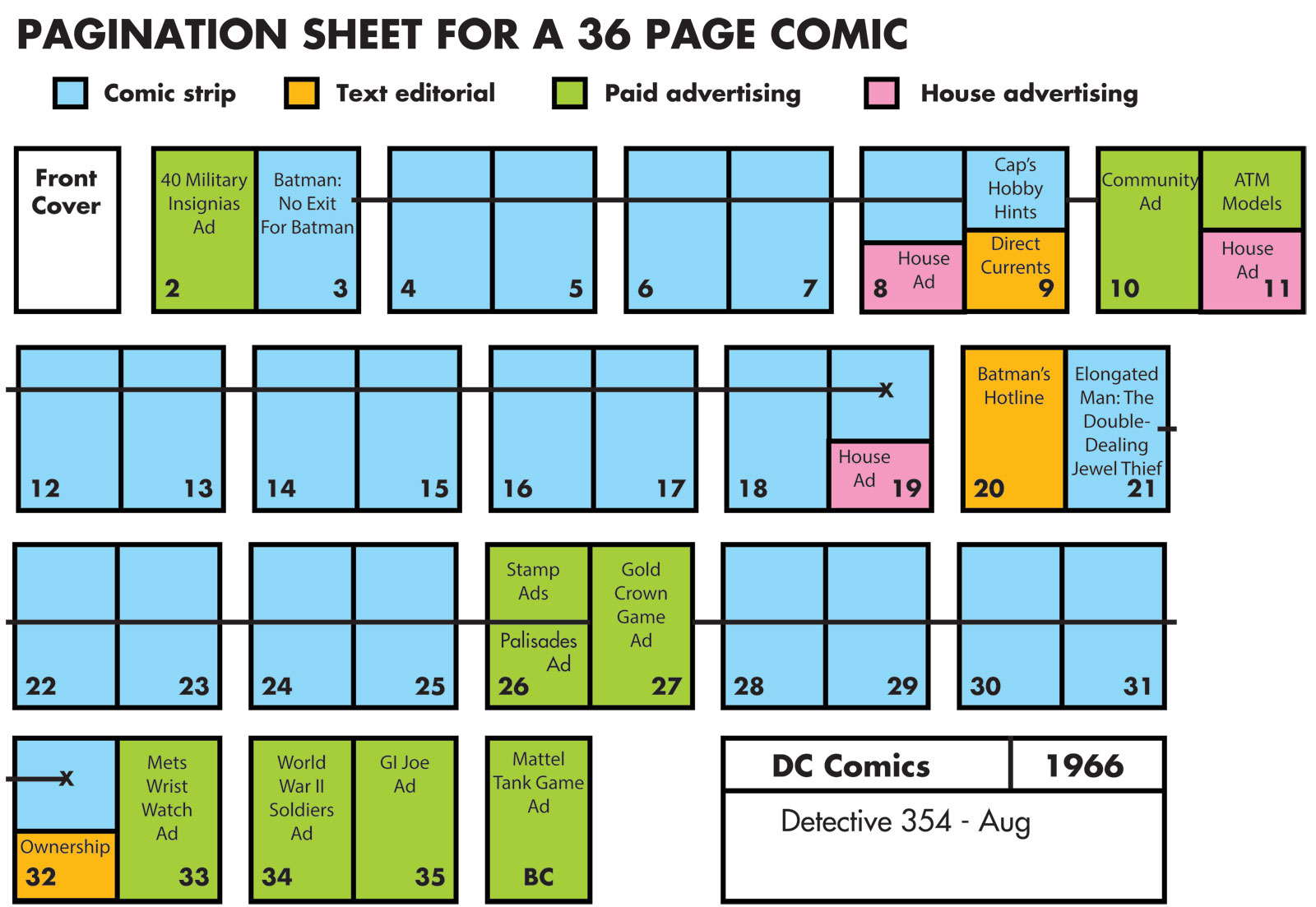
In the Red Unit title Detective Comics 354, there are just seven pages of paid advertising, just over a page of house ads, and a one-page letters column. Which leaves space for just 22 pages of comic strip.
 |
| Click to enlarge. |
There are just two high-profile brands advertising in the comic - Hasbro and Mattel - and with three of the comic strip pages having the lower third taken up with house ads, again I wonder if the Tootsie Rolls ads were cancelled unexpectedly.
WHAT HAPPENED NEXT?
By 1968, Marvel were well ahead of DC in terms of circulation. At the start of the year, Marvel split its anthology titles Strange Tales, Tales of Suspense and Tales to Astonish into six new titles, giving each of the featured heroes their own books. Sgt Fury spinoff Captain Savage also got his own book, as did The Silver Surfer. But there were some casualties, too. Modelling with Millie, Patsy and Hedy and Ghost Rider were all cancelled, and Two Gun Kid went on hiatus for a couple of years.
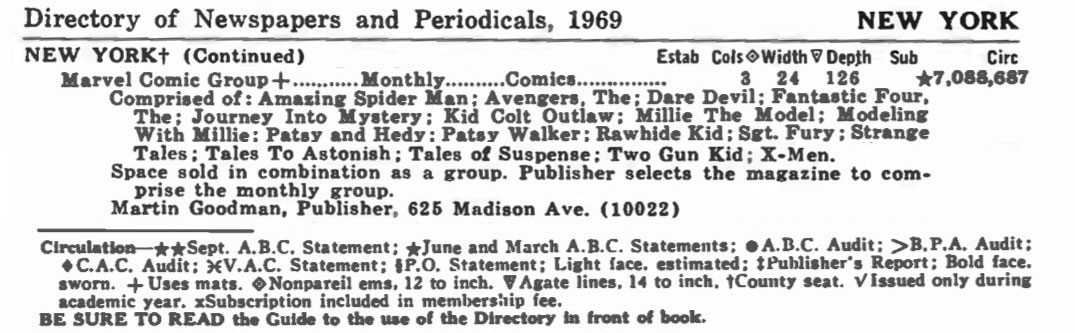
Also in 1968 (or possibly 1967, I don't have the Ayres Directories to check for sure), Marvel abandoned the Red/Yellow Unit split of their titles for advertising purposes. Advertisers found themselves occupying space across the entire range, unless they negotiated a separate rate for a specific title or titles.
 |
| Click to enlarge. |
DC however continued the practice into the 1970s. Though titles were shifted around from Blue Unit to Red Unit and back again, the company maintained the two groups of titles for advertising purposed until at least the end of the 1960s.
So, by the close of the decade, with Martin Goodman no longer the owner of Marvel Comics, the gap between the kind of advertisers we'd see in the DC titles and the low-rent advertisers Goodman was hanging onto was closing up, so that both companies were showing closer to the same sort of quality of advertiser in their books.
 |
| Click to enlarge. |
Starting with the October 1968 titles, with the paid ad page-count increased to 11 and the number of comic strip pages long-since standardised at 20, Marvel added General Mills as a client with a campaign that ran across the late summer / autumn months. The number of classified pages increased to two, though in effect these were more small panel ads rather than classifieds. And there were two pages of letters (which I've omitted from the montage above for space reasons).
 |
| Click to enlarge. |
During 1969, Marvel added another high-profile advertiser, Lee Jeans, then a couple of months later, Matchbox models, though the GRIT newspaper and cardboard Polaris Sub ads would cling on into the 1970s.
 |
| From Daredevil 67 (Aug 1970) - click to expand. |
And who could forget the Columbia Record Club double-page ads? By the time these started appearing, I was a teenager and just starting to get into music via bands like Cream and Led Zeppelin, so I must have been the target audience for ads like this.
It looks to me like Goodman's sale of Magazine Management to Perfect Film and Chemical in 1968, loosened his grip on the overall control of the magazines and the comics, and the new owners started to seek better advertisers. The trend would continue through the late 1960s and into the next decade, until Goodman's contract with Perfect Film expired in 1972.
Next: Atlas Comics cover gallery (1957)