Showing posts with label Bullpen Bulletins. Show all posts

Sunday, 31 March 2019

Bullpen Bulletins: Stan Gets Political

BACK IN THE MID 1960s, just as I was in the process of becoming the Marvel Fanboy I remain to this day, we didn't have comics websites, or YouTube videos or even mimeographed comics fanzines to tell us what was going on. All we had was Stan Lee's ingenious "Marvel Bullpen Bulletins", giving us glimpses inside the Marvel offices and snippets of information about what we could expect to see this and next month from Marvel.

The very first published Marvel Bullpen Bulletins page, from Journey into Mystery 122 (Nov 1965). At the time, Stan was making announcements about various Marvel Comics in text boxes, often yellow, on the various letters pages. This would be replaced by the Bullpen page, but the earliest examples appeared to be a mix of the two.
The Bullpen page made its debut in Journey into Mystery 122 (Nov 1965), which was on sale on 2 Sep 1965. This was a week before the December issues of Fantastic Four and Amazing Spider-Man, often cited (wrongly) as carrying the first Bullpen Bulletins page.

As with the other Bullpen pages of this early period, the Journey into Mystery page was customised for the title, showing an image of Thor where the other pages displayed different characters. For example, the Amazing Spider-Man Bullpen page in issue 31 gave us The Green Goblin. And, of course, it's a Thor tee-shirt in the merchandise section.

But more than that, the Thor Bullpen page appears to have been prepared so early that the corresponding letters page also carried a few announcements, boxed out in yellow, and not just about Thor. For example, they reveal that we can expect more Marvel merchandising in the wake of the tee-shirts and a "brand new gizmo that's sure to sweep the nation". I haven't managed to figure out what that is, yet. Stan also tells us that the last two Marvel bi-monthlies - X-Men and Daredevil - were moving up to monthly publication, and closes out the letters column with a lengthy teaser about the next issue of Journey into Mystery.

Meanwhile, in the adjacent Bullpen Bulletins, Stan reports that Joe Sinnott, whose inking work was last seen in Fantastic Four 5 (Jul 1962), has rejoined Marvel, working on "Agent of Shield", inking Fantastic Four (from 45 on) and "doing as many other features as we can straddle him with". I think you may have meant "saddle", Stan ... straddle is something else entirely.

Despite the Bullpen Bulletins page promise, Joe Sinnott managed few Marvel art assignments before becoming enmeshed in his regular inking work on the company's flagship title Fantastic Four.
As it turned out, Sinnott only contributed art to two issues of Strange Tales' Agent of SHIELD ... 139, where he provided finished art over Kirby's layouts, and 140, where he inked over Kirby layouts and Don Heck pencils. The other featured Sinnott was "straddled" with included just inks for the cover and interior art of X-Men 13 (Sep 1965), before embarking on his long run inking Fantastic Four from 44 (Nov 1965) onwards. What the Bullpen Bulletin story doesn't tell you is that Sinnott continued to pencil and ink for his long-term assignment Treasure Chest until issue 496 (Jul 1972), ending an 11½ year association with the title.

The second item in this first Bulletin reveals that Adam Austin, penciller on the Sub-Mariner feature in Tales to Astonish is not the artist's real name. This came as a shock to me when I retrospectively read this piece of news, as I had been comparing "Austin's" work with Gene Colan's and deciding that I like Colan's better. Of course, I was 12 at the time with little perception of how an inker can improve (or not) a penciller's work, so I was likely comparing the Vince Colletta inked Adam Austin work in Astonish with the Jack Abel inking of Gene Colan in Suspense.

Gene Colan "took over" from Adam Austin with Tales to Astonish 80 and Tales of Suspense 78 (both Jun 1966).

Compared to You Don't Say, the gags in Monsters to Laugh With/Unlimited were a bit lame. Stan was simply recycling one of his old ideas from the 1950s, but this time under Martin Goodman's shilling.
The fourth item plugs You Don't Say and Monsters Unlimited, both Stan Lee side-projects. I wasn't much interested at the time, but I did later pick up copies of both mags, probably during my early teens and, strangely, preferred You Don't Say to Monsters Unlimited (or Monsters to Laugh With, when I first read it). Both titles were a reworking of a Lee independent project during the 1950s, when he started up his own Madison Publishing company and put out two magazines of news and library photos with funny captions - Blushing Blurbs and Golfers Anonymous.

The best reproduction of Golfers Anonymous I could find was from the Stan Lee biography, Excelsior. My apologies for the poor scan quality.
According to Stan's biography, Excelsior, both titles sold out and made thousands of dollars for Lee, but as he was "not the shrewdest guy in town", by his own admission, he never reprinted to capitalise on further profits.

During the 1950s, Kirby would regularly ink his own pencils as this Dec 1959 issue of Young Romance demonstrates. As Marvel's chief penciller during the 1960s, Kirby would seldom be afforded the luxury of inking his own work, as Stan wanted to stretch Kirby as far across the line as possible.
The last item in the inaugural Bulletin page was the promise that Jack Kirby would ink some of his own pencils sometime. Of course, Kirby had very often inked his own pencils in the past, most notably during his late 1950s run at DC Comics, inking many fantasy shorts for Tales of the Unexpected and My Greatest Adventure and most of the Green Arrow adventures. Plus Kirby was also inking many of the romance stories he was still pencilling for Prize around this time. So hardly unprecedented. When Kirby became Stan Lee's go-to artist as the Marvel line of comics mushroomed, Kirby's time became to valuable to squander on inking. But to satisfy the Bulletin promise, Lee had Kirby ink the front cover art for Fantasy Masterpieces 4 (Aug 1966). I can't find any other examples, though maybe someone knows different.

The second Marvel Bullpen Bulletin page addresses more vital issues affecting Marvel fans across the spectrum. We also get the Mighty Marvel Checklist - a very important resource for Marvel readers in those pre-fanzine days - as well as the chance to buy Marvel merchandise.
The second Bullpen page addressed a landmark - to me anyway - decision that Stan had taken a few months earlier. Under the sub-heading "We Goofed Again Department" Stan admitted that the change in name from Marvel Comics Group to Marvel Pop Art Productions had been a mistake. As Marvelites everywhere were quick to point out, they didn't like it. So, the company's name was reverting once more. There follows some news about Artist Musical Chairs as Don Heck and "Adam Austin" switch around, and a plug for Marvel Collectors' Item Classics.

Far more interesting are the mini-items under "Didja Know? Department", which reveals the fact that Sol Brodsky is a "crackerjack penciller and inker" (no, I didn't know that at the time), that Flo Steinberg was winning popularity contest at colleges all over the country and that Martin Goodman was a top-ranked amateur golfer. Nope and nope.

Stan finishes off by telling us that every one of Marvel's titles are hitting the sales jackpot. This might just sound like bragging, but it's important to remember that - as I've mentioned many times here - Marvel's success was Stan's, not Martin Goodman's. For years Goodman had just been copying what other publishers put out. Stan somehow managed to convince Goodman to take a different approach in 1961 with Fantastic Four and the results paid off. Literally. So I am more than happy to allow Stan his "I told you so" moment. 

Matters covered in the Bullpen page for February 1966 included and explanation of why the year's Marvel annuals contained reprints, the arrival of newcomer Roy Thomas at the bullpen and the fact that Joe Sinnott would be the permanent inker on Fantastic Four.
I'm not going to go through the Bulletin pages month-by-month, but I do just want to highlight something in the third Bullpen page which appeared in the February 1966 dated Marvel comics (Fantastic Four 47, containing this Bulletin, would have been on sale 11 Nov 1965).

In the third item, titled "Strictly Personal", Stan addresses the question of his tongue-in-cheek credits in the comics, specifically why he always insults inkers Artie Simek and Sam Rosen with comedy credits. Stan stresses that these jibes are "strictly in fun" and goes on to say "we want to state here and now that we LOVE those two talented, hard-working, dependable letterers of ours". And I'm guessing that Sam and Artie always took that joshing just fine - after all, they lettered the gags into the comics themselves.

But in the final piece on the page, Stan mentions that most of the artists work at home (dispelling the fantasy that they all sit together in one big office swapping practical jokes and  ribald stories). The piece goes on to say that Jack Kirby "drops in, loaded down with a new mess of masterpieces, once a week. Poor Jack! He's so absent-minded that he usually goes home with someone else's hat, portfolio or train ticket. Stan wanted to put a label around his neck reading: 'If found, please return to the marry Marvel bullpen!' but he couldn't - Jack lost the label."

This is from Amazing Spider-Man 22 (Mar 1965), typical of the sort of joshing Stan regularly subjected Artie Simek and Sam Rosen to, the above gag would actually have been lettered by Artie. I'm sure Artie found it as funny as the readers did.
Now even as a kid, I took that to be just a bit of good-natured messing around. It's certainly no more insulting that a lettering credit that reads, "We'll try to pin the blame on poor innocent Artie Simek". Yet, for some reason, Jack wasn't taking this sort of heckling very well. Just a few weeks later, on 9 January 1966, the notorious profile in the New York Herald by Ned Freeland that made out Jack to resemble "an assistant foreman in a girdle factory" came out and Jack took if very much to heart and blamed Stan for the whole thing. This indicates, to me at least, that - for whatever reason - Jack didn't have much patience with Stan's informal tone, even at this early stage.

Also mentioned in this fourth Bullpen page is the real reason Stan took the A-listers out of Avengers, a mild rebuke to the Marvel copycats out there and a plug for the new reprint title Fantasy Masterpieces.
Yet despite that, amidst all the subsequent talk about Kirby and his colleague being robbed of their credit for the contributions they made to the formative Marvel Comics the fourth Bullpen Bulletin page gives lie to that assertion. Right there in black and white, is Stan telling us that the artists make up most of the stories themselves. "All Stan has to do with pro's [sic] like Jack 'King' Kirby, dazzlin' Don Heck and darlin' Dick Ayers is give them a germ of an idea and they make up all the details as they go along, drawing and plotting out the story." It's not like it was a dark Marvel secret, or anything.

The Bullpen Bulletin page would continue in this format for the next year or so. Highlights would be Stan revealing the true identity of Adam Austin in the June 1966 page, announcing the departure of Steve Ditko in the July 1966 titles and telling us that though the Bullpen page is typed on 14th July it won't be published until October 1967.

Amid the plugs for the Marvel Annuals and the mention of the MMMS newsletter "The Merry Marvel Messenger", was a new feature. Titled "Stan's Soapbox" - a reference to the wooden crate favoured by street-corner orators around that time - this first editorial column explained the "Marvel philosophy".
Then, in the June 1967 titles, the Bullpen page welcomed an important format change. The first Stan's Soapbox appeared. In it, Stan claimed that the "message" behind Marvel's stories was nothing more than an attempt to entertain. "And If we can do our bit to advance the cause of intellectualism, humanitarianism, and mutual understanding ... and toss in a little swingin' satire at to in the process ... that won't break our collective heart one tiny bit!"

In the Soapbox for the October 1967 Bullpen page, Stan tries to avoid the calls for a more defined political stance by throwing the matter open to reader opinion. Should Marvel comment on current affairs or not? Other items include a plug for the Fantastic Four cartoon show on ABC-TV, a plug for the Marvel Annuals and Marvel's new humour title Not Brand Echh.
There wouldn't be effort, at least for a few months, for Stan to move his Soapbox editorials beyond thanking Marvel fans for their support and debating wither Marvel should continue mocking the mags published by "Brand Echh". But then, in the October 1967 Bullpen page, Stan addressed head-on the calls for Marvel to make more of a stance on political issues of the day. "Many Keepers of the Faith," Stan wrote, "have demanded that we take a more definitive stand on current problems such as Viet Nam, civil rights and the increase in crime, to name a few." It's then left to readers to decide on whether Marvel should promote their opinions on these matters. "Should we editorialize more - or less - of keep things in their present fouled up form?"

The Bullpen page for October 1968 gave us Stan first stab at a political editorial. It's a bit vague but you can see he's trying to put across his mildly liberal viewpoint without making it political. Other items announce Arnold Drake joining the Bullpen and a plea for pen-pals for serving soldiers in Viet Nam. By this time, the Marvel Checklist is now talking up almost half the page!
Stan wouldn't return to the subject until October 1968, more than a year later. In his Soapbox, Stan writes, "Over the years we've received about a zillion letters asking for the Bullpen's opinion about such diverse subjects as Viet Nam, civil rights, the war on poverty, and the upcoming election". He goes on to say that there isn't one unanimous Bullpen opinion, but "we'd like to go on record about one vital issue - we believe Man has a divine destiny, and an awesome responsibility - the responsibility of treating all who share this wondrous world of ours with tolerance and respect - judging each fellow human on his own merit, regardless of race, creed or colour. That we agree on - and we'll never rest until it becomes a fact, rather than just a cherished dream."

... then this Stan's Soapbox, just a month later.
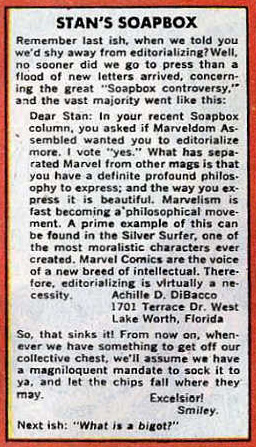
But that's not the end of it. The very next Soapbox reversed the position completely. "That sinks it," commented Stan. "From now on, whenever we have something to get off our chest, we'll assume we have a magniloquent mandate to sock it to ya, and let the chips fall where they may."

Preachy, perhaps, but this editorial from Stan was very much a product of its times, especially American times. And certainly no other comics publisher was printing  opinions like this during the late 1960s.
From there on, there was no stopping Stan, as the above Soapbox shows. It had never really occurred to me at this point (I would have been 14 at the time) that bigotry was a thing. At the time I was surrounded by casual racism. My family, my schoolmates. And like everyone else, I'd laugh at racist stereotype jokes. But I'd never have dreamed of actually hating someone because of their race or religion. That Soapbox would crystalise the concept for me and probably played a key part in focussing the liberal - and, I hope, tolerant - views I hold to this day.

More importantly, this tone would attract other like-minded comics professionals to Marvel ... Denny O'Neill had already joined Marvel a couple of years earlier. And in the future would come writers like Tony Isabella, Chris Claremont and later Larry Hama, who would also do their bit to instil Stan's liberal values into the stories they wrote.

And now, with the global reach of Marvel Production movies, we're seeing Stan's message reach an unprecedented audience - literally of millions - around the world.

Comicsgate is a tragic collection of comics "fans" who have singled out women, left-leaning liberals and people of colour in the professional comic community for attack, presumably because they simply don't like women and people of colour. It's a far cry from what Stan Lee wanted for the future of society, isn't it?
So the comicsgaters can have their sad rants about the recent Captain Marvel movie and the fact that some Marvel characters have been re-imagined as women or ethnic minorities, but I'm glad to say, they will be on the losing side of that argument and on the wrong side of history. Certainly as far as those of us who have grown up with Stan Lee as our guide are concerned ...

Next: Marvel's Women


Sunday, 24 February 2019

Bullpen Bulletins - How it all started

ONE OF THE GREAT THINGS about the comics of Marvel's formative years is how Stan instinctively understood how to connect with his audience. Every bit as important as the exciting scripts and art of the comic stories were the Marvel editorial pages, starting with the letters pages which would soon spin off the Marvel Bullpen Bulletins.

The Marvel Bullpen Bulletin pages started in some November 1965 cover-dated Marvel comics (above is the first one to appear in Amazing Spider-Man, issue 31) ... but the foundations for this were laid much earlier in the letters pages that began in early 1962. Editor Stan Lee would evolve and build on the way he talked back to his readers and finally make a feature of it, a page that many fans (including myself) would read before the story.
The first Marvel letters page was in Fantastic Four 3 (Mar 1962). When you think about it, that's pretty soon after Stan made the conscious effort to up his game and do something a bit more engaging than Godzilla rip-off comics. Quoted in Ronin Ro's Tales to Astonish Stan explained that "we had never gotten fan mail, maybe one letter a year about some stupid subject. But all of a sudden we got fan mail from readers saying 'We love this [Fantastic Four] book', 'We can't wait for the next issue'. I knew we were onto something."

Stan Lee explains what inspired him to start connecting with the Marvel readers
in that signature humorous, friendly tone. Click on image to enlarge.
So, never one to let an opportunity go to waste, Stan immediately started running a letter column in the first available Fantastic Four comic. But though he has in the past stated that the office was swamped with letters, that seems less likely when you take a closer look at that first "Fantastic 4 Fan page".

It's early days, and this letter page from Fantastic Four 3 is not hugely different from the occasional fan letters that ran in the DC Comics of the period ... but for the marked informality of the editorial responses to the letters, certainly the voice of Stan Lee. And what about those handwritten "4"s separating the letters?
While the first letter from future Marvel inker Alan Weiss seems genuine enough, the final letter on the page is from a certain "S. Brodsky" of Brooklyn, New York. Could that be Marvel production guy Sol Brodsky, writing a letter of comment to fill out a page that had fetched up a little short of material?

That trademark Stan Lee light and humorous tone is right there on the very first Marvel Comics letters page. His reply to Alan Weiss reads, "It'll [FF] become a success? What do you think it is now. Chicken liver?? Consider that our artist signs the name JACK KIRBY on everything he can get his greedy little fingers on, I think we can safely claim that that's his name!"

The next FF Fan page looked a little less rushed though no less padded. The "4"s between the letters looked to have been lifted from the FF's uniforms, which was an improvement, but the portrait of Sue Storm looked like it might have been drawn by Stan Lee - Sol Brodsky was a much better artist than that. The padding came in the form of a letter credited to "S. Goldberg" which reads like it was written by Stan himself - Stan Goldberg was the colourist on most of the Marvel titles at the time and also the artist on Millie the Model.

The third Marvel letters column (the second was in Amazing Adult Fantasy 12, on sale a week earlier than FF4) introduces Stan's idea of plugging other Marvel titles to bring cohesiveness and synergy to the line, by mentioning other Marvel product.
The page also contains Stan's first plug for other Marvel titles, as he mentions Millie the Model and Patsy Walker in the reply to the final letter on the page. The first letter - from Len Blake - also mentions Amazing Adult Fantasy (which coincidently introduced a letter column that month), so although Stan hadn't started his cross-over house ads yet, he was using the letter columns to make readers aware that "MC" comics published other titles, too.

I didn't note any later-famous names in the list of contest winners Stan published on the Fantastic Four 6 letters page ... is your name there?
The Fantastic Four Fan Page in FF6 (Sep 1962) contained the results of the contest Stan set in FF4 ... why did the stolen gem become invisible when Sue Storm did? Stan devotes a third of the page to the answer and prints the names of all the readers who got the answer right. Another interesting snippet of information tells us that Stan's working on the letters page on 14th March 1962. This gives us the most accurate picture of the lead times for Marvel Comics at that time. FF6 went on sale on 12th June 1962, which means a 13 week lead time from when Stan was working on the letters page till the issue reached the newsstands. I love trivia like that!

The letters pages continued in Fantastic Four pretty much along the same lines - without the fake letters, it should be noted - until Stan announced he was doing away with the formal "Dear Editor" salutations and started including announcements peppered throughout the page.

For me the most interesting information on FF10's letter page is the news that while eight readers favoured dropping Invisible Girl from the comic, 639 demanded that she stay. So while letters may have been thinner on the ground when FF3 was published, the very existence of letters pages had substantially increased fan mail.
Now all the letters would start with "Dear Stan and Jack" and Stan was explaining to readers how Marvel worked behind the scenes - for example, Marvel had no reserves of Fantastic Four issues 1 - 9 so wouldn't be supplying back issues any longer.

No announcements in this letter column, but some interesting facts about the FF. Did you know that both Reed Richards and Ben Grimm are in their late thirties, whereas Johnny is just 17? With some simple arithmetic, that allows me to calculate that Richards would have been around 18 when he met Nick Fury in Sgt Fury 3. By contrast, the Metropolis Mailbag in Superman 159 is a pretty dull affair. The most interesting thing on the page is the Statement of Circulation.
Fantastic Four 11 (Feb 1963) expanded the letters column to two pages. This was actually quite a big deal, because it meant that Stan had realised just how important it was to connect with the fan-base in an informal and friendly way. By contrast, the Metropolis Mailbag letter column over in the Mort Weisinger-edited Superman 159 the same month was just two-thirds of a page, with the title's Statement of Ownership taking up the remaining third.

The Fantastic 4 Fan Page in issue 12 (Mar 1963) was also a double page of just letters, but did end with the message that Amazing Spider-Man 1 would be on sale on 10th Dec 1962. From that we can calculate that the Marvel books were on sale a good 11 weeks before their cover date. Add that to the 13 week lead time from sending an issue to the printers, then the gap between the in-house deadline and the issue's cover date is almost six months.

Announced in Fantastic Four 13 (Apr 1963) - No new members for the Fantastic Four, Iron Man's appearing in Tales of Suspense and The Sub-Mariner returns in the very next issue of FF.
Fantastic Four 13's letter page contained the first dedicated Special Announcements Section, and it's this that is the earliest foreshadowing of the Marvel Bullpen pages that lay just a couple of years in the future.

A great promotion page from the April 1963 Fantastic Four comic ...
but darnit, I think I may have missed 'em!
That same FF issue also contained a House Ad to die for ... The Amazing Spider-Man 1 and Tales of Suspense 39, featuring the first appearance of Iron Man. Don't you just want to run down to the newsstand now and pick up copies?

As the Fantastic 4 Fan Page progressed, the Special Announcements Section grew longer. By FF30 (Sep 1964) it was taking up almost half the allotted two-page spread. The bulk of the Announcements were just plugging the other Marvel comics on sale the same month - which included a slew of Annuals - but another change was in the wind.

Fantastic Four 30 - would you look at the size of that Special Announcements Section. The first half is highlighting the 1964 Annuals: Amazing Spider-Man Annual 1, Marvel Tales Annual 1, Fantastic Four Annual 2, and Mille the Model Annual 3. The remainder plugs Tales to Astonish 60 - with the new Hulk solo series, Amazing Spider-Man 16, co-starring Daredevil, Avengers 5, Daredevil 3 and Thor 107 (?)
The letters column in Fantastic Four 33 (Dec 1964) included a table listing all the Marvel titles on sale the same month. With the hard-sell sectioned off in its own area, Stan was freed up to reveal what MMMS stood for, to tell readers that every Marvel mag now had a letters column and that Stan had been elected Best Writer as well as Best Editor of the Year by the Academy of Comic-Book Fans and Collectors.

As well as boxing off the Mighty Marvel Checklist into its own section, the Fantastic 4 Fan Page in FF33 also had a healthy announcements section. Click on the image to read future Marvel scripter Don McGregor's suggestion that Reed and Sue marry.
It was definitely taking shape as a Marvel Bullpen Bulletins page in all but name. But the actual Bullpen pages were still a year away, so we'll take a closer look at those next time.

Next: The Marvel Bullpen Page touches down


Sunday, 28 August 2016

United Colours of Commando-dom

BACK IN THE 1960s, I had begun reading American comics by first discovering DC editor Julius Schwartz's re-tooled versions of The Flash and Green Lantern, and the ultra-smooth Michelangelo-inspired art of Carmine Infantino. In pretty short order I discovered Justice League and the other superhero titles. Superman and Batman I'd already been familiar with via the black and white annuals that were available in the UK around the time.

Of course, like all comics of the time, the company's other titles were heavily cross-promoted in the books I picked up. Mostly the superhero titles advertised other superhero titles but, occasionally, an ad for a science fiction comic or a war book would show up in the comics I bought.

As attractive as the DC house ads were, with their terrific Ira Schnapp design, I wasn't in the slightest interested in war comics, so I wouldn't experience the grandeur of Joe Kubert and Russ Heath art until much later.
However I wasn't interested in war comics. After all, we had plenty of war stories in our own home-grown comics I could read if I wanted to. So the work of writer/editor Robert Kanigher and artist Joe Kubert went pretty much unnoticed by me.

Then, by the time I got to 1965, I was avidly devouring Stan Lee and Jack Kirby's Marvel Comics. Captain America was my favourite and I thoroughly enjoyed his adventures in both Tales to Astonish and The Avengers. But seeing the cover of Sgt Fury 13 - either in a house ad or in a shop, I can't recall which now - I knew I had to have it. In that story, as related in my earlier post, Captain America was just a guest star and so Fury and his Howlers had the lion's share of the action. But that was enough to pique my interest. Here was a war story that played out more like a superhero tale. The Howlers were each individuals and had particular talents that came handy in just about any situation. And the combination of Lee's deft, bantering dialogue and Kirby's over-the-top action sequences was enough to make me forgive the title for being a war comic. And the Marvel completist that I was turning into had to track down the earlier issues I'd missed.

WAR - MARVEL STYLE!

By the time the first Sgt Fury comic came out, Lee and Kirby were already beginning to refine the Marvel style of comic-building. Bearing in mind that at this stage Marvel publisher Martin Goodman was still restricted to just eight titles a month under the terms of his distribution contract with the DC-owned Independent News - just sixteen bi-monthly titles in all - it looks like Sgt Fury and His Howling Commandos was a replacement for the cancelled Incredible Hulk, the last issue of which had appeared two months prior.

Sgt Fury 1 placed this odd "Meet the Howling Commandos" double-page spread right after the title splash ... very unusual for a Marvel Comic of this period.
What was different about Marvel's war comic was that the squad was made up of an ethnically diverse crew. Both Lee and Kirby would have been aware that, for example, black and white soldiers would have been segregated into different platoons during WWII, but they didn't care about that. Right from the get-go, the pair set out to create a comic that, though set in the world of two decades earlier, addressed what they saw as real concerns in 1963's United States.

Though I have no way of knowing for sure, I'm convinced this was Stan Lee's doing. In his autobiography Excelsior!, Stan wrote, "I told [Goodman] I felt we were succeeding because, unlike with most other comics, we were concentrating on characterisation and realistic dialogue, which had helped make the fantasy angles seem more believable. Also, I had tried to inject humour, humour that comes out of character and situation rather than simple gags. I referred to our entire approach as the Marvel Style. I told him that it was that style that made the difference.

"Martin replied, 'That's too subtle, Stan. Kids don't appreciate that. You know what I think? I think they're just good titles, that's what. Spider-Man, The Incredible Hulk, Iron Man; they're great names.'

"I knew they were, but that wasn't the point. That's when I decided to bet that I could prove he was wrong. Remember, it was the Sixties and readers were sick of war and anything that had to do with war. So I said, 'I'll do a war book with the worst title I can come up with, but if it's done in the Marvel Style, I'll bet it'll sell.'

"He said, 'Not a chance. Once and for all, this'll prove you're wrong, Stan. Go ahead and try it.'

"Well, it wasn't easy coming up with the worst name possible but I tried. I wracked my weary little brain hour after hour until I finally zeroed in on the most unlikely title I could think of - Sgt Fury and His Howling Commandos.

"The fact that it was a war theme alone should have been its death knell, but the title was admittedly too long and much too cumbersome. We could barely squeeze it on the masthead. Then, to make my task even tougher, I gave our hero, Sgt Nick Fury, the most ethnically mixed platoon I could dream up. It consisted of Jewish Izzy Cohen, Italian Dino Manelli, Irish Dum-Dum Dugan, Gabriel Jones, a black man - well, you get the idea. There was even a gay platoon member named Percival Pinkerton."

That last bit, about Pvt Pinkerton, I'm really not sure about. At the time, I'd always taken the portrayal of Pinky to be just the way Americans see the British - slightly fey, tea-drinking, umbrella-carrying prigs. It never occurred to me, until reading that quote in Stan's book, that Pinky was anything other than Stan's view of a typical British soldier. And I still don't. I'm fairly sure that this is all just retro-fitting history to make Stan seem more astute than he actually was.

This first issue of Sgt Fury didn't seem to know what it wanted to be. Especially out of place is the goofy third panel in the page above and the DC-like "Weapons of War" feature page that might have been at home
in
GI Combat, but seems oddly out-of-place here.
The story in Sgt Fury 1 (May 1963) isn't actually that great or ground-breaking. The plot has Fury and his team parachute behind enemy lines to free a captured resistance fighter before he can be forced to reveal the dates of the Normandy landings to the Nazis. And though in later years Jack Kirby would insist he always did his best work so he could "make sales", I really don't think this is anything like Jack's best work.

The splash page is truly horrible. The composition is jumbled and Nick Fury doesn't look anything like Nick Fury. It's possible that other hands messed with this before it went to press, but examples of Kirby phoning it in are seen all through the book. Is it possible Jack didn't agree with Stan about putting his energies in to a war book? After all, the newsstands were awash with WWII comics. More importantly, are they "Commandoes"? I thought they were "Commandos".

The structure of the comic is odd, as well. There's a six page "origin", which shows us The Howlers in training with Dum-Dum Dugan presiding, then the team parachuting in to France, during which Dugan takes out a Messerschmitt with a hand grenade. The art looks rushed and crude, almost like this prologue was actually an afterthought, and the inking by Dick Ayers is not up to the standard that we'd been used to in the Marvel monster tales in the preceding years.

The second chapter, which runs to 15 pages, seems better drawn, with a full page splash at the beginning, and starts off in the middle of the action with The Howlers already on the ground, infiltrating a French town.

Is it possible that the original story was just these fifteen pages, which were planned for a generic war book (Commando Action?), along with a shorter back-up tale, in the same way the first few Spider-Man stories were just 14 pages? I guess we'll never know, but it doesn't seem an unreasonable explanation.

But those minor carps aside, Lee and Kirby established the feel of the book and the characters right out the gate. All the components that would separate Sgt Fury from its DC counterparts were all there - the informal and slang-laden dialogue, Fury as a tough but fiercely loyal leader, the wisecracks in the face of danger, and the liberal undercurrent, using the Nazis as a stand-in for what Lee saw as intolerant attitudes in contemporary American society.

Sgt Fury 2 had the first portrayal of a Nazi concentration camp in comics. There's also a sequence near the end where Dum-Dum destroys a V2 rocket in its launching pad.
Sgt Fury and His Howling Commandos 2 (Jul 1963), did start out in the middle of a mission with The Howlers infiltrating a French town. But their mission just lasts five pages, by page 6 Fury's back in the UK, being chewed out by CO "Happy" Sam Sawyer and being given a new mission - put a stop to the Nazis' heavy water experiments.

The Howlers deliberately get themselves captured and sent to a concentration camp where the nuclear research is going on. Though Lee and Kirby don't dwell on it, they make it pretty plain that human beings just don't do this kind of thing to each other and that's the reason they're fighting this war.

The issue also featured another "Weapons of War" page and a bonus feature page showing an annotated drawing of a Nazi infantryman.

With this third issue, the Commandos are better defined. Stan also ties the book into mainstream Marvel continuity by having Fury meet Reed Richards, later leader of the Fantastic Four. Indeed a few months later, an older Fury would show up as a guest star in FF 21 (Dec 1963).
Sgt Fury 3 (Sep 1963) developed the characters further, establishing Fury's crew as a bunch of roughnecks you'd never want to get on the wrong side of. After a brawl in a bar, it takes an entire platoon of MPs, backed by a tank, to put Fury and the guys in the guardhouse. But they don't stay long, as Capt Sawyer has a mission for them in Italy. There they meet and agree to help Maj Reed Richards of the OSS, the US's wartime equivalent of Britain's MI6 and a forerunner of the C.I.A. Fury and the team deliver the vital information from Richards to the battalion trapped behind enemy lines, enabling the US forces to escape without casualties.

I quite like the line uttered by Richards on page 11, pictured above (click on the image to expand). "No time for long speeches, Fury!" Over in Fantastic Four, set twenty years later, Reed Richards was characterised by his long speeches, as often commented-on by Ben Grimm. Blink and you miss it, but I think this was just Stan Lee amusing himself.

In Sgt Fury 3 the character of The Howlers is by now even more firmly stablished and while the stories aren't to be taken too seriously and there're more comedy sequences, Stan and Jack never lose sight of the fact that war's a serious business. Nowhere is that more plain than in the next issue.

Lee and Kirby bring a new dimension to the Silver Age war comic by having a major character killed in combat. And staying dead.
Sgt Fury 4 (Nov 1963) once again has Fury and the Howlers behind enemy lines, this time to capture and return with British propagandist, Percy Hawley, aka Lord Ha-Ha. Trouble is, the traitor is the brother of Pamela Hawley, a comely Red Cross worker that Fury met while on leave in London. As the mission unfolds, it turns out that Lord Ha-Ha is a willing collaborator, not the tortured prisoner his family believes. The situation is compounded when Fury's youngest Howler, Junior Juniper, takes a fatal Nazi bullet. Fury must overcome his own anger and report back to the Hawley family that their son died bravely.

The Lord Ha-Ha character is based on a real-life, American-born traitor, William Joyce aka "Lord Haw-Haw", who broadcast Nazi propaganda over the radio airwaves during the Second World War. Joyce was captured in 1945, tried, found guilty of treason and executed by hanging at Wandsworth prison in January 1946.

I didn't think that new inker George "Bell" Roussos was any better or worse than Dick Ayers, who'd inked the first three issues. In some ways the art looks a little sharper here. However, I think the story is much stronger here than it has been in the issues so far. The introduction of a love interest for Fury separates it from other contemporary war comics and using that relationship to set up a moral conflict for Fury when the girl's brother turns out to the the villain of the piece makes for strong and emotionally resonant storytelling.

There's also another "Weapons of War" feature page and an house ad for Avengers 3, which contains a deliberate mistake ... can you spot it, readers?

One of my favourite issues of Avengers, number 3 (on sale beginning of Oct)  is advertised in Sgt Fury 4 (on sale 3 Sept) ... but Stan realised that few readers would know who the red-and-yellow armoured guy was, so showed Iron Man in his old yellow armour. Iron Man's revised Ditko armour first appeared in Tales of Suspense 48 (on sale 10 Sep).
Issue 5 (Jan 1964) continued to cement Sgt Fury and His Howling Commandos as a different kind of war comic. This tale introduced the nefarious Baron Strucker, who would become major villain both to Nick Fury and to other Marvel heroes. The story has Fury challenged to a one-on-one fight by high-ranking Nazi Strucker. Though expressly forbidden by his commanding officer, Fury disobeys and sneaks into occupied France by night to answer the challenge. But the wily Nazi pulls the old "drugged toast" routine and Fury, not realising that "the flagon with the dragon has the brew that is true", succumbs to the drugged wine and passes out in the middle of the fight. The Nazis film the whole shameful incident and dump the unconscious Fury back in Britain via parachute.

Sgt Fury 5 had a great story from Stan Lee, great storytelling and art from Jack Kirby, but is let down slightly by the rushed inks of George Roussos.
For his disobedience, Fury is busted down to private, but the Howlers, far from being gleeful, are sympathetic and supportive, something Fury finds worse than being razzed by them. Nevertheless, Fury manages to secure a return match and, warned by Dino, gives the Micky Finn a miss and kicks Strucker's Teutonic ass. Fury's rank is restored and all is right with the world once more.

As strong as I thought the story was, I didn't think Roussos' inks in this issue were up to the standard he'd set for himself in issue 4. There are many reasons why a piece of work might look rushed - perhaps it was rushed, or perhaps others interfered uncredited - but the result is still the same.

Interestingly, with this issue, Lee took to crediting himself and Kirby as "Ex-Sergeant Stan Lee, U.S. Army" and "Ex-Infantryman Jack Kirby, U.S. Army". It's likely that this was intended to lend a bit of authenticity to the stories, but the writing is so stylised that it couldn't possibly be mistaken for a documentary.

On the surface, Sgt Fury 6 is about the Commandos taking on Rommel in the North Africa campaign, but in the end, there's not very much Rommel in this parable about racism in the U.S. and its parallels in Nazi Germany.
Sgt Fury 6 (Mar 1964) opens with Fury single-handedly capturing three Nazi infiltrators, before his date with Lady Pamela Hawley, the British Red Cross worker. Then Fury and his team are dispatched to North Africa to take on Rommel and his Panzer Tank Divisions. But with Dino injured during training, the Howlers are assigned a temporary replacement, George Stonewell. First off, Stonewell refuses to shake Dino's hand because he's Italian. At first, Fury gives the new man the benefit of the doubt, but when Stonewell is rude to Izzy Cohen, Fury gets suspicious. Finally, when Stonewell says he's not going to sleep in the same barracks as Gabe Jones, Fury gets, well, furious, and tells Stonewell, "You're a genuine, 14-carat, dyed-in-the-wool, low-down bigot!", then warns him, "You so much as look crosseyed at Izzy, or Gabe, or anyone because of his race or colour and I'll make you wish you were never born!"

And if Stan hasn't yet made his position clear, he has Fury go on to say, "Rats like him aren't on any side. They just crawl outta the mud long enough to poison whatever they touch!"

Tellingly, there's a scene in the middle of the story where Stonewell is required to interrogate a captured Nazi officer, who suggests that Stonewell has much in common with the Nazi ideology and that if he switches sides, he'd be well rewarded by Rommel. Stonewell rebuffs this saying, "You're barking up the wrong tree, Fritz. I've got use for Nazis, either ..."

The pay-off to all this is when Stonewell is injured under enemy fire and Izzy hoists the unconscious man onto his shoulders and carries him to safety. A German doctor treats Stonewell's wounds but it's left to Gabe to supply the essential rare type AB blood that Stonewell needs to survive. Stonewell comes round long enough to remark, "No! Not your blood! It -- It wasn't from you??!!"

Stan wisely leaves it to the reader to decide whether Stonewell is redeemed at the end of the story, and Fury gets to make a summing up: "The seeds of prejudice, which take a lifetime to grow, can't be stamped out overnight -- but if we keep trying -- keep fighting -- perhaps a day will come when 'Love thy brother' will be more than an expression we hear in church". It may be out of character for Fury to talk that way, but just putting that sentiment in a kids' comic is a pretty bold step for the early 1960s.

STAN LEE WAS MY FATHER

Back in the early 1960s, we kids lived in a divided world. On the one hand, we would watch the dramatic events unfolding in the United States, as African-Americans (we didn't call them that, then) battled the authorities in their struggle to keep civil liberties and equality in the public eye. Then in the UK, our immigrant citizens were largely integrated into the wider population, working and learning alongside the indigenous British population.

South-East London, where I grew up, was a largely white area at the time. In 1962, I was eight years old and the only black kids I knew were the children of a white couple who managed the tall flats across the road from where I lived in Woolwich.

This block was right across the road from the flats where I grew up. The caretakers and their adopted kids lived in the ground floor corner flat in this picture.
One day, while we were all playing together in the street, we asked them why it was that they were black and their parents were white. They explained that they had been adopted but really were brother and sister. No offence was intended or taken and, mystery solved, we all got back to the important business of playing, and the subject never came up again.

Yet at the same time, we kids were surrounded by casual racism. More than once I'd hear an adult remark that a black family's house was very clean, as if they didn't have hygiene in the Caribbean. Racist jokes were commonplace and we naive kids would even repeat them. But as I got older, more and more my values were shaped by what I read in Stan Lee's Marvel Comics. Not by how my mum behaved, but by how the characters in Stan Lee's stories behaved, and by the liberal - if slightly simplistic - views that Stan professed in his writing.

Those views permeated all the stories Stan wrote, and obviously drip-fed into my consciousness over the years. By the time I was a teenager, Stan had taken to editorialising his stance in the Soapbox column on the Marvel BullPen Bulletins page. The earliest one I could find was in the October 1968 column where Stan says, "We believe that Man has a divine destiny, and an awesome responsibility - the responsibility of treating all who share this wondrous world of ours with tolerance and respect - judging each fellow human on his own merit, regardless of race, creed or colour. That we agree on - and we'll never rest until it becomes fact, rather than just a cherished dream." Which is pretty much what Fury said at the end of Sgt Fury 6, four years earlier.

Stan editorialised - quite strongly - against racism in his Oct 1968 Soapbox. Just a couple of months later, he pulled out all the stops and lambasted those who "condemn an entire race, despise an entire nation or vilify an entire religion." (Click to expand the image)
My mum and stepfather never taught me those values when I was a kid. It was left to Stan Lee to give me my moral compass in life.


BACK TO SGT FURY

Issue 7 of Sgt Fury and His Howling Commandos (May 1964) was a change of pace, putting Fury on trial for disobeying a direct order under fire and striking a superior officer, an act punishable by firing squad.

Sgt Fury 7 is much less a war action epic and more a courtroom drama, along the lines of The Caine Mutiny (1954). Nick Fury is on trial for his life, with no memory of the events that have led to his situation.
The plot introduces Lt Spencer Parker, a childhood acquaintance of Fury. Under Parker's command, Fury and the team are to raid an enemy ammunition dump. But at the last moment, Fury tries to prevent the raid and when Parker won't listen, belts him on the jaw. Critically, the ammo dump explodes, knocking Fury unconscious. When he comes round Fury finds that he's on a charge of insubordination under fire. But Fury has no memory of the events and now has to find a way to prove his innocence in court.

Finally, Fury's memory returns and he's able to prove through the testimony of a captured German soldier that he had prior knowledge that the ammo dump was a trap, rigged to explode to kill the invading commandos. Fury's swift action saved not only Lt Parker's life but those of the Howlers, as well.

Though I have no basis for this, I did wonder if Stan had some idea of having Spencer Parker turn out to be some relative of Peter Parker. In the 1968 Amazing Spider-Man Annual 5, Stan would reveal that Peter's parents were Richard and Mary Parker, who were CIA operatives, recruited to the organisation by Nick Fury, so it's not too much of a stretch.

Issue 7 would be last Sgt Fury drawn by Jack Kirby, except for issue 13 which I covered in my blog entry about Captain America's wartime exploits. And this is where I planned to end this entry. However Sgt Fury 8 (Jul 1964) introduced new Howler Percival Pinkerton to the readers, so I'll cover that issue too.

Sgt Fury 8 was the first in a long run drawn by Dick Ayers and introduced new Howler Percival Pinkerton to the team. The main plot about Dr Zemo's death ray seemed almost incidental.
The story opens with the appearance of the eccentrically-dressed, umbrella-wielding Pvt Pinkerton at Fury's base. Reb and Dum-Dum remark that he's the "cutest-lookin' soldier ya ever did see" though Dino warns that "those British guys are tougher than they look." When a couple of other soldiers fetch up and start mocking Pinkerton's appearance and name, he sets about them with his umbrella, immediately endearing himself to the watching Howlers.

But is he an intentionally gay character? I can't see any evidence of it here. As I said at the beginning of this piece I think, at the time, Stan just wanted to portray an English soldier pretty much as he thought his readers would expect an English soldier to appear. Anything else is just retrofitting.

The rest of the issue involves the Howlers tracking down Nazi scientist Dr Zemo to destroy his death ray weapon. Dick Ayers' art is very serviceable, though he's no Jack Kirby. Right after this, Sgt Fury and His Howling Commandos went to a monthly schedule so, clearly, Marvel readers had taken the comic to their hearts.

What stands out for me is that Stan had to use a relatively obscure title like Sgt Fury to begin furthering his laudable liberal agenda. He didn't use premiere Marvel characters like Fantastic Four or Spider-Man. Maybe that would have been just a step too daring for 1963, but once he realised that the readers were with him, then he made no attempt to disguise what he thought about the equality issue. Later, Stan would use the anti-mutant sentiments in The X-Men to draw a parallel with racism in the US, but that was done in an allegorical way. In Sgt Fury, it was all out in the open for anyone to see.

Despite its position as one of Marvel's more low-key titles, Sgt Fury and His Howling Commandos went on to have a long and successful run with Ayers as the penciller. I especially like the issues inked by John Severin, and later writers like Roy Thomas and notably Gary Friedrich had their own successes with the title.

And of course, Nick Fury became a major player in the Marvel Universe of the present day as well, as director of SHIELD. But that, too, is a story for another day.

Next: Don't mess with the logo