Showing posts with label Comic. Show all posts

Saturday, 27 February 2016

Captain America: Live Action Star of the Small Screen

IT'S PROBABLY hard for younger fans to understand just how slim the pickings were for those of us who followed comic book superheroes back in the 1960s. As early as 1966, Marvel publisher Martin Goodman had licensed the rights to his Marvel characters to television.

The Marvel Superheroes cartoon show was made in colour, though no one had colour televisions back in 1966. And, yes, we really did sit that close to the tv set back then. The screens were so small you couldn't see anything unless you were no more than three feet away. Pretty sure all those cathode rays fried my brain ...
Even Goodman didn't realise what he had, and seemed content to let the producers of the Marvel Superheroes cartoon show do pretty much what they wanted in return for almost no money. The big return would come, reasoned Marty, when the cartoons propelled the sales of his comic books into the stratosphere, just the way the Batman tv show had done for DC's Batman and Detective Comics. But it didn't work out that way ...

In comic books, there is a point to sound effects. However, in an animated cartoon, you have a sound track. The viewers can hear the sound effects. So why in the world would you draw them onto the animation art as well? Unless, of course, you were copying the Batman television show ...
The cartoons, produced by Grantray-Lawrence were pretty poor, even by 1966 standards. Essentially, the production company took stats of the comic book artwork, then enlarged panels, to which they'd add limited - very limited - animation. Viewers would see Captain America standing rigidly still (even during fight scenes) while his animated mouth delivered lengthy monologues.

But that's not to say these cartoon don't retain a certain nostalgic charm ... not much, but some. And the latter half of the thirteen episode series did use more contemporary Marvel Comics as their source material.

The Enchantress' original modus operandi was to beguile and charm others into doing her bidding. This works pretty well for her in the case of Erik Josten, who she seduces (off-camera) and then easily persuades to undergo the Power Man treatment in order to battle The Avengers.
Episode 9 took the plot and art of Avengers 21 and 22 as its starting point, in which The Enchantress finds a human stooge, Erik Josten, and uses Baron Zemo's "Power Man" machine (from Avengers 9) to turn him into ... Power Man.

The Commissar first appeared in Avengers 18, luring the team to south east asia so he can defeat them before the world to demonstrate how communism is superior to "the freedom-loving western democracies". You'd think there's be an easier way ...
The tenth episode jumped back a few issues and presented the Avengers tale from issue 18, where the quartet of Cap, Hawkeye, Quicksilver and Scarlet Witch take on an evil commie foe, The Commissar, in a propaganda version of the Cold War. One by one they're beaten until Wanda is the last Avenger standing ...

This one has Captain America battle the Red Skull's doomsday machines, The Sleepers. It's a pretty good yarn and has the first instance on the current Marvel continuity of Cap jumping out of a plane without a parachute.
Episode 11 takes us back to Captain America solo stories from Tales of Suspense, adapting the Sleeper saga that ran across ToS 72-74. This story acted as a bridge between the World War II exploits of Cap and his contemporary adventures set in the 1960s. Within the context of the comic books it made sense, but here, out of sequence, the viewer is left uncertain as to when this story is taking place.

Okay, this is where it all gets a bit weird. You see, Cap's in love with a feisty World War II resistance fighter called Peggy Carter, aka Agent 13. Then, twenty years later, he runs into her younger sister, Sharon, also designated Agent 13. And falls in love with her. Marvel later tried to make it less creepy by ret-conning Sharon to be Peggy's niece but that, if anything, was worse ...
Episode 12 retells the story from Tales of Suspense 75-77, where Cap battles the ridiculously accented Batroc ("Zee Leapair") master of le Savate. He also runs into a new Agent 13, Sharon Carter, who turns out to be the younger sister of the original Agent 13, Peggy (currently enjoying a pretty good tv series of her own).

The Red Skull gets hold of The Cosmic Cube, a device that can convert his every thought into a reality. Not the sort of ability you want to see conferred on the most evil character in history. There's no way Cap can win this one, is there?
The final episode the the Captain America cartoon series adapts one of my favourite stories from the original Suspense run, in which the Red Skull turns out to be still alive in 1966 and manages to wrest possession of The Cosmic Cube from the hands of A.I.M. It doesn't really capture the doom-laden atmosphere of the original tale, but then the cartoon production people would probably have thought that aspect of the tale a bit dark for younger viewers. Shame, really ... I remember being quite unsettled by the original comic tale when I first read in back in 1966.

Admittedly, viewed today, these cartoons do seem a bit ... well, dire. But if I had seen them at the time, in 1966, I think I would have preferred them to the Batman tv show, my opinions of which can be found elsewhere on this blog. As bad as the animation was, at least the producers treated the characters with respect. The only real lapse - a kind of sop to the "camp" brigade - was the odd hand-lettered sound effects superimposed on top of the picture. And the actual sound effects were a bit over-comical, appearing to have been lifted from old episodes of Huckleberry Hound. Maybe cartoon studios all just used the same sound effects record.

What was more unforgivable was the contempt with which publisher Marty Goodman treated his own intellectual properties. OK, I know there is quite a legal and moral dispute around whether Goodman actually did own Captain America and the other more modern properties, but my point is he at least believed he owned them at this point. And for him to allow others free rein to do a less-than-brilliant job of exploiting the characters in another medium is definitely what I'd categorise as contempt.

But sadly, things would get worse before they got better. Eleven years later, Captain America would return to tv screens in live-action form.


JUST WHO IS REB BROWN?

So, The Incredible Hulk tv series (1977) had been a big success for Universal-MCA. By 1978, Hulk fever was everywhere. Marvel in the US responded with a magazine-size comic, Rampaging Hulk, which tried to set the dial back to the early Lee-Kirby style of the early Sixties' Incredible Hulk comics. Marvel UK tackled the other end of the readership demographic and released a weekly title, Hulk Comic (1979) aimed at the younger reader.

Marvel launched two titles to capitalise on the success of the Incredible Hulk tv series - a black and white mag for the US market and a weekly kids' comic for the UK.
Universal, who'd bought a package of characters from Marvel, also made a feature-length pilot for a Dr Strange tv series, which cast Peter Hooten in the lead role. It wasn't bad, by any means, but as it was originally aired against Roots in the US, it didn't get the viewing figures it needed, so the planned tv series went nowhere.

Peter Hooten looked every bit the part as Marvel's Dr Strange (1978). Anne-Marie Martin made a fetching Clea, though in this she wasn't from an alien dimension.
I'm pretty sure I read somewhere that Universal had also licensed the rights to The Sub-Mariner at the same time, though I don't believe any attempt was made to produce a pilot. That Universal claims to this day to be the rights holder to Prince Namor seems to bear this out.

Reb Brown as Captain America. There were a couple of small changes to the uniform between Captain America and Captain America: Death Too Soon.
They gave it a third (and final, as it turned out) roll of the dice with Captain America, which featured Reb Brown as a heavily reconceptualised Steve Rogers.

The first of the two pilots, Captain America (1978), was all over the place. Reb Brown was criminally miscast as Steve Rogers, a slab-of-meat surfer type who's just got out of the army and wants to be an artist. He is on his way to see an old friend of his father's when he's invited to a meeting with a covert government agency, led by Dr Simon Mills (Len Birman). Mills wants him to help with a line of experiments to enhance human capabilities that Rogers' father had been working on. Though attracted to Mills assistant, Dr Wendy Day (Heather Menzies), Rogers doesn't want to be following orders any time soon, and turns down the offer. From there he's embroiled in a plot to detonate a neutron bomb on American soil and is severely wounded by the henchmen of the plotter, industrialist Lou Brackett (Steve Forrest). In a desperate bid to save Rogers' life, Dr Mills injects him with the FLAG serum Dr Rogers had developed, enhancing Steve's strength and senses to about ten times normal human levels. Dr Mills gives Steve Rogers a flash motor cycle and a uniform, and Captain America takes on the baddies and foils the nuclear threat.

The film seems very slow moving ... the sequence with Steve Rogers trying out his new motorcycle, and the subsequent scenes of him trying to outrun a helicopter seems impossibly extended, at over seven minutes. Just pruning this section might have made the film seem less flabby.

Its other liabilities include really bad acting from the lead, a rather flimsy-looking plastic shield and the fact that Captain America isn't shown in uniform until over an hour into the movie. Oddly, the first film also sets up Dr Wendy as a love interest for Steve Rogers (contrary to other reports, the two do share a kiss on the beach), at a time when tv heroes didn't have regular girlfriends. And the tv origin doesn't start with a puny Steve Rogers ... though, in all fairness, this would have been very difficult to pull off with 1978 special effects technology.

It certainly looks from this that the producers intended for Steve Rogers and Dr Wendy Day to be an item. And in the extended motorcycle chase sequence, Rogers (not Captain America at this point in the movie) leaps from a motorcycle to a helicopter.
The second attempt at a pilot seemed marginally better. It's ten minutes shorter, which really helps ... and it seems to veer more towards Incredible Hulk territory, with a wandering Steve Rogers, still working for Dr Simon Mills' clandestine government agency, but out interacting with real people in a small community in danger from the plot of a dangerous international terrorist.

In the second pilot, Dr Wendy is now played by Connie Sellecca, and is no longer romantically tied to Steve Rogers. Just as well, as Rogers gets entangled with a young widow whose town he's trying to save. The terrorist Miguel is played in typical humorless style by Christopher Lee and has the villain running a nearby prison as his base of operations by posing as the warden. The plot has Miguel in possession of an ageing chemical with which he's dosed a couple of nearby towns. Unless Captain America can defeat the baddies and acquire the antidote, hundred of thousands of US citizens will age 38 days every hour.

Christopher Lee makes another bad choice of roles, here as European terrorist Miguel. And Dr Wendy Day has now changed from blonde Heather Menzies to brunette Connie Sellecca and is no longer romantically interested in Steve Rogers.
Both films use the old Six Million Dollar Man trick of slow motion for the super-power scenes, accompanied by that all-too-familiar "zziinnggg!" sound effect. And I think that's indicative of its in-built problems. The producers couldn't make up their minds whether they were trying to follow The Incredible Hulk or the Six Million Dollar Man. Giving Captain America super-strength just seemed wrong. I'd have thought the character would have been far more credible to a tv audience if he was simply a normal human boosted to the absolute peak of physical perfection, as in the comic book. All the twenty foot leaps and bending prison bars with his bare hands just seemed ridiculous on television.

So, unsurprisingly, the almost unprecedented two feature-length pilots didn't lead to a full tv series and Captain America slipped back into the comic book ghetto from whence he'd come. And I think if it had, I wouldn't have watched it. Once again, Hollywood producers seemed completely indifferent to the concepts that had led a comic character to endure for almost forty years and had dispensed with the very Unique Selling Point that had made Captain America great.

Next time I want to get back to silver age comics and look at the original run of six issues to feature The Hulk, back in the early 1960s.

Next: Hulk not smash yet


Monday, 31 August 2015

... Catches thieves just like flies

AS I NOTED in last month's blog entry, at the age of 12 I hadn't been much enamoured of John Romita's version of Spider-Man. I had been a die-hard Steve Ditko fan and, when he unceremoniously ditched the creation that had made him famous, in 1966, I struggled to warm to the new, sleek, decidedly un-nerdy version of Peter Parker.

The whys and wherefores have been adequately covered in other blogs - mine and other people's. My reaction to this changing of the guard was to turn my attention firmly backwards and seek out the invaluable Marvel Tales reprints of the earlier Spider-Man stories.

At first, you could have been forgiven for thinking that Stan Lee had just aped the classic DC Comics reprints of earlier stories. The cover formats of the DC 80-pagers and the early Marvel Tales were visually quite similar. Both took either panels from the stories they were reprinting or generic images of the characters and put them together in a kind of patchwork quilt of a cover - no focal point, no single striking image. Just an attempt to show customers just how much they would get for their 25c (in the UK, 1/6).


The Secret Origins Giant was a bit of a holy grail in the early 1960s. I only ever saw the ads in other DCs but never saw the real thing. The first Marvel Tales I wouldn't own until much later, but it was another must-have item in my social circle in 1964. I did however have a copy of Marvel Tales 2 in 1965.
And for most kids, this quantity over quality approach would have worked just fine. But once Marvel's two reprint titles became regular bi-monthly publications, Stan thought it through and hit on a much better idea. He reproduced the original covers of the issues he was reprinting on the front covers of Marvel Tales and the new Marvel Collectors' Item Classics.


Above left: A typical Marvel house ad from 1965 - I loved these as a kid and there was a real sense of "treasure hunt" around trying to find all the issues in the newsagents. Stan tapped into the same feeling when he revised the layout of the Marvel reprint titles.
Of course he'd been doing this for a while with the Marvel House ads, which I've covered in an earlier blog. Those ads made me want to find all the Marvels they depicted. And it was the same with all the other kids I knew who followed comics. There was something quite compelling about those wallet-sized cover repros ... so when Stan used the same idea on the covers of Marvel Tales and Marvel Collectors' Item Classics well, it was like an ad for all those old issues we'd missed - with the issues actually inside.

And, as usual, Stan knew what he was doing. The way Marvel's sales had grown dramatically between 1961, when the first issue of the Fantastic Four came out, and 1966 demonstrated that there were many current readers of Marvel Comics who had missed out on the early issues. And Stan was also referencing those earlier issues in almost every story he was writing

So because Stan was a really generous guy (and because he'd also spotted a sales opportunity) he provided us with a jumping on point. Or rather, two ...

MARVEL TALES

During 1965 and 1966, as I was buying more and more Marvel comics and leaving DC behind, I quickly found that the two Marvel reprint books were a great source of stories I'd missed. As I've noted in another post, one of the first Marvel Tales I came across was issue 3, which featured a reprint of ASM6 from November 1963. But now, fifty years on, it's impossible to remember which order I found these reprints in. So I'll cover them in the order of publication of the originals.

The first appearance of The Amazing Spider-Man. The 11-page story was later reprinted in full in the first Marvel Tales Annual in October 1964. I never did see a copy of Marvel Tales 1 until much later.
Amazing Fantasy 15 was always a tough comic to find. First time I ever came across it was when I was on holiday with my family in France. It was our first foreign holiday and we were in a campsite just outside Antibes. There was an older kid a few tents away from us who had brought a stack of comics with him and in that pile he had an Amazing Fantasy 15. This would have been August 1964. I tried everything I could think of to get that comic from that kid. Any comic from my stack, any three comics, money ... I tried everything short of conking him on the head and running away. But there was no deal to be made. It was a compelling cover and it was the first indication I had that the adventures of the Wall-Crawler didn't begin with Amazing Spider-Man 1. He did, however, let me read the comic, so I was able to find out how Peter Parker had come to be Spider-Man. And quite a dark tale it was too.

Even in the first formative story, where it would have been Stan Lee driving the concept and plotting rather than Ditko, this was a pretty unusual comic scenario. From the very first page, Peter Parker is marked out by his peers as a complete loser. Despite a loving home life, with his Uncle Ben and Aunt May, Peter is rejected and ridiculed mercilessly by his schoolmates. And there can't be a comic nerd anywhere who doesn't know what that feels like.

Right from the very first page of the Spider-Man saga, Stan Lee establishes exactly who the character is. This kind of information would probably occupy 20 pages in a modern comic.
But then Parker's life takes a different turn ... in the kind of weird lab accident that Stan loved so much, Peter is bitten by a radioactive spider, which somehow transfers the arachnid genetic characteristics to Peter's blood and he begins to show signs of spider-like abilities. And at first, this appears to be a good thing.

Suddenly, through no hard work or natural talent, Peter becomes the celebrity known as Spider-Man and is all over the media - giving demonstrations of his abilities on television and appearing on chat shows, foreshadowing current media phenomena like America's Got Talent by many decades.

Although Peter never asked for his spider abilities, his first thought is how he can use them to make money and make his own life better. He's a selfish teenager who really needs a serious life-lesson ...
And that's when it all goes horribly wrong. The sudden fame, contrasted with how Peter Parker has been forced to put up with his classmates' relentless bullying, made the teen selfish and stupid, and in a moment of callousness, he allows a criminal to escape the pursuing police, little realising that this same criminal would go on to murder his kindly Uncle Ben.

... And when the life lesson comes, Peter learns one of the great truths of life ... good luck comes with a price and usually, it's way more than you planned on paying.
It's the sort of twist-in-the-tail that Stan Lee had been employing in the mystery tales he'd been running in the preceding 14 issues of Amazing Adventures/Adult Fantasy. But this was the first time it had been applied to a super-hero story. And for a ten-year old reading this, Peter Parker's realisation of how badly he'd messed up - blaming himself for the death of his Uncle and feeling guilt for the devastation he'd brought to the life of his aunt May - is tangible. And it is this simple blueprint that would drive every Spider-Man story of any quality ever after.

Accounts of what happened next vary. Stan Lee has said in autobiography Excelsior that he threw Spider-Man into Amazing Fantasy 15 because Marty Goodman had decreed that it would be the last issue of that magazine, and Stan figured he had nothing to lose. But the evidence tends to indicate otherwise.

Though I have no way of knowing, my opinion is that Stan didn't just put the Spider-Man story in the last issue of Amazing Fantasy. I think he planned to have Spider-Man as an ongoing feature in the title, in the same way that Thor was featured in Journey into Mystery 83, which debuted the same month. The editorial message in Amazing Fantasy 15, unsigned but almost certainly written by Stan, clearly states, "As you can see, we are introducing one of the most unusual new fantasy characters of all time - The SPIDERMAN, who will appear every month in AMAZING. Perhaps, if your letters request it, we will make his stories even longer, or have TWO Spiderman stories per issue."

That's pretty clear cut. "Spiderman" was to be regular feature. So when Marty cancelled Amazing Fantasy out from under Stan, there's a very strong chance he had a couple more Spider-Man stories in the inventory. And we know what Marty thought of inventory.

Journey into Mystery 83, featuring the debut of Thor came out the same day (5th June) as Amazing Fantasy 15, and Strange Tales 101, with the first solo Human Torch Story, was just two months later. Both comics contained three stories - 13 pages plus two five pagers. This fitted the standard Marvel format of 23 story pages per issue.
That first Spider-Man story ran 11 pages. The rest of Amazing Fantasy 15 was filled out with two five-pagers and a three-pager, a total of 24 pages of comic strip. Yet, the first Thor story in Journey into Mystery was 13 pages, and the first solo Human Torch story which appeared in Strange Tales 101 the following month was also 13 pages. So Stan's preferred pagination for Amazing would likely have been two-five pagers and a 13-page Spider-Man story, the same format as Journey into Mystery 83 and Strange Tales 101.

As it turned out, the first two issues of Amazing Spider-Man had two stories - each having one at 14 pages and one at ten. So it's my theory that the two 14-pagers were destined for the never-published 16th and 17th issues of Amazing Fantasy.

After Marty cancelled the title, Stan was left with two 14-pagers on his inventory. So when Goodman relented and gave Spider-Man's own title the green light, there was no way Stan could fit two 14-page stories in Amazing Spider-Man 1. He'd need to to put one in each of the first two ASM issues and commission a pair of ten-page fillers for the remaining story pages. If I'm right, then the untitled first story in ASM1, telling how Spidey saves astronaut John Jameson from certain death in a faulty space capsule would have been intended for Amazing Fantasy 16 ... and the first story in ASM2, "Duel to the Death with the Vulture" would have been meant for Amazing Fantasy 17.

These two tales introduce many of the elements that the Spider-Man strip would be built on: J. Jonah Jameson, the Daily Bugle and his unreasonable hatred of Spider-Man; Aunt May's belief that "Spider-Man is a horrible menace, just like that nice Mr Jameson says"; Jameson's Now Magazine; Peter Parker's selling pictures to Jameson; Spider-Man's spider sense power; and Peter Parker's science know-how used to defeat Spider-Man's enemy.

When you read the two ten-page stories, it seems even more likely that they are the filler tales. The ten-pager from ASM1, "Spider-Man vs The Chameleon", is definitely a weaker story, with a pretty trite plot device (the villain impersonates the hero) and a guest appearance from The Fantastic Four shoe-horned in ... just the kind of gimmick you'd want for a first issue. The ten-pager from ASM2 is also quite weak recycling, as it does, the old invading-aliens-from-space plot that Stan had used so many times before in titles like Strange Tales and Tales to Astonish.

This is all just speculation on my part, but it seems to fit with the known facts.

One story each from Amazing Spider-Man 1 and 2 was reprinted in the second Spider-Man Annual in 1965. I did manage to track down a copy of this at the time, though the remaining stories from ASM1 & 2 would elude for many years.
But none of this was on my radar back in 1965. I wouldn't catch up with a couple of these stories until they were reprinted in the mid-1960s in Amazing Spider-Man King Size Annual 2 - the 14-page lead story from ASM1 and the ten-page "The Uncanny Threat of the Terrible Tinkerer" from ASM2. The other two stories I wouldn't read until very much later.

To my mind, the Amazing Spider-Man comic didn't really get going until issue 3, when Stan and Steve were able to start doing book-length stories. But I'll cover that in the next entry in this Marvel in the Silver Age saga.

Next: Look out, here comes the Spider-Man


Wednesday, 30 July 2014

Superheroes on the early 1960s screen

BACK IN THE 1960s, when I was a lad of about ten, our cinema entertainment didn't include an Avengers or an X-Men franchise ... heck, we didn't even have a Fantastic Four franchise. But I'll tell you what we did have in the way of superheroes on the screen - nothing. That's right, zilch.

As I've recounted in an earlier post on this blog, the biggest cause for excitement for me in 1965 was the imminent arrival of  Batman at my local ABC Minors Saturday morning pictures. Not in person, of course, just in the form of the 1943 Batman movie serial.

"Careful what you say, fellas ... you never know who may be listening.
Now let's get this stolen money divided up ..."
As excited as I was, this was tempered with some disappointment that the episodes were in black and white and were obviously very old. But it was Batman. Fighting bad guys. In a costume. When you've never seen real life superheroes doing what they do on screen, this was pretty brilliant stuff.

I've since managed to get DVDs of both the Batman serials and, given when they were made, they both hold up pretty well. I guess for contemporary tastes, these old series must seem pretty repetitive. The first five minutes and the last five minutes are taken up with a recaps and previews of the episodes on either side. But we should remember that these episodes were never intended to be viewed immediately one after the other. Audiences in the 1930s and 1940s would go to the pictures more than once a week. It was their television, and they would have been exposed to a serial chapter on pretty much every visit. So keeping the storylines straight in their heads would have been tough without the constant recaps.

The important point is that Hollywood then, as now, thought of the comics (both newspaper and comic book) and pulps as generous sources of characters and ideas. The result was that these characters were kept uppermost in the public consciousness and, even if only the junior members of the audience went out and bought copies, it added up to sales.

The downside was that the flavour of the adventures portrayed in the serials was more serial than comic book. The superheroes only ever battled thugs in suits and fedora hats, whether fifth columnists, mad scientists or just plain old crooks. There was no Joker, Mr Mind or Red Skull going in in the serials.

The first comic book superhero serial to make it to the screen was The Adventures of Captain Marvel in 1941. It was supposed to have been a Superman serial, but DC/National were giving Republic the runaround during negotiations for the rights, so the studio simply approached Fawcett and did a deal with them instead. It would be almost 10 years before Superman made it to the screen after that lapse in judgement.

Cowboy actor Tom Tyler made a pretty good Captain Marvel in the 1941 serial.
But this wasn't the first time Republic had been knocked back by Superman's publishers. A year earlier, Republic had prepared a serial to star Superman. The scripts were written, the stunt men lined up and then National pulled out. Rather than waste all that preparation, Republic changed the name of the main character to "Copperhead", made him a two-fisted private eye in a chainmail mask, and went ahead with the serial anyway, as The Mysterious Doctor Satan (1940). 


The first chapter of The Mysterious Doctor Satan was titled "Return of the Copperhead",
even though he'd technically never been away.
This was the next serial that turned up at our ABC Minors. And I loved it. It had everything - a mad scientist in the title role; marauding robots, well, robot; loads of knock-down brawls; and a rough-and-tumble hero in a cool mask.

Bob Wayne (Robert Wilcox), descendent of an old West outlaw,
puts on the chainmail mask and battles the thugs of Doctor Satan.
With all these set-backs, Superman wouldn't finally appear on-screen in a serial until 1948, which I wouldn't see until much later. And then in 1952, the character starred in the ground-breaking Adventures of Superman, which would be syndicated across the USA and be re-run until  the late 1960s. However, I was completely unaware of the Superman tv show in 1965. Though I can't be positive, neither I nor any of the folks I've asked can remember the series being screened in the UK during or before the 1960s.


WHAT'S ON TELLY, THEN?

That's not to say there was nothing on tv to capture my imagination. Probably my favourite show was My Favourite Martian (1963). The premise was almost the same as Superman ... an alien - in this case a martian called Exodus - crash-lands on Earth and newspaper reporter Tim O'Hara takes him in while the spacecraft is under repair. The gimmick is that O'Hara is always trying to out Exodus, but the alien outwits him at every turn, using his extraterrestrial (super)powers of invisibility, levitation and mind-reading. Character actor Ray Walston played the visitor and Bill Bixby, who would have another brush with superpowers in the next decade, played the reporter.

The martian ship looked barely big enough to carry a baby, let alone a grown man/martian. But the show was a big success with us kids, and of course there was a Gold Key comic book version, as well.
Other tv shows would shamelessly steal the core idea - ALF, Mork & Mindy - and there was a truly awful big-screen remake with Jeff Daniels and Christopher Lloyd, mugging horrendously as the alien visitor, in 1999.

I only have vague recollections of the Invisible Man tv series, but I do remember it scared the daylights out of me when I was about nine. Particularly the title sequence, which I would watch from behind the living room door (we were too poor to have a sofa).

I haven't seen the show since the early 1960s, but I remember the special effects for The Invisible Man (1958) being quite convincing. I'm probably mistaken ...
Another favourite was the puppet show Space Patrol. I liked it a good deal better than rival show Fireball XL5, because it had solid science fiction ideas and the occasional scary moment ... for example, though the crew of the Galasphere ranged mostly around the solar system, the producers realised that it would take weeks or months to reach Jupiter at sub-light speeds, so the crew went into suspended animation while control of the ship was switched to "robot control".

The adventures of Galasphere 347 would range across the solar system, no faster-than-light speeds here. The design of the spaceship was especially striking and fuelled my boyhood obsession with gyroscopes.
And on that cue, sliding doors would part to reveal a couple of really creepy, spiky robots that didn't talk but did glower effectively. 

The robots in Space Patrol were completely inhuman, unlike Robert the Robot in Fireball XL5 who was given a loveable personality. The shots of the future city were accompanied by throbbing electronic sounds, a bit like the Forbidden Planet soundtrack but stranger and more aggressive.
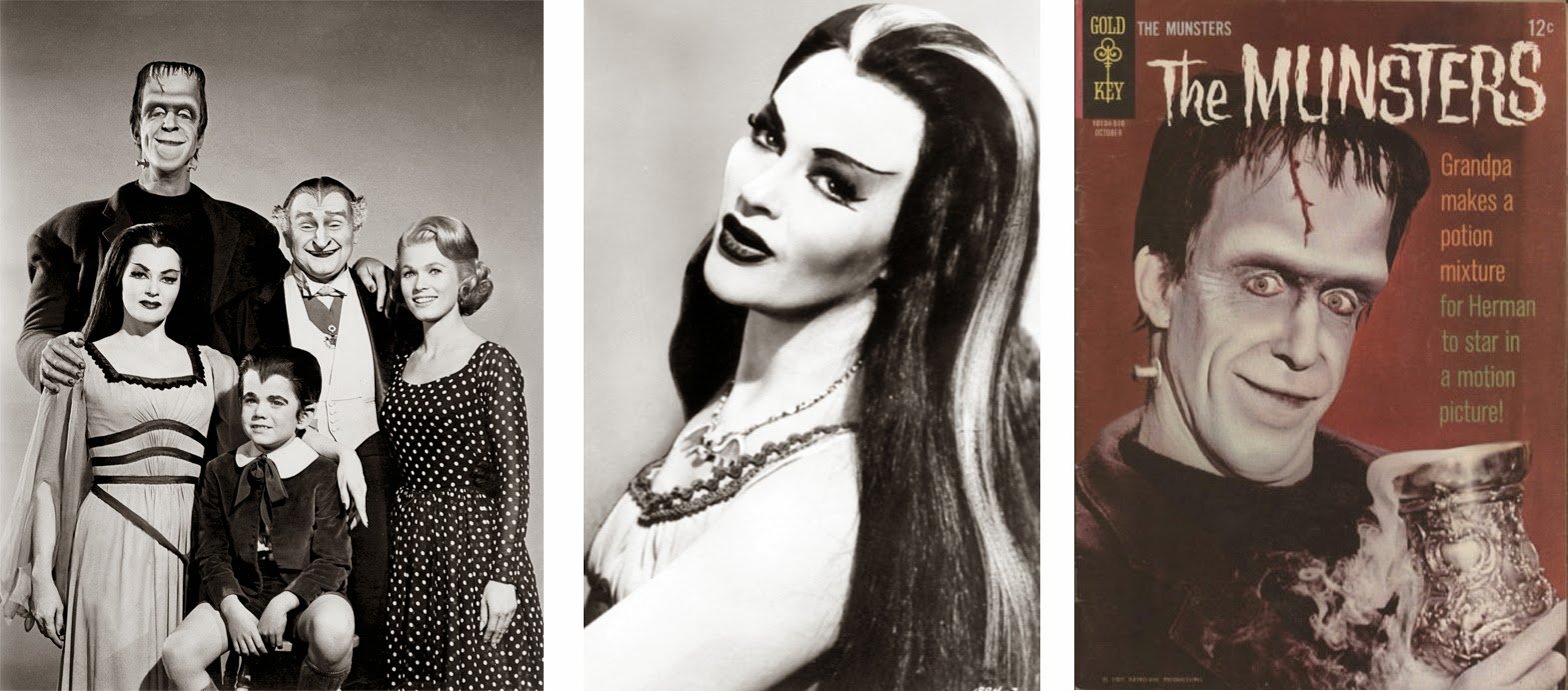
And I liked The Munsters as well ... by 1965, I was already a big fan of Famous Monsters of Filmland and I felt very clever knowing that the Munster family were all based on the classic Universal monsters. Fred Gwynne and Al Lewis had been in the earlier Car 54 Where Are You?, which I had been aware of but hadn't followed.

The Munsters were a typical American suburban family - except that they all looked like classic Universal horror film characters. I'm not sure which one Lily was meant to be, but I thought she was stunning when I was ten years old. And there was the Gold Key comic to scour the newsagents for, as well.
Of course, I much preferred them as The Frankenstein Monster and Dracula than as two bumbling New York police officers. I also loved the way the gorgeous Pat Priest as Marilyn Munster was seen as hideously deformed by the family. And, weird child that I was, I thought there was something strangely attractive about Yvonne de Carlo as Lily Munster ...

And the last pre-Batman show I especially enjoyed was The Avengers. Like all the shows I've mentioned here already, The Avengers managed to pack in elements of science-fiction, horror and fantasy, though it was - at least, on the surface - an espionage series, leading some fans to later dub it "Spy-Fi".

The chemistry between Steed (Patrick McNee) and Mrs Peel (Diana Rigg) added considerably to the  success of The Avengers. The Gold Key comic wouldn't come until 1969, as the US saw the show much later than us.
There had been spy shows before. Top Secret (with its infuriatingly catchy theme tune "Sucu-Sucu"), for example, and the grim and gritty Danger Man with Patrick McGoohan, but for kids of comic-reading age, The Avengers was the perfect television series. Stand-out episodes were the two Cybernaut segments, "The Maneater of Surrey Green" and of course the notorious "Touch of Brimstone" episode, featuring the beautiful Diana Rigg wearing a dominatrix corset in a bullwhip fight with the bad guy, The Honourable John Cleverly Cartney, played by soon-to-be cult actor Peter Wyngarde.

The "Cybernauts" episode was broadcast in the autumn of 1965. At the time I would have been unaware of Peter Cushing. My interest in Hammer films came a little later. But it had "giant robots, karate-ing everything". Mrs Peel didn't do much karate-ing in "A Touch of Brimstone", but then, she didn't need to.
Needless to say, the latter episode was aired quite a bit later at night and I had to plead with my mum to let me stay up and watch it. I can only imagine how uncomfortable she must have felt watching this with her 11 year old son - doubly uncomfortable because it would have just made it worse if she'd drawn attention to it by saying, "This is not suitable, off to bed with you." At the time I would have been completely oblivious to my mother's discomfort, though not to the not-inconsiderable charms of Miss Rigg in bondage gear ...

Much later, Chris Claremont would appropriate Wyngarde's persona from this episode as the basis for Jason "Mastermind" Wyngarde in his 1975 version of The X-Men and have him turn Jean Grey into a red-headed version of Mrs Peel as the "Queen of Sin".

Jason Wyngarde (a reinvented Mastermind) would turn up in X-Men 122  (Jun 1979) as head of the Hellfire Club, though his look would be based on the much later Peter Wyngarde character of Jason King, who played the second-lead in Department S and would spin off into his own, self-titled series.
But other than these shows, it was pretty slim pickings for a comic-reading kid in the first half of the 1960s. Our American cousins, however, were spoiled for choice by comparison ...

NOT IN THE UK, YOU CAN'T ...

During the late 1950s and early 1960s, US television was awash with shows that I would have loved back then. The king of these, which still holds up spectacularly well, was The Twilight Zone. With writers of the calibre of producer Rod Serling, along with Richard Matheson, Charles Beaumont  and George Clayton Johnson, it's little wonder that the series was a huge success. Why we never got it in Britain is anyone's guess. Thank goodness for DVD box sets ... the format was half-hour episodes which invariably ended with an especially clever twist ending. Kind of like EC stories on-screen but not as repetitive ...

A disturbing scene from the second season episode of The Twilight Zone, "Eye of the Beholder".
Rod Serling's iconic voiceover intros have since passed into pop-culture legend. You'll often hear people imitate his dry, clenched-teeth delivery without actually knowing where it came from ... and the writing was always tight, crisp and ever-so-slightly sinister:

"Suspended in time and space for a moment, your introduction to Miss Janet Tyler, who lives in a very private world of darkness, a universe whose dimensions are the size, thickness, length of a swath of bandages that cover her face. In a moment, we'll go back into this room, and also in a moment, we'll look under those bandages, keeping in mind, of course, that we're not to be surprised by what we see, because this isn't just a hospital, and this patient 307 is not just a woman. This happens to be The Twilight Zone, and Miss Janet Tyler, with you, is about to enter it." opening narration, "Eye of the Beholder".

In a similar vein to Twilight Zone was Outer Limits. Again, I have no recollection of this ever turning up on UK tv at the time. The format was slightly different - one hour episodes - but producer Joseph Stefano's writing team would include Harlan Ellison, Leslie Stevens and Stefano himself.

Robert Culp is surgically altered by a group of scientists to look like an alien - part of a plot to make the world think the Earth is imminent danger of invasion from outer space, which they think will force the hostile nations to unite and work together.
The episode "Architects of Fear" has been cited by some as Alan Moore's inspiration - oh, okay, swipe - for the ending of Watchmen. Other stand-out episodes were Ellison's "Soldier" and "The Zanti Misfits", by Stefano, who would also write the screenplay for Alfred Hitchcock's Psycho.

But these were both big-budget, networked fantasy shows that have been written about at length elsewhere. Since the 1960s, I've become aware of far more obscure shows that had used comics as the source material.

Flash Gordon was a half-hour adventure show from 1954 that featured Steve Holland, who later be the model for James Bama's iconic Doc Savage paperback book covers. The show was based on the King Features Syndicate newspaper strip of the same name, that had also been the basis for the 1930s super-serials. Though we didn't get the strip in UK newspapers, I was familiar with the serials during the 1960s.

Flash Gordon star Steve Holland was James Bama's model of choice for the Doc Savage paperbacks. This explains why Doc looks slightly older in Bama's covers than you might expect, as Holland would have been about 40 by this time.
As a syndicated show, this series was shot on the meagrest of budgets, and lasted just the one season, but I'd've loved it if it had been shown on UK tv. More recently, some of the episodes have been broadcast on UK satellite tv.

Another show from that era that popped up on a satellite channel was Sheena, Queen of the Jungle, starring the imposing Irish McCalla in the title role. Created by comics legend Will Eisner, Sheena was a kind of female Tarzan, who was the lead feature in Fiction House's Jumbo Comics from 1938 till 1953. She also enjoyed a run in her own quarterly comic from 1942 - 1953. 

In the end, Sheena Queen of the Jungle proved to be far more than just a female Tarzan knock-off. Surviving as the lead feature in Jumbo Comics from 1938-1953 was some achievement, and she also supported her own title for almost ten years. Actress Irish McCalla was Sheena come to life.
The tv show ran 25 episodes in 1955, and was quite racy for the times. McCalla was never going to win an Emmy for her performance, but her resemblance to the comicbook heroine was uncanny. I would have loved the show at the age of ten as, and I've noted this elsewhere in this blog, even at that age I had an eye for attractive heroines.

And because she is so impressive, here's a completely gratuitous triptych of portraits of the amazing Irish McCalla.
Many years later, Marvel Comics writers like Gerry Conway and Steve Gerber would remember Sheena, and include their own knock-off "Shanna the She-Devil" in Daredevil, then in her own series. One black-and-white strip, "The Wrath of Raga-Shah" from Rampaging Hulk 9 (June 1978), was quite risque and made such an impression on me in the 1970s that I built one of our regular UK Marvel Summer Specials around it.

After guest-star spots from Daredevil 109 on, Shanna became a regular if minor Marvel Comics character. Never really able to sustain her own series, the character was still a hit with 1970s teenagers like myself.
The other, higher profile, superhero series we never got in the UK was The Adventures of Superman. Starting in 1952, the syndicated series ran for six seasons, the last four filmed in colour, even though colour tv wasn't available in the US until 1965.

A couple of years earlier, National Comics had finally struck a deal, with Columbia rather than Republic, to produce a 15-chapter serial, Superman (1948). Kirk Allen was cast in the lead role as Superman/Clark Kent, with Noel Neill as Lois Lane and Tommy Bond as Jimmy Olsen. Vamping to the full, Carol Forman was the deliciously villainous Spider Lady.

Kirk Alyn made a pretty good Superman, better in my opinion than George Reeves. Carol Forman, veteran of several serials, made a slinky Spider Lady, Metroplis' Queenpin of Crime.
Columbia produced a second serial, Atom Man vs Superman, in 1950. Lyle Talbot was cast as the villain, Atom Man, who turned out to be Kal-El's arch-nemesis Lex Luthor. The serial included all of the comic book's tropes, including kryptonite, The Daily Planet and Lois Lane scoffing at the idea she could ever have suspected that mild Clark Kent might be Superman.

The villain Atom Man wore a metal bucket on his head so Superman wouldn't know who he was. All the comic book supporting characters were once again present,  Pierre Watkin (as Perry White), Tommy Bond, Kirk Alyn (here as Clark Kent) and Noel Neill.
The two serials were quite successful, so Superman editor and National's movie contact guy Whitney Ellsworth, starting looking round for another way to exploit DC's main character. Ellsworth struck a deal with Lippert Pictures and cast George Reeves as Superman/Clark Kent (after Kirk Alyn wanted too much money) and Phyllis Coates as Lois Lane in a b-movie length feature Superman and the Mole Men (1951). The idea was to have something to show the networks to demonstrate how a Superman tv series would look, but the running time meant it could be released on the movie circuits to recoup the expenditure if there was no interest from the broadcasters. In the end, National got the best of both worlds. The movie was released on 23 November 1951, and did reasonably well ...

"Full-length" is probably over-egging it a bit. The movie ran just 58 minutes and was later re-edited to form the only two-part story in the whole of Superman's 1950s tv run.
But before that even happened, Ellsworth had launched into production of the new tv series The Adventures of Superman, with the same cast (except for Jeff Corey who fell foul of HUAC and was blacklisted), in September 1951. But, unable to secure a sponsor, production had to shut down after a few weeks. Finally, a year later, National had convinced the sponsor of the Superman radio program Kelloggs to back the tv series and the show began its syndicated run on US tv in September 1952.

The first episode has Superman's father Jor-El trying to convince a sceptical Krypton council of the imminent destruction of their planet, but with his warnings falling on deaf ears, Jor-El is determined to save at least his infant son.

An uncredited Robert Rockwell played the part with steely determination in a cast-off costume from the Flash Gordon serial, Conquers the Universe. Aline Towne is Lara. And here's the original Flash Gordon costume before it was modified.
But when the tiny rocket lands on Earth, it's discovered by Eben (Tom Fadden) and Sara (Frances Morris) Kent, rather then the more familiar Jonathan and Martha. This was early days, after all. The Kents, first appearing in Adventure Comics 103 in 1946, only became established after the Superboy comic began its run in 1949, so the "Jonathan and Martha" names for the Kents weren't so familiar to audiences ... or tv script writers.

Tom Fadden also went uncredited by the producers for his role as Eben Kent, even though he was the one who pulled the infant Kal-El from the blazing rocket, whereas Frances Morris (like Aline Towne) was credited on-screen. I'm detecting a clear bias towards mothers.
The whole section of baby Kal-El arriving on Earth is dispatched in the first few minutes of the first episode of the show. The Smallville years are largely glossed over, except for Eben's death, and it's Sara who provides Clark with his iconic uniform.

Once Clark gets to Metropolis as Superman, the show had to face the thorny problem of his superpowers. The key challenge was making him fly. A few years earlier, the serials had tackled the problem by turning the long-shot figure of Kirk Alyn into a cartoon Superman and literally animating the flying sequences. It kind-of almost worked. But not really. 


The producers of Adventures of Superman took a different approach ... they had George Reeves take run across the set, jump onto an out-of-camera spring board and dive off the side of the frame. Then they'd cut to Reeves lying on a small platform with back-projected sky behind him. That, too, kind-of almost worked. But I know that today's audience would find it Plan 9 From Outer Space funny.

Many years later, the Christopher Reeve version of Superman was heavily marketed with the ad-line, "You'll believe a man can fly". At the time I couldn't figure out what the big deal was. After all, he was Superman, right? What I hadn't realised was that US audiences had grown up with George Reeves' springboard-bouncing take-offs and the moviemakers were worried audiences would be expecting the terrible flying effects of the television show.
But for the most part, this version of Superman was just an airborne strongman. The producers never addressed Superman's full set of superpowers. Occasionally, he'd use X-ray or telescopic vision, but hardly ever super-speed. At least not in the black-and-white shows that I've seen.

I very much liked the way Reeves handled the Clark Kent persona. Instead of the fake coward of the comics, Clark was quite rugged as the Daily Planet journalist. He'd often stand up to crooks in this identity, one time faking out a crook by jamming his steel-hard fingers in the guy's back to make him think it was a gun.

I quite liked Reeves' portrayal of Clark as a capable newspaperman. There was very little sign of the comic book's fake coward here ...
In this show, Clark was just as important a character as Superman, and more than once demonstrated that he could be a capable investigator. Consequently, there was little room for his supporting cast, lead by Phyllis Coates' Lois Lane to speculate that Clark could ever actually be Superman.

Mostly the crooks were just standard criminals in business suits. The black and white photography enhanced the show's noirish qualities. The supporting cast were strong, featuring Jack Larson as Jimmy Olsen, Phyllis Coates as Lois Lane and John Hamilton as Perry White. Coates would be replaced by the serials' Noel Neill from season two onwards.
What the tv show didn't have that the comic books had was ongoing villains. Mostly Superman battled none-too-bright thugs in business suits - not unlike some of the earlier superhero serials. So there was no Trickster or Prankster or Lex Luthor to be seen anywhere in Adventures of Superman. In fact the first two seasons were quite noir-ish in their approach, a feeling enhanced by the back and white photography. Once the series switched to colour with the third season, we began to see a bit more whimsy and humour.

The series was an instant success, even though it was syndicated rather than backed by a major network. This meant that stations across the US could take or leave the show depending on whether the station manager and his audiences liked it, and not have it forced on them through a network contract. Even with that, Adventures of Superman was a smash hit, George Reeves became a huge star on the back of it and the show's catchphrases, such as "Is it a bird, is it a plane?" and "faster than a speeding bullet", entered the US zeitgeist. So massive was the success that Reeves as Superman was a guest star on the phenomenally popular I Love Lucy tv show in January 1957.

Though I Love Lucy was the top-rated comedy show on US tv, with ratings of about 50 million, Superman was played straight, as though he was a real person with real super-powers..
Even though the Superman show lasted just six seasons - the final four really being just half seasons with only thirteen episodes, it ran in syndication well into the late 1960s and beyond. All the more incredible, then, that we never got Superman on tv in the UK during the show's run.

So I was left wishing just as hard as I could that I'd be able to see a "real life" superhero either on television or in the movies. At that age, I had never heard the proverb that says, "When the gods want to punish us, they give us what we wish for". So little did I know that in the spring of 1966, shortly before my twelfth birthday, I would get my wish ...

Next: THAT tv show ...


STOP PRESS  +++  STOP PRESS  +++   STOP PRESS  +++   STOP PRESS

A couple of posts back, while examining the artwork for the trademark Marvel Comics corner box, I was speculating on the origins of the Kirby Sub-Mariner figure used on the later Tales to Astonish covers. I chanced across the solution recently, and I've added the info to the original post. Have another look at the post and learn what I learned ...