Showing posts with label Robert Bernstein. Show all posts

Sunday, 1 July 2018

Iron Man: The Golden Years

IRON MAN WAS MARVEL'S SEVENTH superhero series, debuting in Tales of Suspense 39 (Mar 1963, on sale 10 Dec 1962). Editor Stan Lee had taken to introducing his new cast of costumed characters in the existing monster titles, after Publisher Martin Goodman had been burned by the failure of The Hulk's own title earlier that year. Given how averse Goodman was to spending money unnecessarily - new titles had to be registered with the US Postal Service and there was a cost attached - he'd decreed "no new titles" until Marvel's new characters proved themselves.

Iron Man was originally coloured grey, presumably to make it obvious his suit was made of iron, but it didn't take Stan long to figure out that this would make the comic a bit drab ... so he did something about it in the following issue.
So after The Fantastic Four and The Hulk, Stan's new creations were assigned to the fantasy books: Spider-Man in Amazing Fantasy and Thor in Journey into Mystery (both Aug 1962), then The Human Torch in Strange Tales 101 and Ant-Man in Tales to Astonish 35 (both Sep 1962). By the time 1963 rolled round, the sales were improving on all the Marvel books, so Goodman gave the green light to reinstate The Amazing Spider-Man (in his own title), then add Sgt Fury, The Avengers, The X-Men and Daredevil to the roster.

The original spidermen, perched high above the New York City streets. By adding the hyphen, Stan made the expression different from its common usage and in the process created a term that could be trademarked.
What I'd noticed, even back then, was that Stan was using familiar terms for the names of his new superheroes. The expression "spiderman" was in common use in New York - it was the name given to the guys who worked on the skyscrapers, precariously working hundreds of feet above the Manhattan sidewalks. Thor, of course was already familiar to any schoolkid as the Viking God of Thunder. Daredevil was also a term in common usage, and "iron man" was often used to describe a particularly strong or tough sportsman.

Was Stan being especially clever by choosing names that were already familiar to his youthful audience, or was he just reacting positively when a familiar term he could use as a superhero name popped into his head? I guess we'll never know for sure, but it occurs to me that there's a pattern here and patterns are usually deliberate.

What I do know is that Stan, like any other creator, wasn't creating in a vacuum. Let's not get dragged in to another discussion here about who did what back in the early 1960s Marvel offices and allow that Stan, as editor, got to make the decisions about what characters were called, what they looked like and whether they were published or not. Probably with a bit of interference from Goodman. So it's extremely likely that Stan was getting inspiration from what he saw going on around him in magazines, newspapers and in movies and on television. I'm pretty sure he's said as much in various interviews.

The other thing he was consciously doing was building a line of super-characters who each had some defining flaw. With the Fantastic Four it was that they argued with each other - and with Ben Grimm in particular, it was that he just wanted to be human and not a monster. Spider-Man had the worst luck ever in his private life, dealing with bullying at school and caring for his sickly aunt, whose poor health was likely a result of the murder of her husband, Ben Parker. The Hulk was a tragic combination of Frankenstein's monster and Jekyll-and-Hyde, Daredevil's blind ... well, you get the idea.

So when it came to Iron Man, Stan took the idea of a man with a broken heart and combined it with the technology of the day to come up with something unique ...


THE MAN IN THE IRON VEST

One of the big health scares when I was a kid in the 1960s was poliomyelitis, more commonly known as polio. I knew at least one kid on our council estate who'd had it. It wasn't that rare to see children around 1963 wearing leg calipers as a result of the paralysis caused by polio. It was common in the United States too, with no less than President Franklin Roosevelt confined to a wheelchair by the disease.

Stan would have certainly been aware of polio, as it was common in the States from the beginning of the 20th century up until the US polio epidemic of 1952, and beyond.

An unknown polio victim from the 1950s with the characteristic leg-strengthening calipers.
In extreme cases, victims would experience paralysis of the diaphragm and would be unable to breath unaided. This lead to many spending some time in an Emerson mechanical respirator, colloquially know as an Iron Lung. These were terrifying, bulky devices that used external air pressure to deflate and then inflate the sufferer's lungs. Some spent years in such devices and a few companies tried to create less-cumbersome, more portable versions.

Some polio sufferers spent years trapped inside these devices, while the compression machinery did their breathing for them. Though it may seem barbaric by today's standards, the iron lung saved thousands of lives.
I think it's against this background that Stan came up with the idea for Iron Man and handed it to his brother Larry Lieber to script. The idea of damage to the lungs evolved into damage to the heart - a far more dramatic device - but the concept of mechanical help to keep vital physical processes running remained at the core of the idea.

Here's an immensely telling photo I came across while researching this post ... some attempts were made during the 1950s to create a mechanical respirator that wouldn't trap the victim in a hospital room for months or years. Does it remind you of anything?
Once the Unique Selling Point of Iron Man became his broken heart, Stan was able to introduce clever elements that highlighted Tony Stark's plight. For example, Stark was a millionaire playboy who dated an endless string of actresses and super-models, yet became unable to let any of them get close due to his terrible secret. The idea that his precarious health prevented him from pursuing the woman he truly loved - Pepper Potts - added another layer of drama to the mix. So much so that while reading the Iron Man stories as a kid, I'd often skip over the superhero battle sections to find out what was going to happen in Stark's civilian life.


GOING FOR GOLD

For his first appearance, in Tales of Suspense, Iron Man was coloured grey. I'm guessing this was an attempt by Stan to make it clear to his young audience that the character was indeed literally made of iron. Why he didn't go with a "knight-in-armour" metallic sheen to the suit we'll never know, but it might have more sense to make Iron Man's costume look like shiny metal rather that grey cardboard. Maybe it was something to do with the makeshift nature of the prototype ... but more on that later.

It would have made the character visually more appealing and dynamic if the colourist - probably Stan Goldberg - had made an attempt to colour Iron Man's suit as shiny metal, perhaps white with blue and black highlights, like the later Silver Surfer.
The story opens with a glimpse of the lifestyle of the rich and successful munitions manufacturer Tony Stark. These days, of course, armaments manufacturers are hardly heroes, but in 1963, during the early stages of the United States' involvement in the Viet Nam war, this probably didn't seem such a terrible idea to Stan. I mean, who'd have thought we'd still be talking about this stuff more than fifty years on?

With scant regard for Newtonian physics, Stan has Tony Stark create a magnetic device that can rip the door from a steel safe. Of course the reality is that the table the magnet's attached to would simply fly across the room, drawn to the safe by the magnetic attraction ... but let's not allow the scientific facts to get in the way of a good story.
When we first see Stark, he's demonstrating a high-tech device - a transistor-powered magnet - powerful enough to tear a safe apart from a distance. Transistors were the electronic miracle of the 1950s and 1960s. By the time I was reading comics, transistor radios had all but made valve technology obsolete. I'd had a transistor radio of my own in 1964 that I'd listen to Radio Luxembourg on, with its non-stop pop hits, then Radio Caroline, three years before the launch of BBC's Radio One.

The chestplate created by Tony Stark and Yinsen contains a wealth of technology designed to keep Stark's heart beating. The only thing that bothered me is where did they get the advanced transistors from, in the middle of the Viet Nam jungles?
Once the origin story gets properly under way, we find Stark in the Viet Nam jungles, witnessing a demonstration of the miniature mortars he's created for the US-backed South Vietnamese Infantry. But he's separated from his escort, blunders into a Viet Cong booby trap and is captured, wounded with shrapnel near his heart. Forced to work for communist bully Wong Chu, Stark contrives to create a transistor-powered suit of armour, aided by kindly elderly scientist Professor Yinsen. Yinsen gives his life to keep the communists away from Stark until the suit is fully charged then, look out, Wong Chu ... The armour has the added bonus of keeping his heart beating despite the shrapnel lodged in his chest.

Iron Man's first adversary wasn't so much a villain, more a monster straight out of all those fantasy tales that had been running in Tales of Suspense around this time. It was as though Stan hadn't quite decided on how to run his b-team superhero line. Having it scripted by Robert Bernstein, an alumni of the Mort Weisinger Superman titles, wasn't helping to create a unique approach, either.
With the pesky origin story out of the way, Stan could focus on developing the supporting cast and gallery of villains for his new iron-clad hero. And all-in-all he'd do a better job with Iron Man than he did with Ant-Man. But it would take a few issues to get going. Tales of Suspense 40 (Apr 1963) was a bit of a damp squib as far as the menace Iron Man faced. It was the time-worn plot device of invading aliens using a robot avatar to scare/test the population of Earth before getting their talons dirty. The plotting is credited to Stan Lee and it does have a similar feel to the earlier fantasy tales in Suspense. I didn't think there was anything wrong with Don Heck's and Larry Leiber's work on Tales of Suspense 39, but Stan must have had misgivings, as he got Jack Kirby to lay out his plot with a script by "R.Berns" - in reality DC comics hack Robert Bernstein. This would account for the weak resolution to the story, though it is notable for having the scene in which Tony Stark changes the Iron Man suit from grey to gold - I'm betting money that was a Stan Lee directive.

I've condensed several pages in the image above to focus on the thought process behind Stark's changing the look of his armour. Bernstein assigns credit for the idea to Stark's date, Marion. 
The first action sequence in the short 13-page story shows Tony Stark taking a date to the circus. Even at the tender age of ten, I thought this was a pretty cheap move for a multimillionaire, but it's just the kind of scenario a DC writer would come up with. As luck would have it, all the lions escape during the performance and Stark has to transform to Iron Man to save the day. However, the bystanders are shaken by the sight of a grim, grey iron-clad man and Stark makes a note-to-self to do something about softening the armour's appearance. At the end of the scene, Stark's date Marion suggests that gold would be a better colour for the armour and so Stark paints the dull grey suit a sparkling metallic yellow.

It's a seminal moment ... and such a good idea that I now wonder whether Stan hadn't planned it this way all along ... create the character with a dull, monsterish appearance then refine the look really quickly.
The rest of the tale tells how Stark goes looking for Marion and discovers that her home town has been taken over by a monstrous "neanderthal" man called Gargantus. It turns out that Gargantus is a robot drone controlled by aliens orbiting high above Earth. Iron Man uses his physics-defying magnets to rip the robot apart (in reality, the magnets would just fly towards Gargantus and stick to him) and scares the aliens off with the same weapon. The aliens don't seem to know any more about physics than scripter Bernstein does.

The defeat of Gargantus and his alien controllers is a lame plot device. Shaky physics aside, it just feels a bit lazy. A clever idea for the resolution of the story would have made it far more memorable ... though, as I've said before here, Stan and the Bullpen weren't making history here, they were just filling pages.
Overall, it's not quite there yet. The gold armour is a big improvement over the dull grey ... but I still wonder why Stan didn't go with a silver or chrome look. It would have been more appropriate for a character called Iron Man. Maybe he just wanted the character to pop on the newsstands and logic took second priority to that. The next issue wasn't any major improvement.

As good as Kirby's composition is here, his version of Iron Man's armour is heavy-looking and clunky. It doesn't have the feel of up-to-the-minute technology, even by 1963 standards. And Dr Strange is a pretty forgettable villain. Iron Man wouldn't really get interesting until Kirby was no longer contributing.
The next Iron Man tale, in Tales of Suspense 41 (May 1963), gave us a villain called Dr Strange. But the first half of the story is taken up with establishing Tony Stark as a man who can never love, due to his (literally) broken heart and demonstrating Iron Man's powers and explaining how they work.

Another montage from the story, with Stan emphasising again that due to Stark's heart-condition and his dual identity as Iron Man, he can never enjoy a proper Personal Relationship ... which begs the question, Is Tony Stark the world's only platonic playboy?
The rogue scientist villain, Dr Strange, is pretty unmemorable, and the plot device used here is that of Iron Man being mind-controlled to do bad stuff by the villain. Iron Man eventually breaks the mind control but his electrical systems are compromised by Dr Strange and it's left to Strange's "ungrateful" daughter to save Iron Man with a handy flashlight battery.

Looking at this final scene in the story, you have to wonder where Stan Lee the Editor was. That's an awful lot of dialogue crowding the drawings out of the page. At least a third of the over-explanatory text could be cut to make this a more streamlined read.
The laborious scripting is still by Bernstein, the art is again by Jack Kirby, but this time inked by Dick Ayers. I don't think it's a good combination for Iron Man and Ayers' inking in particular seems heavy-handed on this issue. There's no real flair to this material yet and the revolving door of Stark's dates does not yet constitute a supporting cast. Something else needed to happen to get the series up on its feet. Fortunately, Don Heck would be back next issue.

Though it's still Jack Kirby pencils - or more likely layouts - here, it's the inks of Don Heck that are starting to shape Iron Man into the definitive version of the character. It's a real pity about the stock communist villain.
I've made no secret of the fact that I'm a big fan of Don Heck. For me, his version of Iron Man is the defining one. And though it would take him a couple of issues to properly find his feet, he'd go on to create some interesting villains, as well as designing the series' supporting cast of Pepper Potts and Happy Hogan. Tales of Suspense 42 (Jun 1963) gives us the first all Heck art job since issue 39. But sadly Bernstein's script, featuring yet another communist bully-boy, doesn't give Heck much to draw. The convoluted plot has an impersonator-type bad guy, The Actor - not a million miles away from Spider-Man's Chameleon foe - offer to steal important secrets for an unpleasant communist called The Red Barbarian. He'll achieve this by impersonating Tony Stark. During the course of stealing the plans, The Actor chances to discover that Stark is Iron Man. 

Given that The Actor hasn't told any of his henchmen that Iron Man is Tony Stark, why are they telling Iron Man that The Actor impersonated him? The Actor impersonated Tony Stark. Editor Stan ... are you even reading this stuff?
Iron Man doesn't even appear until page 10, too late to stop The Actor's getaway. There follows some shenanigans with Iron Man intercepting - then impersonating - The Actor, to what ends I'm still not quite sure. All in all, just another muddled script from Robert Bernstein, with not enough Iron Man action. It does get better, though, I promise ...

Jack Kirby's cover design here is as strong as ever, with a powerful image of Iron Man front and centre, though there's no great sense of menace. I found it interesting that Kirby's version of Iron Man had no chin, while inside, Don Heck was drawing Iron Man's headgear as curving in under his jaw and into his neck.
Tales of Suspense 43 (Jul 1963) featured another familiar Lee-style plot, re-used from Tales to Astonish 41 and 49. The ruler of a hidden realm is abducting scientists to work on a super-weapon. In this case it's the beautiful Kala, who rules an underground queendom and has designs of conquest on the surface world.

So, if the Netherworlders civilisation is superior to that of the surface dwellers, why would they want to live on the surface, with its terrible weather, pollution, wars and mankind? And if you Netherworlders are all so smart, what do you need Stark's technology for?
When you think about all those Silver Age Marvel stories, it must be pretty crowded down there beneath the Earth's surface, what with the Moleman (FF1, Nov 1961), Tyrannus (Hulk 5, Jan 1963), The Lava Men (Journey into Mystery 97, Oct 1963) and now Kala and her subterranean hordes.

It's pretty good going, even for Tony Stark, to be able to recreate Iron Man's armour overnight, right under the unsuspecting noses of the Netherworlders. If I'd been scripting it, I'd made sure Stark brought his attache case with him.
Needless to say, Tony Stark outwits the ambitious ruler by agreeing to create a weapon, but instead building another Iron Man suit overnight. He makes pretty short work of the queen's soldiers and grabs her, clippering (!) his way to the surface to give Kala a taste of what life on the surface would be like. It's not to her liking.

I think we can all agree that Tony Stark is an engineering genius, but atomic powered scissors? Really? Robert Bernstein was responsible for some complete nonsense in these early Marvels.
"Kala, Queen of the Netherworld" is another journeyman effort by Robert Bernstein. The biggest surprise about Stan's brief "writers for hire" period in 1962/3 was that he put up with obviously sub-standard writing for as long as he did. The story did benefit from Jack Kirby's pacing, as he supplied at least layouts for Don Heck's finished art, but it creaks pretty badly.

Straight out of the ending of Lost Horizon (1937). When Kala leaves her idyllic underground kingdom and is exposed to the nasty surface air, it does nothing for her complexion. (BTW - note how Don Heck's given Iron Man a chin here.)
Sadly we still had another few issues of this material to wade through before we got to the good stuff. In the meantime, it was the Bernstein business as usual ...

Even though Queen Cleopatra is being dragged up into the air by a metal demon, she seems to be quite happy at the prospect. The original art had Cleo looking alarmed but, for some reason, Stan had her expression altered to a smily one.
Tales of Suspense 44 (Aug 1963) pits Iron Man against another iron-willed female ruler, this time the legendary Cleopatra, in the story "The Mad Pharoah" ... the notorious mis-spelling of Pharaoh is Stan's. The story tells how Tony Stark is called in to help with an archeological dig in Egypt. He recommends Iron Man's services to help excavate the tomb of the "Mad Pharoah", Hatap. 

In Tales of Suspense 44, Iron Man (with a chin) has some more digging to do, but this time uses a diamond tipped drill, a big improvement over the atomic scissors. He then makes short work of defeating The Mad Pharoah's armies and still has time to make Cleopatra, convincingly beautiful in Don Heck's art, fall in love with him. All-in-all, a good day's work for Tony Stark.
However, during the night, the revived Hatap kidnaps Stark and transports him back to ancient Egypt to help Hatap usurp the throne of Queen Cleopatra. Of course, as Iron Man, Stark has no such intention and joins the battle on the side of Queen Cleo. With Hatap dispatched it only remains for Stark to return to his own era, which is pretty easy as Hatap's magic simply wears off and Iron Man fades away to the 20th Century.

Here's an unaltered version of the ToS 44 cover, published by Alan Class in the mid-1960s in the UK. You can see that Cleopatra looks more scared here, and the lettering in the jaggy box is different from the US version. Click on image to enlarge.
It is one of the better stories in Robert Bernstein's run, though not by much, and Don Heck was really beginning to find his rhythm with this tale, turning in the finest job of his run on the title so far.

This would have been the first all-Don Heck cover for an Iron Man Tales of Suspense, but something must have gone wrong, because Stan had the production department cut up a stat of the first page of the Kala story from Suspense 43 and paste that in to this cover art. I'd love to see what Heck's original art might look like, but I guess we'll never know. I've included the source Kirby artwork below.
The big change in Tales of Suspense 45 (Sep 1963) was that Stan - I presume - decided that Tony Stark need a supporting cast. This made a lot of sense from a story-telling point of view as now Stark would have someone to talk to. And by introducing a male and a female assistant for the millionaire munitions manufacturer, there would be fun to be had from the inevitable love triangle.

The first 12 pages of "The Icy Fingers of Jack Frost" were devoted to introducing and establishing the personalities of new supporting characters Happy Hogan - an ex-boxer hired as Stark's driver/bodyguard - and Pepper Potts, Stark's already in-post but unseen personal assistant.
However, the villain was very weak and ranked pretty low on the originality scale as well. Fortunately, he didn't show up till page 12 and as I've said before, at the time I had more interest in Stark's civilian life than in his battles as Iron Man, so spending the first two thirds of the page count introducing Happy Hogan and Petter Potts was fine with me.

Here's the source of the Iron Man figure for the cover of Suspense 45 ... and just for fun, I've mocked up what the original artwork for the cover might have looked like if Heck's Iron Man figure hadn't been edited out. I kind of like it better ... click on image to enlarge.
The other big change is that the Iron Man story has been expanded from the 13 pages of previous issues to a colossal 18 pages in this issue. So despite the workmanlike scripts by Robert Bernstein, the character must have been proving popular enough with the readers for Stan to scrap one of the fantasy back-up stories to make more room for Iron Man. It would drop back down to 13 pages for just the next issue, then go back to 18 pages with Tales of Suspense 47.

Tales of Suspense 46 was by far the best of the Robert Bernstein stories, featuring the villain who would become friend and ally to Tony Stark and Iron Man, The Crimson Dynamo. The Kirby version of the Dynamo on the cover doesn't do justice to the way Don Heck drew him inside.
Tales of Suspense 46 (Oct 1963) had Robert Bernstein's last Iron Man story, and, in all fairness, he goes out on a high note, with the introduction of a terrific villain, The Crimson Dynamo, a communist counterpart to Iron Man. It begins when Soviet scientist Anton Vanko builds an electrically-powered suit of armour with the aim of defeating Iron Man and in the process humiliating the United States. But Russian premiere Nikita Khrushchev plans to allow The Crimson Dynamo to liquidate Iron Man, then kill Vanko to prevent him taking over the USSR.

The best thing about this story was Don Heck's terrific design for The Crimson Dynamo, my favourite villain of The Golden Years, but also the fact that rather than being sent home defeated and in chains, Anton Vanko is recruited by Tony Stark as a valuable addition to the US research programme.
After a series of mysterious sabotage incidents at the Stark plant, Iron Man gets to confront the culprit - The Crimson Dynamo - and battle him one-on-one. It doesn't take Iron Man long, courtesy of his superior armour, to trap The Dynamo, and convince him that the Soviets will kill him the moment he returns to Russia. The story ends with Iron Man and The Dynamo friends and Khrushchev hopping mad that he's been outwitted ... again.

Iron Man 2's Ivan Vanko was an oddball hybrid of Ivan (The Crimson Dynamo) Vanko and the much later Whiplash character, who worked for The Maggia. I'd rather have seen one or the other ... but then, I'm a purist.
The Vanko character was later appropriated by the Marvel movie Iron Man 2 (2010), when he was synthesised into the Micky Rourke Whiplash character. The original Whiplash was a low-level Stark employee, Mark Scarlotti, who invented a super-strong metal whip and challenged Iron Man in Tales of Suspense 97 (Jan 1968). Combining him with Ivan Vanko, The Crimson Dynamo, resulted in an odd hybrid. I think I'd have preferred that they'd stuck to the original concept and used The Crimson Dynamo as presented in the comics, as he was more interesting character than what we were finally served up with.


WHO THE HECK IS ROBERT BERNSTEIN?

Robert Bernstein was born on 23 May 1919. Other than that, not much is known about the early life of this long-time comics writer. 

Robert Bernstein's earliest work in comics was sporadic to say the least. What he was doing for gainful employment between his text story for Fantastic Comics (1940) and his first comic script for Crime Does Not Pay (1946) is anyone's guess.
His earliest known work for a comics publisher was a two-page text story for Fox's Fantastic Comics 9 (Aug 1940), "Diamond Madness". Then after a six year gap, Bernstein scripted "Ghoul's Gold" which appeared in Lev Gleason's massively successful comic, Crime Does Not Pay 43 (Jan 1946). In the first half of 1946, Bernstein bounced around between comics companies like Fawcett and DC, picking up text story writing assignments wherever he could, then in the 1949, sold a string of comic scripts to St John's Hollywood Confessions and Teenage Romances comics.

Bernstein established himself as the main writer for the successful Marvel character The Black Rider at the beginning of the 1950s. So associated with the character was he, that even the Black Rider's appearances in other tiles, like Wild Western, were scripted by Bernstein.
By 1951, Bernstein was working regularly for Atlas, as lead scripter on Black Rider, and selling scripts to Spy Cases and Wild Western. In 1952, he began placing stories with the Quality Comics titles G.I. Combat and Ken Shannon, and Weird Thrillers, published by Ziff-Davis.

Bernstein began contributing scripts to Quality's Blackhawk title by the mid-1950s, then adding G. I. Combat and the EC title Psychoanalysis to his client list.
While Atlas' Spy Cases remained his main client, Bernstein landed some work with EC, writing for the New Direction title Psychoanalysis around 1955, and began contributing scripts to Quality's Blackhawk comic and to Robin Hood Tales. He stayed with Blackhawk when it transitioned to a DC title, and this gave him a foot in the door at the biggest and most successful comics company of the period. The other Quality comic that went over to DC G.I. Combat also used Bernstein's scripts, so pretty quickly, he was writing for Action Comics (Congo Bill/Congorilla), Adventure Comics (Aquaman and Green Arrow) and Lois Lane. He also wrote a couple of Superman stories, creating the villain Metallo, and a few tales for Superboy as well.

Few of Bernstein's stories were cover featured at DC in the late 1950s and early 1960s, but he did write one of my all-time favourite Superboy stories, "Superboy's Big Brother", which introduced Mon-El, drawn by George Papp in Superboy 89 (Jun 1961).
By the beginning of the 1960s, Bernstein was well entrenched at DC, but he still found time to moonlight for Archie Comics - writing scripts for The Fly and Adventures of the Jaguar.

Then at the beginning of 1963 Stan Lee, unhappy with the scripting work his brother Larry Lieber was doing on the Marvel b-titles, hired Bernstein to write Thor in Journey into Mystery 92 (May 1963), The Human Torch in Strange Tales 108 (May 1963) and Iron Man in Tales of Suspense 40 (Apr 1963). Bernstein's tenure lasted just eight months. The most amazing part is that it took Stan that long to realise that Bernstein (and Ernie Hart over on Tales to Astonish) were way worse than Larry could ever be. And it was at that point that Stan took over scripting the Marvel anthology titles himself.

Robert Bernstein contributed an incredible 14 scripts, most of them quite bland, to Marvel's second-tier titles during 1963. He was supposed to be a better option than Stan's brother Larry Lieber, but was unable to provide the spark that Stan was looking for. It's not as though Stan didn't give him ample opportunity, though. Finally, Stan bowed to the inevitable and took on the scripting job himself.
After Marvel, Bernstein would continue to work for Archie Comics and for DC until 1964 ... his last story was the King Superman tale for Action Comics 312 (May 1964), though a Jimmy Olsen story - possibly an inventory script - appeared in Jimmy Olsen 101 (Apr 1967).

Robert Bernstein's comics career stuttered to a halt around 1964. What he did after that is uncertain, but it's likely that his second career as a stager of classical music concerts was making him far more money than writing for comics ever could ... and he wouldn't have to put up with Mort Weisinger's abuse.
A keen fan of classical music, he founded the Roslyn Music Group, which offered soloist and chamber music recitals at Long Island University, giving Bernstein a second career as a music impressario.

Robert Bernstein (left) in 1965 with classical music cronies pianist Géza Anda (centre) and Jerry Schoenbaum (right), head of MGM's classical music division.
Robert Bernstein died of heart failure on 19 December 1988, at his winter home in Delray Beach, Florida, survived by wife Beverly and daughter Alison. He was 69.


THE END OF THE GOLDEN ERA

With the very next issue of Tales of Suspense, Robert Bernstein was out and Stan Lee took over the scripting of Iron Man himself. Lee also temporarily replaced Heck with Steve Ditko, in preparation for the sweeping changes he would be bringing to the series over the next couple of months ...

At the end of 1964, Stan moved some of his artists around, reassigning Don Heck to Thor for a few months and drafting in Steve Ditko to help with the changes Stan was envisaging for Iron Man. The character was to move into a very important revisionist period.
But all of that can wait till next time, when I take an in-depth look at Iron Man Phase Two.

Next: Red Metal, Yellow Metal ... Red Metal, Yellow Metal


Sunday, 31 December 2017

Thor: The Wilderness Years

THE EARLIEST THOR STORIES have always been associated with the grand art of Jack Kirby. But it wasn't actually that way. While the first seven issues of Journey into Mystery that featured the Thunder God were drawn by Kirby, these tales had none of the epic sweep the Silver Age version of the character is remembered for. Thor would battle Commies and gangsters and we'd rarely see more than tantalising glimpses of Odin and the fabled realm of Asgard. Then, all too soon, Kirby was off the title, re-assigned by Editor Stan Lee to other more pressing projects, like the epic first Fantastic Four Annual (Oct 1963), as well as new titles X-Men and The Avengers

Working over a plot by Stan Lee and a script by Larry Lieber, Al Hartley turned in his only superhero story of the Silver Age, "Trapped by the Carbon Copy Man". The result was less than legendary.
Another artist had to be found for Journey into Mystery 90 (Mar 1963, on sale January) ... and for that task, Stan selected Al Hartley.

The tale begins with Dr Don Blake resolving to tell his nurse, Jane Foster, that he is really The Mighty Thor and that he loves her. This would be an ongoing sub-plot for the first few years of the Thor strip. Stan seemed to want a romantic undercurrent - usually an unsuccessful one - in every title he wrote. As a ten-year old I found this a little tiresome. The Reed and Sue relationship I didn't mind, as they were a couple from the get-go. Even Hank and Jan were all right, because they too quickly became an item. But could I have been the only one who thought it was a bit creepy that Professor X was secretly mooning over Jean Grey in those early X-Men issues?

Al Hartley's art in Journey into Mystery 90 is a real anomaly, and has all the hallmarks of a rush job. The main figures seem crude and cartoony and the backgrounds are sparse and often absent altogether.
Just as Blake is about to reveal his true identity, Thor's father Odin intervenes and forbids him to say any more. But when Blake goes out to walk it off, he finds all kinds of strange behaviour. Cars driving on the sidewalks, polkadot bridges and advertising posters pasted over apartment windows.

The explanation for the madness is that aliens with designs on conquering Earth have substituted duplicates for important decision-makers (and Jane Foster) in an effort to make the Earthlings confused and frightened and so easier to conquer. Yes, I thought was was a bit lame, too. So Blake offers to betray Thor to the aliens - much to the captured Jane Foster's horror - then turns the tables by giving the aliens a darn good thrashing.

It's probably the least of the early Thor stories, not helped by an especially hokey script and the inappropriate artwork of Al Hartley

WHO THE HECK IS AL HARTLEY?

Henry Allan Hartley, born 25 October 1921 in New Jersey, was the son of Congressman Frederick Allan Hartley. His father, said Hartley in a later interview, "encouraged me. He knew I wanted to draw from the time I could hold a crayon ... My father wanted me to pursue my own dreams and never attempted to steer me in any other direction."

Hartley drew for his local newspaper while still in high school, and sold a Western comic-book story to the pulp publisher Street & Smith. When the Second World War broke out, Hartley enlisted in the Army Air Corps and flew 20 missions as a B-17 bomber pilot over Europe.

On leaving the Service in 1945, Hartley began looking for work as a cartoonist, and quickly landed work with Stardard Comics, drawing his first regular assignment, "Rodger Dodger" in Exciting Comics 51-67 (Sep 1946 - May 1949), gag strips like "Zippy" and "Henry" in Fighting Yank, and a range of short humour strips for America's Best Comics. Hartley also produced art for Ace Comics and ACG.

Al Hartley went quickly from one and two-page fillers for Standard Comics, to six-page stories for Ace Comics and ACG, before landing at Timely Comics, where he produced work in many genres for Stan Lee.
It wasn't long before he found work at Timely Comics, as Hartley related to Alter Ego magazine: "I'd developed enough of a reputation that it wasn't difficult to get a job at Timely in 1949. Stan Lee knew my work and hired me. When I started working with Stan, he wrote most of my stories, although I later wrote all of my own stories. We did all kinds of genres: war, Westerns, detective, science-fiction - you name it. We’d take a theme, and I’d illustrate the story. There were no typed scripts, just a very loose plot line. It was my job to draw the story with as much excitement, surprise, and suspense as I could. Then, Stan would write the dialogue. It's hard to put a time frame on it, but I'd guess we started working that way in the mid-1950s."

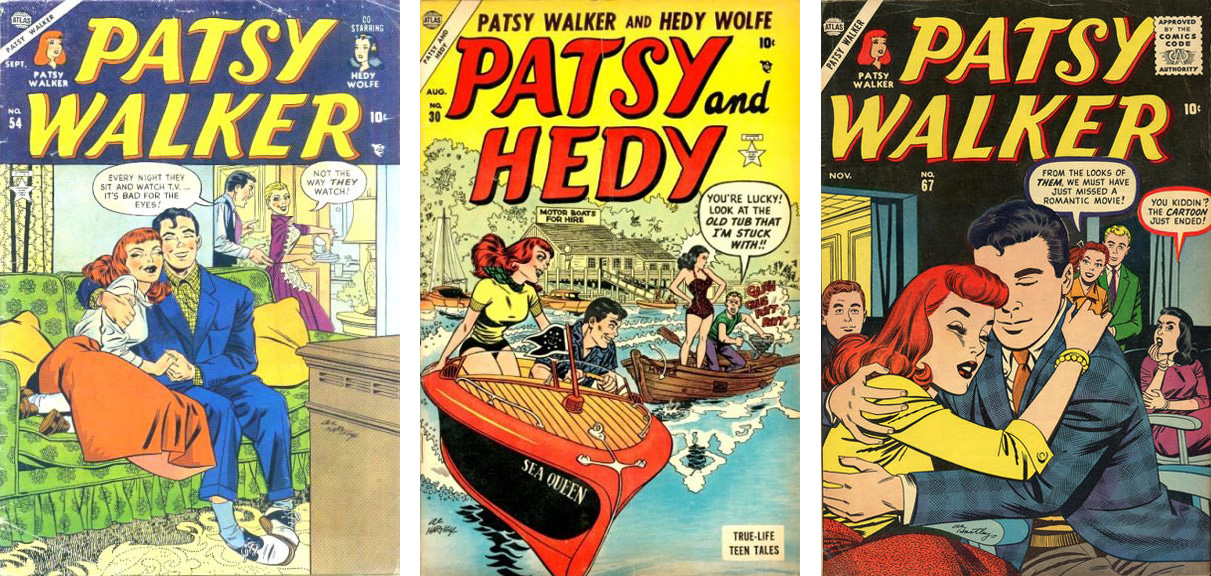
After a couple of covers in 1954, Al Hartley became the main artist of the Patsy Walker titles in 1956, supplying covers and interior art for both Patsy Walker and the companion spin-off Patsy and Hedy.
By 1953, Hartley was working almost exclusively on Atlas' burgeoning line of romance comics, like the long-running Love Romances, Girls' Life and Love at First Sight. Then in 1954, he produced his first work for the title he would be most associated with, Patsy Walker, a cover for the September issue, 54. But it would require another two years of toiling across the Atlas range before Hartley started drawing regularly for the Patsy Walker titles, starting with the November 1956 issue of Patsy Walker 67.

Under Al Hartley, Patsy Walker lasted 58 issues, and Patsy and Hedy running even longer at 61 issues. Hartley also wrote and drew the 1966 Marvel curiosity, Patsy Walker's Fashion Parade, an annual-size collection of one-page items showing Patsy in a range of different outfits.
Patsy Walker lasted until 1965, and its companion title Patsy and Hedy ran until 1967. Once the Patsy Walker books were cancelled, Hartley began working for Archie Comics. Shortly after, he became a committed Christian and founded Spire Comics, specialising in religious themed comics. He also entered into a deal with Archie owner John Goldwater to licence the use of the Archie characters in his Spire comics.

How Hartley ended up drawing the Thor strip in Journey into Mystery 90 is anyone's guess. Even Hartley couldn't remember. "Superheroes weren't really my forte," he told Alter Ego. "I don't recall the circumstances that led me to draw that story. At that stage of the game, I was mostly doing work that I was more comfortable with, mostly teenage and humor stories." 

Al Hartley: 25 October 1921 - 27 May 2003
Al Hartley was by no means a bad artist. Quite the opposite. He may not have preferred drawing superhero tales, but it's plain from his 1950s output for Atlas Comics that he could turn his hand, successfully, to any genre. While we'll never know the true circumstances behind the Hartley-drawn Thor story, it's likely that Stan needed a rush art job while he cast around for a replacement for the departing Jack Kirby. "Trapped by the Carbon Copy Man" has all the characteristics of a filler story, probably plotted, scripted and drawn in days. My best guess is that Stan's selected artist also had a tight deadline and Stan worried he wasn't going to make it, so commissioned this fill-in "just in case". After all, as I noted last time, Stan and the Bullpen weren't making history here, they were just making 12c comics.

In the end, though, the replacement artist Stan settled on was an interesting choice ...

THOR MK 2

Journey into Mystery 91 (Apr 1963) gave us the Thor tale, "Sandu, Master of the Supernatural", plotted by Stan, scripted by Larry and pencilled and inked by Joe Sinnott. In it, Loki increases the power of a sideshow mind-reader, Sandu, so that he can levitate and teleport any object. Advised by Loki, Sandu separates Thor from his hammer and, binding Thor with chains, buries him beneath a building. Thor only escapes when a deus ex machina, in the shape of Odin, sends two Valkyrie bearing Thor's magic Belt of Strength, enabling Thor to escape and defeat Sandu.

At the darkest point in Thor's battle with Loki's lieutenant Sandu, Odin despatches two Valkyrie to deliver Thor's Belt of Strength to help him escape from a seemingly inescapable death-trap.
As with earlier stories, the events here further cement Don Blake's real identity as Thor, son of Odin, as the monarch of Asgard has no qualms about sending Thor the Belt of Strength when his son's defeat seems imminent. Sandu's not the greatest villain, resembling in many ways the Miracle Man of Fantastic Four 3 (Mar 1962), but as the puppet of Loki, he'll do.

As an artist for Thor, Sinnott's not a bad choice from Stan's point of view. He's reliable and has a long association with Stan and Marvel Comics, going right back to the early 1950s. And of course, he'd become Marvel's premiere inker from 1965 on, providing consistency across Marvel's flagship titles as pencillers came and went.

WHO THE HECK IS JOE SINNOT?

Joe Sinnott was born on 16 October 1926 in Saugerties, New York. One of seven children, his father ran a successful cement manufacturing plant. Joe enlisted in the Navy in 1944 and served in Okinawa, driving a munitions truck. He was discharged in 1946 and worked for three years driving a cement truck for his father. In 1949, he enrolled in the Cartoonists and Illustrators School.

One of his instructors was Tom Gill, who asked Sinnott to assist on a range of Dell western comics. "Tom was paying us very well. I was still attending school and worked for Tom at nights and weekends," said Sinnott in a later interview. "We'd do the backgrounds and the figures, but since they were Tom's accounts, he'd do the heads so it looked like his work. I did this for about nine months. It was great learning," he said, adding, "I can never have enough good to say about Tom Gill. He gave me my start." Sometimes pencilling, sometimes inking, Sinnott would work with Gill on the early Atlas titles Kent Blake of the Secret Service and Red Warrior.

One of Joe Sinnott's early Atlas jobs, here inking over the pencils of Tom Gill for the second issue of Red Warrior (Mar 1951).
While still at the Cartoonists and Illustrators School, Sinnott wanted to branch out on his own so he approached Stan Lee separately and was put to work straight away. "I'd go down to the city on Friday," Sinnott told The Jack Kirby Collector, "and Stan would give me a script to take home. I'd start on Monday morning by lettering the balloons in pencil. Then I'd pencil the story from the script and ink it and leave the balloons penciled. I'd pencil a page in the morning, and ink it in the afternoon. I never burned the midnight oil; I'd start work at 7:45 in the morning, and I'd work until about 4:30 in the afternoon. I always figured if you couldn't make a living in eight hours a day, you shouldn't be in the business. I'd bring the story back on Friday and he'd give me another script. I never knew what kind of script I'd be getting. Stan had a big pile on his desk, and he used to write most of the stories himself in those days. You'd walk in, and he'd be banging away at his typewriter. He would finish a script and put it on the pile. Sometimes on his pile would be a western, then below it would be a science fiction, and a war story, and a romance. You never knew what you were getting, because he always took it off the top. And you were expected to do any type of story."

Three of Joe Sinnott's rare covers during Marvel's Atlas years. However, his interior art output was prodigious ... in excess of 1300 pages of pencilled and inked art from 1951 - 1957.
For the next six years, Sinnott would pencil and ink more than 250 stories for Atlas, in every genre - war, western, horror and crime -  contributing interior art to the company's mainstream titles like Marvel Tales, Battle Action, Wild Western, Spy Thrillers ... though very rarely covers. 

When the Great Atlas Implosion of 1957 hit, Sinnott had to find other work. "I was up to $46 a page for pencils and inks," said Sinnott, "and that was a good rate in 1956, when the decline started. I was down to $21 a page when Atlas stopped hiring me ... Stan called me and said, 'Joe, Martin Goodman told me to suspend operations because I have all this artwork in-house and have to use it up before I can hire you again.' It turned out to be six months, in my case. He may have called back some of the other artists later, but that's what happened with me."

Joe Sinnott during his Atlas Comics heyday, in the mid-1950s
During those lean six months, Sinnott took on any commercial art job going - record covers, billboard art, Charlton comic strips and even ghosting for DC Comics artists, before Stan called him back to resume work on the fledgling Marvel Comics. And with the January 1959 Marvel comics, Joe Sinnott was off and running again, pencilling and inking his first cover for Journey into Mystery 50 (Jan 1959).

On his return to Marvel in 1959, Sinnott seemed to pick up where he left off, pencilling and inking a variety of stories for the fledgling Marvel. Then, just as suddenly, he stopped and worked almost exclusively for Charlton, pencilling for Vince Colletta's inks.
Over the next year, Sinnott was back knocking out pencils and inks on four and five page stories for Stan Lee's mystery, western and war comics. Then he stopped working for Marvel and concentrated on his Charlton work for the next two years, till the end of 1961. I couldn't uncover a reason for this.

It would be two years before Sinnott returned to Marvel. His first inking job over Jack Kirby pencils during this period was for the Strange Tales 94 (Mar 1962) story, "I Was a Decoy for Pildorr: The Plunderer from Outer Space", though he had also inked the earlier "I Was Trapped By Titano the Monster That Time Forgot" in Tales to Astonish 10 (Jul 1960).
Then slowly, he began pencilling stories for Stan Lee again, starting with Gunsmoke Western 62 and Tales to Astonish 31 (both May 1962). He had also inked - over Jack Kirby pencils - Fantastic Four 5 (July 1962) and Journey into Mystery 83 and 84 (Aug - Sep 1962). "Before Stan called me to ink Jack on Fantastic Four 5, I never knew the Fantastic Four existed," Sinnott later recalled." I lived up here in the Catskill Mountains, and I never went down to the city at that time. Everything was done by mail and I didn't know what books were coming out, even. Stan called me up and said, 'Joe, I've got a book here by Jack Kirby and I'd like you to ink it, if you could. I can't find anybody to ink it. I was dumbfounded by the great art and the characters. I had a ball inking it. I remember when I mailed it back, Stan called me. He said, 'Joe, we liked it so much, I'm going to send you number 6.' But I had committed myself to another account at Treasure Chest ... and this was a 65-page story I was going to have to do on one of the Popes." This would have been "The Story Of Pope John XXIII, Who Won Our Hearts", in Treasure Chest vol 18, 1 - 9 (Sep 1962 - Jan 1963).

It was just a few months later that Joe Sinnott took on his short run, pencilling and inking the Thor stories in Journey into Mystery 91 - 96. "At the time, the rates at Marvel were terrible," recounted Sinnott, "and I was really rushing my work. Not that I wasn't trying my best at Marvel, but I did the best I could with the limited time we had. My main account artistically was Treasure Chest. Looking back I wish I'd done better work on Thor, but at the time it was just another job, and I certainly didn't think the character was going anyplace. At the time, I was probably penciling and inking one page of Thor a day, doing three or four pages of romance for Vince Colletta, and squeezing in some Archie after supper."

It was those poor rates that would keep Sinnott out of Marvel until the tail end of 1965, when he began inking Kirby in earnest with Fantastic Four 44 (Nov 1965).

AND BACK TO THOR

Journey into Mystery 92 (May 1963) presented an Asgard-heavy story, once again drawn by Joe Sinnott, but Lee had engaged DC writer Robert Bernstein to script the tale under the pen-name of "R. Berns" (though I can't imagine that fooled any of the DC editors).

"The Day Loki Stole Thor's Magic Hammer" is almost entirely an Asgard-bound tale, with guest appearances by Odin, his wife Frigga and Heimdall, guardian of the Rainbow Bridge. Oh, and Loki's the bad guy.
Stan's plot has Loki contrives to escape from his enchanted "uru" chains by attracting Thor's hammer with magical magnetism, reasoning that the hammer - made of the same material - will shatter the bonds. This leaves Thor to battle a succession of mystical menaces, hurled against him by Loki, without his hammer and, in typical DC style, Thor fashions first a hammer of wood, then a hammer of stone, as weapons of defence.

Joe Sinnot turns in a workmanlike job with the art, but Bernstein's script creaks badly at several points and has the inescapable odour of one of those Silver Age Superboy scripts that he'd been writing for Mort Weisinger. So much so that I wonder how much of a plot steer Stan had given him.

It's Stan's old friends the Communists again, this time making themselves all radioactive and hypnotising Thor to toss his hammer away ... it's not actually explained why Thor's hammer doesn't immediately return. There quite a neat scene at the end where Don Blake has to dive to the bottom of the Hudson River to retrieve the hammer, though.
Journey into Mystery 93 (Jun 1963) was a bit of a change of pace. Despite the art team of Jack Kirby and Chic Stone, the story had no Asgard at all and instead concentrated on a scientific menace, The Radioactive Man, a Red Chinese scientist who turns his body into a living atomic pile. Exactly why Kirby was assigned the art on this story in the middle of the Joe Sinnott run has been lost in the mists of time. It's unlikely it was deadline problems, as Sinnott has always been very clear about his methodical working habits. It's unlikely it was a pencilling "lesson" for Sinnott set by Stan, else he'd have had Sinnott ink it - and Stan wouldn't have been using Jack that way this early in Marvel's development.

It's a workmanlike story that seems separate from the Thor adventures on either side of it, as it doesn't in any way advance the development of the Thor concept. And Bernstein's scripting is a little careless. In one scene he has Thor, hypnotised by the Radioactive Man, throw his hammer away. Of course, the enchanted mallet should return under its own power, but it doesn't. Turning back to Don Blake, our hero invents a TV scanner to trace the whereabouts of the hammer, even though Blake is a medical doctor not an electronics expert.

The plot device of having Thor struck on the head to cause his personality shift is just the kind of story Mort Weisinger was commissioning over at DC Comics. I have no idea why Stan thought this would be a better approach for Thor what what Larry Lieber had been doing.
With Journey into Mystery 94 (Jul 1963), Sinnott was back, along with Loki and Asgard. Again scripted by Bernstein, this story had Loki cause Thor to be struck on the head by his own hammer, causing a personality shift that makes Thor evil. The two brothers then team up to cause havoc in Midgard, ultimately confronting the United Nations to demand the surrender of Odin. But second blow on the head restores Thor to normal and Loki is recaptured. It struck me as I was reading this that it scanned like a DC Comics story of the same period, hardly surprising since Bernstein had scripted almost exclusively for DC from 1957 onwards.

In "The Demon Duplicators" Thor battles standard issue mad scientist Prof Zaxton, who creates an evil duplicate of Thor, with two hammers. 
Journey into Mystery 95 (Aug 1963) trod a similar path to the previous issue. While Sinnott's art was workmanlike, the Robert Bernstein script used to time-honoured cliche of the hero's evil duplicate. Prof Zaxton is demonstrating Dr Don Blake's new android before an invited audience, with the aid of Thor. We know Zaxton must be evil because his name starts with a Z. Due to a mistake by Zaxton, the android announces he's malfunctioning and will explode within seconds. Only Thor's quick thinking prevents a catastrophe, as he flings the android high into the sky where it detonates harmlessly.

When Thor transforms back to Dr Blake and returns to his office, he finds Zaxton has arrived ahead of him and is holding Nurse Foster hostage. Zaxton demands that Blake help him modify his duplicating machine so it can replicate living creatures, specifically humans. But when Blake changes to Thor to try to stop Zaxton, the crazy scientist duplicates Thor, and a battle ensues. But because the evil duplicate isn't worthy to possess the power of Thor, the original defeats him relatively easily. The payoff is that Zaxton duplicates himself to confuse Thor, but the original accidentally perishes, leaving the good duplicate to carry on.
In another contrived Robert Bernstein scripted story, we see a magic battle over Washington DC, a cameo appearance by Robert F. Kennedy and the denouement where Thor scares Merlin into surrender by transforming from his Thor identity to Dr Don Blake.
Joe Sinnott's last issue as Thor artist would be Journey into Mystery 96 (Sep 1963), a tale which pits Thor against the magician Merlin. Archeologists have discovered the tomb of Merlin and have shipped the sarcophagus to the U.S. to put on display in a museum. But when they open the coffin, they're surprised to see Merlin looking as though he were asleep rather than dead. In fact he is only asleep and soon revives to begin menacing America, beginning with sending a rocket off course. Thor soon catches up with Merlin in Washington DC and the two engage in a magic duel, until Thor demonstrates his "superior" magic by transforming back to Dr Blake. The terrified Merlin surrenders and goes back to sleep in his coffin.

I told the story of how Stan replaced Larry Leiber as scripter on Journey into Mystery, Strange Tales and Tales to Astonish with Robert Bernstein and Ernie hart, and later admitted to Larry that he'd been wrong, in an earlier post, so I won't rehash it here. But suffice it to say that Stan had become pretty disillusioned with his hired-gun scripters by mid-1963 and with the October and November issues of the anthology titles, took over scripting Iron Man, Ant-Man, Human Torch and Thor himself, and gave each of them a boost in the form of a new gimmick in the process.

So the October issue of Journey into Mystery would see the return of Jack Kirby for one issue, to set up Don Heck as regular penciller, Stan Lee taking full control of the writing and the introduction of a Kirby-drawn back-up feature, "Tales of Asgard", which would feature the adventures of Thor alongside his fellow gods, away from the realm of men. 

But that's a story for next time ...

Next: What the Heck is going on with Thor?