Wednesday, 30 July 2014

Superheroes on the early 1960s screen

BACK IN THE 1960s, when I was a lad of about ten, our cinema entertainment didn't include an Avengers or an X-Men franchise ... heck, we didn't even have a Fantastic Four franchise. But I'll tell you what we did have in the way of superheroes on the screen - nothing. That's right, zilch.

As I've recounted in an earlier post on this blog, the biggest cause for excitement for me in 1965 was the imminent arrival of  Batman at my local ABC Minors Saturday morning pictures. Not in person, of course, just in the form of the 1943 Batman movie serial.

"Careful what you say, fellas ... you never know who may be listening.
Now let's get this stolen money divided up ..."
As excited as I was, this was tempered with some disappointment that the episodes were in black and white and were obviously very old. But it was Batman. Fighting bad guys. In a costume. When you've never seen real life superheroes doing what they do on screen, this was pretty brilliant stuff.

I've since managed to get DVDs of both the Batman serials and, given when they were made, they both hold up pretty well. I guess for contemporary tastes, these old series must seem pretty repetitive. The first five minutes and the last five minutes are taken up with a recaps and previews of the episodes on either side. But we should remember that these episodes were never intended to be viewed immediately one after the other. Audiences in the 1930s and 1940s would go to the pictures more than once a week. It was their television, and they would have been exposed to a serial chapter on pretty much every visit. So keeping the storylines straight in their heads would have been tough without the constant recaps.

The important point is that Hollywood then, as now, thought of the comics (both newspaper and comic book) and pulps as generous sources of characters and ideas. The result was that these characters were kept uppermost in the public consciousness and, even if only the junior members of the audience went out and bought copies, it added up to sales.

The downside was that the flavour of the adventures portrayed in the serials was more serial than comic book. The superheroes only ever battled thugs in suits and fedora hats, whether fifth columnists, mad scientists or just plain old crooks. There was no Joker, Mr Mind or Red Skull going in in the serials.

The first comic book superhero serial to make it to the screen was The Adventures of Captain Marvel in 1941. It was supposed to have been a Superman serial, but DC/National were giving Republic the runaround during negotiations for the rights, so the studio simply approached Fawcett and did a deal with them instead. It would be almost 10 years before Superman made it to the screen after that lapse in judgement.

Cowboy actor Tom Tyler made a pretty good Captain Marvel in the 1941 serial.
But this wasn't the first time Republic had been knocked back by Superman's publishers. A year earlier, Republic had prepared a serial to star Superman. The scripts were written, the stunt men lined up and then National pulled out. Rather than waste all that preparation, Republic changed the name of the main character to "Copperhead", made him a two-fisted private eye in a chainmail mask, and went ahead with the serial anyway, as The Mysterious Doctor Satan (1940). 


The first chapter of The Mysterious Doctor Satan was titled "Return of the Copperhead",
even though he'd technically never been away.
This was the next serial that turned up at our ABC Minors. And I loved it. It had everything - a mad scientist in the title role; marauding robots, well, robot; loads of knock-down brawls; and a rough-and-tumble hero in a cool mask.

Bob Wayne (Robert Wilcox), descendent of an old West outlaw,
puts on the chainmail mask and battles the thugs of Doctor Satan.
With all these set-backs, Superman wouldn't finally appear on-screen in a serial until 1948, which I wouldn't see until much later. And then in 1952, the character starred in the ground-breaking Adventures of Superman, which would be syndicated across the USA and be re-run until  the late 1960s. However, I was completely unaware of the Superman tv show in 1965. Though I can't be positive, neither I nor any of the folks I've asked can remember the series being screened in the UK during or before the 1960s.


WHAT'S ON TELLY, THEN?

That's not to say there was nothing on tv to capture my imagination. Probably my favourite show was My Favourite Martian (1963). The premise was almost the same as Superman ... an alien - in this case a martian called Exodus - crash-lands on Earth and newspaper reporter Tim O'Hara takes him in while the spacecraft is under repair. The gimmick is that O'Hara is always trying to out Exodus, but the alien outwits him at every turn, using his extraterrestrial (super)powers of invisibility, levitation and mind-reading. Character actor Ray Walston played the visitor and Bill Bixby, who would have another brush with superpowers in the next decade, played the reporter.

The martian ship looked barely big enough to carry a baby, let alone a grown man/martian. But the show was a big success with us kids, and of course there was a Gold Key comic book version, as well.
Other tv shows would shamelessly steal the core idea - ALF, Mork & Mindy - and there was a truly awful big-screen remake with Jeff Daniels and Christopher Lloyd, mugging horrendously as the alien visitor, in 1999.

I only have vague recollections of the Invisible Man tv series, but I do remember it scared the daylights out of me when I was about nine. Particularly the title sequence, which I would watch from behind the living room door (we were too poor to have a sofa).

I haven't seen the show since the early 1960s, but I remember the special effects for The Invisible Man (1958) being quite convincing. I'm probably mistaken ...
Another favourite was the puppet show Space Patrol. I liked it a good deal better than rival show Fireball XL5, because it had solid science fiction ideas and the occasional scary moment ... for example, though the crew of the Galasphere ranged mostly around the solar system, the producers realised that it would take weeks or months to reach Jupiter at sub-light speeds, so the crew went into suspended animation while control of the ship was switched to "robot control".

The adventures of Galasphere 347 would range across the solar system, no faster-than-light speeds here. The design of the spaceship was especially striking and fuelled my boyhood obsession with gyroscopes.
And on that cue, sliding doors would part to reveal a couple of really creepy, spiky robots that didn't talk but did glower effectively. 

The robots in Space Patrol were completely inhuman, unlike Robert the Robot in Fireball XL5 who was given a loveable personality. The shots of the future city were accompanied by throbbing electronic sounds, a bit like the Forbidden Planet soundtrack but stranger and more aggressive.
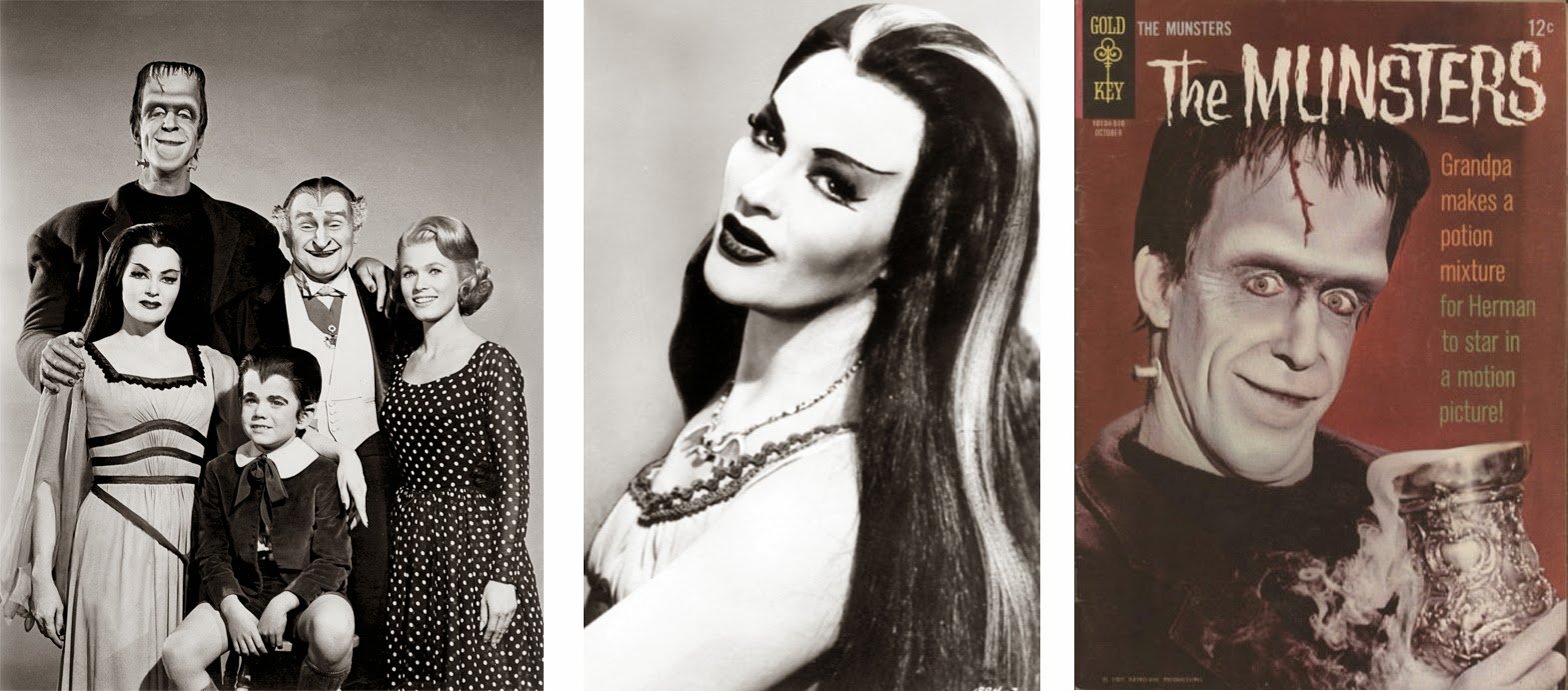
And I liked The Munsters as well ... by 1965, I was already a big fan of Famous Monsters of Filmland and I felt very clever knowing that the Munster family were all based on the classic Universal monsters. Fred Gwynne and Al Lewis had been in the earlier Car 54 Where Are You?, which I had been aware of but hadn't followed.

The Munsters were a typical American suburban family - except that they all looked like classic Universal horror film characters. I'm not sure which one Lily was meant to be, but I thought she was stunning when I was ten years old. And there was the Gold Key comic to scour the newsagents for, as well.
Of course, I much preferred them as The Frankenstein Monster and Dracula than as two bumbling New York police officers. I also loved the way the gorgeous Pat Priest as Marilyn Munster was seen as hideously deformed by the family. And, weird child that I was, I thought there was something strangely attractive about Yvonne de Carlo as Lily Munster ...

And the last pre-Batman show I especially enjoyed was The Avengers. Like all the shows I've mentioned here already, The Avengers managed to pack in elements of science-fiction, horror and fantasy, though it was - at least, on the surface - an espionage series, leading some fans to later dub it "Spy-Fi".

The chemistry between Steed (Patrick McNee) and Mrs Peel (Diana Rigg) added considerably to the  success of The Avengers. The Gold Key comic wouldn't come until 1969, as the US saw the show much later than us.
There had been spy shows before. Top Secret (with its infuriatingly catchy theme tune "Sucu-Sucu"), for example, and the grim and gritty Danger Man with Patrick McGoohan, but for kids of comic-reading age, The Avengers was the perfect television series. Stand-out episodes were the two Cybernaut segments, "The Maneater of Surrey Green" and of course the notorious "Touch of Brimstone" episode, featuring the beautiful Diana Rigg wearing a dominatrix corset in a bullwhip fight with the bad guy, The Honourable John Cleverly Cartney, played by soon-to-be cult actor Peter Wyngarde.

The "Cybernauts" episode was broadcast in the autumn of 1965. At the time I would have been unaware of Peter Cushing. My interest in Hammer films came a little later. But it had "giant robots, karate-ing everything". Mrs Peel didn't do much karate-ing in "A Touch of Brimstone", but then, she didn't need to.
Needless to say, the latter episode was aired quite a bit later at night and I had to plead with my mum to let me stay up and watch it. I can only imagine how uncomfortable she must have felt watching this with her 11 year old son - doubly uncomfortable because it would have just made it worse if she'd drawn attention to it by saying, "This is not suitable, off to bed with you." At the time I would have been completely oblivious to my mother's discomfort, though not to the not-inconsiderable charms of Miss Rigg in bondage gear ...

Much later, Chris Claremont would appropriate Wyngarde's persona from this episode as the basis for Jason "Mastermind" Wyngarde in his 1975 version of The X-Men and have him turn Jean Grey into a red-headed version of Mrs Peel as the "Queen of Sin".

Jason Wyngarde (a reinvented Mastermind) would turn up in X-Men 122  (Jun 1979) as head of the Hellfire Club, though his look would be based on the much later Peter Wyngarde character of Jason King, who played the second-lead in Department S and would spin off into his own, self-titled series.
But other than these shows, it was pretty slim pickings for a comic-reading kid in the first half of the 1960s. Our American cousins, however, were spoiled for choice by comparison ...

NOT IN THE UK, YOU CAN'T ...

During the late 1950s and early 1960s, US television was awash with shows that I would have loved back then. The king of these, which still holds up spectacularly well, was The Twilight Zone. With writers of the calibre of producer Rod Serling, along with Richard Matheson, Charles Beaumont  and George Clayton Johnson, it's little wonder that the series was a huge success. Why we never got it in Britain is anyone's guess. Thank goodness for DVD box sets ... the format was half-hour episodes which invariably ended with an especially clever twist ending. Kind of like EC stories on-screen but not as repetitive ...

A disturbing scene from the second season episode of The Twilight Zone, "Eye of the Beholder".
Rod Serling's iconic voiceover intros have since passed into pop-culture legend. You'll often hear people imitate his dry, clenched-teeth delivery without actually knowing where it came from ... and the writing was always tight, crisp and ever-so-slightly sinister:

"Suspended in time and space for a moment, your introduction to Miss Janet Tyler, who lives in a very private world of darkness, a universe whose dimensions are the size, thickness, length of a swath of bandages that cover her face. In a moment, we'll go back into this room, and also in a moment, we'll look under those bandages, keeping in mind, of course, that we're not to be surprised by what we see, because this isn't just a hospital, and this patient 307 is not just a woman. This happens to be The Twilight Zone, and Miss Janet Tyler, with you, is about to enter it." opening narration, "Eye of the Beholder".

In a similar vein to Twilight Zone was Outer Limits. Again, I have no recollection of this ever turning up on UK tv at the time. The format was slightly different - one hour episodes - but producer Joseph Stefano's writing team would include Harlan Ellison, Leslie Stevens and Stefano himself.

Robert Culp is surgically altered by a group of scientists to look like an alien - part of a plot to make the world think the Earth is imminent danger of invasion from outer space, which they think will force the hostile nations to unite and work together.
The episode "Architects of Fear" has been cited by some as Alan Moore's inspiration - oh, okay, swipe - for the ending of Watchmen. Other stand-out episodes were Ellison's "Soldier" and "The Zanti Misfits", by Stefano, who would also write the screenplay for Alfred Hitchcock's Psycho.

But these were both big-budget, networked fantasy shows that have been written about at length elsewhere. Since the 1960s, I've become aware of far more obscure shows that had used comics as the source material.

Flash Gordon was a half-hour adventure show from 1954 that featured Steve Holland, who later be the model for James Bama's iconic Doc Savage paperback book covers. The show was based on the King Features Syndicate newspaper strip of the same name, that had also been the basis for the 1930s super-serials. Though we didn't get the strip in UK newspapers, I was familiar with the serials during the 1960s.

Flash Gordon star Steve Holland was James Bama's model of choice for the Doc Savage paperbacks. This explains why Doc looks slightly older in Bama's covers than you might expect, as Holland would have been about 40 by this time.
As a syndicated show, this series was shot on the meagrest of budgets, and lasted just the one season, but I'd've loved it if it had been shown on UK tv. More recently, some of the episodes have been broadcast on UK satellite tv.

Another show from that era that popped up on a satellite channel was Sheena, Queen of the Jungle, starring the imposing Irish McCalla in the title role. Created by comics legend Will Eisner, Sheena was a kind of female Tarzan, who was the lead feature in Fiction House's Jumbo Comics from 1938 till 1953. She also enjoyed a run in her own quarterly comic from 1942 - 1953. 

In the end, Sheena Queen of the Jungle proved to be far more than just a female Tarzan knock-off. Surviving as the lead feature in Jumbo Comics from 1938-1953 was some achievement, and she also supported her own title for almost ten years. Actress Irish McCalla was Sheena come to life.
The tv show ran 25 episodes in 1955, and was quite racy for the times. McCalla was never going to win an Emmy for her performance, but her resemblance to the comicbook heroine was uncanny. I would have loved the show at the age of ten as, and I've noted this elsewhere in this blog, even at that age I had an eye for attractive heroines.

And because she is so impressive, here's a completely gratuitous triptych of portraits of the amazing Irish McCalla.
Many years later, Marvel Comics writers like Gerry Conway and Steve Gerber would remember Sheena, and include their own knock-off "Shanna the She-Devil" in Daredevil, then in her own series. One black-and-white strip, "The Wrath of Raga-Shah" from Rampaging Hulk 9 (June 1978), was quite risque and made such an impression on me in the 1970s that I built one of our regular UK Marvel Summer Specials around it.

After guest-star spots from Daredevil 109 on, Shanna became a regular if minor Marvel Comics character. Never really able to sustain her own series, the character was still a hit with 1970s teenagers like myself.
The other, higher profile, superhero series we never got in the UK was The Adventures of Superman. Starting in 1952, the syndicated series ran for six seasons, the last four filmed in colour, even though colour tv wasn't available in the US until 1965.

A couple of years earlier, National Comics had finally struck a deal, with Columbia rather than Republic, to produce a 15-chapter serial, Superman (1948). Kirk Allen was cast in the lead role as Superman/Clark Kent, with Noel Neill as Lois Lane and Tommy Bond as Jimmy Olsen. Vamping to the full, Carol Forman was the deliciously villainous Spider Lady.

Kirk Alyn made a pretty good Superman, better in my opinion than George Reeves. Carol Forman, veteran of several serials, made a slinky Spider Lady, Metroplis' Queenpin of Crime.
Columbia produced a second serial, Atom Man vs Superman, in 1950. Lyle Talbot was cast as the villain, Atom Man, who turned out to be Kal-El's arch-nemesis Lex Luthor. The serial included all of the comic book's tropes, including kryptonite, The Daily Planet and Lois Lane scoffing at the idea she could ever have suspected that mild Clark Kent might be Superman.

The villain Atom Man wore a metal bucket on his head so Superman wouldn't know who he was. All the comic book supporting characters were once again present,  Pierre Watkin (as Perry White), Tommy Bond, Kirk Alyn (here as Clark Kent) and Noel Neill.
The two serials were quite successful, so Superman editor and National's movie contact guy Whitney Ellsworth, starting looking round for another way to exploit DC's main character. Ellsworth struck a deal with Lippert Pictures and cast George Reeves as Superman/Clark Kent (after Kirk Alyn wanted too much money) and Phyllis Coates as Lois Lane in a b-movie length feature Superman and the Mole Men (1951). The idea was to have something to show the networks to demonstrate how a Superman tv series would look, but the running time meant it could be released on the movie circuits to recoup the expenditure if there was no interest from the broadcasters. In the end, National got the best of both worlds. The movie was released on 23 November 1951, and did reasonably well ...

"Full-length" is probably over-egging it a bit. The movie ran just 58 minutes and was later re-edited to form the only two-part story in the whole of Superman's 1950s tv run.
But before that even happened, Ellsworth had launched into production of the new tv series The Adventures of Superman, with the same cast (except for Jeff Corey who fell foul of HUAC and was blacklisted), in September 1951. But, unable to secure a sponsor, production had to shut down after a few weeks. Finally, a year later, National had convinced the sponsor of the Superman radio program Kelloggs to back the tv series and the show began its syndicated run on US tv in September 1952.

The first episode has Superman's father Jor-El trying to convince a sceptical Krypton council of the imminent destruction of their planet, but with his warnings falling on deaf ears, Jor-El is determined to save at least his infant son.

An uncredited Robert Rockwell played the part with steely determination in a cast-off costume from the Flash Gordon serial, Conquers the Universe. Aline Towne is Lara. And here's the original Flash Gordon costume before it was modified.
But when the tiny rocket lands on Earth, it's discovered by Eben (Tom Fadden) and Sara (Frances Morris) Kent, rather then the more familiar Jonathan and Martha. This was early days, after all. The Kents, first appearing in Adventure Comics 103 in 1946, only became established after the Superboy comic began its run in 1949, so the "Jonathan and Martha" names for the Kents weren't so familiar to audiences ... or tv script writers.

Tom Fadden also went uncredited by the producers for his role as Eben Kent, even though he was the one who pulled the infant Kal-El from the blazing rocket, whereas Frances Morris (like Aline Towne) was credited on-screen. I'm detecting a clear bias towards mothers.
The whole section of baby Kal-El arriving on Earth is dispatched in the first few minutes of the first episode of the show. The Smallville years are largely glossed over, except for Eben's death, and it's Sara who provides Clark with his iconic uniform.

Once Clark gets to Metropolis as Superman, the show had to face the thorny problem of his superpowers. The key challenge was making him fly. A few years earlier, the serials had tackled the problem by turning the long-shot figure of Kirk Alyn into a cartoon Superman and literally animating the flying sequences. It kind-of almost worked. But not really. 


The producers of Adventures of Superman took a different approach ... they had George Reeves take run across the set, jump onto an out-of-camera spring board and dive off the side of the frame. Then they'd cut to Reeves lying on a small platform with back-projected sky behind him. That, too, kind-of almost worked. But I know that today's audience would find it Plan 9 From Outer Space funny.

Many years later, the Christopher Reeve version of Superman was heavily marketed with the ad-line, "You'll believe a man can fly". At the time I couldn't figure out what the big deal was. After all, he was Superman, right? What I hadn't realised was that US audiences had grown up with George Reeves' springboard-bouncing take-offs and the moviemakers were worried audiences would be expecting the terrible flying effects of the television show.
But for the most part, this version of Superman was just an airborne strongman. The producers never addressed Superman's full set of superpowers. Occasionally, he'd use X-ray or telescopic vision, but hardly ever super-speed. At least not in the black-and-white shows that I've seen.

I very much liked the way Reeves handled the Clark Kent persona. Instead of the fake coward of the comics, Clark was quite rugged as the Daily Planet journalist. He'd often stand up to crooks in this identity, one time faking out a crook by jamming his steel-hard fingers in the guy's back to make him think it was a gun.

I quite liked Reeves' portrayal of Clark as a capable newspaperman. There was very little sign of the comic book's fake coward here ...
In this show, Clark was just as important a character as Superman, and more than once demonstrated that he could be a capable investigator. Consequently, there was little room for his supporting cast, lead by Phyllis Coates' Lois Lane to speculate that Clark could ever actually be Superman.

Mostly the crooks were just standard criminals in business suits. The black and white photography enhanced the show's noirish qualities. The supporting cast were strong, featuring Jack Larson as Jimmy Olsen, Phyllis Coates as Lois Lane and John Hamilton as Perry White. Coates would be replaced by the serials' Noel Neill from season two onwards.
What the tv show didn't have that the comic books had was ongoing villains. Mostly Superman battled none-too-bright thugs in business suits - not unlike some of the earlier superhero serials. So there was no Trickster or Prankster or Lex Luthor to be seen anywhere in Adventures of Superman. In fact the first two seasons were quite noir-ish in their approach, a feeling enhanced by the back and white photography. Once the series switched to colour with the third season, we began to see a bit more whimsy and humour.

The series was an instant success, even though it was syndicated rather than backed by a major network. This meant that stations across the US could take or leave the show depending on whether the station manager and his audiences liked it, and not have it forced on them through a network contract. Even with that, Adventures of Superman was a smash hit, George Reeves became a huge star on the back of it and the show's catchphrases, such as "Is it a bird, is it a plane?" and "faster than a speeding bullet", entered the US zeitgeist. So massive was the success that Reeves as Superman was a guest star on the phenomenally popular I Love Lucy tv show in January 1957.

Though I Love Lucy was the top-rated comedy show on US tv, with ratings of about 50 million, Superman was played straight, as though he was a real person with real super-powers..
Even though the Superman show lasted just six seasons - the final four really being just half seasons with only thirteen episodes, it ran in syndication well into the late 1960s and beyond. All the more incredible, then, that we never got Superman on tv in the UK during the show's run.

So I was left wishing just as hard as I could that I'd be able to see a "real life" superhero either on television or in the movies. At that age, I had never heard the proverb that says, "When the gods want to punish us, they give us what we wish for". So little did I know that in the spring of 1966, shortly before my twelfth birthday, I would get my wish ...

Next: THAT tv show ...


STOP PRESS  +++  STOP PRESS  +++   STOP PRESS  +++   STOP PRESS

A couple of posts back, while examining the artwork for the trademark Marvel Comics corner box, I was speculating on the origins of the Kirby Sub-Mariner figure used on the later Tales to Astonish covers. I chanced across the solution recently, and I've added the info to the original post. Have another look at the post and learn what I learned ...


Sunday, 1 June 2014

The Sincerest Form of Flattery

AT THE BEGINNING OF THE 1960s, there was no doubt that DC Comics were the undisputed sales champions of the comics business. Although slightly outsold by Disney's Uncle Scrooge title (854,000 per month), Superman (820,000) and related titles held seven of the top ten positions in the sales chart. The highest seller in Stan Lee's stable of soon-to-be Marvel Comics was Tales to Astonish at 185,00 a month. Today, of course, any publisher would have palpitations at the thought of that kind of monthly sale, but back in 1961, it was strictly small potatoes. To say that Marvel were a distant second would be overstate things. Outselling Marvel publisher Martin Goodman's titles by multiple margins were books from Dell, Archie and Harvey ... pretty much in that order.

This is the top ten selling titles for 1961, in chart order - not a Stan Lee title in sight.
Given those kinds of sales figures, DC Comics could be forgiven for feeling a bit smug. The sales on their Superman family of titles were solid, boosted in part by the popular Adventures of Superman tv show. DC's second string of characters - Flash and Green Lantern - were also enjoying strong sales, thanks to the sleek makeovers they'd had from editor Julius Schwartz and his stable of top-notch pencillers Gil Kane and Carmine Infantino and - probably more importantly - the smooth inking styles of Joe Giella and Murphy Anderson. They couldn't even see Stan Lee in their rearview mirror.

But that was about to change. Early in 1961, Marty Goodman had heard, possibly from DC publisher Jack Liebowitz (accounts vary), how well DC's new title Justice League of America was doing saleswise. The comic collected all of Schwartz's second string characters plus other DC third-rankers like Green Arrow and Aquaman and teamed them in book-length adventures. Goodman immediately ordered his editor Stan Lee to produce a copycat book starring his Golden Age big three - Captain America, Human Torch and Sub-Mariner. But at this point in his career, Stan had realised that Goodman's imitation tactics had created no boost to sales whatsoever, and that slavishly copying other publishers' ideas was getting Marvel nowhere. The story of how Lee - on the verge of quitting the business - was persuaded by his wife to do as Marty asked, but do it his own way is detailed in my previous blog entry. Stan gave Marty his supergroup, but included only The Human Torch in the line-up - and then took a chance and wrote what he would want to read if he were a comic buyer. The result would have an impact on DC's sales in just a few years.

In a different blog entry, I'd questioned why FF artist Jack Kirby - who claimed he alone had created and written the Fantastic Four stories - would put The Sub-Mariner in issue 4 when the copyright was likely held by Bill Everett. On reflection, one possible explanation might have been that Goodman hauled up Lee and demanded to know why The Sub-Mariner wasn't featuring in their new superhero team book. So Lee directed Kirby to include Subby in issue 4 so as to have something to show his publisher.

Lee and Kirby revamped Golden Age hero The Human Torch as a member of the Fantastic Four, as per publisher Martin Goodman's instructions, but balked at putting Captain America and Sub-Mariner in the team. Shortly afterwards, Prince Namor was introduced as a villain, possibly to stifle Goodman's complaints.

MUST BE DOING SOMETHING RIGHT

The comics business has never been an industry to spend money on advertising or marketing. Usually, they've just created a title, delivered it to the newsstands and crossed their fingers. And that had always worked just fine. Kids bought comics based on whether they'd heard of the character - Superman, Tarzan and Disney characters being the most recognised - or if their friends told them a comic was good. In 1960, the best-selling comics were Disney stuff, Tarzan and Superman, based on the sales figures reported in 1961. But as the 1960s progressed, something strange started to happen. The average sales of DC Comics went into freefall and Marvel's began a relentless upward climb. And all this by word-of-mouth.

Okay, not only word-of-mouth.

As big a threat to comics sales as television was, it had also proved to be a boon - sort-of. Comics have always been a source of material for both big and small screen entertainment. During the 1930s and 1940s, Hollywood constantly looked to comics - both newspaper strips and comic books - for characters to license. As early as 1936, newspapers' Flash Gordon starred in three successful movie serials, quickly followed by the similar Buck Rogers, Jungle Jim, Mandrake the Magician, Adventures of Captain Marvel, Batman, Captain America and Superman. As the serial era wound down, Hollywood found that television could make low-budget entertainment even cheaper, and some characters, like Jungle Jim and Superman switched to tv.

The Adventures of Superman was filmed in black and white from 1952 and went to colour in 1954. However it would be a good few years before the tv audience was able to see Superman in blue, red and yellow, as the show wasn't transmitted in colour until 1965.
Starring George Reeves as Superman/Clark Kent, The Adventures of Superman made its debut in 1952, tightly controlled by DC comics and distributed via syndication rather than by the more common network method. Though production ceased in 1958, the show continued in syndication until well into the 1960s, and was the main factor in keeping the profile of the character and the sales of the main Superman comic title high. Even as late as 1967, Superman was outselling Amazing Spider-Man by almost two-to-one.

This process would be repeated in 1966 when the Batman tv show (I know, I know) increased the sales of DC's Batman comic by 100%. However, the effects on comic sales was much shorter lived for the Batman comic than it had been for Superman. By the third season, sales had dipped down almost to pre-tv show levels and by 1968, Amazing Spider-Man was outselling Batman.

However, even as early as 1964, the sales figures must have been making DC accountants feel uneasy. Marvel was already rapidly closing the gap on rivals DC and by 1965 had equalled DC in average sales. And that with just the 16 titles they'd been limited to by the draconian distribution deal Jack Liebowitz had forced Marty Goodman to sign in 1957.

Something had to be done. So DC did it. They gave us Go-Go Checks.

Words fail me ...
Go-Go Checks were introduced on all DC Comics at the end of the year in 1965. For anyone not familiar with the phenomenon, DC simply added a band of black and white checks to the top of every cover in their line. That's it.

Yes, there's Go-Go Checks. But nothing else had changed. The cover themes were as daft as ever, and were still driving (sometimes very awkwardly) the stories inside. Even at 11 I felt DC just didn't "get it".
Now I'm probably biased, because by 1965, I was a die-hard Marvel reader. Even at the age of 11, I could tell that Stan Lee's stories in the Marvel books were far more sophisticated and interesting than the kids' stuff that DC were offering. In all fairness, the eight-year-old in me still has a fondness for the Weisinger-inspired silliness of the Superman family titles, but all-in-all I was over that by 1965 and was instead devouring the Lee-Kirby Fantastic Four stories.

The companies' flagship titles, the month that DC added Go-Go Checks. Marvel was offering us Fantastic Four vs Galactus and the Silver Surfer. DC had Superman changing into a dragon and scaring some college professors.
Which makes it all the more astonishing to me that the DC management weren't able to see that it would take more than some "trendy" livery on their covers to combat the threat of Martin Goodman's jumped-up comics company. In 1964, Liebowitz had been smart enough to see that a radical overhaul of the Batman titles was needed to bring the character out of its sales slump and save Batman from cancellation and oblivion. So how come he didn't understand that it was Lee's whole creative approach that was elevating Marvel's circulation and positioning them to take over as the market's sales leaders? I guess we'll never know.

The Go-Go Checks lasted from April 66 till July 1967 and all during that period, DC's top-selling comic stuck doggedly to the outdated and rather boring Weisinger-style stories. You could argue, "If it ain't broke, don't fix it." But the formula was broke. DC just hadn't realised it yet.

During the 15 months that the DC comics sported the Go-Go Checks, and even after, the Superman stories followed the same formula that editor Weisinger had enforced for the preceding ten years, a melange of lost superpowers, secret identity threats and even jokey (if slightly offensive) body-shock situations.
By contrast, Marvel's whole approach could not have been more different. Certainly, Jack Kirby was responsible for much of the "sense of wonder" that permeated the Fantastic Four and Mighty Thor titles. But even Stan Lee and his Spider-Man collaborator John Romita were presenting far more interesting and mature situations for their hero than anything DC was doing.

By contrast, the Lee-Romita Spider-Man title presented genuine threats and life-changing events for their most popular character. Readers were given a real sense that Spider-Man was in danger of physical harm.
It was DC's failure to update their out-moded story styles for a new, more savvy generation of comics readers that lost them their sales lead. By mid 1967, DC's total monthly sales were trailing Marvel's by almost a million, around 13% behind their rivals. It was only going to get worse for DC from here. The Go-Go Checks hadn't helped one bit. And while DC were consciously not imitating Marvel Comics, there were others who were.

THE C LIST

In the mid-1960s, especially in the UK, us kids really only bothered with two types of comics - Marvels and DCs. Of course there were quite a few other companies, but DC had the big names and Marvel had Lee & Kirby. Archie was huge in the States, but never made much of an impact on us in Britain. It was just too, well, American for us. We liked the tall buildings, the cool cars and cops with guns, but the high school antics of Archie never appealed to me or to the kids I went to school with.

Archie Comics had tried - almost half-heartedly - to develop a line of superheroes as early as 1959, when they engaged Joe Simon and Jack Kirby to produce The Double Life of Private Strong and, shortly after, The Fly, forming the backbone of the "Archie Adventure Series".

Although on the surface, The Shield appeared to resemble Captain America, the Golden Age character actually pre-dated Simon & Kirby's patriotic hero. This revamp, ironically by S&K, was more like Superman than Cap.
The Double Life of Private Strong featured the Archie-owned Golden Age character The Shield, revamped with an new civilian identity and backstory. In this version The Shield was Lancelot Strong, who'd been given superhuman abilities by his scientist father. When communist agents killed his dad, Strong was adopted by a rural couple, discovered his powers in his teens and adopted a bumbling, timid persona to conceal his abilities. Superman publishers DC Comics didn't like the sound of that very much and, under threat of legal action, Archie cancelled the title after two issues. But also in Double Life of Private Strong 1 was a two-page strip featuring The Fly, also by Simon & Kirby.

The artwork for The Fly seems quite a bit more old-fashioned than Kirby's concurrent work over at Atlas/Marvel. Perhaps this was due to Simon's influence. Weirdly, the cover to issue 3 looks more like it was drawn by Mike Golden in the early 1980s than by Simon & Kirby in the late 1950s.
Two months after the debut of Private Strong, Archie publisher/editor John Goldwater launched The Adventures of the Fly, with Simon & Kirby again providing the finished package. The Fly was in reality teenager Tommy Troy who finds a fly-shaped ring in his home's attic. Rubbing the ring, he transforms into an adult superhero.

The character started as a pitch to Harvey Comics back in 1953. In his book, The Comic Book Makers, Joe Simon described the genesis of the character: "In 1953, a year before the devastating Senate investigation into comics, I was visited by C.C. Beck, the artist behind the success of Captain Marvel. Beck told me that he owned the Ukulele Bar & Grill in Miami, Florida, and while tending the bar, often thought about doing another superhero. He offered to 'take a crack' at the business again, if I would come up with an idea for a new character and a script.

"Jack Oleck, my brother-in-law, who had been the number one scriptwriter for Simon and Kirby since the early days of Young Romance, had time on his hands. Oleck always had time, even if he turned out a script seven days a week. As always, he was anxious to join in a new venture."

The first page of a Silver Spider script by Jack Oleck, discovered amongst papers in Joe Simon's apartment.
Simon's idea was for a character called "Spiderman", and he asked Oleck to come up with an origin. In Oleck's pitch, orphan Tommy Troy is adopted by a strange elderly couple and finds a strange ring in their attic. When he rubs the ring, a genie appears to offer one wish. Tommy wishes he were a superhero. Joe Simon changed the name to The Silver Spider and took Beck's sample pages to Harvey. Editor Sid Jacobson thought the pitch was "old-hat" and "a take-off on The Green Hornet", so the series didn't sell. Simon later revived the idea for Archie's Goldwater as The Fly.

The origin of the Silver Spider, created by Joe Simon and C.C. Beck, scripted by Jack Oleck and drawn by Beck. The concept failed to sell to Alfred Harvey in 1953 and was shelved immediately afterwards. Jack Kirby had no involvement.
In later years, particularly in a lengthy interview in The Comics Journal 134 (Feb 1990), Kirby would claim he and Joe Simon came up with the idea for Spider-Man, originally called The Silver Spider. It's possible that Kirby was misremembering his work with Joe Simon on The Fly as some kind of early pitch to Stan Lee for what became Spider-Man. And if that's not the case, then Kirby's claim to have had a hand in the creation of Spider-Man would have amounted to him pitching other people's work to Stan.

In any case, Simon & Kirby stopped working on the title after The Fly 4, and Kirby gave his full attention to freelancing for Marvel. The writing on The Fly was taken over by Robert Bernstein and the art fell to John Giunta and later John Rossenberger, seasoned professionals all. Bernstein had been a staple at DC, scripting many first and second tier characters, like Superman, Jimmy Olsen, Congorilla and Aquaman. Stan also gave him a shot at Marvel where he wrote stories for Thor (Journey into Mystery 92-96), Iron Man (Tales of Suspense 40-46) and Human Torch (Strange Tales 108-109), though I thought those issues were the dullest of the early runs. Lee must have agreed, because he took back the scripting on those titles and Bernstein was gone. Giunta was known primarily for inking Superboy, Jimmy Olsen and Wonder Woman stories for DC. Rosenberger had drawn romance stories for DC and mystery stories for ACG. The remainder of the run on Adventures of the Fly was unremarkable and the series was cancelled in 1964.

The other title in the Archie Adventure Series was The Adventures of the Jaguar. The character's origin was remarkably similar to The Fly's. Zoologist Ralph hardy finds a "nucleon energy" (that's magic) belt in a hidden temple in Peru and on putting it on, is tranformed into ... The Jaguar. As the Jaguar he has all the abilities of the animal kingdom, multiplied by a factor of a thousand. With stories again created by Bernstein and Rosenberger, the comics didn't set the world alight, but still managed to stay on the stands from September 1961 until the 15th issue in November 1963.

The Jaguar had an origin story that was suspiciously similar to that of The Fly's. Way too much reliance on magic artifacts and abilities that mimicked those of animals.
But in 1965, Archie publisher Goldwater thought he saw an opportunity. He had been watching the rise and rise of Stan Lee's Marvel Comics and figured, "How hard can it be?" He hired Superman co-creator Jerry Siegel to revamp all of his superhero properties into one line of comics, The Mighty Comics Group.

Starting with The Fly, Siegel morphed him into Fly Man and pitched the writing style as a bad pastiche of Stan Lee, mixed with the hokiness of the Batman TV show, albeit nearly a year before the Caped Crusader hit the airwaves. To further beef up the appeal, Siegel included additional superheroes teamed up to help Fly Man battle The Spider, including Golden Age MLJ characters The Comet and The Black Hood, as well as a revamped version of The Shield ... and of course Fly-Girl - not to be confused with the later dance troupe that shot Jennifer Lopez to fame. At the end of the story, the heroes wonder if they should form a super-team called The Mighty Crusaders and continue to fight crime.

Siegel's run on Fly Man was a pretty cynical attempt to ape the success of the superheroes in Stan Lee's Marvel Comics. Toward the end of the run, Archie Comics took to featuring the heroes in a corner box that was a bit too similar to the established Marvel trademark cover box.
Of course ... they did. So much so that as well as starring in Fly Man's comic, The Mighty Crusaders got their own title. As with the Fly Man stories, art was by Paul Reinman. Reinman's notable achievements were a long run as artist on the Golden Age Green Lantern character, then contributing art for the fantasy, war and western tales in Marvel pre-hero titles for years, at the same time as freelancing for ACG. Later, Reinman would ink Kirby's pencils on Fantastic Four 18, 19 & 21, Avengers 3 & 5 and X-Men 1-5.

The covers of the Archie Mighty Comics line went out of their way to look like they were published by Marvel. The story titles in particular tried to capture Stan's sense of melodrama.
To further ram home how hard Archie were trying to fool readers into thinking their comics were as good as Marvel's, they took the branding one step further and re-titled Fly Man "Mighty Comics Presents", making the books resemble Marvel's anthology titles Tales of Suspense, Tales to Astonish and Strange Tales, rotating the characters on the covers and even using a split cover on issue 42.

At the end of its run, the format of the final issue Mighty Crusaders changed to feature just the one character, foreshadowing the run of Mighty Comics Presents that followed right on its heels.
The trouble with the Mighty Comics Group was just ... their comics weren't very good. I remember reading a couple when they came out and even my 11 year old mind could figure out that this stuff was just a bad copy of Marvel Comics. And they've not stood the test of time very well, either.

To give you a taste, here's a bit from Mighty Comics Presents 40 (Nov 1966), with The Web battling Iron Fist. Who actually has iron fists. Made of iron. The Web is enjoying a good fight with his enemy Iron Fist for reasons that are never explained. Then, Iron Fist's costume goes out of control and he asks The Web to help him. Like they're suddenly best friends.

Pages 3, 4 and 6 from the first issue of Mighty Comics Presents.
Read the extract and make up your own mind.
Later, when the Web gets home, his wife Rosie gives him a hard time for dressing up in a superhero costume and fighting bad guys. We know she's called Rosie because the Web mentions her name in every speech balloon. The Web's civilian name, on the other hand, remains a mystery until page 7 (not ideal as this is the first issue), when Rosie finally calls him by name. When The Web (John Raymond, by the way) doesn't give up being a superhero, she leaves him. To get her to come back, he has to promise not to fight as The Web again.

Finally, Iron Fist attacks John and Rosie and The Web honours his promise to his wife. Iron Fist is so upset that The Web won't fight that he gives up being a super-villain and leaves.

All of this portrayed with horrendous dialogue by the legendary Jerry Siegel.

It's hard to imagine what Siegel was trying for. Funny? It really wasn't funny. Satire? Satire should be cleverer. Other than Paul Reinman's workmanlike art, there just doesn't seem to be any talent going into these stories. In fact, it's a bit sad to see the great Jerry Siegel - the guy who wrote Superman, for goodness' sake - reduced to this. It's a bit like watching Bela Lugosi in an Ed Wood movie.

Mercifully, John Goldwater cancelled the Mighty Comics series with issue 50, cover dated October 1967.

SOME KIND OF TOWERING ACHIEVEMENT

Wally Wood had contributed the pencil art for Marvel's Daredevil, issues 5-8, (and by definition the plotting/pacing) but had been unhappy about either Stan Lee criticising his storytelling or Stan having Wood plot the stories while Lee took the payment and the credit. I kind of lean more towards Wood's lack of ability to work from anything other than a full script (as he did at EC), as his storytelling on Daredevil was quite weak. I'd also add that I don't think that Wood, brilliant as he was at EC science fiction, was very good at superhero action. For issues 9-11 of Daredevil, Wood inked over Bob Powell pencils.

So, after exiting Marvel, for whatever reason, Wood immediately teamed up with Len Brown and established the Tower line of comics featuring newly-created superheroes in an attempt to do what Stan was doing back at Marvel.

Len Brown had been a creative editor at Topps Chewing Gum from about 1959. In 1962 inspired, legend has it, by Wally Wood's cover art for Weird Science 16, Brown pitched an idea for a set of cards that would depict the Martian invasion of Earth.

I liked the cover for Weird Science 16 so much that I asked artist John Ridgway to do a pastiche of it for the cover of Marvel UK's Transformers 2, when I was supervising editor on that title back in 1984.
Brown hired Wood to produce a series of concept sketches, Bob Powell to pencil the art for the cards and Norman Saunders to render the art in a fully painted style. The result was Mars Attacks, one of the most notorious of all trading cards sets. It's interesting to note that when Wood struggled to produce pages for Daredevil that matched Lee's expectations, Bob Powell was the artist drafted in to help out. It's not known whether this was Wood's doing rather than Lee's, but it was probably a match made in heaven given the artists' prior history on the Topps project.

The design influence of Wood's Weird Science cover can be seen on the design of the gum card Martians. The card set scandalised suburban America and Britain during the 1960s, due in no small part to Wood's subversive sense of anarchy.
Even before Wood left Daredevil, he was talking to Brown about a possible new series of comics. They'd first discussed the concept of a group of superheroes working together for a government organisation in 1964. A year later, with Wood already dissatisfied with the way things were going at Marvel, he asked Brown to write a 12-page outline for the series. "I submitted a Captain Thunderbolt story in which he fought a villain called Dynamo," recalled Brown. "I had always loved the old Phantom Empire serial with Gene Autry in the 1930s. I remembered that the Thunder Riders were agents of the evil queen in the serial. I loved the name, the Thunder Riders, so I recommended 'Thunder Agents' to Wally."

Wood had been casting around for a property he could offer to Tower Publications' managing editor Harry Shorten. Shorten had been an editor for Archie/MLJ during the 1940s and in the 1950s had started his own publishing company, producing television magazines. Shorten wanted Wood to be the editor for his new line of comics, but stressed that Wood would be strictly creative, and wouldn't have to do the boring officework part of the editor's role. When it became obvious that Wood couldn't handle the art by himself, Shorten brought in long-time Archie artist Samm Schwartz as a production editor to handle trafficking. Gil Kane, Steve Ditko, Reed Crandal, Chic Stone, Sal Trapani and others produced art and the series was off and running.

The T.H.U.N.D.E.R. Agents title managed a respectable three year run, from Nov 1965 to Nov 1968, doing better than the Archie line of superheroes.
What set the Tower Comics apart from the beginning was that they were all 68-page, 25c books, which made them an attractive, if pricey, read. The core title was  T.H.U.N.D.E.R. Agents, an anthology comic which featured Dynamo, NoMan, Menthor as well as the heroes fighting together as T.H.U.N.D.E.R. Agents. Two spin-off titles, Dynamo and NoMan, followed, but were short-lived. Tower also published some war, teen and funny animal titles, but I have no recollection of those at all.

With the cover of Dynamo 4, it's hard to tell whether Wood was being ironic or had just given up trying to think of new ideas. NoMan lasted just two issues and the other titles made little or no impact. The Tippy Teen title was very much an Archie knock-off, featuring art by Archie contributors Samm Schwartz and Dan DeCarlo.
I remember seeing the Tower comics at the time in 1965 and thinking that the art was nice but the stories were a bit boring. The scripts were written by Len Brown, Larry Ivie, Steve Skeates, Lou Silverstone, Bill Pearson and others. And none of these guys seemed to grasp what it was that made Lee's Marvel books different from the Competition, Distinguished or otherwise. The writing just has no pizzazz, no enthusiasm. It's hard to imagine anyone reading these stories and being entertained. I wasn't.

And I couldn't have been alone because after 1968. Tower Comics pretty much closed its doors and left the field to Marvel, DC and Charlton.

THE D LIST

In 1965, American Comics Group (ACG) decided that they too would have a crack at superheroes. The company had long published a handful of war, romance and mystery titles, but were best known for Adventures into the Unknown (1-174, Fall 1948 - Aug 1967, Forbidden Worlds (1-145, Jul/Aug 1951 - Aug 1967) and Unknown Worlds (1-57, Aug 1960 - Aug 1967).

Their first hero was Magicman, who appeared in Forbidden Worlds 125 (Jan/Feb 1965). As Tom Cargill, Magicman is the immortal son of the 18th Century magician Cagliostro and, joining the army to fight in Viet Nam, uses his magical abilities to combat evil ... well, communists. The series was written by ACG editor Richard Hughes and had gorgeous, clean-line artwork by Pete Costanza, who had drawn many Captain Marvel stories during the preceding two decades.

The ACG heroes appeared at the beginning of 1965. Though not strictly a super-hero, Herbie's alter-ego The Fat Fury appeared around the same time as Magicman and Nemesis, so is not likely to have been just a coincidence.
ACG immediately followed Magicman with another occult hero, Nemesis. Debuting in Adventures into the Unknown 154 (Feb 1965), Nemesis was the spirit of detective Steve Flint who is murdered by the mob. Awaiting processing in the afterlife, Flint strikes a bargain with the Grim Reaper that allows him to return to Earth and avenge his own murder. A bit similar to DC's Spectre, really. The Magicman stories were also written by Richard Hughes and drawn in the main by Chic Stone.

For most of its existence, ACG comics had concentrated on horror and mystery stories. During the comics purge of the 1950s, ACG had survived by severely toning down the horror elements. They didn't dip a toe into superhero tales until 1965, which suggests Hughes, or more likely publisher Ben Sangor, had noted the success of Marvel's heroes and thought ACG should have some costumed heroes of its own. Hughes had created The Black Terror for Standard during the 1940s, along with Fighting Yank and Pyroman, so he had a track record. However, some ACG fans weren't happy with the move. In response to a reader complaining about the inclusion of a recurring character in Adventures into the Unknown 161, Hughes replied that it was "simply a matter of business. The popularity of costume heroes was such that we just had to go in for them to some extent ... our readers were demanding them."

DC had been publishing superheroes continuously since Action Comics 1, so it's unlikely Hughes is referring to the popularity of Superman and Batman, which at this point was in decline. Yet if it was Marvel who'd inspired him to create Nemesis and Magicman, why do the ACG scripts read more like DC material than like Lee's hip, informal yarns? Tellingly, after the cancellation of its titles and the closure of ACG in 1967, Hughes went on to script Jimmy Olsen and Hawkman for DC.

I think if Hughes had been savvier, he could have used Magicman to take some kind of stance on the Viet Nam conflict, which formed a background for the character's stories. Using the setting as a kind of Hogan's Heroes comedy scenario is a missed opportunity at best, and faintly offensive at worst.

DELL'S KEY WASN'T SO GOLDEN, EITHER

The other player that tried to muscle in on Marvel's (and to an extent DC's) turf was comics giant Dell. Founder George Delacorte had been there for the birth of the American comic book. When he collected a bunch of newspaper comic strips and put them into the first recognisable comic book, The Funnies, in 1933, he created an entire industry. In later years, Dell concentrated on licensed material, publishing huge amounts of Disney and Warner Bros material from their animated cartoons, along with iconic fictional characters from pulps and radio, like Tarzan, Lone Ranger and Zorro. Their tv tie-ins were legendary and many cult tv shows had a Dell comic - Man from U.N.C.L.E, Star Trek and Twilight Zone to name just three.

And their own originated characters enjoyed massive sales. Turok Son of Stone (a native American adventure book) outsold most DC titles during the early 1960s.

But when it came to superheroes, Dell didn't enjoy such a sparkling success. Their first forays into super-powered shennanigans were bland enough ... Nukla made his first appearance in late-1965 and Superheroes almost a year and a half later in early-1967.

Nukla was really CIA spy and pilot Matthew Gibbs. While flying a mission over Communist China (surely a breach of some kind of international protocol), his plane is fired upon by the Chinese military and is instantly vaporised by the resulting nuclear explosion. We might argue that it serves him right, but he does gain the ability to reassemble his body through sheer force of will and can now perform amazing nuclear-powered deeds, provided he can first de-materialise his body into an intangible nuclear cloud. To be fair, Nukla wasn't terrible. But it wasn't great either. A bit like Captain Atom, without the great Steve Ditko artwork.

The Superheroes featured a team called The Fab Four (familiar, much?), teens who find themselves able to transfer their minds into four super-powered androids - El (laser, infra-red and x-ray powers), Polymer Polly (speed and heat resistance), Hy (hypersonics) and Crispy (cryogenics). Like Nukla, Superheroes was written by Joe Gill and drawn by Sal Trapani. But where Trapani's art on Nukla is neat and ordered, similar to the DC comics by Gil Kane and Infantino, the art on Superheroes is chaotic and messy. It looks to me like Trapani was trying to emulate the dynamic layouts of the Marvel comics but not quite pulling it off ...

Trapani was the brother-in-law of longtime Charlton inker and editor Dick Giordano, drawing science fiction strips for Charlton during the 1950s. In the 1960s, he provided art for ACG and Warren, and moved to DC, along with Giordano in the 1970s, finally fetching up as an inker at Marvel during the 1980s.

Nukla isn't an especially bad comic ... it just isn't very good, either. The Superheroes, on the other hand, defies description of just how awful it is. And that's being kind.
Joe Gill had enjoyed a long stint at Charlton Comics, where he'd co-created Captain Atom, Peacemaker and Judomaster. Credited by Mark Evanier as probably the most prolific scripter in comics, Joe Gill began by scripting Captain America after the departure of Simon & Kirby from Timely in 1942 and continued writing western and teen stories until around 1948, when the industry went into a post-war downturn. Gill landed at Charlton and worked there almost exclusively right through till the 1970s. He also did much colouring work for Charlton.

As bad as these Dell superhero titles were, they looked like literary gold compared to the next adventure offerings from the company. Dracula, Werewolf and Frankenstein were an attempt by Dell to turn the Universal Monsters into superheroes. It didn't work.

With scripts by Don Segall and art by Bill Fraccio and Tony Tallirico, these superhero adventure stories were cringingly bad, both in concept and execution.

Just when you think it can't get any worse ... Dell tries to turn the Universal movie monsters into superheroes.
Dracula was a modern-day descendent of the original Count Dracula, researching into a cure for brain damage using bat blood. Exposure to his experimental serum gives him bat-like abilities and he moves to America where he adopts the secret identity of Al U. Card. See what they did, there? Incredibly, even though Dracula lasted just three issues, Dell thought it was a good idea to reprint the entire series in 1972. I don't think it would have sold any better than it had in 1967. It's pretty inept stuff, even if Dell were aiming it at non-discerning eight year olds.

Frankenstein was created in 1866 by a scientist known only as The Doctor, The Monster has superior intellect and the strength of 50 men. He lies dormant for 100 years below a castle outside Metropole City, until awoken by a convenient lightning bolt. To disguise his monstrous appearance Frankenstein puts on a rubber facemask and takes the name Frank Stone (sigh!)

Werewolf has Major Wiley Wolf (honest, I'm not making this up) crashing his aircraft in the Arctic Circle, developing amnesia and becoming like a wild animal, as he lives with a pack of wolves for six months in the Canadian wilderness. After being rescued, he resigns from the Air Force and joins the CIA, who train him to the peak of physical perfection and ... It's no use. I can't go on.

Don Segall had written for DC and Tower Comics was probably best known as the co-creator, with Steve Ditko, of The Creeper. By the 1970s, he'd moved into television, where he enjoyed a similar level of success as a writer and producer, contributing single scripts to shows like Diff'rent Strokes and Love Boat. Fraccio and Tallirico were a long-time double act who frequently worked under the collective name of Tony Williamson or Williamsune and enjoyed a long stint at Charlton Comics and later at Warren, contributing art for Creepy, Eerie and Vampirella. Their art was never great and they never aspired to be anything other than jobbing artists who would deliver competent work - when circumstances allowed - on time for a reasonable rate.

After the failure of these books, Dell pretty much stuck to its core strength of movie, cartoon and tv tie-ins until closing its doors in 1973.

WHAT IS SO HARD?

It's a good deal easier to figure it out with the benefit of hindsight, but it's still pretty incredible that so many smart, experienced publishing people were unable to see the obvious. The secret of Marvel's success in the 1960s wasn't really a secret at all. Stan Lee put it all out there on show, so with a little bit of thought, anyone could figure it out.

It wasn't just putting an eye-catching branding idea on the cover. Yes, Marvel had the trademark corner box on the cover ... but so did Mighty Comics, and look what happened to them. DC Comics tried their own version with the Go-Go Checks. But if that's the only change you're going to make, then that's not going to alter the direction of your sales figures. 

It wasn't just publishing stories where the character had a glib line in dialogue. True, DC characters all talked like your humourless and slightly boring uncle, but Archie tried jokey dialogue with their Fly Man and Mighty Crusaders comics (admittedly bad jokey dialogue) and that didn't work either. 

And it wasn't Jack Kirby alone. DC had had Jack Kirby both before and after Marvel - his runs on Green Arrow and Challengers hadn't been tours de force of sales and read just like any other DC comics of the time. And don't get me started on the "Fourth World" stuff. I wasn't a fan at the time, and re-reading those books more recently confirmed my worst fears. No matter what Jack claimed ... he couldn't write. I love him to bits as an artist and an ideas man, but a writer he was not. And in case you think it was the DC editors holding him back, just look at those early Archie Adventure Comics with his legendary partner Joe Simon.

No, what made Marvel Comics special was the Voice that Stan Lee brought to them. It was the way his characters talked, each with his own personality. Even if you couldn't see the pictures, you'd be able to tell if it was The Thing or Spider-Man speaking. It was also the way his characters reacted to the extraordinary circumstances they found themselves in - mostly with shock and surprise, just like we would if it were us. Even the innocent bystanders in Marvel comics often refuse to believe what was right in front of their eyes, claiming that an invasion of New York by Galactus must be some kind of advertising stunt, which is exactly how people in the real world would react.

And, as I've covered in detail in other entries in this blog, Stan sought to extend that real world informality to his letters pages and his Bullpen Bulletins.

It was all those factors, working together, that separated Marvel from DC, ACG, Archie and Dell. And it was the fact that Stan had talent as a writer, and had his characters drive the plots, that made his stories speak to the readers in a way they could relate to. Every other superhero series I've looked at in this entry did exactly the opposite. Contemporary comic characters like The Web, Superman and Dracula all sounded pretty much the same - no personality, no unique voice, no characterisation - and existed only because of the demands of the plot.

Today comic readers take characterisation for granted. Customers expect a much higher standard of writing than the companies were prepared (or able to) to offer during the formative years of the 1960s. So today, it's not uncommon to see writers of the caliber of Joss Whedon, Michael J Straczynski and Kevin Smith writing scripts for comics. But back then, there was only Stan, trying to raise the standards, all by himself. It just took the industry a decade to catch up with him, as first Roy Thomas, then other decent writers like Len Wein, Marv Wolfman and Tony Isabella filtered into the business, all heavily influenced by the work of Stan Lee.

Next: Superheroes on the 1960s screen