Sunday, 31 March 2019

Bullpen Bulletins: Stan Gets Political

BACK IN THE MID 1960s, just as I was in the process of becoming the Marvel Fanboy I remain to this day, we didn't have comics websites, or YouTube videos or even mimeographed comics fanzines to tell us what was going on. All we had was Stan Lee's ingenious "Marvel Bullpen Bulletins", giving us glimpses inside the Marvel offices and snippets of information about what we could expect to see this and next month from Marvel.

The very first published Marvel Bullpen Bulletins page, from Journey into Mystery 122 (Nov 1965). At the time, Stan was making announcements about various Marvel Comics in text boxes, often yellow, on the various letters pages. This would be replaced by the Bullpen page, but the earliest examples appeared to be a mix of the two.
The Bullpen page made its debut in Journey into Mystery 122 (Nov 1965), which was on sale on 2 Sep 1965. This was a week before the December issues of Fantastic Four and Amazing Spider-Man, often cited (wrongly) as carrying the first Bullpen Bulletins page.

As with the other Bullpen pages of this early period, the Journey into Mystery page was customised for the title, showing an image of Thor where the other pages displayed different characters. For example, the Amazing Spider-Man Bullpen page in issue 31 gave us The Green Goblin. And, of course, it's a Thor tee-shirt in the merchandise section.

But more than that, the Thor Bullpen page appears to have been prepared so early that the corresponding letters page also carried a few announcements, boxed out in yellow, and not just about Thor. For example, they reveal that we can expect more Marvel merchandising in the wake of the tee-shirts and a "brand new gizmo that's sure to sweep the nation". I haven't managed to figure out what that is, yet. Stan also tells us that the last two Marvel bi-monthlies - X-Men and Daredevil - were moving up to monthly publication, and closes out the letters column with a lengthy teaser about the next issue of Journey into Mystery.

Meanwhile, in the adjacent Bullpen Bulletins, Stan reports that Joe Sinnott, whose inking work was last seen in Fantastic Four 5 (Jul 1962), has rejoined Marvel, working on "Agent of Shield", inking Fantastic Four (from 45 on) and "doing as many other features as we can straddle him with". I think you may have meant "saddle", Stan ... straddle is something else entirely.

Despite the Bullpen Bulletins page promise, Joe Sinnott managed few Marvel art assignments before becoming enmeshed in his regular inking work on the company's flagship title Fantastic Four.
As it turned out, Sinnott only contributed art to two issues of Strange Tales' Agent of SHIELD ... 139, where he provided finished art over Kirby's layouts, and 140, where he inked over Kirby layouts and Don Heck pencils. The other featured Sinnott was "straddled" with included just inks for the cover and interior art of X-Men 13 (Sep 1965), before embarking on his long run inking Fantastic Four from 44 (Nov 1965) onwards. What the Bullpen Bulletin story doesn't tell you is that Sinnott continued to pencil and ink for his long-term assignment Treasure Chest until issue 496 (Jul 1972), ending an 11½ year association with the title.

The second item in this first Bulletin reveals that Adam Austin, penciller on the Sub-Mariner feature in Tales to Astonish is not the artist's real name. This came as a shock to me when I retrospectively read this piece of news, as I had been comparing "Austin's" work with Gene Colan's and deciding that I like Colan's better. Of course, I was 12 at the time with little perception of how an inker can improve (or not) a penciller's work, so I was likely comparing the Vince Colletta inked Adam Austin work in Astonish with the Jack Abel inking of Gene Colan in Suspense.

Gene Colan "took over" from Adam Austin with Tales to Astonish 80 and Tales of Suspense 78 (both Jun 1966).

Compared to You Don't Say, the gags in Monsters to Laugh With/Unlimited were a bit lame. Stan was simply recycling one of his old ideas from the 1950s, but this time under Martin Goodman's shilling.
The fourth item plugs You Don't Say and Monsters Unlimited, both Stan Lee side-projects. I wasn't much interested at the time, but I did later pick up copies of both mags, probably during my early teens and, strangely, preferred You Don't Say to Monsters Unlimited (or Monsters to Laugh With, when I first read it). Both titles were a reworking of a Lee independent project during the 1950s, when he started up his own Madison Publishing company and put out two magazines of news and library photos with funny captions - Blushing Blurbs and Golfers Anonymous.

The best reproduction of Golfers Anonymous I could find was from the Stan Lee biography, Excelsior. My apologies for the poor scan quality.
According to Stan's biography, Excelsior, both titles sold out and made thousands of dollars for Lee, but as he was "not the shrewdest guy in town", by his own admission, he never reprinted to capitalise on further profits.

During the 1950s, Kirby would regularly ink his own pencils as this Dec 1959 issue of Young Romance demonstrates. As Marvel's chief penciller during the 1960s, Kirby would seldom be afforded the luxury of inking his own work, as Stan wanted to stretch Kirby as far across the line as possible.
The last item in the inaugural Bulletin page was the promise that Jack Kirby would ink some of his own pencils sometime. Of course, Kirby had very often inked his own pencils in the past, most notably during his late 1950s run at DC Comics, inking many fantasy shorts for Tales of the Unexpected and My Greatest Adventure and most of the Green Arrow adventures. Plus Kirby was also inking many of the romance stories he was still pencilling for Prize around this time. So hardly unprecedented. When Kirby became Stan Lee's go-to artist as the Marvel line of comics mushroomed, Kirby's time became to valuable to squander on inking. But to satisfy the Bulletin promise, Lee had Kirby ink the front cover art for Fantasy Masterpieces 4 (Aug 1966). I can't find any other examples, though maybe someone knows different.

The second Marvel Bullpen Bulletin page addresses more vital issues affecting Marvel fans across the spectrum. We also get the Mighty Marvel Checklist - a very important resource for Marvel readers in those pre-fanzine days - as well as the chance to buy Marvel merchandise.
The second Bullpen page addressed a landmark - to me anyway - decision that Stan had taken a few months earlier. Under the sub-heading "We Goofed Again Department" Stan admitted that the change in name from Marvel Comics Group to Marvel Pop Art Productions had been a mistake. As Marvelites everywhere were quick to point out, they didn't like it. So, the company's name was reverting once more. There follows some news about Artist Musical Chairs as Don Heck and "Adam Austin" switch around, and a plug for Marvel Collectors' Item Classics.

Far more interesting are the mini-items under "Didja Know? Department", which reveals the fact that Sol Brodsky is a "crackerjack penciller and inker" (no, I didn't know that at the time), that Flo Steinberg was winning popularity contest at colleges all over the country and that Martin Goodman was a top-ranked amateur golfer. Nope and nope.

Stan finishes off by telling us that every one of Marvel's titles are hitting the sales jackpot. This might just sound like bragging, but it's important to remember that - as I've mentioned many times here - Marvel's success was Stan's, not Martin Goodman's. For years Goodman had just been copying what other publishers put out. Stan somehow managed to convince Goodman to take a different approach in 1961 with Fantastic Four and the results paid off. Literally. So I am more than happy to allow Stan his "I told you so" moment. 

Matters covered in the Bullpen page for February 1966 included and explanation of why the year's Marvel annuals contained reprints, the arrival of newcomer Roy Thomas at the bullpen and the fact that Joe Sinnott would be the permanent inker on Fantastic Four.
I'm not going to go through the Bulletin pages month-by-month, but I do just want to highlight something in the third Bullpen page which appeared in the February 1966 dated Marvel comics (Fantastic Four 47, containing this Bulletin, would have been on sale 11 Nov 1965).

In the third item, titled "Strictly Personal", Stan addresses the question of his tongue-in-cheek credits in the comics, specifically why he always insults inkers Artie Simek and Sam Rosen with comedy credits. Stan stresses that these jibes are "strictly in fun" and goes on to say "we want to state here and now that we LOVE those two talented, hard-working, dependable letterers of ours". And I'm guessing that Sam and Artie always took that joshing just fine - after all, they lettered the gags into the comics themselves.

But in the final piece on the page, Stan mentions that most of the artists work at home (dispelling the fantasy that they all sit together in one big office swapping practical jokes and  ribald stories). The piece goes on to say that Jack Kirby "drops in, loaded down with a new mess of masterpieces, once a week. Poor Jack! He's so absent-minded that he usually goes home with someone else's hat, portfolio or train ticket. Stan wanted to put a label around his neck reading: 'If found, please return to the marry Marvel bullpen!' but he couldn't - Jack lost the label."

This is from Amazing Spider-Man 22 (Mar 1965), typical of the sort of joshing Stan regularly subjected Artie Simek and Sam Rosen to, the above gag would actually have been lettered by Artie. I'm sure Artie found it as funny as the readers did.
Now even as a kid, I took that to be just a bit of good-natured messing around. It's certainly no more insulting that a lettering credit that reads, "We'll try to pin the blame on poor innocent Artie Simek". Yet, for some reason, Jack wasn't taking this sort of heckling very well. Just a few weeks later, on 9 January 1966, the notorious profile in the New York Herald by Ned Freeland that made out Jack to resemble "an assistant foreman in a girdle factory" came out and Jack took if very much to heart and blamed Stan for the whole thing. This indicates, to me at least, that - for whatever reason - Jack didn't have much patience with Stan's informal tone, even at this early stage.

Also mentioned in this fourth Bullpen page is the real reason Stan took the A-listers out of Avengers, a mild rebuke to the Marvel copycats out there and a plug for the new reprint title Fantasy Masterpieces.
Yet despite that, amidst all the subsequent talk about Kirby and his colleague being robbed of their credit for the contributions they made to the formative Marvel Comics the fourth Bullpen Bulletin page gives lie to that assertion. Right there in black and white, is Stan telling us that the artists make up most of the stories themselves. "All Stan has to do with pro's [sic] like Jack 'King' Kirby, dazzlin' Don Heck and darlin' Dick Ayers is give them a germ of an idea and they make up all the details as they go along, drawing and plotting out the story." It's not like it was a dark Marvel secret, or anything.

The Bullpen Bulletin page would continue in this format for the next year or so. Highlights would be Stan revealing the true identity of Adam Austin in the June 1966 page, announcing the departure of Steve Ditko in the July 1966 titles and telling us that though the Bullpen page is typed on 14th July it won't be published until October 1967.

Amid the plugs for the Marvel Annuals and the mention of the MMMS newsletter "The Merry Marvel Messenger", was a new feature. Titled "Stan's Soapbox" - a reference to the wooden crate favoured by street-corner orators around that time - this first editorial column explained the "Marvel philosophy".
Then, in the June 1967 titles, the Bullpen page welcomed an important format change. The first Stan's Soapbox appeared. In it, Stan claimed that the "message" behind Marvel's stories was nothing more than an attempt to entertain. "And If we can do our bit to advance the cause of intellectualism, humanitarianism, and mutual understanding ... and toss in a little swingin' satire at to in the process ... that won't break our collective heart one tiny bit!"

In the Soapbox for the October 1967 Bullpen page, Stan tries to avoid the calls for a more defined political stance by throwing the matter open to reader opinion. Should Marvel comment on current affairs or not? Other items include a plug for the Fantastic Four cartoon show on ABC-TV, a plug for the Marvel Annuals and Marvel's new humour title Not Brand Echh.
There wouldn't be effort, at least for a few months, for Stan to move his Soapbox editorials beyond thanking Marvel fans for their support and debating wither Marvel should continue mocking the mags published by "Brand Echh". But then, in the October 1967 Bullpen page, Stan addressed head-on the calls for Marvel to make more of a stance on political issues of the day. "Many Keepers of the Faith," Stan wrote, "have demanded that we take a more definitive stand on current problems such as Viet Nam, civil rights and the increase in crime, to name a few." It's then left to readers to decide on whether Marvel should promote their opinions on these matters. "Should we editorialize more - or less - of keep things in their present fouled up form?"

The Bullpen page for October 1968 gave us Stan first stab at a political editorial. It's a bit vague but you can see he's trying to put across his mildly liberal viewpoint without making it political. Other items announce Arnold Drake joining the Bullpen and a plea for pen-pals for serving soldiers in Viet Nam. By this time, the Marvel Checklist is now talking up almost half the page!
Stan wouldn't return to the subject until October 1968, more than a year later. In his Soapbox, Stan writes, "Over the years we've received about a zillion letters asking for the Bullpen's opinion about such diverse subjects as Viet Nam, civil rights, the war on poverty, and the upcoming election". He goes on to say that there isn't one unanimous Bullpen opinion, but "we'd like to go on record about one vital issue - we believe Man has a divine destiny, and an awesome responsibility - the responsibility of treating all who share this wondrous world of ours with tolerance and respect - judging each fellow human on his own merit, regardless of race, creed or colour. That we agree on - and we'll never rest until it becomes a fact, rather than just a cherished dream."

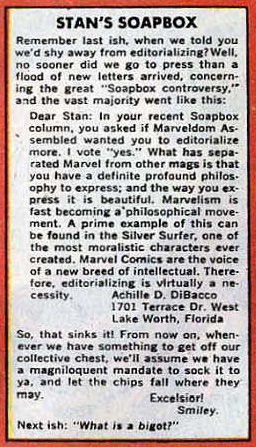
... then this Stan's Soapbox, just a month later.
But that's not the end of it. The very next Soapbox reversed the position completely. "That sinks it," commented Stan. "From now on, whenever we have something to get off our chest, we'll assume we have a magniloquent mandate to sock it to ya, and let the chips fall where they may."

Preachy, perhaps, but this editorial from Stan was very much a product of its times, especially American times. And certainly no other comics publisher was printing  opinions like this during the late 1960s.
From there on, there was no stopping Stan, as the above Soapbox shows. It had never really occurred to me at this point (I would have been 14 at the time) that bigotry was a thing. At the time I was surrounded by casual racism. My family, my schoolmates. And like everyone else, I'd laugh at racist stereotype jokes. But I'd never have dreamed of actually hating someone because of their race or religion. That Soapbox would crystalise the concept for me and probably played a key part in focussing the liberal - and, I hope, tolerant - views I hold to this day.

More importantly, this tone would attract other like-minded comics professionals to Marvel ... Denny O'Neill had already joined Marvel a couple of years earlier. And in the future would come writers like Tony Isabella, Chris Claremont and later Larry Hama, who would also do their bit to instil Stan's liberal values into the stories they wrote.

And now, with the global reach of Marvel Production movies, we're seeing Stan's message reach an unprecedented audience - literally of millions - around the world.

Comicsgate is a tragic collection of comics "fans" who have singled out women, left-leaning liberals and people of colour in the professional comic community for attack, presumably because they simply don't like women and people of colour. It's a far cry from what Stan Lee wanted for the future of society, isn't it?
So the comicsgaters can have their sad rants about the recent Captain Marvel movie and the fact that some Marvel characters have been re-imagined as women or ethnic minorities, but I'm glad to say, they will be on the losing side of that argument and on the wrong side of history. Certainly as far as those of us who have grown up with Stan Lee as our guide are concerned ...

Next: Marvel's Women


Saturday, 9 March 2019

Marvel at the Oscars - an interlude

I WAS WATCHING THE OSCARS a few nights ago and was delighted to witness four Academy Awards go to Marvel Studios movies. In addition, Black Panther (2018) and Avengers: Infinity War (2018) gathered a further five nominations between them. That's bonanza year for Marvel - nine nominations and four Awards - and a record for comic book-based movies.

Marvel Productions' Black Panther racked up a formidable seven nominations at this year's Oscars, winning in an unprecedented three categories. It's a great achievement for Stan and Jack, but I wish Don MacGregor had been given more credit for creating the bulk of the storyline.
There was a time, a few years back when the term "comic book movie" was an insult that the Hollywood establishment hurled around when a movie they hated was successful. Not any more ...

It appears to me that big studio pictures based on comic books are undergoing the same transformation that science fiction and fantasy movies underwent from 1977 onwards, after the release of Star Wars. Think about it. Before George Lucas' masterpiece what big studio-financed fantasy movies were there? 

For all its success and kudos, I was never a great fan of  2001. I've always found a cold piece of work - beautiful to look at but utterly devoid of emotion. Planet of the Apes, on the other hand, I always loved. The first movie, at least. 2001 was nominated for three Oscars and won one. Likewise Planet of the Apes.
Well, there was 2001: A Space Odyssey (1968). That was financed by MGM and did manage some grudging acknowledgement from The Academy of Motion Picture Arts and Sciences. It was nominated for Best Art Direction and Best Original Screenplay, but won only in a technical category, Best Special Effects. The same year, Planet of the Apes, which was a big budget 20th Century-Fox production, was nominated for Best Costume Design and Best Music Score and was given an Honorary Award for Best Makeup, a category that didn't exist at the time, and wouldn't be introduced until 1981.

There were no nominations for sf or fantasy pictures in 1970. Or 1971.

Back in 1971 Kubrick's Clockwork Orange wasn't my kind of movie. I was much more interested in Hammer's When Dinosaurs Ruled the Earth. Jim Danforth's dinosaurs were terrific . but it must have galled Ray Harryhausen that he hadn't won an Oscar for his Dynamation special effects at that point and would later be given a special Academy Award, almost as a consolation prize.
In 1972, Stanley Kubrick was nominated for Best Director for Clockwork Orange. The movie also gained a nomination for Best Adapted Screenplay, and another for Best Editing, a category it shared with Andromeda Strain (if that even counts as a science fiction movie). And When Dinosaurs Ruled the Earth got a nominated for Best Visual Effects.

And no nominations in 1973 ...

The Exorcist was another movie I didn't see at the time, and still haven't see to this day. Never really fancied it. It just all seems a bit ... unpleasant. This despite the fact that I would say I was more a fan of horror movies than science fiction films. Still, it did pretty well at the Academy Awards ...
In 1974, The Exorcist was nominated in 10 categories, including Best Picture, and won in only two - Best Sound and Best Adapted Screenplay.

1975 had no nominations, unless you count Young Frankenstein's Best Sound and Best Adapted Screenplay. I don't, as I consider it a comedy movie, rather than sf or fantasy.

Nothing in 1976 ... In 1977, King Kong was nominated for Best Sound, a Special Achievement Award for Visual Effects, as well as Best Cinematography, a category it shared with Logan's Run. Another thing these two movies shared was a spectacular lack of understanding of what makes a good science fiction or fantasy film. And The Omen gathered two nominations for Best Score and Best Song.

Does anybody actually like the 1976 King Kong? For me it was a colossal failure on every level ... from its "camp" script by Lorenzo Semple Jr to its dreadful man-in-a-monkey-suit effects. And don't even get me started on Logan's Run ...
But that all changed at the 1978 Academy Awards ... Both George Lucas and Steven Spielberg had big budget fantasy movies out and both made a big dent in the prevailing wisdom that sf movies couldn't be good. Here's what the results looked like ...

Awards
Category Winner
Best Effects, Visual Effects Star Wars
Best Art Direction-Set Decoration Star Wars
Best Costume Design Star Wars
Best Film Editing Star Wars
Best Music, Original Score Star Wars
Best Sound Star Wars
Special Achievement Award, Sound Effects Star Wars
Best Cinematography Close Encounters of the Third Kind
Special Achievement Award, Sound Effects Editing Close Encounters of the Third Kind
Nominations
Category Nominations
Best Actor in a Supporting Role Alec Guinness, Star Wars
Best Director Star Wars
Best Picture Star Wars
Best Writing, Screenplay Written Directly for the Screen Star Wars
Best Director Close Encounters of the Third Kind
Best Actress in a Supporting Role - Melinda Dillon Close Encounters of the Third Kind
Best Art Direction-Set Decoration Close Encounters of the Third Kind
Best Effects, Visual Effects Close Encounters of the Third Kind
Best Film Editing Close Encounters of the Third Kind
Best Music, Original Score Close Encounters of the Third Kind
Best Sound Close Encounters of the Third Kind

Granted most of the wins were in the technical categories, but look at the nominations ... Best Director, Best Screenplay ... Best Picture?

What Star Wars and Close Encounters both had that both King Kong and Logan's Run hadn't was humanity. It was emotion that connects Lucas' and Spielberg's films to audiences. As demonstrated by the slew of Awards both films garnered.
Yes, the ground definitely shifted in 1978 and set a healthy precedent for science fiction and fantasy movies to be considered good enough to garner Academy Awards and Nominations. And I think we're seing another shift right now, with comic book adaptations breaking through into the mainstream. And interestingly, it really started when Marvel took control of their own adaptations and formed Marvel Studios.

Even though it wasn't a Marvel Studios production, I thought Columbia's first adaptation of Spider-Man was a pretty good effort, thanks in no small part to the skills of comics fan Sam Raimi.
There had been a couple of nods for non-Marvel productions, like Spider-Man and Spider-Man 2, but pretty quickly the Marvel movies were being acknowledged every year at the Oscars from 2010 onwards.

And this year - 2019 - was the big breakthrough year. Just look at this results table for the recent Academy Awards ...

Awards
Category Winner
Best Achievement in Production Design Black Panther
Best Achievement in Costume Design Black Panther
Best Achievement in Music Written for Motion Pictures (Original Score) Black Panther
Best Animated Feature Film Spider-Man: Into the Spider-Verse
Nominations
Category Nominee
Best Achievement in Visual Effects Avengers: Infinity War
Best Achievement in Sound Editing Black Panther
Best Achievement in Sound Mixing Black Panther
Best Achievement in Music Written for Motion Pictures (Original Song) Black Panther
Best Motion Picture of the Year Black Panther

So maybe this is the start of a new trend ... and even if it's not, it wouldn't bother me one bit. I'm just grateful that Stan and his collaborators made all those great comics characters fifty-odd years ago and that Marvel was smart enough to form their own production company and make movies that honoured and respected the source material.

Probably my favourite of the Marvel Studios productions so far. For me, Doctor Strange absolutely captured the essence of the classic Stan Lee and Steve Ditko comics strips of the 1960s. Just needed a touch more "By the hoary hordes of Hoggoth" and "The all-seeing Eye of Agamotto".
My ten-year-old self would have loved The Avengers, Doctor Strange and Black Panther as much if not more than I do now. My only regret is that Stan didn't live long enough to witness the results of the 2019 Academy Awards himself. 

He would have been proud.

Next: Back to the Bullpen Bulletins


Sunday, 24 February 2019

Bullpen Bulletins - How it all started

ONE OF THE GREAT THINGS about the comics of Marvel's formative years is how Stan instinctively understood how to connect with his audience. Every bit as important as the exciting scripts and art of the comic stories were the Marvel editorial pages, starting with the letters pages which would soon spin off the Marvel Bullpen Bulletins.

The Marvel Bullpen Bulletin pages started in some November 1965 cover-dated Marvel comics (above is the first one to appear in Amazing Spider-Man, issue 31) ... but the foundations for this were laid much earlier in the letters pages that began in early 1962. Editor Stan Lee would evolve and build on the way he talked back to his readers and finally make a feature of it, a page that many fans (including myself) would read before the story.
The first Marvel letters page was in Fantastic Four 3 (Mar 1962). When you think about it, that's pretty soon after Stan made the conscious effort to up his game and do something a bit more engaging than Godzilla rip-off comics. Quoted in Ronin Ro's Tales to Astonish Stan explained that "we had never gotten fan mail, maybe one letter a year about some stupid subject. But all of a sudden we got fan mail from readers saying 'We love this [Fantastic Four] book', 'We can't wait for the next issue'. I knew we were onto something."

Stan Lee explains what inspired him to start connecting with the Marvel readers
in that signature humorous, friendly tone. Click on image to enlarge.
So, never one to let an opportunity go to waste, Stan immediately started running a letter column in the first available Fantastic Four comic. But though he has in the past stated that the office was swamped with letters, that seems less likely when you take a closer look at that first "Fantastic 4 Fan page".

It's early days, and this letter page from Fantastic Four 3 is not hugely different from the occasional fan letters that ran in the DC Comics of the period ... but for the marked informality of the editorial responses to the letters, certainly the voice of Stan Lee. And what about those handwritten "4"s separating the letters?
While the first letter from future Marvel inker Alan Weiss seems genuine enough, the final letter on the page is from a certain "S. Brodsky" of Brooklyn, New York. Could that be Marvel production guy Sol Brodsky, writing a letter of comment to fill out a page that had fetched up a little short of material?

That trademark Stan Lee light and humorous tone is right there on the very first Marvel Comics letters page. His reply to Alan Weiss reads, "It'll [FF] become a success? What do you think it is now. Chicken liver?? Consider that our artist signs the name JACK KIRBY on everything he can get his greedy little fingers on, I think we can safely claim that that's his name!"

The next FF Fan page looked a little less rushed though no less padded. The "4"s between the letters looked to have been lifted from the FF's uniforms, which was an improvement, but the portrait of Sue Storm looked like it might have been drawn by Stan Lee - Sol Brodsky was a much better artist than that. The padding came in the form of a letter credited to "S. Goldberg" which reads like it was written by Stan himself - Stan Goldberg was the colourist on most of the Marvel titles at the time and also the artist on Millie the Model.

The third Marvel letters column (the second was in Amazing Adult Fantasy 12, on sale a week earlier than FF4) introduces Stan's idea of plugging other Marvel titles to bring cohesiveness and synergy to the line, by mentioning other Marvel product.
The page also contains Stan's first plug for other Marvel titles, as he mentions Millie the Model and Patsy Walker in the reply to the final letter on the page. The first letter - from Len Blake - also mentions Amazing Adult Fantasy (which coincidently introduced a letter column that month), so although Stan hadn't started his cross-over house ads yet, he was using the letter columns to make readers aware that "MC" comics published other titles, too.

I didn't note any later-famous names in the list of contest winners Stan published on the Fantastic Four 6 letters page ... is your name there?
The Fantastic Four Fan Page in FF6 (Sep 1962) contained the results of the contest Stan set in FF4 ... why did the stolen gem become invisible when Sue Storm did? Stan devotes a third of the page to the answer and prints the names of all the readers who got the answer right. Another interesting snippet of information tells us that Stan's working on the letters page on 14th March 1962. This gives us the most accurate picture of the lead times for Marvel Comics at that time. FF6 went on sale on 12th June 1962, which means a 13 week lead time from when Stan was working on the letters page till the issue reached the newsstands. I love trivia like that!

The letters pages continued in Fantastic Four pretty much along the same lines - without the fake letters, it should be noted - until Stan announced he was doing away with the formal "Dear Editor" salutations and started including announcements peppered throughout the page.

For me the most interesting information on FF10's letter page is the news that while eight readers favoured dropping Invisible Girl from the comic, 639 demanded that she stay. So while letters may have been thinner on the ground when FF3 was published, the very existence of letters pages had substantially increased fan mail.
Now all the letters would start with "Dear Stan and Jack" and Stan was explaining to readers how Marvel worked behind the scenes - for example, Marvel had no reserves of Fantastic Four issues 1 - 9 so wouldn't be supplying back issues any longer.

No announcements in this letter column, but some interesting facts about the FF. Did you know that both Reed Richards and Ben Grimm are in their late thirties, whereas Johnny is just 17? With some simple arithmetic, that allows me to calculate that Richards would have been around 18 when he met Nick Fury in Sgt Fury 3. By contrast, the Metropolis Mailbag in Superman 159 is a pretty dull affair. The most interesting thing on the page is the Statement of Circulation.
Fantastic Four 11 (Feb 1963) expanded the letters column to two pages. This was actually quite a big deal, because it meant that Stan had realised just how important it was to connect with the fan-base in an informal and friendly way. By contrast, the Metropolis Mailbag letter column over in the Mort Weisinger-edited Superman 159 the same month was just two-thirds of a page, with the title's Statement of Ownership taking up the remaining third.

The Fantastic 4 Fan Page in issue 12 (Mar 1963) was also a double page of just letters, but did end with the message that Amazing Spider-Man 1 would be on sale on 10th Dec 1962. From that we can calculate that the Marvel books were on sale a good 11 weeks before their cover date. Add that to the 13 week lead time from sending an issue to the printers, then the gap between the in-house deadline and the issue's cover date is almost six months.

Announced in Fantastic Four 13 (Apr 1963) - No new members for the Fantastic Four, Iron Man's appearing in Tales of Suspense and The Sub-Mariner returns in the very next issue of FF.
Fantastic Four 13's letter page contained the first dedicated Special Announcements Section, and it's this that is the earliest foreshadowing of the Marvel Bullpen pages that lay just a couple of years in the future.

A great promotion page from the April 1963 Fantastic Four comic ...
but darnit, I think I may have missed 'em!
That same FF issue also contained a House Ad to die for ... The Amazing Spider-Man 1 and Tales of Suspense 39, featuring the first appearance of Iron Man. Don't you just want to run down to the newsstand now and pick up copies?

As the Fantastic 4 Fan Page progressed, the Special Announcements Section grew longer. By FF30 (Sep 1964) it was taking up almost half the allotted two-page spread. The bulk of the Announcements were just plugging the other Marvel comics on sale the same month - which included a slew of Annuals - but another change was in the wind.

Fantastic Four 30 - would you look at the size of that Special Announcements Section. The first half is highlighting the 1964 Annuals: Amazing Spider-Man Annual 1, Marvel Tales Annual 1, Fantastic Four Annual 2, and Mille the Model Annual 3. The remainder plugs Tales to Astonish 60 - with the new Hulk solo series, Amazing Spider-Man 16, co-starring Daredevil, Avengers 5, Daredevil 3 and Thor 107 (?)
The letters column in Fantastic Four 33 (Dec 1964) included a table listing all the Marvel titles on sale the same month. With the hard-sell sectioned off in its own area, Stan was freed up to reveal what MMMS stood for, to tell readers that every Marvel mag now had a letters column and that Stan had been elected Best Writer as well as Best Editor of the Year by the Academy of Comic-Book Fans and Collectors.

As well as boxing off the Mighty Marvel Checklist into its own section, the Fantastic 4 Fan Page in FF33 also had a healthy announcements section. Click on the image to read future Marvel scripter Don McGregor's suggestion that Reed and Sue marry.
It was definitely taking shape as a Marvel Bullpen Bulletins page in all but name. But the actual Bullpen pages were still a year away, so we'll take a closer look at those next time.

Next: The Marvel Bullpen Page touches down


Monday, 28 January 2019

Next time ... on Marvel's Agents of SHIELD

EVEN EIGHT MONTHS IN to the Strange Tales run of Nick Fury Agent of SHIELD, it didn't seem as if writer and editor Stan Lee really had a handle on the series. The first seven episodes had repurposed ideas lifted from the first four James Bond movies and the first couple of seasons of Man from UNCLE. Some of the blame for these slightly below average comics can be laid at Stan's door, but really, it was Kirby that was floundering.

Strange Tales 142 had one of the best of the early SHIELD covers, but somehow the story inside the comic seemed to be sputtering, despite full Jack Kirby pencils (and presumably plot) and adequate Mike Esposito inks.
Left to his own devices to plot the SHIELD stories, Jack Kirby drew up a storm but the ideas weren't coming together to form a cohesive whole.

Strange Tales 142 (Mar 1966) was the last issue of the title to go on sale in 1965 (9th Dec), with Jack Kirby returning to provide full pencils for Micky (Esposito) Demeo's inks. The episode kicks off with bombast and gunfire as Fury and his SHIELD technicians test a peculiar-looking robo-gunman. The contraption goes haywire until one of the tech guys literally pulls the plug. It's a great action opening, but it has nothing to do with the rest of the story - exactly the kind of thing Kirby does when he doesn't have a solid story idea.

The opening of the SHIELD adventure in Strange Tales 142 is a great slice of Kirby-style action but doesn't actually contribute to the story that follows - in that we never see the Robo-Gunman again. Even more impressive is the underground burrowing machine used by The Fixer, though it does seem a little familiar ...
The real plot kicks off when SHIELD's ESP division reports that powerful mind-reader Mentallo has penetrated the secret lair of The Fixer (a kind of bargain-basement Mad Thinker) and the two have formed a sinister partnership. When it comes time for the villains to attack SHIELD, they arrive in a subterranean tank not dissimilar to the vehicle used by the Hate Monger in Fantastic Four 21 (Dec 1963, which also starred Nick Fury) and the mole machine used by The Rabble Rouser in Strange Tales 119 (Apr 1964). 

Top: The Hate Monger pilots his subterranean tank below the city in a scene from Fantastic Four 21. Above: In Strange Tales 119, The Rabble Rouser admits his sub-surface craft is a smaller version of the one used by The Hate Monger, but doesn't elaborate where he got his from.
During the scene, The Fixer explains that he's had help building his burrowing vehicle from an organisation called THEM, though he doesn't elaborate further. Does this mean that The Hate Monger and the Rabble Rouser (two quite similar villains) also had help from THEM? Or was Marvel just lazily recycling old ideas? You decide ...

Eluding SHIELD's defences, the evil pair are soon inside SHIELD's nerve centre and take on Fury and his security detail. They disable the defending soldiers with "Element Z", a paralysing agent, and capture Fury, planting a mind-control mask over his face.

It's okay as action comic stories go, but I can't help feeling that if Stan had more of a hand in plotting this, he'd have a bit more actual story going on. What is kind of interesting is that the plot crosses over slightly with Tales of Suspense 75 (Mar 1966) which, for the Captain America strip, was a bit of a new beginning, with Kirby back on full pencils after the lacklustre stories drawn by George Tuska, featuring the slightly tedious Sleeper story-arc.

It looks a lot to me like Jack Kirby was doing just the loosest layouts for Strange Tales 143, except for the amazing full-page drawing of Tony Stark's Neutralizer cannon on page 3. 
Strange Tales 143 (Apr 1966) is a bit better, storywise. This time the art is credited to Jack Kirby with an assist from Howard Purcell, and inks by Mike Esposito again. The plotting seems a bit more detailed, with SHIELD essentially having used Fury as bait to draw The Fixer and Mentallo into a trap. With the head of SHIELD strapped to an H-Bomb, the baddies think they can force SHIELD to obey their orders, but of course it doesn't work out that way. Fury is able to send a mental message to the ESP Division, and Dum-Dum Dugan and the other ex-Howlers attack, as The Fixer and Mentallo are disabled with a psychic attack from the ESP team, and disintegrate the H-Bomb with Tony Stark's Neutralizer weapon.

It's a satisfying end to the three-part story, but the pages not fully-pencilled by Kirby are a little bland, despite Howard Purcell's pedigree as a veteran penciller with 25 years experience. The next issue would continue with the same creative team and a new villain, The Druid.


WHO THE HECK IS HOWARD PURCELL?

Howard Purcell was born on 10 November 1918. Not a great deal has been documented about his early life. Little is known of his family, but we do know that he attended art classes at the The Art Students League of New York, a school that offers tuition to people from all walks of life at affordable prices. For a while he worked as an animator at the New York City studios, but by 1940 he was freelancing for DC Comics. His very first job was a regular assignment pencilling the Mark Lansing back-up feature from Adventure Comics 53 (Aug 1940) onwards. 

Howard Purcell established himself very quickly at DC Comics during the early 1940s, and was soon drawing several back-up strips before graduating to one of DC's star features with Green Lantern.
Less than a year later, Purcell landing his first cover assignment, with All-American Comics 25 (Apr 1941), drawing lead character Green Lantern. The same month, Purcell began pencilling Red, White and Blue in All-American Comics 25. The following month he picked up the art assignment from Sargon the Sorcerer in All-American Comics 25 onwards and Lando, Man of Magic in Word's Best (Finest) Comics from issue 1 (Spr 1941).

Purcell enjoyed a long run as artist on DC's hit series Mr District Attorney, based on the successful radio and tv series of the late 1940s and early 1950s.
Yet, just as quickly, these assignments faded away and by the beginning of 1944, Purcell was drawing just The Gay Ghost for DC's Sensation Comics. Purcell's comics career picked up after WW2, and in 1947, he became the main artist on DC's Green Lantern, as well as regularly drawing Hop Harrigan in All-American Comics and Johnny Peril in All-Star Comics. In 1949 he was the main artist for Mr District Attorney until 1957. From there Purcell was once again a jobbing artist, working for the DC anthology comics, House of Secrets, House of Mystery, Tales of the Unexpected and My Greatest Adventure, until 1964, when he took over on Sea Devils.

Purcell flirted with superhero comics during the early 1960s, but didn't pursue that course, appearing to prefer adventure titles like Sea Devils and DC's sci-fi and mystery titles.
Purcell's work on SHIELD in Strange Tales was a bit of an anomaly, because straight after he continued with his regular assignment on Sea Devils for DC until 1967. In 1968, Purcell drew romance stories for Young Romance and Heart Throbs, but at the end of that year, he made a brief return to Marvel and drew the first Black Knight solo story in Marvel Superheroes 17 (Nov 1968) along with a couple of Watcher back-up tales in Silver Surfer.

Howard Purcell: 10th Nov 1918 - 24th Apr 1981
Then it was back to DC for intermittent assignments during the early 1970s on Adventure, Detective and Brave and the Bold. By the mid-1970s, Purcell had pretty much retired. He died on 24th April 1981.


AND NOW, BACK TO AGENTS OF SHIELD

Howard Purcell would contribute pencil art for one more episode of SHIELD over Jack Kirby layouts in the following month's Strange Tales, issue 144 (May 1966).

Strange Tales 144 features a new villain called The Druid, who uses a combination of magic and science to threaten the forces of Good. A bit like Dr Doom, then. Or Diablo? Except that I've scoured the comic and I can't see any evidence that The Druid uses any kind of magic at all.
The story starts off with a weird magical ceremony, except that it doesn't seem to be magic at all, just the same old advanced technology. Quite what The Druid's deal is, I'm not sure, but he sure seems to have a grudge against SHIELD. Using "mystical rites combined with modern, sinister science" the Druid and his followers launch a deadly Satan Egg which is programmed to find Colonel Fury and destroy him.

The whole "magic combined with science" schtick does seem to be a bit of a hobby-horse for Jack Kirby. He's used it over and over again, most notably with Fantastic Four foe Dr Doom, and it's a great idea ... but for me it's never been wholly successful. As time went by, the magic component of Doom's abilities was dropped and Kirby moved him more towards super-science - technology that couldn't be explained by our real-world Newtonian physics. That's also my take on the technology in Kirby's Fourth World stories and the follow-up The Eternals. There doesn't appear to be any magic involved in what The Druid does either, unless he's just using the mystic trappings to fool his followers - though that isn't made apparent in the script.

The introduction of Jasper Sitwell was the best thing about this episode and reads much more like a Stan invention than a Jack one. Am I right in saying that it was Sitwell who here first utters the deathless catchphrase, "Don't Yield, Back SHIELD"? I wish they'd say that in the tv show ...
More entertaining in this story is the introduction of boy-scout SHIELD agent Jasper Sitwell. Despite his being subverted as a sleeper Hydra agent in the recent Marvel Movies, I always like the Sitwell character and thought he was more than just a comic foil for Fury and the other agents. Stan treated the character with respect and made him a highly capable agent, despite the buffoonish veneer. There has been some speculation that penciller Howard Purcell based Jasper Sitwell on Marvel editor Roy Thomas, but I can't see much resemblance.

Jasper Sitwell is again the best thing about this issue's SHIELD tale. I really didn't care if I never saw The Druid again, and I thought the Esposito inks swamped the fine-line style of Don Heck, whose pencils deserved better.
There would be more Jasper Sitwell in Strange Tales 145 (Jun 1966). As Fury is drawn into a final confrontation with The Druid, the wily technical wizard forces Fury into hand-to-hand combat. Fury appears to fall into The Druid's trap, but is in reality playing for time to give Sitwell the opportunity to take out The Druid's army of henchmen. The Druid is defeated and unmasked, though SHIELD are unable to identify him. A pretty unmemorable villain, The Druid does show up in some later 1970s issues of Captain America.

A few story points are explained during this episode. There are further references to THEM. The Fixer (remember him?) is interrogated by Fury and reveals that he works for THEM, but reveals there is no connection between THEM and The Druid. Stan also includes a caption box to explain that The Druid's "outward trappings suggest a cult of black magic, to impress the unthinking masses, it is a magic founded on deception." So that clears that up, then.

The art is once more Don Heck pencils over Jack Kirby plot and layouts, with Mike Esposito again on inks. Esposito's inks are especially unsuited to Heck's fine pencils and the artwork for this issue has the bland look of shop-created comic strip art, due to the diversity of art styles that just fail to mesh. All of which contributed to the feeling that Stan and Jack almost regretted ever starting this series and were struggling to get some life and energy into it. 

Meanwhile, over in Tales of Suspense 78, further information about THEM is revealed, when Nick Fury and Captain America team up again to battle a sinister combat LMD sent to kill them by the shady beekeepers.
There's also mention of the events in the Captain America strip in Suspense 78 (May 1966), which happen between Strange Tales 145 and 146 and should probably be read before moving on to the next Nick Fury adventure. But briefly, Fury takes the mini brain he discovered on The Fixer's person back in ST145 to Cap to ask if he's come across anything like it and if he's heard of Them. The pair are attacked by a battledroid and defeat it. That's pretty much it.

Strange Tales 146 (Jul 1966) featured a Dr Strange cover for the last Ditko art on the character, so I've used the SHIELD splash page here instead. The story introduced AIM and the iconic yellow uniforms of THEM.
On sale the same day as Tales of Suspense 78 (10th March 1966), Strange Tales 146 featured Them as a full-blown enemy of SHIELD. The story also introduces the outfit called AIM (Advanced Idea Mechanics) who step forward to offer technology to SHIELD after Tony Stark's factories are shut down and Stark himself is under congressional investigation. 

THEM have hijacked SHIELD's LMD technology and have crafted mindless warrior androids designed to fight in any environment. We get to see the underwater version attack a SHIELD swamp buggy in the opening sequence of the story, though they're repelled and SHIELD are able to track them to THEM's HQ.

We're also introduced to Count Royale, a representative of A.I.M., who wants to offer advanced technology to SHIELD. He appears to have the endorsement of some senior military types, though we'll learn later in the story that it seems as though A.I.M. are playing both ends against the middle and supplying advanced weapons to both SHIELD and THEM.

The art is still Don Heck pencils over minimal layouts from Kirby and Esposito inks. The art has much more of a Heck look to it, especially apparent in the design of the THEM uniforms, which definitely have a Heck look about them.

The machinations of A.I.M.'s Count Royale make the senior US military doubt Fury's qualifications to lead SHIELD in this issue. I do think it's a bit unfair for the General here to criticise Fury's unkempt appearance as he has - in fairness - just woken up from a deep sleep. It's also stretching credibility to think that an army general wouldn't be able to recognise the value of a top tactician and fighting man like Colonel Nick Fury. Surely the man's record speaks for itself?
The plot does start to get a little bit richer in Strange Tales 147 (Aug 1966), as the full extent of Count Royale's plan is revealed. In a scene at the beginning of the episode Royale expresses his concerns to the US military generals that A.I.M. feels Fury is not the right kind of person to be leading SHIELD. We then see A.I.M. stage an invasion of SHIELD's barbershop entrance, taking the guarding agents hostage. Fury is forced into a reckless personal rescue mission, reinforcing Royale's claims that he's too reckless to lead such an important organisation. Though Fury and his team defeat the A.I.M. invaders, he plays directly into the hands of Royale and as the episode comes to end, realises that his future as Head of SHIELD is now in the balance.

As much as I thought Mike Esposito's inks were ill-suited to the pencils of Don Heck, I thought that this issue's art was even less attractive than the preceding issues. Was Esposito especially rushed on this issue? No, he didn't even ink it. Despite the credits naming "Mickey Demeo" as the embellishers, turns out the art was inked by Dick Ayers - a fine enough artist in his own right, but probably the one inker I'd think of as even less suited to Heck's delicate pencil work than Esposito.

Strange Tales 148's SHIELD story gave Jack Kirby the opportunity to plot, draw and script the entire 12 page story. It seems an odd development, considering how protective of the Marvel "voice" Stan Lee was. Perhaps he was less concerned because he considered it a one-off as vacation cover ...
It all starts coming to a head in Strange Tales 148 (Sep 1966). After an assassination attempt by A.I.M. that kills an LMD instead of Fury, the head of SHIELD realises that they're under surveillance and plans to thwart A.I.M.'s attempt to discredit him. His nerves apparently frayed by the pressure he's under, Fury snaps at the loyal Jasper Sitwell and tells him to stay out of his hair.

Later, when Fury is summoned before a hearing to determine his fitness for office, he appears to lose his temper again and makes to physically attack Count Royale. But when Sitwell is called to the stand, he begins by saying that there's not a man he hates more than Fury. But of course it's a ruse, and Sitwell reverses the direction of his testimony and Fury leaps out a window to escape.

This is one of the few early Marvel stories that is openly credited to Jack Kirby - both plot and script. The "voice" doesn't sound so very different to that of Stan Lee, so I have to wonder just how much editing Stan did before this issue went to press. That said, there's some inconsistencies and plain old plotting errors that I'd have to point out.

The transition from panel 2 to panel 3 is just wrong. Fury is seen from the same angle in both frames, but the technician mysteriously moves from Fury's left to Fury's right (and back to the left in panel 4) in an eyeblink. His white lab coat also changes to a green suit sleeve. I think Jack got a bit muddled with his angles, don't you?
Firstly, there's a very confusing sequence early in the story where a technician demonstrated a "transparency ray" that works like an x-ray machine that needs no film or screen for the effects to be visible. The big frame in the middle of the page makes it look like Fury's firing the ray - the arm holding the raygun has a green sleeve, just like the suit Fury's wearing. This makes it look like Fury's firing the ray at the technician.

And secondly, why did we need to go through the subterfuge with Sitwell pretending to hate Fury for a minor telling off? It's not like Sitwell's reversing his testimony on the witness stand helped Fury escape. And indeed, Fury's escaping just plays more into the hands of Count Royale. So it comes across as bad plotting. Where was Editor Stan Lee when he was needed? (Oh yes, on holiday, as mentioned in the issue's credits.) But despite these minor carps, it's still a fun issue and quite satisfying to know that Fury and Sitwell had a plan all along. More of that unfolds the following month.

The SHIELD story in Strange Tales 149 featured the first Marvel artwork - for many, many years - of Ogden Whitney. He would contribute this one job, then not work for Marvel again for a couple more years.
Strange Tales 149 (Oct 1966) is headlined as "The End of A.I.M." - and it just might look that way. After a three page sequence where A.I.M. steal an LMD of Fury, but are in reality kidnapping and armed, dangerous and very real Nick Fury, the action switches back to the SHIELD Helicarrier. In the confusion, Count Royale sneaks away to rejoin his A.I.M. co-conspirators, but fails to notice Sitwell tagging him with a tracking device ... with a pea-shooter.

Sitwell is able to follow Royale to a hidden lair inside a mountain, but no sooner does Royale enter than the entire mountain explodes. Alerted that another player in the game must've destroyed A.I.M.'s headquarters, Fury searches the paraphernalia captured by SHIELD the last time they encountered Hydra. Is Fury's hunch correct ... are Hydra behind, THEM, A.I.M. and possible even The Secret Empire?

Well, it certainly looks like these secrets criminal organisations are all working together. Why else would these A.I.M. goons think they'll be safe with a masked driver claiming to be an operative of The Secret Empire?
This episode of SHIELD marked a major re-jig in creative personnel. Stan took a step back and turned over scripting to neophyte Denny O'Neil, at least for this one issue. And while Kirby was still on layouts, the full art was provided by long-time ACG artist Ogden Whitney. ACG was going out of business at this time and Whitney presumably needed work fast. In my view, he was spectacularly unsuited to Marvel superhero work and though he does a professional and tidy job, it lacks the pizzaz that the regular Marvel artists could muster. 


WHO THE HECK IS OGDEN WHITNEY?

John Ogden Whitney was born in 1918, in Stoneham, Massachusetts, to father Ethan and mother Alberta. Little has been recorded about his early life. In 1932, Whitney's father died, so the Whitney children - Ethan, Helen and Ogden then aged 17 - took jobs to support the family. After working in a print shop for a while, Ogden landed work with DC Comics, drawing his first strip, a Cotton Carver story "The Land of Thule" for Adventure Comics 41 (Aug 1939). Whitney only stayed with DC for few months, working exclusively on Adventure Comics. For the last two months of his tenure, he also drew the Adventure lead feature Sandman, taking over from incumbent penciller and then-DC-superstar Craig Fessell.

Despite only working for National Comics for a few months, Ogden Whitney rose from jobbing artist on backup strips to drawing the star feature in Adventure Comics, Sandman.
Just as suddenly, Whitney jumped ship to Columbia, a comic book offshoot of the McNaught and the Frank Jay Markey newspaper syndicates, where he took up residence as chief artist on Columbia's launch title Big Shot Comics, co-creating Skyman with another DC superstar Gardner Fox. He would also draw Rocky Ryan for the same comic, and would continue with Columbia until the end of the 1940s.

It's unknown why Whitney left National abruptly and joined Columbia Comics ... but it was probably an opportunity to be a big fish in a small pond. He would work for Columbia all through the war years.
But in January 1943, he joined the US Army, driving an army truck for a while after basic training. He soon found himself in the same art department as fellow comics artist Fred Guardineer, drawing signs and posters. He also found time to continue with his comics assignments for Columbia. Later in the war, he served in the Adjutant General's office in the Philippines. He was honorably discharged in early 1946 with the rank of Master Sergeant, and returned to his mother's home in Woodside, Queens, NYC.

Whitney also found work at Magazine Enterprises on a variety of genres from horror to romance and humour. 
In the post-war years, Whitney continued to contribute art to the Columbia titles, but also began selling to Magazine Enterprises, which was founded by former Columbia editor Vin Sullivan. Whitney would provide covers and internal strips for A1 (teen humour), Manhunt (crime) and several other titles. At the beginning of 1950, Whitney did a few jobs for Ziff-Davis, pencilling and inking stories for Amazing Adventures, Famous Stars and Kid Cowboy. But by The spring of 1950, he began his long-term relationship with American Comics Group (ACG), when he drew a strip for Lovelorn 5 (Apr-May 1950) for long-serving ACG editor Richard Hughes. Very quickly Whitney was drawing war, westerns, romance and mystery for ACG, but still found time to pencil and ink strips for Quality, Magazine Enterprises and, for a brief period in 1952, Atlas/Marvel. 

Whitney enjoyed a long run at ACG drawing stories for pretty much every comic the company published, as well and the lion's share of the covers as well. The mild mystery and horror stories seemed to suit Whitney and later was drawing exclusively for ACG.
Quality went out of business in 1956, leaving Whitney more and more reliant on his ACG account. Not that Whitney had much to worry about. As a favourite of editor Hughes, Whitney was drawing one or two stories apiece for the main ACG mystery titles Forbidden Worlds and Adventures into the Unknown and quite a few of the covers. Hughes would add Unknown Worlds in the summer of 1960, so Whitney had three regular magazines that featured his art. But in the 73rd issue of Forbidden Worlds, Whitney drew a throwaway comedy character from a Richard Hughes script, Herbie. Completely unaware they'd just started a cult, both turned their attention back to the innocuous ACG trademark mystery titles. It would be a year and a half before Herbie appeared again in Forbidden Worlds 94 (Mar 1961). Readers clearly responded, because Herbie went on to turn up in Forbidden Worlds 110, 114 and 116, then graduated to his own title in April 1964.

There's not a comic character stranger than Herbie. It really wasn't my cup of tea, but the character enjoyed (and still has) quite a fervant following.
As the 1960s drew to a close, ACG floundered and went out of business. Richard Hughes went on to write a few scripts Jimmy Olsen and Hawkman at DC Comics and Ogden Whitney had to look elsewhere for work. He sold some art to Tower Comics, then did some work on Two Gun Kid and Millie the Model for Stan Lee at Marvel around 1967-1968.

At the tail end of his career, Ogden Whitney returned to Marvel to draw a few stories. I do wonder why he never tried DC Comics again.
MAD Magazine editor Ferry de Fuccio was probably one of the last comics people to see Whitney alive. In a letter to a friend he described visiting Whitney at "40 Park Avenue South ... Naturally, I gushed about Whitney's Golden Age work when I visited his apartment. His wife, Anne, was quite lovely and refined but Whitney wasn't anything like the svelte characters he used to draw. Fat and obviously addicted to liquor ... Anne seemed troubled by her husband's state. She supported the family with her private secretary job in the area of the Empire State Building. Richard E. Hughes, editor at American Comics Group, was especially helpful to 'old-timers' [and] gave Whitney work, though Ogden seemed absorbed in trying storyboard continuity samples to crack the advertising field. I saw him working on the special pads imprinted with rows of blank TV screen. He couldn't qualify. ... I passed Whitney's apartment house [circa 1972-1973] and asked the doorman: 'Does Ogden Whitney still live here?' The doorman spoke in a hush, 'No! His wife died and his condition became extremely irrational. He was finally evicted — carried bodily — from his apartment.'"

John Ogden Whitney: 1918 -13 Aug 1955
Pulp historian David Saunders reported that Ogden Whitney died at the age of 56 at Saint Barnabas Psychiatric Hospital in the Bronx on 13 August, 1975.


... AND BACK TO SHIELD

With Strange Tales 150 (Nov 1966), Stan Lee was back on scripting duty, with trusty Jack Kirby on layouts and a not-so-new Marvel newcomer John Buscema pencilling under Frank Giacoia inks. 

Anyone care to take a guess as to who the villains might be in Strange Tales 150's SHIELD tale?
The story opens with Fury testing a new weapon called the Overkill Horn. SHIELD are speculating that someone else has a similar weapon and it's come as no surprise to any reader just who that other party might be. Then, when Fury is invited to a hedonistic party by international playboy Don Caballero, he astonishes his SHIELD partners by accepting the invitation. It's doubtful that Caballero's true identity will surprise anyone, either.

What stands out most about this episode of SHIELD is just how good Buscema's drawing is compared to the revolving roster of artists that has lead up to this point. His skill with characterful faces and action figurework is superb, and it's a real shame that he didn't stay on SHIELD. But if he had, then we probably wouldn't have had the incredible work of the artist who would arrive with the following issue of Strange Tales.

In the meantime, John Buscema would go on to draw three fill-in issues of the Hulk series in Tales to Astonish before getting the regular gig as pencil artist on The Avengers ... a series he would draw for the next 30 issues or so, as well as branching out as the main artist on The Sub-Mariner and The Silver Surfer during the same period. 

Overall, this early run of SHIELD tales feels a little unsatisfactory, but I can't make up my mind whether this is because I now know how good the subsequent run - written and drawn by Jim Steranko - would be. On balance, that's probably not the case, because I wasn't mad about these comics at the time, either.

At some point in the future, I will take a look at Steranko's sublime run on SHIELD, a job that will not seem like a chore at all.

Next: Marvel Bullpen Bulletins